Redefining Conventional Wisdom. Congratulations to Wise on its Public Debut!


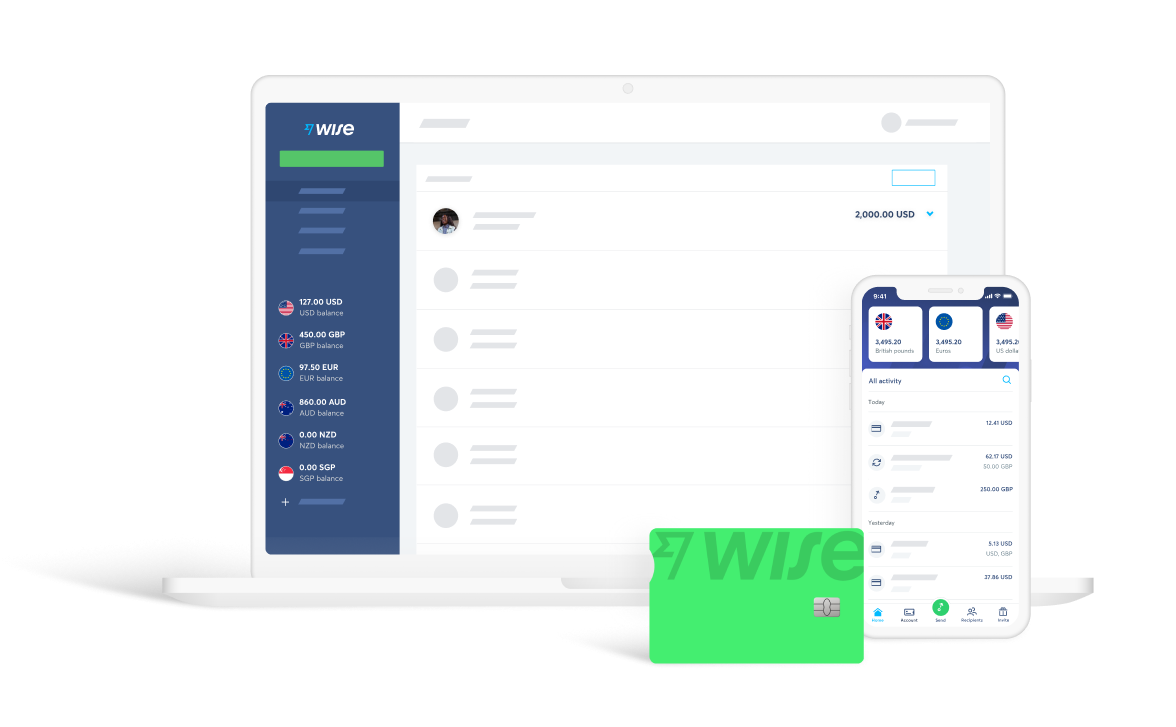
The story of Wise (previously known as TransferWise) is one that reflects a mission-driven company truly impacting the lives of tens of millions of people. As Wise embarks on a new journey as a publicly traded company, we wanted to briefly reflect on our partnership.

Sapphire Ventures first met co-founder Kristo Kaarman (CEO), Matthew Briers (CFO) and team back in 2017. Since then, I’ve learned invaluable lessons from Kristo and the Wise team about the importance of staying the course and being driven by doing good versus solely profit.

During a time when conventional wisdom had nearly every high-growth venture-backed start-up losing significant capital in hopes of reaching scale to turn a profit, Wise redefined the norm to build a hugely valuable technology business. Despite investor pressure to spend more on marketing to help promote customer acquisition due to best-in-class efficiency, Wise resisted and instead kept the discipline of maintaining that efficiency.

While revenues could easily jump by charging even a fraction of a percent more for their service of moving money across borders, Wise instead adhered to their core beliefs of providing the lowest cost and most convenient option for consumers and businesses to transfer money around the world. The management team was a group of always measured, long-term thinkers with short-term precision in execution–a combination only the best teams and companies enjoy.

What’s most impressive is that Wise has been able to achieve this milestone of going public in a very challenging space. The global complexity in technology, integrations and regulations that is required to pull off their service, many times instantly, is unparalleled. And they are disrupting the massive fees banks generate for each and every wire transfer.

It’s been truly a pleasure to partner with Kristo and the team. And I am certain this is only the beginning for Wise. Congratulations to Wise on bucking the trend and doing things their own way to build an incredible, enduring company!

Israel’s Booming Tech Scene: Top Trends & Players in the Startup Nation

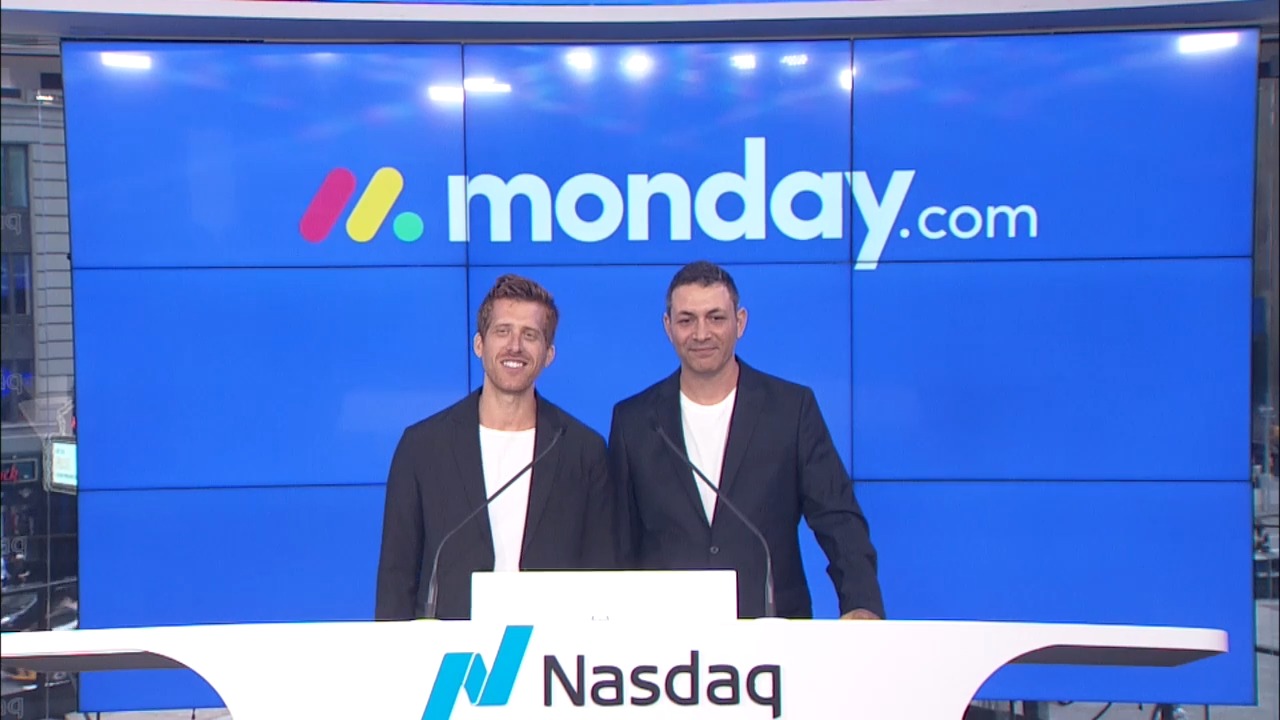
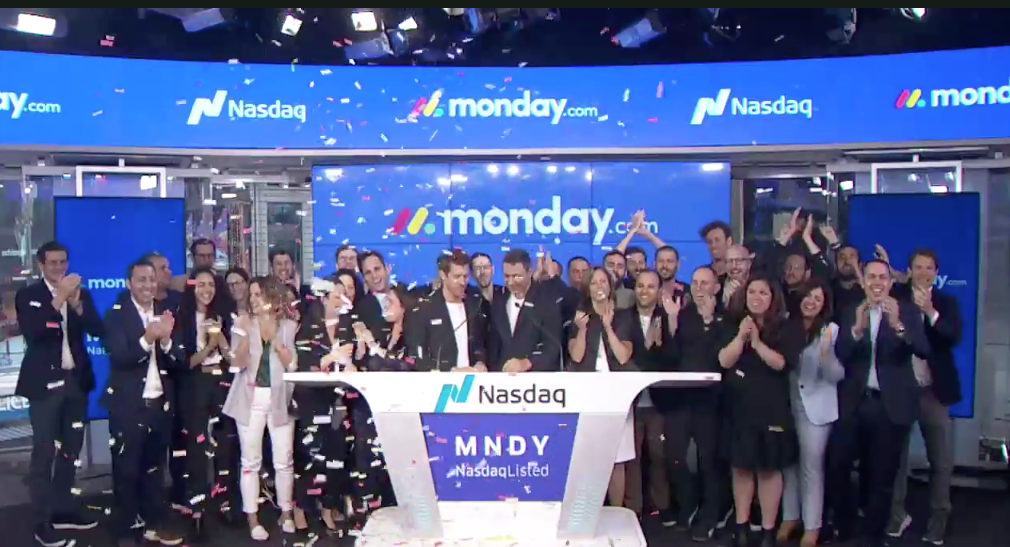
$14B in VC funding, 19 IPOs and more than $15B in exits. It’s no denying that last year was an exciting one for the Israeli tech ecosystem. And so far, 2021 seems to be exceeding that velocity. Just recently, we led Verbit’s Series D financing and celebrated Monday.com’s IPO

Even with all of these exciting recent developments, successful tech companies coming out of Israel is nothing new. It has had a great track record of producing innovative companies such as Mobileye (acquired by Intel in 2017), Waze (acquired by Google in 2013) and Annapurna Labs (acquired by Amazon in 2015), just to name a few. 

At Sapphire, we have a history of identifying and backing high-growth Israeli companies including JFrog, Monday.com, Kaltura, Verbit and OwnBackup. We feel JFrog’s IPO last September, coupled with monday.com’s IPO a few weeks ago, are a testament to the strength of the Israeli ecosystem, which is why we remain excited about Israel’s continued growth as a world-class startup hub, and the country’s ability to build Companies of Consequence.
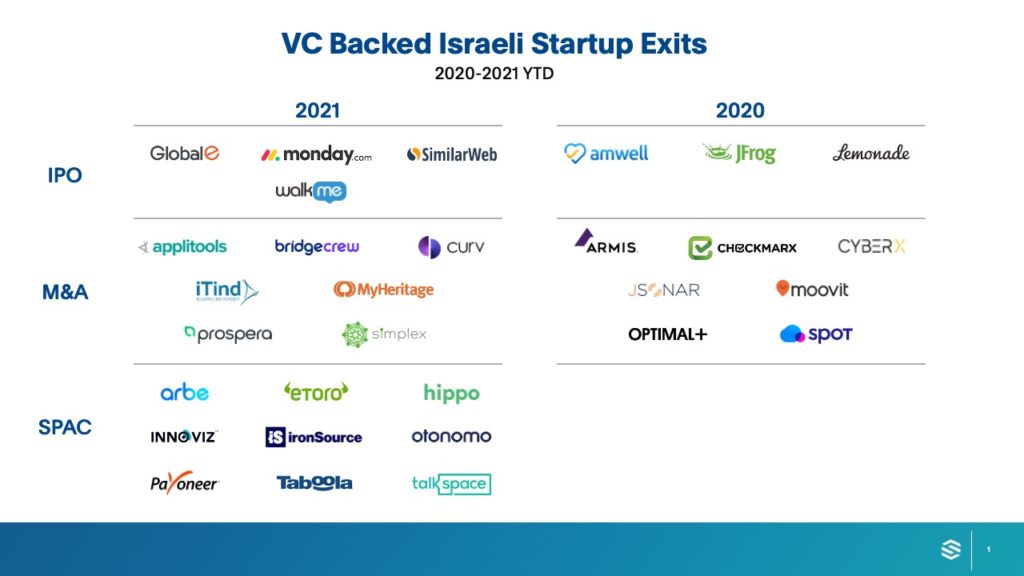
VC Backed Israeli Startup Exits 2020-2021 YTD

What’s driving Israel’s robust tech ecosystem

So what are the key factors that have created such a robust startup ecosystem in Israel? There are many reasons worth highlighting including the mature early-stage ecosystem, Israel’s military being an incubator for top tech talent and the startups’ early ambition for global expansion from day one. 

1. Early-stage funds support the development of the Israeli tech scene

How did the Israeli tech ecosystem first take-off? It started in the 1980s when the defense and aerospace industries invested heavily in Israel, which led to new technologies. For example, in 1981, Israel devoted over 20% of its GDP to military expenditure. At about this same time, venture capital first emerged in Israel. The first VC fund was founded in Israel in 1985 when the former Chief of Staff of the Israel Air Force Major-General Dan Tolkowsky founded Athena Venture Partners

This success was further expanded with Yozma, an Israeli government initiative launched in 1993 offering attractive tax incentives and using government funds to double any investment. As a result, R&D investment across all of Israel is twice the average of other countries according to the OECD. This funding and support will continue to propel the Israeli tech ecosystem forward.

Additionally, given the strength of Israeli founders coupled with global ambitions, it’s no surprise there is a mature investing ecosystem ready to support these founders. Many early stage funds such as 83North, Aleph, TLV, Angular Ventures, Entrée Capita and others invest capital into the earliest opportunities in Israel to bolster development. The presence and success of these funds at the earliest stage in Israel has led to further development of opportunities in this space. 

2. The military serves as an incubator and accelerator of Israel’s startups

Israel has a strong recurring pipeline of founders and builders ready to tackle tough technical problems. Israel’s Military Intelligence Agency, Unit 8200, provides graduates with access to leading-edge technology. Many startups grow out of this community due to the technical knowledge and experience these founders gain by working on big problems in a high pressure environment and gaining valuable leadership skills early on. 

To date, over 1,000 startups have been founded by former members of Unit 8200. We continue to be impressed by Israeli’s strong technical founders and look forward to meeting many of the new entrepreneurs that come from Israeli’s military.

3. Startups have early ambitions of expansion 

Israel has more startups per capita than anywhere else in the world, which is largely driven by Israeli founders’ focus on going global from their initial launch. Due to it’s relatively smaller market size compared with Europe, the U.S., etc., entrepreneurs in Israel know from the start that they will need to think global to build a large company. 

Further propelling the growth of Israel’s startups is the compact market size of the market, which is an advantage as entrepreneurs can recognize if they have product-market-fit quickly while keeping overhead low. Similar to Silicon Valley, there is a tight knit tech community in Israel creating network effects across the ecosystem.

Additionally, Israeli founders don’t have to go it alone to test their global ambitions. There are 270 multinational corporations including Google, Apple, Facebook, Microsoft, and many others that have established more than 320 R&D facilities across Israel to further test these hypotheses.

This unique market environment in Israel has led to a number of successes. Many of these startups are starting to gain traction globally, with over 1,000 Israeli startups working and employing people across Europe. Israel also has the third largest number of companies listed on the Nasdaq (after the U.S. and China). Sapphire is excited to continue to support these and future success stories as they build a strong foundation in Israel and look to expand globally.

5 Israeli startup trends we’re excited about

Israel’s strength as a startup hub continues to make it a priority for our team. Our goal is to invest in companies that are not only innovating in their respective verticals, but either already are or will soon become the category leader. While we evaluate and invest in startups across a range of tech sectors, there are a few areas that we’re particularly enthusiastic about:

  • Cybersecurity – Well known strength attributed to military service, specifically Unit 8200
  • Fintech – Recent successes show that fintech is emerging as a flourishing sector for Israel 
  • AI & Automation – Enterprises are looking for more efficient workflows and “boring AI” solutions
  • Healthtech – Digitization of healthcare continues to accelerate in part due to Covid
  • Data Infrastructure & Tooling – More and more new data tools are emerging as part of the modern data stack 
A global leader in cybersecurity 

Israel has long been known for its strength in cybersecurity attributed to the entrepreneurs that came from Unit 8200, and for good reason has been labeled a global leader in cybersecurity. Israel has over 400 cybersecurity companies in operation today that export over $6.5B in cybersecurity products per year. Some of the world’s largest cybersecurity companies started in Israel including Check Point, CyberArk and Forescout

As new cybersecurity trends emerge, we’re keeping a close eye on Israeli startups leading the charge in the following areas: 

  • Cloud-focused solutions to safeguard identities and data have recently received significant and well-deserved attention, including Ermetic, Orca Security and Wiz
  • Threat detection is another key area of interest, whether to safeguard company data like Aqua Security and Hunters or protect the entire API library like Salt Security
  • Solutions like Perimeter81 and Axonius have gained significant traction as companies recognize the importance of cybersecurity for their assets and networks. 
Fintech is fast emerging as a flourishing sector 

When you think of fintech, startup hubs including London and New York may come to mind at first. However, don’t overlook Israel! Israel punches above its weight when considering its fintech success to date. Israel boasts over 500 fintech startups and has 12 fintech unicorns. Some of Israel’s flourishing fintech companies include Lemonade, eToro and Melio

Large financial institutions recognize the potential coming out of Israel’s fintech ecosystem and are investing heavily. Citi, Barclays and Santander all built fintech innovation labs in Tel Aviv, while RBS used an Israeli fintech to build the underlying technology for its recent spinout, Esme. Fintech has emerged as a strong sector because it has tapped into synergies between security and finance, specifically around fraud and data analytics. 

One of the sub-sectors in fintech we are especially excited about is the payments space. In B2B payments, Melio is disrupting how small businesses pay vendors and contractors, and Rapyd provides an API-based, fintech-as-a-service platform covering payments, banking services, and fraud prevention.

It’s not just payments that are seeing breakout success stories. Pagaya’s platform to deliver credit evaluations via machine learning and Stampli’s platform to optimize corporate invoice management represent other exciting areas within fintech. 

The AI and automation sectors continue to produce success stories

Over the years, we’ve observed the rise of low code and no code platforms globally as we wrote about in our blogpost on How Automation & Low Code/No Code Platforms Help Power our Lives: 4 Trends Driving Adoption. We expect these trends to continue as Gartner predicts low-code app development will account for more than 65% of app development functions by 2024. And monday.com’s recent IPO is an example of Israel’s strength in this sector. 

In addition to low-code/no-code, we are seeing exciting companies emerge out of Israel focusing on what we like to call “boring AI,” meaning AI/ML solutions focused on making the work lives of knowledge workers less boring by automating the mundane and mindless everyday tasks. In many ways, Israel is leading the way in AI development, ranking third in the world in number of AI businesses started and the AI ecosystem is growing rapidly, exceeding over 1,100 startups in 2018 (a 120% increase in the span of 4 years)

Since Automation and AI solutions can benefit every industry, there are many different use cases. For example, for manufacturers and warehouse owners, Seebo and Fabric are two companies that provide automated and predictive solutions to better streamline and monitor their operations. Salto is a solution that recently emerged from stealth mode and is targeted at improving business application configuration. Applitools tests the visual aspects of web and mobile applications to ensure they appear correctly. Granulate optimizes infrastructure and workload performance in real-time and has saved three billion hours of core usage. AI and Automation startups aren’t just impacting the typical industries you’d expect, but many others as well. And Optibus, a govtech startup, is focused on providing better routing, optimization and planning for public transit. These are only a handful of companies that come to mind, which is why this space is so attractive to us.

Healthtech has become a priority due to COVID

As Israel battled the pandemic and worked to vaccinate its citizens, startups focused on digital health and telemedicine adapted their existing platforms to fight the spread of COVID. Even before the pandemic though, changes had already begun across the healthtech landscape, with big data and AI helping the industry leap forward as explained in our blog post on How COVID-19 has Accelerated HealthTech Adoption

One example of an exciting startup capitalizing on trends coming out of COVID is Aidoc, which uses computer vision and AI to detect and pinpoint critical anomalies for radiologists by analyzing medical images. Additionally, Datos Health is improving patient care and Nym Health is already working with 40 medical providers to provide a better billing system and prevent coding related denials of payment.

But who exactly is helping fuel the growth of these healthtech startups in the country? VC funds are driving lots of this development in the healthtech space. In fact, Pitango Capital Partners found that 250 healthtech companies have raised ~$6.5B. While VC funds and societal trends are accelerating the use of digital health solutions, the Israeli government is also backing the latest developments in healthtech. In 2018, the Israeli government earmarked $300M for digital health initiatives. The support by VCs and the Israeli government is great to see, and adds to our excitement about the next-gen healthtech startups that are emerging in Israel.

Data infrastructure and tooling startups emerge across the data stack 

Data tooling and data infrastructure startups continue to be a core area of interest for Sapphire. We are seeing more and more visionary startups in this sector as the companies adopt a more modern approach to their data stack and emergence of an open data ecosystem as we’ve written about here

As a result, we are seeing opportunities across the data stack develop out of Israel. In the cloud data warehouse space, Firebolt has built a solution to better assess, analyze and use data. Another example is Upsolver, a no-code data lake engineering platform for agile cloud analytics. Additionally, Israeli startups are looking to address data quality and observability issues, such as Monte Carlo and Databand. In the data privacy space, BigID and Mine have built powerful platforms helping both enterprises and consumers. And finally, ActiveFence’s platform is helping enterprises to better moderate their platforms and remove malicious activity. We believe that there will only be more data infrastructure and tooling startups launched out of the ecosystem, which we’re looking forward to analyzing and potentially backing.

What’s next for the Israeli ecosystem?

Israel is filled with plenty of startup technology success stories. But in many ways, this is only the beginning. We strongly believe that success will feed future success, and the Israeli ecosystem will only continue to develop promising companies across cybersecurity, fintech, AI/automation, healthtech, data infrastructure, as well as a variety of other sectors. 

At Sapphire Ventures, we’ve backed numerous Companies of Consequence in the Israeli tech ecosystem and believe that innovative opportunities will continue to emerge. If you are a globally minded Israeli entrepreneur, please reach out to us here: https://sapphireventures.com/contact.

Special thanks to Tyler Crown for his help in researching and publishing this piece.

Congratulations to IAS on the IPO Milestone! On a Mission to Measure & Verify Digital Ad Integrity

Today is another fantastic day for the Sapphire family as we welcome Integral Ad Science as the newest multi-billion dollar public company (NASDAQ: IAS). As we reflect on this milestone, we couldn’t have made it here without an incredible IAS team, past and present–congratulations to everyone involved!

 IAS has been a multi-stage journey for Sapphire. We first invested six years ago when we led the Series E. The business was rapidly growing and cash-flow positive (a rarity these days), so the team was able to control its own destiny and invest back into the business. 

Three years later, Vista Equity Partners acquired a large stake in the company, a transaction where we had the opportunity to sell or rollover our equity stake. Our conviction in IAS had only grown over the years, and we were bringing in a new and experienced team we believed would take the business to another level. Suffice it to say, we’re happy with the decision to hold-on to the thesis and be part of this road to IPO. We would be remiss not to thank Vista, an expert in bolstering companies, for getting the most out of the IAS team. This is what they do and we look forward to partnering with them again in the future.

When we decided to stay the course with IAS, investing as businesses approach and enter the public markets was a new strategic move for Sapphire. Now, rather than selling at the earliest opportunity and locking in a return, we often choose to double down over the lifetimes of many of our companies and frequently invest further at the IPO.  

More than 10 years since its founding, we’re thrilled for IAS’ team on the IPO. We’re proud to see the company enter this next phase of growth in what we are confident will be a long and storied journey as a public company. 

IAS Uncovers an Opportunity to Set Quality Standards for Digital Ads

The age-old adage “half the money I spend on advertising is wasted, but the trouble is I don’t know which half” holds more true today than ever before as advertisers try to keep up with consumers’ changing habits and the revolving door of digital trends. 

No one wants to spend dollars on an ad campaign that is never going to be seen by the right audience, isn’t aligned with your brand, or worse yet, is actually a bot. The problem grows larger as digital advertisers have to manage campaigns across devices, channels and formats, including desktop, mobile, CTV, social, display, video and more. 

Before IAS, brands and their agencies relied on publishers and ad platforms to self-report results of digital ads with no easy way to compare the effectiveness of campaigns and mediums. And they certainly didn’t have access to a global benchmark of success. Publishers employed varying reporting metrics, and they themselves worried over the efficient use of inventory. In addition, the rise and prominence of walled gardens enhanced the need for an independent platform to gauge true visibility.

IAS saw an opportunity to set the standard as an independent evaluator of digital advertising quality, verifying that digital ads are served to a real person rather than a bot, viewable on-screen and appear in a brand-safe and suitable environment in the correct geography. In this way, advertisers optimize their ad spend and better measure consumer engagement with campaigns across platforms, while publishers improve inventory yield and revenue.

Further, IAS has integrations with all major advertising and technology platforms and uses advanced AI to process 100+ billion daily web transactions across Amazon, Facebook, Google, Instagram, LinkedIn and others to deliver real-time analytics on campaign performance and track where every digital dollar goes. IAS customers now consist of 2,000+ advertisers and publishers across 111 countries.  

Continued Opportunity in Adtech

The world has fallen back in love with adtech and IAS is a clear example of the opportunity in the space. The industry is not without challenges, but we have seen success stories across other Sapphire investments including 6sense, Attentive, Adverity, Braze and OpenX, and exited companies like Criteo, ExactTarget, Krux, Marin, Segment and Tremor. It’s an industry with plenty of possibilities, and as the adtech world changes (i.e. cookies going away, limiting the power of the big platforms, enhanced privacy, etc.), companies like IAS are at the forefront of providing innovative solutions.

In another example of just how popular adtech is today, Shopify and Instacart are two companies that are aggressively getting into the adtech fray. Furthermore, eMarketer estimates that the global non-search digital advertising market surpassed $180 billion in 2020 and will grow to over $270 billion by 2023 (15% CAGR)–a likely conservative estimate as growth in ecommerce and consumer time online far eclipses that number (44% surge in 2020 expected to taper to a respectable 20%+). It’s no wonder that according to LinkedIn, digital marketing is one of the most in-demand careers with the greatest number of job openings. In this dynamic and burgeoning industry, Sapphireis looking for companies of consequence that are changing the way brands and consumers interact. 

An Exciting Road Ahead for IAS

IPOs are always an exciting event for executives, employees and investors, so we want to wish a huge congratulations to everyone who has been part of the journey, including the company’s fearless leader, CEO Lisa Utzschneider. This is a big step in the life of the business and sets the stage for the much longer journey ahead as IAS continues to become an even greater company of consequence in the world of both advertising and tech.

Why I joined Sapphire Sport

Five years working at a leading health & fitness brand will teach you a thing or two about the $4 trillion wellness economy1. I saw countless products slide across my desk that ranged from amazing to terrifying.

  • Smart devices that passively tracked everything from blood glucose to bowel movements.  
  • Personalized supplements that “could” make you smarter, faster, basically immortal.  
  • ‘Better for you’ granola bars and meal delivery kits filled with novel ingredients from crickets to duckweed. 
  • Software products using every two-letter acronym in technology to enhance the fitness experience — AI, AR, VR, ML, CV.  

There were a lot of great ideas and, to say it nicely, a lot of complete and utter BS. But eventually, two clear themes emerged. 

  1. When it comes to something as personal as health, you need to prove your legitimacy on the BS spectrum. Your customers deserve products that work and seeing results is the only way to retain them in the long term.
  2. Most founders were seeking something that historically hasn’t existed in the VC landscape: a partner with true authority in the sector, who could provide tangible value and expertise and the ability (and desire) to validate their product’s efficacy to the market.

This got me thinking, what does the future of the venture capital industry look like, how should the next generation of top-tier firms operate, and is there an opportunity to create an investment vehicle that brings more to the table?  

To me, investing must go beyond talent, customer, and partner introductions. Especially in the early stages, founders need investors with a sophisticated understanding of the sector they are trying to disrupt and deep connections to the key players and distribution channels who can improve the trajectory of their business. 

I’m so glad to say that this vision has come to life in Sapphire Sport, which is why I joined as a Partner in February. I was initially drawn to our LP base — the owners and investors of major sports franchises, entertainment groups and lifestyle brands, all of them leaders in the art of powerfully connecting their brands to their audiences but also humble enough to acknowledge that consumer technology is key towards reaching the next generation and maintaining that market leadership position.

Having grown up in and around sports, the idea of several dozen LPs who compete on the field collaborating in one venture fund was hard to believe. But they did – owners and investors from major U.S. sports franchises— NFL, MLB, NBA, WNBA, NHL, and MLS— , City Football Group, owners of English Premier League champions Manchester City; as well as strategic entertainment organizations, family offices and institutional investors. These LPs look to Sapphire Sport as their consumer tech insiders, to generate superior returns but also providing insights into next-generation, tested and scalable investment processes, highly relevant deal flow, actionable collaboration opportunities, and more. And for us, this partnership offers a sector-focused vantage point at a level higher than our peers, with an emphasis on media, gaming, e-commerce, and health & human performance. 

And feedback from our founders tells us the model is working, “Very few investors, surprising as it may sound, have thought deeply about the opportunity spaces they map and model. They don’t get the difference between ‘trendy’ and a genuine ‘trend’…Sapphire Sport had thought deeply about the advantages and disadvantages of our space, the challenges and partnerships necessary for success (and necessary to avoid), and how they can leverage their network and LPs in order to maximise founder and company success,” explains Ryan Mullins, Founder & CEO of Aglet

Not only do our LPs and their talent directly co-invest alongside us in funding rounds — most recently, Tonal in March and Overtime in April — but they actively seek relationships with our portfolio companies in order to stay on the cutting edge. The magnitude of consumers that this LP base touches is enormous, both online and IRL. What an opportunity that is to band together the world’s most innovative lifestyle brands and founders in order to shape the next generation for the better. It’s not sports tech; it’s about the entire consumer landscape. 

I’ll be sharing my POV on what makes an attractive wellness investment in a soon-to-come blog called “All hail happiness: The Gen Z buying habit coming to a wellness investment near you.” Stay tuned.

1 – https://globalwellnessinstitute.org/press-room/statistics-and-facts/

Harnessing our Network’s Collective Intelligence: Sapphire Unveils Centers of Excellence to Help Portfolio Companies Scale

Sapphire Ventures partners with visionary teams building companies of consequence. We invest capital, resources and expertise in category defining startups, and a key part of the value we deliver to our portfolio is our Portfolio Growth platform. Launched in 2014, the team is made up of experienced operators who play a crucial role in helping our portfolio companies land new customers, hire exceptional talent and ultimately, scale. 

Today, we’re excited to announce that we’re building upon Portfolio Growth’s success by expanding the platform and introducing dedicated Centers of Excellence (CoEs). Over the years, we’ve built a powerful network of CIOs, CXOs and corporate buyers, as well as executive talent. We’re now leveraging this collective intelligence to bring to our portfolio companies the following CoEs:

These CoEs will deliver best practices to specific personas such as the CRO, CFO, CTO and engineering leadership. They will serve as a hub for each practice area, becoming the go-to-destination for useful content, playbooks, workshops and peer-to-peer connections, ultimately providing incremental value to our portfolio.

“Our partnership with Sapphire is strategically important to Dremio. Their team deeply understands the enterprise technology space, and as such, they’re a tremendous help in getting us access to customers, introducing us to key executive talent and offering insights that come straight from corporate decision makers. I’m looking forward to leveraging Sapphire’s new Centers of Excellence to help continue our aggressive scale and growth trajectory.”

–Billy Bosworth, CEO, Dremio 

The next evolution of Portfolio Growth is here

When we launched Sapphire’s Portfolio Growth platform, the first thing we heard from our portfolio companies was customers, customers, customers! Early on, that was our singular focus. As we responded to our portfolio needs we developed what we believe to be the widest network amongst VCs of enterprise CIOs and CXOs, with the team making 400+ customer and partner introductions annually.* To add, Sapphire’s annual CIO Summit has become the preeminent industry conference convening hundreds of enterprise CIOs, startup CEOs and VCs. While these are impressive metrics, we don’t measure ourselves against number of introductions and events. Instead, we prioritize bottom-line impact, which is why much of the work we do results in significant deals for our portfolio. 

As Portfolio Growth hit its stride with our customer and partner network, winning the war for talent emerged as another area of need for our portfolio. Many of our portfolio companies needed help strategizing on how to take their executive ranks to the next level, so we expanded Portfolio Growth by adding the Talent Network, which is dedicated to helping CEOs find and hire the right executive talent to grow their businesses. Like our customer and partner network team, the Talent Network is well-connected, making more than 350 talent introductions annually and driving impactful results for our portfolio. **

We’re now in our next evolution of Portfolio Growth where we’re seeing our portfolio companies hungry for insights and information to help them build and grow. We’ve identified a clear need to understand and establish best practices within key operating areas of their business. That’s why we’ve been developing benchmarks and useful content for some time now, and are proud to officially unveil the following CoEs:

  • Sales and GTM: Helping CROs and revenue leaders leverage new sales channels to drive revenue, offering insights on GTM trends and applications, and granting access to a network of similar portfolio companies. Example: The Startup’s Guide to Cloud Marketplaces.
  • International Expansion: Arming businesses with the tools they need to break into new global markets, this CoE caters to c-level executives, and will lean on our visibility over global business operations to provide practical advice to expanding businesses. Example: European Expansion Playbook.
  • CXO and Corporate Buyers: Building on our robust CIO network, this CoE provides data, research and advisory insights into how CIO and CXO enterprise decision-makers evaluate new and emerging technologies. Amongst many things, this CoE annually benchmarks data on CIO and buyer trends. Example: CIO Innovation Index.  
  • Capital Markets: Everything a CFO or CEO needs to know to navigate capital markets, including venture debt, private financing and acquisitions, as well as IPOs and M&As. Example: The Road to IPO or M&A: Best Practices for Planning an Exit Strategy.
  • Infrastructure and DevOps: To the product leaders within our portfolio, this CoE offers practical guidance on scaling technology and infrastructure alongside business growth—without sacrificing agility and innovation.
  • Emerging Manager Investors: As part of Sapphire Partners, this CoE is for VC investors launching or scaling a fund. It provides insights and best practices from the collective experience of the #OpenLP network and the Sapphire Partners team on topics such as fundraising, fund structure and governance, ESG and diversity, portfolio construction and LP communications.

“As ActivTrak works hard to stay one step ahead, understanding the latest trends from enterprise buyers, as well as fellow startup CEOs, is invaluable to us. We’ve already seen enormous value from the Portfolio Growth team facilitating partnership and commercial introductions, providing insight on go-to-market strategy and helping with our talent needs. I’m a big supporter of Sapphire’s new Centers of Excellence. My team can’t wait to dive into some of the content, peer-to-peer networks and best practices the CoEs have to offer.”

–Rita Selvaggi, CEO, ActivTrak

Uniquely positioned to deliver services that matter most

Operational playbooks for execution in enterprise technology evolve on a near-monthly basis. While it’s what makes our industry dynamic, it’s challenging for portfolio executives to keep up with emerging trends. That’s why we consider it our job to cut through the noise and highlight best practices for our portfolio companies based on what our network is saying. 

Sapphire is uniquely positioned to offer the most up-to-date perspectives and best practices for three key reasons:

  1. Sapphire has +deep expertise in enterprise technology stemming from our history. Since becoming an independent VC firm a decade ago, we’ve invested in more than 120 companies and have experienced over 60 exits.
  2. We’re constantly meeting with Global 2000 CIOs, CXOs and decision-makers, so we know what’s top-of-mind to them. We know what they look for when choosing to work with emerging technologies, and are able to capture those insights and translate them into actionable playbooks, workshops and content.
  3. We have a network of about 4,500 industry practitioners in our Talent Network who we regularly interact with. Their cumulative knowledge informs our engagements with our portfolio and helps us produce content on topics most relevant to talent professionals.
The right time to offer more

In early 2020, when it was unclear how the pandemic would impact businesses and the economy, our portfolio companies relied on our years of expertise and network to guide them through. We paused all of our typical activities and focused our energy on meeting with our companies, offering guidance and sharing playbooks developed for and during the pandemic. We also provided open access to industry experts and peer-to-peer virtual events to help our portfolio navigate the uncertainty. 

The experience reinforced for us that our portfolio companies and their leaders can benefit from tapping into the aggregated wisdom of our network and operational know-how of their peers, investors and industry thought leaders. The impact the pandemic had on our portfolio companies acted as an accelerator of the Portfolio Growth platform’s natural progression. Now that we’re past the worst of COVID, this is the perfect time to introduce these new CoEs to support our portfolio. 

With the launch of our CoEs, we’re further getting in the trenches with our entrepreneurs to help them grow their companies. By building a comprehensive, trusted resource, these new CoEs are our everyday commitment to supporting our portfolio companies along their journey, and we’re excited to see how they will help build tomorrow’s companies of consequence.


The Future of Work in Post-Pandemic Europe from CXOs at Roche, Bentley, Deutsche Telekom and Others

With vaccinations underway in Europe, an end to the COVID-19 pandemic finally feels like it’s in sight. As a result, businesses across the continent are considering how to return to in-person operations after nearly a year at home and on Zoom. Here at Sapphire Ventures, we recognized the importance of this topic and convened several roundtables including dozens of executives  from companies such as Wacker, Bentley, Deutsche Telekom, Roche and others to understand what their version of the future of work will look like.

Will people want to come back to the office? How often and how long will they be willing to commute? Has working from home led to less balance and more productivity, but less innovation? And what solutions will stay in the rotation for success in the workplace? We asked these and more, and distilled the results below. Long story short, where and how people work will remain different for the time being, with employers indexing on larger organizational changes in order to adapt to their employees’ new working preferences.

5-Day Commutes are Long Gone

We learned from executives that when the pandemic hit, they were surprisingly well-suited to the work-from-home from the IT stack perspective. That’s not to say everyone flourished immediately, as there were changes and adaptations needed. But most executives felt their company tools simply became more ingrained in worker daily lives. Zoom, Teams and Hangouts were the most popular platforms, and tools like monday.com (Sapphire portfolio company), Jira, Google Docs and Office 365 let their teams work asynchronously.

As offices reopen, the bigger issue executives and their teams  face is what workplaces will look like. The individual-desk, open-plan office space is not yet COVID safe, and many employers would like to minimize the days where in-person work is needed. We heard often that 2 to3 days in the office were ideal for many future work schedules. With that in mind, office architectures are changing with less floor space, more collaborative areas and fewer individual work spaces. Some companies have even gone so far as to make the office entirely collaborative with no individual workspaces. Sapphire Portfolio companies Auth0 and Segment discussed their perspectives on how to make this successful last year when we were in the thick of things.

Coming out of the discussions, one thing was clear:  Applications that help remote work are here to stay. With an increasingly high volume of digital native workers in companies, tools for fast, asynchronous, collaborative work will be foundational for employee productivity.

Learning Skills to be Successful 

We learned that in the pandemic, work meetings and interactions were different. Suddenly, only one person on a Zoom could speak at a time and written communications were more important than before. We also learned that Zoom couldn’t replace a meeting room, and that Slack wasn’t the same as having a quick discussion at the coffee machine. 

In order to maximize the efficiency of communication amongst in-person and remote individuals in the future, executives at our roundtable said that they were focused on employee skills and learning applications, such as Degreed and BetterUp (both Sapphire portfolio companies). The keys to success here have been: 

  1. Easy mobile access
  2.  Adaptive learning structures 
  3.  An aspect of job upskilling and coaching. 

These factors, in our conversations, were what workers at the companies we spoke to felt were most important to feel non-stagnant in their jobs.

In addition to business skills, personal health surfaced as a need amongst the enterprise leaders we spoke with . The mental and physical health of a remote structure cannot be taken for granted, as work-life balances tumble in the wrong direction. Solutions like Noom, Unmind (a Sapphire portfolio company) and other workplace wellness programs helped employees self-organize, stay mentally and physically fit, and avoid burnout. 

Drawbacks of the Fully Remote Lifestyle

The drawbacks of navigating the pandemic and working from home have been plentiful. Everyone has been affected in various, obvious ways, and while some thrived at first in their new work-from-home life, it quickly became tedious and exhausting for many. As we imagine a world of remote work possibilities, many of the executives said that they’re not planning for the majority of their staff to be fully remote. As a region, Europe is now faced with a very curious issue as many folks repatriated to their home countries during the pandemic.

When we asked our executives to elaborate on why they wouldn’t offer full remote status to their staff, they answered with the data and insight they saw during the pandemic. Yes, productivity while working from home rose a bit, but they lost the sort of innovation they would normally see from their collaborative teams. Employees found it difficult to be on camera all day, but also had a hard time unplugging, causing massive workforce fatigue. This, coupled with the greater difficulty to bridge diversity gaps and reach D&I targets, brought many to the difficult decision to mandate some in-person work for the majority of employees.

The Opportunity Ahead for  Enterprises

As enterprises begin to reopen, we’ve gathered some suggestions for CIOs, CHROs and other executives to consider: These are not exhaustive, but were repeated themes we found in our conversations.

  1. Lean on start-up solutions to find quick wins in new remote work endeavours
  2. Prioritize learning, mental wellbeing and physical health applications as a benefit to employees
  3. Utilize focused employee feedback solutions like Culture Amp (Sapphire portfolio company) to keep a finger on the pulse of your teams
  4. Bridge the gap between IT and HR when deciding on what end-user solutions are priorities
  5. Note the cultural and economic inequalities of your workforce and work hard to find solutions to keep both parties engaged

Final Thoughts

We knew going into these roundtables that company leaders would discuss just how different work was going to be post-pandemic. While some employers are working hard to get back to normal,  we’re living and working in a new normal where some things will be forever reimagined. For example, flexibility in the workplace will be part of the  new normal for the majority of knowledge workers. People are tired and overworked, but excited for the social nature of their collaborative spaces. Where there is a chance to take an innovative risk, consider that your teams have been incredibly adaptive over the past year and will continue to respond to what  works and doesn’t.


The Startup’s Guide to Nailing Customer Success

The global software as a service (SaaS) market reached $157 billion in 2020, more than doubling the market size in 2014. As the number of SaaS companies exploded, delivering exceptional customer experiences has become a top priority for these businesses. 

The pandemic further heightened the need and urgency to understand and build strong relationships with customers. During times of uncertainty, new customers can be difficult to win and existing customers easier to lose, especially if there isn’t a strong focus on Customer Success (CS). It’s those companies that have nurtured customer relationships, validated business value and enabled strong product adoption that have been able to maintain and even grow customer accounts during one of the most unusual periods in recent history.

While the customer journey is enabled through collaboration with sales, support and product teams, CS has emerged as a critical function responsible for ensuring a smooth onboarding, continuous education, customer satisfaction and net dollar retention through understanding and effectively serving the customer, proactively reducing churn and identifying upsell opportunities. Furthermore, customer retention and expansion is one of the most efficient ways for SaaS businesses to grow. Acquiring a new customer can be up to 25x more expensive than selling to an existing one, which is why nailing CS is critical for every SaaS company.

With CS becoming an increasingly important function in every company, we are excited to share with the startup community the The Startup’s Guide to Nailing Customer Success on how to build, scale and succeed with a CS team. 

We’ve gathered insights from over 20 executives from companies such as Box, Monday.com, Pendo, LinkedIn and Okta with the goal of helping startups think strategically and enabling them to execute tactically in building a world class CS organization.

Download the Playbook

Attend the Webinar

We’re also hosting a webinar on June 22nd at 10am PT on the topic: The Startup’s Guide to Customer Success. CS leaders from monday.com, Pendo and SmartRecuiters will discuss how they built their teams, what they wish they could do differently, and tips and tricks for success.


Monday on a Thursday. Congratulations to Monday.com! 

Thinking back to our first meeting with Monday.com co-CEOs Roy and Eran in 2017 reminds us of just how special that conversation was. We recall it vividly because of their torrid growth, the unique way they were driving the business and how they articulated the vision for Monday.com–a platform to help literally anyone achieve heightened productivity at work.

Four years later, we’re thrilled to celebrate the entire Monday.com team on this incredible milestone of going public. An event like this serves as an appropriate time to reflect on what we believe makes Monday.com so unique as there aren’t many companies to achieve their level of size, growth and overall impact.

Entrepreneurs who stay the course

Eran and Roy march to their own beat in the best way. Entrepreneurs are constantly met with doubt and questioning. It can be easy to shift course and become indecisive. That wasn’t the case with Roy, Eran and team. Everything from sales compensation to building their own in-house business intelligence suite to operationalize and analyze their go-to-market is uniquely Monday.com.

While most SaaS companies are known to generate quick bookings by selling to other tech businesses, Monday.com took pride in their non-tech customer traction by signing on Unilever, HSBC, the NHL, Mars–to name a few. The single-mindedness of Roy and Eran to do things their way has fostered an organization-wide culture rooted in individualism, creativity and togetherness in the face of inevitable skepticism along the way.

A truly universal platform

At its core, Monday.com set out on a mission to change the way work was done. The vision for the business wasn’t to build a better project management application, but rather to create a platform that any user across any industry, function and country could leverage to build their own applications that fit their day-to-day workflows.  From construction workers to law firms to tech marketers, Monday.com serves as the ultimate platform (and set of applications) that delivers an out-of-box experience but can still adapt to meet customized needs.

Driving a broader impact

At Sapphire, we partner with visionary teams and help them build Companies of Consequence. To us, “consequence” doesn’t only mean revenues and valuation, but rather companies that are driving a broader impact on an industry or society at large. Beyond Monday.com’s mission to democratize software, Roy and Eran have found every opportunity to use Monday.com for good. For example, the company recently launched the Equal Impact Initiative to further its mission of closing the digital divide between the for- and non-profit sectors by providing a robust digital transformation toolbox for nonprofit teams.

We’re hugely grateful for the partnership with Monday.com. And we couldn’t be more excited for Roy, Eran and the entire team on this next chapter of their journey–which in many ways is a new beginning!


Simplifying Transcription and Captioning with AI: Why Sapphire is Thrilled to Once Again Back Verbit

When people think of AI, they often think of far-off, complex and headline grabbing applications. Think driverless vehicles, autonomous drones and intelligent robots – incredible AI use-cases that we will one day in the future see in our daily lives.

Here at Sapphire Ventures, we love this sort of AI, but what excites us most is backing companies that are leveraging AI to help solve real problems today. What we’ve been known to call “boring AI” is the sort of AI that we gravitate toward. It doesn’t seem very exciting at first blush, but we like to partner with companies of consequence that improve business processes and end-user experiences by simplifying existing problems with AI. Simply put, we want to help companies, teams and people develop products that are enhanced with the power of AI right now, rather than waiting for some AI-driven solution to materialize in the future.

The automatic transcription and captioning market is a perfect example of what we’re talking about here. Before COVID-19, automatic transcription across all sectors would have been worth more than $30 billion by 2025. That’s a pretty large number and it’s likely now even greater due to the aftermath of the pandemic. Highly accurate transcription has always been essential for higher education institutions, the legal industry, media and entertainment companies and many other market sectors. But as massive amounts of people began working and learning from home over the past year, accurate transcription became crucial.

The market opportunity, coupled with an incredible team and product, was why we chose to lead Verbit’s Series C in November 2020. And today, we’re thrilled to double down on Verbit and lead the company’s Series D financing.

Verbit is a best-in-class transcription and captioning platform that uses “human in the loop” techniques to make the AI models used for transcription nearly 100% accurate. Most transcription products using only AI models are able to achieve only ~90% accuracy. Since we led Verbit’s Series C, Founder & CEO Tom Livne and his team have exceeded our expectations. They not only successfully integrated their acquisition of AST into Verbit’s ASR platform, but also have several of the largest legal services vendors OEM’ing Verbit’s products. 

We believe that Verbit continues to have a massive market opportunity in front of it. The team’s continued ability to move into new market verticals, such as media and entertainment, corporate, government and others, will be critical to their ongoing success. Verbit’s demonstrated success in the education and legal markets gives us confidence 

that Verbit will be able to continue to enter new verticals that require much-improved and lower cost transcription services. 

In addition to the market opportunity, the company’s talented and driven leadership team has been key to Verbit’s growth as it spreads the adoption of ASR technology. The team givesthe company its competitive edge in a highly execution oriented industry. Verbit’s Founder and CEO, Tom Livne, is also a lawyer by training and is an exceptional negotiator. These factors give us confidence that Verbit can not only grow organically, but can pull off its roll-up strategy to grow rapidly and efficiently. 

Sapphire Ventures is proud to continue to partner with Verbit in their next phase of growth. “Boring” applications of AI/ML have paradoxically proven to be some of our most exciting investments—including Moveworks, which harnesses conversational AI to streamline IT operations, Clari, which provides a single view and shared set of workflows for a company’s go-to-market operations and generates AI powered insights on active and potential deals, and Punchh (recently acquired by PAR), which supports brick-and-mortar retailers with a suite of AI and machine learning-driven marketing and revenue optimization products. We have been evangelists in this space for years, and look forward to helping Verbit on its journey to become a company of consequence.


Since We Last Spoke: Privacera’s CEO on Securing Data While Meeting Data Science Priorities

A few months ago, Sapphire invested in Privacera by participating in the company’s $50M series B. As we noted in our funding blog back in March, the volume of data that companies collect and analyze is ballooning. The more data that companies manage, the more they can analyze to make informed business decisions. But along with all of this data comes the need to comply with a growing number of privacy regulations that govern data usage. That’s where Privacera comes in. It’s data governance platform helps companies provide data access to the users that need it while making sure access is consistent and secure. 

Since Privacera’s Series B, I had the pleasure of catching up with founder and CEO Balaji Ganesan to hear about his journey to-date, plans for the company in the years to come and Privacera’s just-released survey on Balancing Data Privacy with Data Science Productivity, which finds that securing sensitive data conflicting with data science priorities. Check out our Q&A:

Why did you decide to start Privacera? Can you talk a little bit about your journey? 

We started Privacera because of our previous experience with securing data scattered across Hadoop data lakes. Our previous company (XA Secure) was acquired by Hortonworks (now part of Cloudera), and transformed into the open-source data governance project Apache Ranger. While at Hortonworks we started noticing that enterprises migrating to the cloud (both public and private) were facing the same privacy, security and data governance challenges with their data. 

In the Hadoop world, data was scattered across different parts of the Hadoop ecosystem in on-prem data lakes. The same problem occurs in current day enterprise cloud architectures, where data is scattered across multiple cloud services. When all the data is stored and governed in a single place, it’s fairly straightforward to manage and control access to data. When enterprises start migrating to the cloud, with different cloud platforms for different needs–think AWS, Azure, Google Cloud, Databricks, Snowflake, Presto just to name a few–it becomes far more fragmented and difficult to ensure proper privacy and access controls. 

Seeing this, Don Bosco Durai and I started Privacera in 2016 to extend what we had built with XA Secure and Apache Ranger, which is currently deployed around the world and manages access to petabytes of data. We took the same unified data governance framework and extended it to the cloud. Today, we are very excited about the next phase of our journey in enabling enterprises to securely share data whether it’s in a public or private cloud or in an on-prem data store, and appreciate Sapphire’s participation in our latest $50M Series B funding round. 

What is going on in the industry right now that’s driving demand for a solution like Privacera?

There are two primary forces driving the need for a solution like Privacera. 

  1. Consumers are demanding increased privacy. Consumers have realized that there is a cost to their “free” digital transactions on social media, and that Facebook, YouTube, Apple Pay, Google Home and Amazon’s Alexa are all looking to capture their information to improve their business models. Earlier this year, WhatsApp privacy policies drove a flurry of new signups to alternatives such as Signal and Telegram. This new privacy concern among consumers is motivating governments to take action with new laws, including GDPR in the EU, CCPA in California, LGPD in Brazil and the latest proposals in Florida
  2. There is a driving need for enterprises to increase data-driven decision making. Enterprise data storage and analytics workloads are migrating to multiple cloud platforms to increase the agility in how their analytics data-science teams access and use data to fulfill business needs. In fact, our recent survey showed that 81% of enterprises have two or more cloud platforms, while 40% have five or more. However, there is no unified way to secure this data and provide access to it while complying with all the new data governance regulations. Just like Okta manages user access and governance to applications, Privacera manages user access and governance to data.

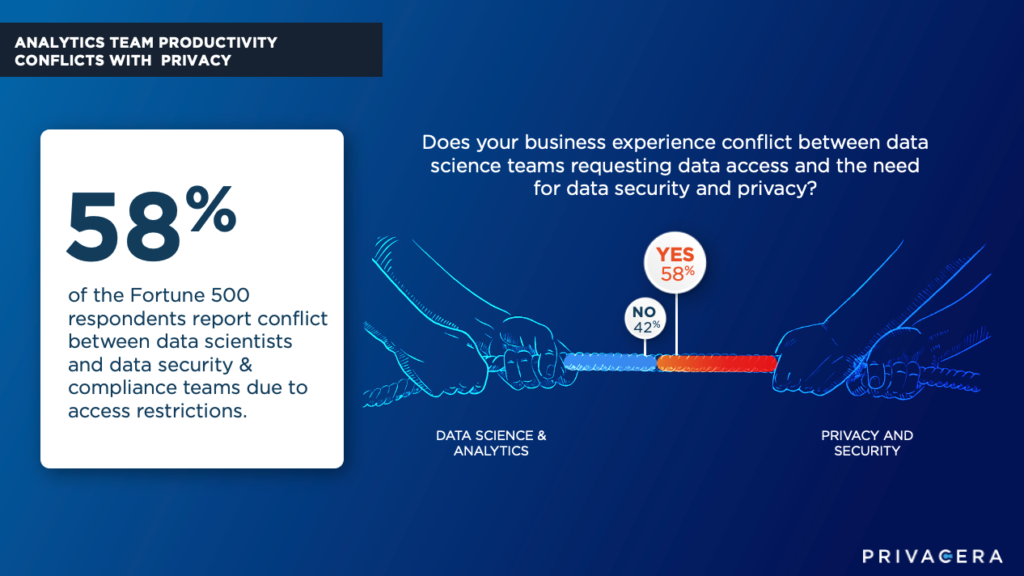
Illuminating the conflict between t\the demand for increased privacy and the migration to the cloud is the fact that 58% of survey respondents report conflict between their analytics and data science teams and their data security and compliance teams due to access restrictions. 

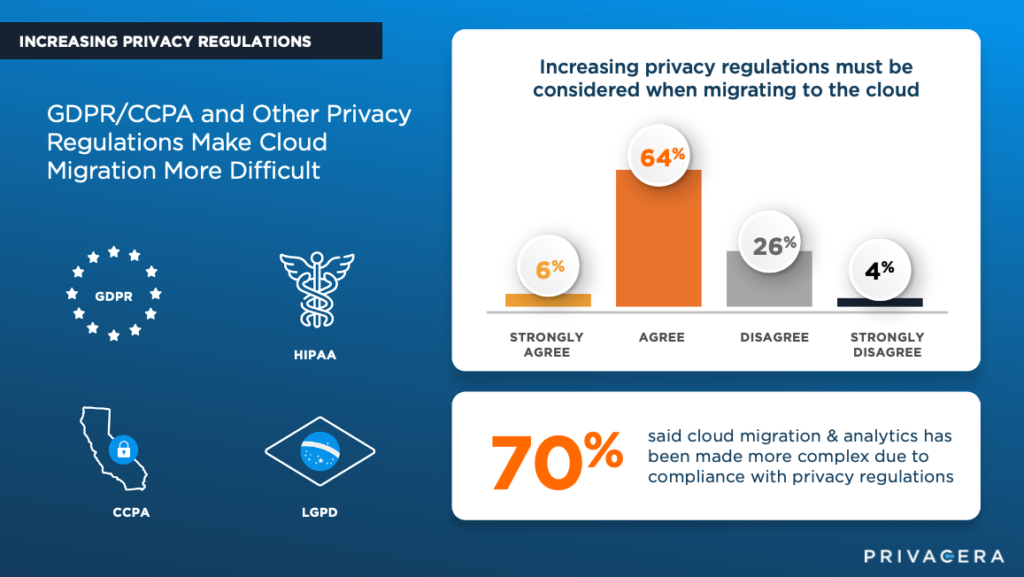
What’s more is that 70% of respondents said that privacy regulations make migrating analytics and data-science models to the cloud more difficult. This highlights the changing dynamics of the industry, as multiple forces converge to increase attention on enterprise cloud architecture and data privacy. 

What are you doing to help companies get started with Privacera?

McKinsey found that COVID-19 spurred an increase in investments in digital innovation. With digital innovation means growing volumes of data that become a treasure trove for analysts and data scientists tasked with deriving “the next best decision.” However, this treasure trove of data should be treated exactly as such, and enterprises need to proactively, and holistically manage the security of this digital data, no matter where it may be—on-prem, or more often of late, in the cloud. 

Privacera’s mission is to enable the responsible use and access of data, and to help balance data security with user needs to create data-driven enterprises as easily as possible. To help enterprises easily adopt holistic data governance policies and ensure privacy and security of data, Privacera recently launched PrivaceraCloud, the industry’s first SaaS data access and governance solution, which provides centralized management of data access, authorization policies and auditing in public cloud environments. 

Enterprises can get started quickly and easily without having to invest in infrastructure resources, and also instantly migrate well-vetted and existing data governance policies from on-prem to the cloud. 

What are you looking forward to as you move into your next phase of growth?

We are looking forward to accelerating our vision and expanding our customer base of Fortune 500 companies. We know that enterprises must make investments in personnel and technology to meet the demands of both data security and digital transformation. We recognize that the current methods of securely sharing data are dependent on piecemeal processes, which is untenable and unscalable. Our report found that 70% of respondents would require automated solutions for data governance and access control in the next 1-3 years. 

To execute upon our vision of secure data sharing across multiple clouds and of becoming the “one ring to rule them all,” as some of our customers call it, we are looking to continue to expand our partner integrations, increase investment in our industry first SaaS data access governance offering and ensure the financial stability needed to create a long-lasting company with the most advanced technology leaders in the industry for petabyte-scale data governance. 

We believe that we are just at the beginning of our journey as a critical and embedded component of every enterprise data architecture, and look forward to addressing the evolving market needs for data privacy and compliance. 

Why are you excited to partner with Sapphire Ventures? 

Partnering with Sapphire Ventures is a great opportunity for us to work with a VC that’s focused on enterprise startups, and more specifically, focused on investing in the data and analytics ecosystem. 

Sapphire has invested in multiple companies in our industry, including most recently, Dremio, and we found that Sapphire brought a significant amount of expertise to the table regarding the workings of the entire data ecosystem. Casber Wang’s blog on the open data ecosystem is a prime example of just how well the Sapphire team understands the space, how different players are forming the next generation cloud data tech stack and how they can all work together to solve enterprise problems.

Additionally, Sapphire’s approach to partnering to build high-value category leading startups in the data and security space such as Sapphire’s recent Sumo Logic IPO and recent Auth0 acquisition by Okta, was attractive to us.

Privacera’s solution is not a stand alone offering–its primary premise is to help integrate data governance processes across a multi-cloud enterprise architecture. We are partnering with Sapphire since they understood that we are providing a cloud data access governance solution, which is not just a part of the stack, but the connective tissue necessary for holistic compliance across a highly dynamic and diverse landscape. 

How do you plan to leverage the latest investment?

We plan to utilize the latest investment to drive growth across all aspects of our company, but especially in our customer-facing teams. We are expanding our sales team to increase coverage across multiple geographies and adding to our customer success team to better support their needs. We are increasing resources for our SaaS solution to accelerate innovation and development–in terms of number of staff, and by inviting industry experts and innovators to join our journey. 

When we announced our Series A funding round, we were wary that the COVID pandemic could have a negative impact on our business. Instead, the pandemic has increased attention on data privacy, and has increased the rate of digital transformation. This latest investment will allow us to accelerate our scaling plan and fuel our mission to become the data governance bedrock of every enterprise’s data architecture.