#gettingInvolved with Customer Success: Here’s Why We’re Thrilled to Lead involve.ai’s Series A

As more businesses shifted from perpetual to subscription-based pricing models over the past 10 years, delivering exceptional customer experiences and continuous engagement have become a strategic priority and an important investment area for business leaders. At Sapphire, we have backed many entrepreneurs building solutions that enable seamless and delightful customer experiences like UJET and Gorgias for customer support, Podium for messaging, Contentful for publishing content, and Clari, 6Sense, Outreach and Highspot for sales enablement.  

Delivering a world-class customer experience (CX) is a team sport, requiring collaboration across sales, marketing, product, support and customer success (CS). Increasingly, many organizations view CS as an essential, revenue-generating role due to its responsibility in helping customers reach an “aha! moment,” which can happen through quick onboarding and a focus on continuous education and engagement to drive renewals and upsells. When done right, CS not only increases revenue and boosts retention, but strengthens loyalty and builds brand. And for companies that rely on self-serve or product-led models, CS may be the first touchpoint with the customer!

Last year, the pandemic enforced the criticality of CS as companies of all sizes tightened budgets and re-evaluated contracts with a critical eye. CS teams were on the front lines, determining whether or not a customer would churn by quickly adapting to customers during a crucial time. Through discussions with dozens of CS leaders over the past couple of months, we were surprised to discover that even with the proliferation of tools for adjacent functions within CX and expansion of budgets to support CS teams, very few solutions exist that target modern CS teams. First-generation CS tools often require major upfront capital and a long time to value. As a result, most CS teams rely on manual Salesforce exports and spreadsheets, making it nearly impossible to understand customer health in real-time–especially the case during a volatile period. 

That’s why we were so excited when Mary Poppen, Chief Customer Officer at Glint, told us about Involve.ai. Soon after, we met with founder and CEO Gaurav Bhattacharya, and heard about his vision for a CS intelligence and workflow platform that allowed CS teams to track real-time customer health–and to do it in a completely automated way. That’s when we knew we had to partner. 

Involve takes a fundamentally different approach compared to incumbents by being the only vendor in the market building an intelligent, ML-based platform that generates predictive insights around churn and expansion opportunities, and eliminates manual data entry. Involve automatically ingests and aggregates structured and unstructured customer data from tools such as Salesforce, Outlook, Slack, Zendesk, Snowflake, and Gainsight, and applies machine learning models to extract hidden insights in real-time. Customers are able to gain extreme accuracy with existing users experiencing 80+% prediction accuracy immediately after historical data analysis, and improving from there to 90+% as more data is collected over time. Involve went to market just last October, but has quickly been able to land large enterprise accounts. We’ve heard rave reviews from customers about how Involve’s platform was a game-changer for their CS teams, driving significant revenue to their organizations. 

In particular, customers shared that co-founders Gaurav (CEO) and Saumya (CPO) were laser-focused on delivering the absolute best product and experience. They’re also incredibly humble and empathetic people. One customer said, “They are the nicest people you’ll ever meet, but beneath that, they have tremendous intensity!” It’s no wonder that when I met Gaurav and Saumya back in March, we immediately clicked. All three of us are first-generation immigrants, and bonded over our upbringings and our collective love of dogs. They are also a duo that works in lockstep–their communication, trust and teamwork reflect 15 years of friendship. Their relationship, deep empathy for customers and remarkable scrappiness has allowed them to overcome problems, big and small, and build an innovative and (what I believe to be) the best-in-breed CS intelligence platform.

As long as a company has customers, then it’s worth investing in CS. Now is the time to empower Customer Success to become a growth driver! We are excited to lead Involve’s Series A, and support the team on their journey to bring intelligent, data-driven insights and workflows to enhance customer experiences. 

Check out Involve’s SOC-2 certified product here, read our blog on why CS is important and check out our CS playbook for anyone starting to invest in CS. 

Turning the Tables on Notation: Introducing the #OpenLP Origins Podcast Miniseries

Notation’s Origins podcast was created in 2016 to shed light on “the money behind the money” in venture. Over the past five years, the podcast has featured dozens of LPs and GPs sharing their wisdom on the ins and outs of venture investing. 

Since day one, the Sapphire Partners team has been hugely supportive of this effort. We are LPs in Notation but our support goes beyond just that. Unbeknownst to Notation, at the same time they were ideating on Origins, we were ideating on #OpenLP. Neither knew about the other’s plans until Notation shared the idea for Origins with us. We immediately saw how similarly we were thinking about the need to bring more insights and perspectives from LP investors to the broader venture conversation. 

Recently, Notation asked us at Sapphire Partners to takeover their Origins podcast for an #OpenLP Origins miniseries. They asked us to host because we “partner with the best early stage venture funds, and have a deep LP network to bring exciting new voices to the show.”

We’re thrilled to be given the opportunity to tap into our network of amazing LPs, as well as leading GPs, to surface insights for the venture community. We hope you enjoy this first episode in which we talk to Notation about the origins of Origins, the origins of Notation, and how it is going (Spoiler alert… really well! They were 100% right that pre-seed is a thing and leaned in early into crypto). 

Stay tuned for next month’s episode which will feature a leading US endowment talking about how endowments and foundations invest in venture funds. We hope you enjoy the series!

If there are questions or individuals you would like us to interview – please tweet us at @Open_LP.

In this initial kickoff episode of the #OpenLP miniseries, Sapphire Partners turns the tables on Notation and interviews them about topics including:

  • The origin of the Origins podcast (and Notation as a firm)
  • How the pre-seed and seed market has evolved over the past years
  • How the NYC tech scene feels, particularly in the wake of COVID
  • Trends in the crypto space and the opportunities ahead
  • The most valuable attributes an LP can bring to the table for a GP
  • And much, much more…

LISTEN ON ITUNES
LISTEN ON SPOTIFY


Sapphire Partners Announces Next Generation of #OpenLP Initiative

Resource for the Established Venture Investor and Emerging Manager Community Sees Significant Traction

Today, Sapphire Partners, a global investor in early-stage venture funds, announced the launch of the new and improved OpenLP initiative.

Launched by Sapphire Partners in 2015, #OpenLP is a crowd-sourced effort to shed light on the limited partner (LP) perspective in the venture ecosystem. #OpenLP aggregates and amplifies insights from a diverse group of LPs and GPs across the venture industry, all in service of greater transparency and understanding. 

VCs and entrepreneurs are hungry for the LP voice, which has historically been relatively opaque. The interest in hearing more from LPs has been clear, and along with it the #OpenLP movement has grown significantly.

Now, Sapphire Partners is upleveling #OpenLP by relaunching the website with a new look, improved site navigation, and a dedicated Emerging Manager section. It’s intended to be a one-stop shop for aspiring and established fund managers and investors to learn about the venture ecosystem.

OpenLP Clarifies Critical Link Between Funders and Founders

Beezer Clarkson, who heads Sapphire Partners and spearheaded the launch of #OpenLP, shares, “Venture investors and entrepreneurs want and deserve to know how ‘the money behind the money’ thinks and operates. We launched #OpenLP to bring light and transparency to the LP perspective, as well as to encourage more LPs to share their perspectives. Over the last few years we have seen both an increased interest in the LP perspective, as well as an incredible new amount of venture investors entering the industry. With this new and improved #OpenLP website, our goal is to make this information even more accessible and actionable than before, particularly for investors (or aspiring investors) from diverse or non-traditional backgrounds.”

“#OpenLP is such an incredible resource for the venture community,” said prominent investor and podcaster Harry Stebbings of 20VC. “As a GP, I routinely find myself referring other venture investors to #OpenLP for a window into the LP mindset. This upleveling of #OpenLP as a content repository is a fantastic development for us venture investors, especially emerging managers.”

With this new iteration of the #OpenLP website, Sapphire Partners is helping further clarify a critical link between funders and founders, bringing the LP perspective to the dialogue, and amplifying and aggregating voices to help all parties better understand how to engage and leverage their LPs.

About Sapphire Partners
Sapphire Partners is the dedicated investment organization within Sapphire Ventures focused on investing in early-stage venture funds in the US, Europe and Israel. Formed in 2012, Sapphire Partners uses an evergreen-like funding structure to invest in dozens of fund managers who are focused on technology investments.

About Sapphire Ventures
Sapphire Ventures is a leading venture capital firm that partners with visionary teams and venture funds to build companies of consequence. For nearly two decades, Sapphire has been investing capital, resources and expertise in innovative startups and technology-focused venture funds around the world. With more than $6.8B in AUM(a) across Sapphire Ventures, Sapphire Partners and Sapphire Sport, and with team members in Austin, London, Palo Alto and San Francisco, Sapphire is well-positioned to help scale companies and venture funds, elevating them to become global category leaders. Learn more: https://sapphireventures.com/.

(a) “AUM” — Assets Under Management (AUM) represents Sapphire’s Regulatory Assets Under Management as of 12/31/2020 per ADV filed March 2021

hand holding a small pitcher and is watering a potted plant

Coming Into the Spotlight: How Customer Success Can Turbo Charge Subscription Growth


As the world slowly reeled back from the impact shock from COVID-19, our team at Sapphire Ventures was flooded with inquiries from portfolio companies about a topic we all know is important, but often sits backseat to new customer acquisition, it’s much flashier sister. 

What I’m referring to, of course, is customer success (“CS”). “When should I hire a VP of customer success?” “Who should that person report to in my organization?” “Should customer success be responsible for upsells, as well as churn mitigation?” These were some of the common questions we were asked. While it wasn’t surprising that business leaders were asking for help around improving customer success practices, it was surprising that there weren’t many publicly available resources available.

To fill that gap, Rico Mallozzi, who formerly oversaw GTM initiatives as part of Sapphire’s Portfolio Growth team, and I spoke with over 20 CS leaders across companies including LinkedIn, Okta and monday.com (a recent Sapphire IPO) to produce the Startup’s Guide to Nailing Customer Success. In the playbook, we dug into why we believe successful SaaS companies prioritize CS just as much as they focus on new sales acquisition and key strategies for rolling out CS at a high-growth subscription based company.

Why are We Talking about Customer Success Again? 

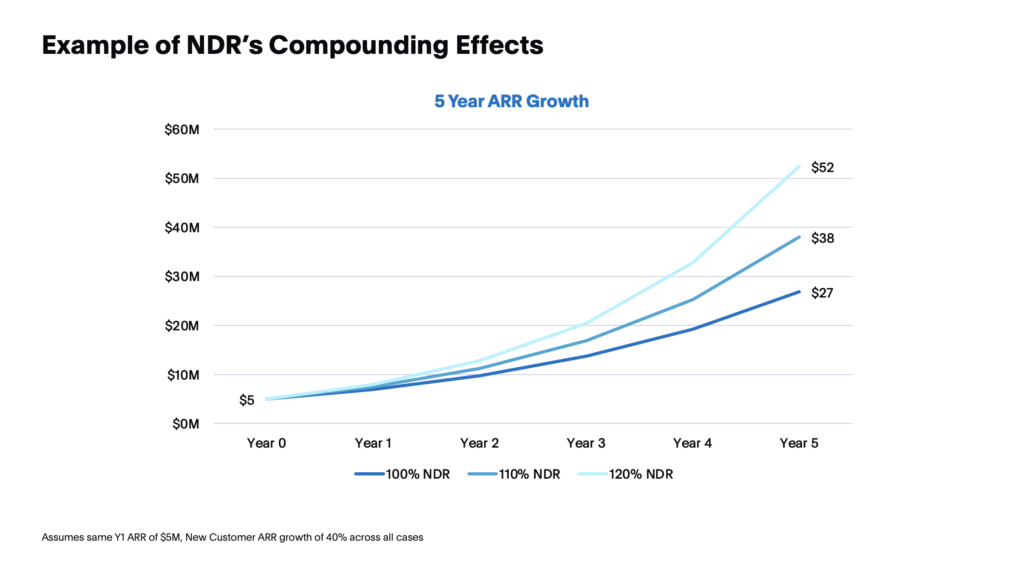
There are many good reasons why organizations care about investing in customer success, but an obvious one comes down to math. If we compare three different companies that have the same starting point in year 0 and have identical new ARR growth rate of 40%, but varying rates of net dollar retention (“NDR”) of 100%, 110% and 120%, by year 5, ARR will be 1.4x and 1.9x greater than the 100% NDR company for the 110% and 120% NDR companies, respectively. In other words, having a strong CS organization that can drive NDR compounds growth dramatically. 

NDR rates, as it turns out, are also tightly correlated with valuations for public companies. I mapped the % NDR to TEV/NTM valuation multiples below, and it can be seen that for the public SaaS companies we looked at, those with higher net dollar retention generally receive higher valuation multiples, albeit with some outliers. 

When it comes to SaaS metrics, LTV/CAC is an important efficiency metric. CAC (customer acquisition cost) is spent upfront on marketing, sales and onboarding to acquire and to bring on a new customer. For enterprise SaaS companies, it often takes more than a year to break even on these costs. Churn and expansion are both direct drivers of LTV, and customer success teams play an important role in increasing company valuation and making a big impact on SaaS efficiency metrics. 

New Dog, Old Tricks

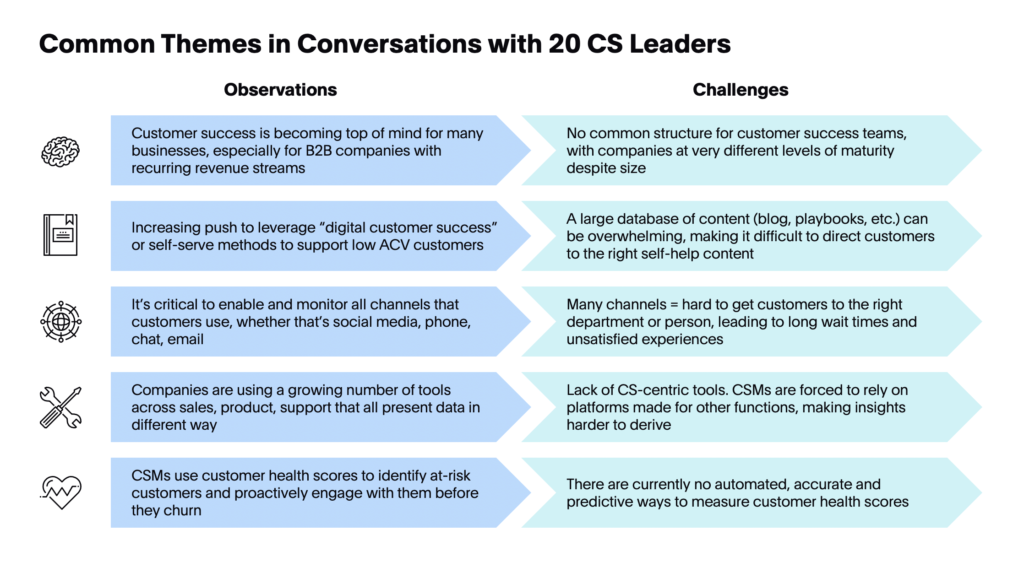
What we learned in our conversations with CS and revenue leaders was that customer success was very much top of mind (hello, COVID!), but rapidly changing business models like product led growth (“PLG”) go-to-market motions were changing the game and making it difficult for legacy customer success practices to keep up. On top of that, customer data was littered everywhere in the organization and across many, many systems–customer data that could be immensely valuable to not only CS, but to sales, marketing and product, is instead splintered and unusable. 

Customer success as a function has grown in importance alongside the rise of subscription business models for both B2B and B2C companies. Adobe (2012), Microsoft (2013), Splunk (2013), Apple (2015) and Tableau (2017) all adopted subscription models within the last decade and that evolution is still ongoing. At the same time, we’re seeing more and more companies adopt a subscription model from the start.  

Prior to the last decade, CS was generally thought of as a cost center and key metrics tracked were focused on CSAT and NPS, collected via simple feedback surveys. Sophisticated companies eventually graduated to tracking analytics driven “health scores” that were configured manually by CSMs (customer success managers) within a rules based paradigm. However, product usage and user behavior naturally change making it very difficult to keep health scores accurate. 

A Shortage of Purpose Built Tools for CS

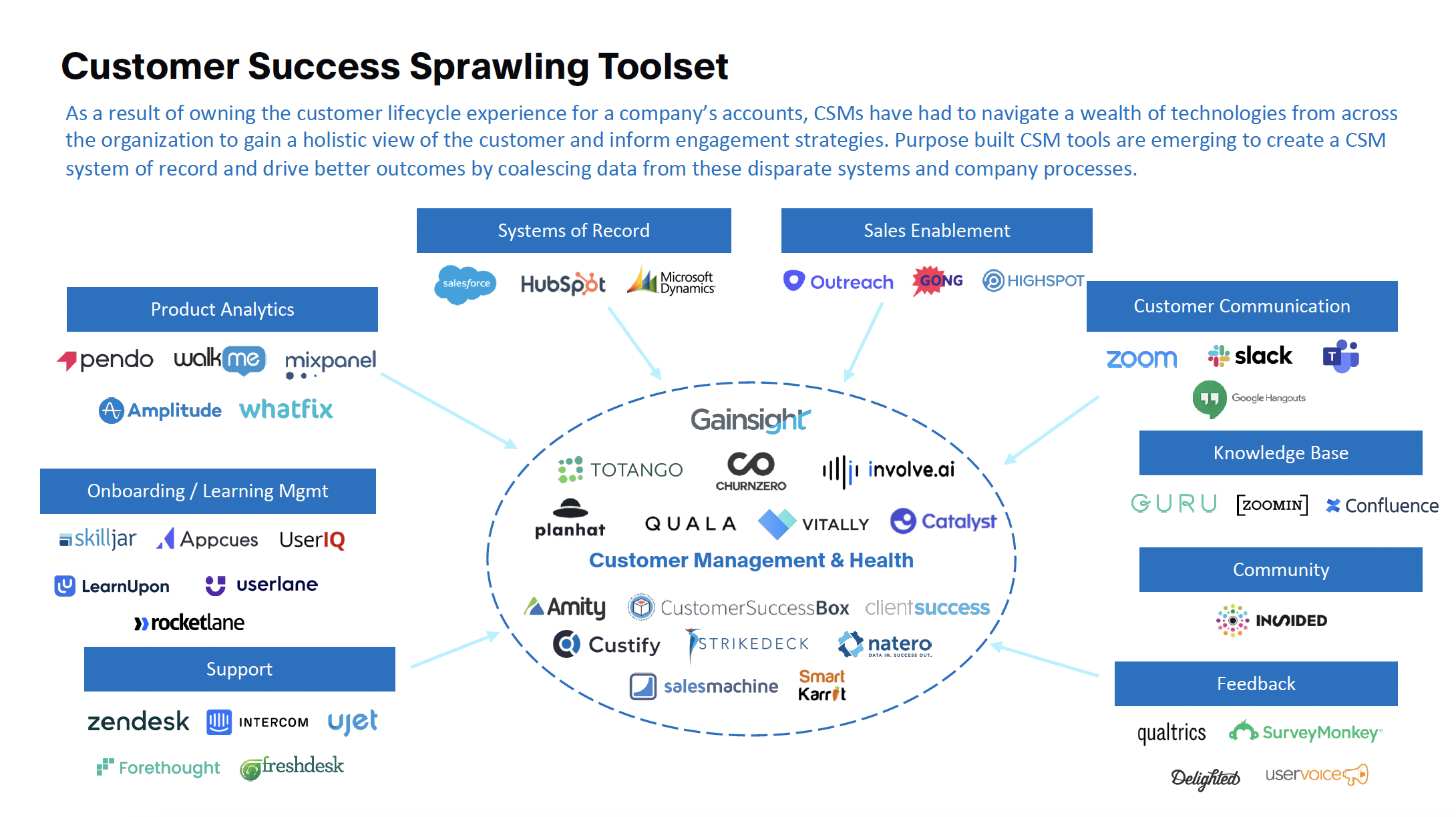
One of the biggest challenges that CS organizations face is the sprawling toolset an individual CSM needs to use to manage and report on customer relationships.The CS industry also lacks purpose built tools for CSMs, which is a major opportunity for emerging players. CSMs own the customer lifecycle experience and have to navigate through a multitude of solutions owned by other functional groups (including product, support, sales, etc.) to gain a holistic view of the customer and inform engagement strategies. 

While Gainsight in many ways created a category around CSM tools, it’s been around since 2009. Another company aiming to help CS organizations is Totango, but it too is more than a decade old. More recently, ChurnZero (2015) and Catalyst.io (2016) have come on to the scene, but there’s clearly a shortage of new technologies in the market dedicated to helping CSMs better do their jobs. 

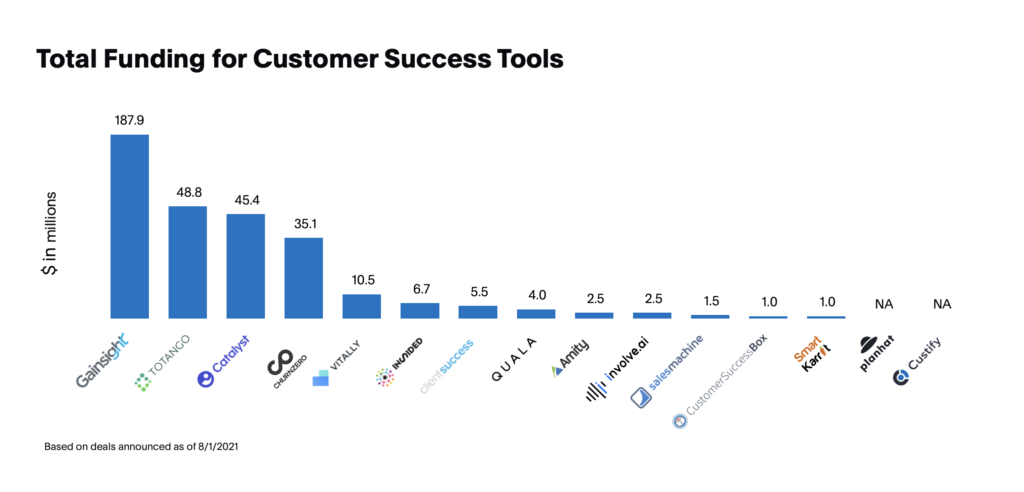
When compared to the number of start-ups in the rest of the customer experience stack (sales and marketing enablement, support and so on), the number of new companies that have been funded in CS is woefully low. I believe that this will soon (and has already started to) change as a confluence of factors, including the rise of product-led GTM motions, improvements in AI and increased awareness of the importance of CS, will create opportunities and budget for startups building solutions targeted at CS teams. 

To illustrate, here’s a graphic representing the funding to-date for customer success focused startups: 

AI is the Next Frontier 

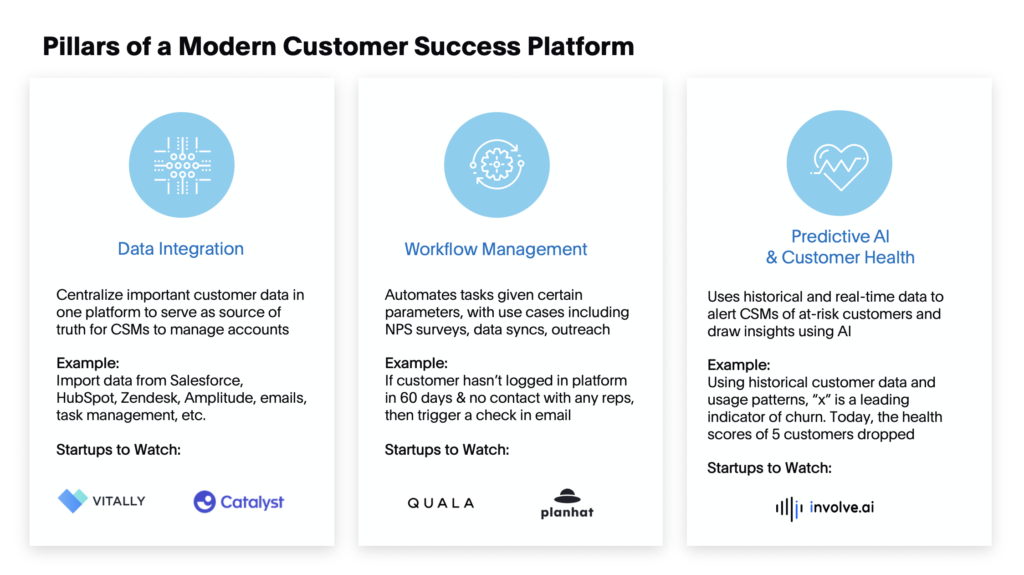
Based on our research, there are three core pillars of a modern customer success platform: Data integration, workflow management and predicative AI. 

Most platforms have focused on the first two pillars and haven’t gone as far as to leverage AI to predict customer health in order to act as an “early warning system” to inform what the best next action should be. In looking at dozens of companies in the customer success space, Involve.ai, a young company based out of Santa Monica, is one of the only companies we’ve seen hone in on leveraging AI today. 

Here are a few reasons why AI has the potential to be a game changer for customer success:

  1. Weaponize customer data. Customer data lives everywhere. Every interaction with a customer, whether digital or in-person, leaves bread crumbs about how the customer feels and what the customer thinks. This information can live in Zendesk tickets, emails, Slacks and many other places. Using advanced NLP, these shards of information can be stitched together to create a dynamic narrative around the state of customer health.
  2. Data-driven results. AI-based tools can provide objective insights instead of relying on individual CSMs who are often managing anywhere from 10 to over 100 accounts at once. With an early warning system, CSMs can focus on the accounts that are a churn risk or ones that are ripe for expansion. 
  3. Digital or “tech touch” CS. How to scale CS teams at rapidly growing companies is always the #1 question. Depending on the average ACV of customers, savvy companies are leveraging technology to automate CS, making it vastly more scalable and flexible as the number of accounts grows. 

At Sapphire, we have a deep history of investing in the customer experience space for many years including companies like Segment (data), Contentful (CMS), Pendo (product), UJET and Gorgias (support), Podium, Highspot and Outreach (sales and marketing). In following the overall industry closely, it’s clear that there’s an acute need for customer success focused solutions that will be able to work alongside other tools, enhance them and share back critical customer insights to the rest of the organization. 

If you’re a customer success leader, building a product for customer success or just have a passion for all things CS, feel free to reach out to me. Let’s chat! Email me at: [email protected]

Special thanks to my colleagues, including Eileen Qian, for their help in writing this post.

The Rise of Customer Experience (CX) Automation: Why We’re Excited to Co-Lead yellow.ai’s Series C

Over the last decade consumers have come to expect everything on-demand. But as we detailed in a prior blog post, businesses simply can’t hire enough people to attend to the barrage of customer requests they receive daily. And thus, the first generation of chatbots was born. But these bots frustrated customers because they weren’t robust enough to understand conversational language and were limited to regurgitating FAQs. 

Fast forward a few years later, the technology and know-how needed to successfully automate customer requests is now at a level where chatbots can identify intent, manage context and understand the nuances of conversational language. With these developments, the next generation of chatbots is capable of doing much more than ever before, which is why we are excited to back yellow.ai and co-lead their Series C. 

yellow.ai is pioneering the CX Automation category with a platform that not only addresses inbound customer support requests, but also enables businesses to proactively engage customers, as well as complete transactions–across text and voice channels. Here’s more on why we’re excited to partner with yellow.ai.

From Customer Service Automation to Total CX Automation

The customer service team in any organization is often faced with the impossible task of reducing costs while maintaining or improving customer satisfaction ratings. Over the years, increasingly intelligent chatbots have emerged to handle high volume requests that can be easily automated, freeing human agents to focus on more complex requests. Organizations that have seen success in customer service automation, as well as forward-thinking vendors are now pushing the industry beyond customer service into use cases in sales and marketing that can also be automated using chatbots. As this trend gains steam, customer service automation is giving way to CX automation, which encompasses customer service, sales, marketing and other conversational touchpoints with the customer.  

At $20B, the market for automating customer service interactions is a large one, but yellow.ai already does much more than address customer service use cases. yellow.ai’s platform also addresses sales use cases (known as conversational commerce) with deployments in verticals such as financial services where consumers can take out a personal loan online through a conversation with a chatbot. yellow.ai’s platform can also help power insurance companies where chatbots can assist customers with purchasing a new policy. 

Conversational commerce presents a huge opportunity for yellow.ai. In fact, a 2021 study from Juniper Research found that the total spend over conversational commerce channels will reach $290 billion by 2025. yellow.ai’s platform can also be used for marketing use cases, and in particular customer engagement, which is expected to be another multi-billion dollar use case for the company. Customer engagement includes acquiring leads, product discovery and launching smart promotions. For example, in the home décor vertical, customers have used yellow.ai to qualify leads and book appointments with sales associates. 

A Low-Code No-Code Approach to CX Automation

yellow.ai is a robust platform that customers can use to build chatbots for customer support, sales or marketing use cases. In enterprise software, “robust” has historically meant that a product is inaccessible to non-technical users, creating a dependency on engineering teams who have other priorities. yellow.ai differentiates itself by providing a low-code, no-code chatbot development interface that makes it easy for non-technical users to build and iterate on chatbot conversation flows themselves. If you know how to use PowerPoint and Excel, you can create a chatbot conversation flow in yellow.ai.

To support enterprise demand to reach customers on their preferred channel, yellow.ai’s chatbots can be deployed on mobile apps, websites, messaging (SMS, WeChat, WhatsApp etc.), voice assistants (Amazon Echo, Google Assistant), IVR and email. And because yellow.ai’s origins are in the India and APAC markets, its chatbots were built to operate out of the box in 100+ languages such as Spanish, Portugese, Bahasa, Malay, Mandarin and more.

Finally, CX will always be a combination of automation and human effort. yellow.ai is built for this reality and can accommodate human agents in addition to chatbots. yellow.ai’s chatbots seamlessly transition customer conversations to human agents who can address customer requests more efficiently through yellow.ai’s pre-built workflows such as fetching CRM info without an agent having to manually go into the database and providing dynamic canned responses where scripted responses can be dynamically populated with user data.  

A Founding Team Always Up for a Challenge

At Sapphire, we back ambitious founders and management teams building companies of consequence, and we couldn’t be more excited to partner with co-founders Raghu (CEO), Rashid (Chief Product Officer) and Kishore (CTO) on the next phase of yellow.ai’s growth.

After hardening the platform in the India and APAC markets–where multilingual capabilities, support for dozens of conversation channels and ability to scale to millions of conservations are table stakes–yellow.ai’s founders have set their sights on making a big push in North America, building upon an existing beachhead of customers and use cases. 

The market for CX automation is here to stay and we look forward to working with yellow.ai to build the industry leader in this category.

Left to right: Rashid Khan, Raghu Ravinutala and Jaya Kishore Reddy Gollareddy

Banking on Disruption: Why We’re Over the Moon to Invest in Mercury

With a financial services market that’s expected to hit $22.5 trillion in 2021, businesses are drowning in innovative financial tools — API-driven payroll, SaaS bookkeeping, online payments, analytics, and so on. 

But, amid a wide range of fintech innovations, one (very large) corner of financial services remains relatively unchanged: the business bank account, which still acts as the starting point and single source of truth for most businesses’ financial operations. 

This is especially true for digitally-native tech startups, entrepreneurs, and solopreneurs who yearn for banking services that reflect the pace and needs of their fast-moving online world. Startups are increasingly underserved by incumbent banks and the traditional “relationship banking” that’s been the standard for decades. When expectations and reality are misaligned, there’s opportunity for disruption. 

That’s why we’re so excited to be investing in Mercury

Disruptive banking for tech disruptors

Mercury’s easy-to-use, digitally-connected business banking platform is built specifically for early-stage companies in tech and ecommerce. From easy account set-up to real-time money flows, automated payments/reconciliation, and API integrations with key systems in the finance stack (QuickBooks/Xero, Gusto, Deel/Remote, Pilot, etc.), Mercury is speeding up the way its business customers operate.

As one of Mercury’s customers told us, “[Mercury] Feels like a bank built with tech founders. [The] Interface makes it fun to log into a bank account. The whole banking experience feels like banking should be in 2021.”

By joining startup customers on their journey from day one, Mercury is upstream of most other financial products and services, offering a distinct advantage that puts them in a pole position to develop additional products and services and offer them to customers before the competition. This raises Mercury’s potential from service provider to ecosystem enabler, and that’s a powerful place to sit.

Unsurprisingly, Mercury’s ‘banking disruption to empower disruptors’ approach is paying off.  Since its launch in 2019, Mercury has grown quickly, adding 40,000+ business customers from ~200 countries and holding $4b+ in customer deposits.

Experienced founders building a “company of consequence”

We first met Mercury co-founder Immad Akhund over two years ago, just as Mercury launched.  From the start, we’ve been inspired by Immad and his co-founders’ far-reaching vision and rapid execution.   And as an entrepreneur and multi-startup founder, Immad has strong customer empathy and keen insights into what startups and entrepreneurs need from their banking solutions.

At Sapphire we’ve witnessed the power of fintech disruption through our investments in portfolio companies like AvidXchange, Currencycloud, Current, IEX, OnDeck Capital, Square, Transferwise and Yapily. We’re excited to invest in Mercury’s Series B, alongside friends at A16Z, CRV, and Coatue.  This financing is a fantastic milestone for Immad and team, and we’re thrilled to be part of Mercury’s journey to become a company of consequence in a massive market that’s hungry for a modern solution. 

From Visualizing to Realizing the Future of Video: A Big Congrats to Kaltura on the IPO

Today is an exciting day at Sapphire Ventures. Another one of our portfolio companies has gone public, becoming a true company of consequence! Kaltura, which is on a mission to power any video experience for any organization, is now trading on NASDAQ as KLTR! 

As Kaltura embarks on this next chapter of their journey, we’d like to take a moment to reflect on what has made Kaltura so special, on the market opportunity for video today and on what’s ahead. 

When we first teamed up with Kaltura

Ron Yekutiel, Kaltura co-founder and CEO and his team have always believed that video was going to be the most powerful and engaging digital tool for human interaction. Since the company began in 2006, Kaltura has been committed to creating better communication, learning and TV experiences. And the team has had a prescient vision of video as a way to revolutionize how people connect, collaborate, work, learn and entertain by making it a seamless and accessible part of everyone’s lives.  

We actually passed on our first opportunity to invest in Kaltura. The company was growing rapidly, but it was still early and the team was trying to tackle a lot. We would make the same mistake the second time around, which Ron loves to remind us of. To our defense, we finally got it right on the third try as we had seen the business execute to plan and deliver on building out a broad platform. Not only did we invest, but we backed up the truck and wrote the largest single check Sapphire had written at that point in time. We had finally realized it takes a certain amount of chutzpa to say you’re going to power every video experience and were excited to go big, co-leading Kaltura’s Series D in 2014. 

Fast forward to now, not only has Kaltura continued to kick-butt serving educational institutions, enterprises, media companies and telecoms giants globally, but they’ve expanded the product line (organically and through three acquisitions) to keep up with technology and standards evolutions like the rise of OTT and RTC. This put Kaltura in a position to keep on their growth path, and to accelerate their vision as 2020 became the year where the world had to run remote and mostly on video. The market for Kaltura’s live and on-demand video SaaS solutions really reached an inflection point over the past year, becoming essential to operating any organization.

What a special team looks like

Ultimately, it’s all about the people that build the most successful companies, so Kaltura’s exceptional co-founders; Ron Yekutiel (CEO), Michal Tsur (President), Shay David (Board Director) and Eran Etam, all deserve a mention here.

Beyond appreciating the execution capabilities of the team at Kaltura, we appreciate them as people. There’s a saying that once you’re a Kalturian you’re always a Kalturian. It’s the kind of group where you exchange hugs instead of handshakes at board meetings. And it’s the kind of group where they don’t just know you’re getting married, they want to plan a second ceremony for you in Israel. 

While Kaltura’s current headquarters are in New York, it was founded in Israel, and we were lucky enough to visit the team in their home country early on in our relationship. The trip was a while ago, but remains fresh in our minds and will forever be an experience of a lifetime. After they worked us to the bone “light for a Kalturian” they’d likely say, the Kaltura team was kind enough to act as our tour guides, showing us the cultural wonders of the country, while introducing us to their incredible cuisine and delicious snacks. To this day, we still get our favorite Israeli snack, Bamba, delivered to us by the team on trips to the west coast.

The Kaltura difference

Video consumption is here to stay, fueled by trends like increased broadband availability, mobile device penetration, the rise of over-the-top streaming (OTT) and now remote work amidst COVID and beyond. It sits at the heart of digital transformation too, with organizations increasingly embracing solutions to better engage with customers and employees. It’s a global market, which includes on-demand, live, and real-time video experiences, worth approximately $50 billion. 

Kaltura is rightly very proud to have created the first and only open-source video platform, which is now home to one of the world’s largest online video developer communities.

Its live and on-demand video SaaS solutions are offered like lego building blocks that enable organizations to do anything with video, to suit any end market and any use case. Its off-the-shelf products are also renowned for flexibility, modularity, ease of integration and accessibility.

Today, Kaltura’s solutions are deployed globally across thousands of enterprises, media companies, service providers and educational institutions that utilize video to teach, learn, communicate, collaborate and entertain. Its technology even helped power our very own 6th annual virtual CIO summit and massive conferences like Amazon’s Reinvent in 2020.

A bright future for Kaltura

While one never really knows if they’re building the kind of company that will meet society’s demands and ultimately go public, Kaltura had a clear goal dating 14 years back and was working extremely hard to get to this point. As they say, timing is everything, and it couldn’t be better for Kaltura. Video is having an incredible moment, and is going to be an increasingly prevalent part of everyone’s lives going forward.

We’re so proud of our partnership with Kaltura and are enjoying seeing Ron and the whole team gain much deserved recognition for the company they’ve built. With leading solutions available for the on-demand and live video markets and intentions of expanding into Video Experience Cloud with new media services, as well as new products and industry solutions, Kaltura doesn’t plan on slowing down any time soon. We believe the company is perfectly positioned to capitalize on future opportunities and look forward to witnessing its next stage of growth and beyond.

Supercharging Open Banking to Create Better Financial Services: Why We’re Excited to Lead Yapily’s Series B

Seeing the rise of open banking and evolution of solutions from rudimentary screen scraping to integrating open APIs in Europe, our search began for a visionary team that could power the open banking and open finance capabilities of fintech companies. The first time we met Stefano Vaccino, founder and CEO of Yapily, and his team, everything just clicked. The team is hungry, experienced and stacked with strong engineering and payments talent, and they impressed us with their deeply thoughtful, humble and infrastructure-first approach. 

At Sapphire, we have a long history of investing in and building companies of consequence in the API-first category, having backed Apigee (acquired by Google), Auth0 (acquired by Okta), Mulesoft (acquired by Salesforce), Segment (acquired by Twilio), Contentful and Project44, as well as in the fintech and payments industry, having backed AvidXchange, Currencycloud, Current, IEX, OnDeck, Paytm, Square and Wise. We’ve been interested in fintech innovation for some time now, and more recently have been excited about the European payments landscape in particular. In fact, we just published a blog about why we think the European payments market is hotter than ever. The timing was therefore perfect when Yapily started talking to us about their intentions to raise their Series B.

Covering more than 90% of accounts in major European countries, Yapily provides a single API for companies to embed the power of open banking within their products and services. For example, Yapily enables companies to access, create and execute payments on behalf of their users from one bank account to another. Without Yapily, those companies would have to integrate with, and maintain connections to, each individual bank – a significant resource and time intensive task. 

Yapily is helping companies create better financial services for everyone, which is why we are thrilled to back Yapily, and lead their Series B, joining our friends at LocalGlobe, Lakestar and HV Capital. We look forward to supporting Stefano and the entire Yapily team on their journey to power the open banking and open finance infrastructure of third party fintechs and build a company of consequence. 

Here’s why we’re excited to partner with Yapily:

A Huge and Rapidly Growing Market 

European regulation such as PSD2 in the EU and Open Banking in the UK has forced financial institutions to open up their data to third parties. This began with providing individuals access to their personal banking information, but has quickly led to a number of applications that connect the otherwise siloed and fragmented elements of the banking ecosystem together. 

Driven by open banking and open finance, Europe is at the forefront of fintech and payments  innovation. A massively growing industry, the open banking market at its inception in 2018 was worth $7.2B and is expected to grow to $43.2B by 2026. This projection aligns with our thinking as we believe there will be an expansion of product use cases into additional market segments (such as pensions, insurance, etc.) as open finance is further adopted. 

To date, the vast majority of activity in the open banking landscape is related to data. It’s our belief that the opportunity in the payments market is also considerable with a widely held industry view that open banking payments will take significant market share from card payments over the next few years. Yapily offers two core products across the data and payments segments of open banking, and the company is already seeing the benefit of the strong market tailwinds across both. 

An infrastructure-only approach for open banking  

Yapily is unique in its product positioning as an infrastructure-only player. This means, Yapily provides only the API and tooling features to their customers, unlike other open banking providers that are building applications. Additionally, Yapily takes an API-first approach and focus–they haven’t built legacy technology such as screen-scraping or reverse API engineering. This architecture difference allows Yapily to scale quickly, extending coverage wherever it goes, while providing more flexibility, reliability and security to their customers. 

Perfect Market Timing

Although open banking has been a much talked about concept in Europe for the last few years, most companies have started to implement and capitalize on open banking in their product offerings in only the last 12-24 months, and even more recently for payments use cases. As a newer entrant to the market, Yapily has been able to develop their infrastructure in parallel with the increasing adoption of open banking APIs, and didn’t need to build out additional revenue streams to tide them over until the market was sufficiently ready. 

A Visionary Leader with Strong Industry Experience

Founder and CEO Stefano Vaccino brings with him deep expertise in the payments and fintech industry, and has recruited a seasoned management team across both commercial and technical roles, including executives from Stripe, Google, Modulr, Currencycloud and WEX Europe. 

We are humbled by the ambition of the Yapily team to build a company of consequence within open banking and open finance more broadly and are excited to back their next phase of growth!

The Power of Payments: Why the European Payments Market is Hotter than Ever

£3.50. Tap. Tasty coffee. £49.99. Click. Snazzy new shoes. 

For consumers, convenient digital payments have become a part of everyday life. Long gone are the days of carrying wads of cash or *gasp* writing paper checks. For businesses, payment methods and the technologies that power them are changing rapidly. It is becoming easier than ever for merchants to accept different payment methods and for businesses to efficiently complete transactions. 

At Sapphire, we have a long history of investing in and building companies of consequence in the fintech and payments industry, having backed AvidXchange, Currencycloud, Current, IEX, OnDeck, Paytm, Square (NYSE: SQ) and Wise. Speaking of Wise, we’re thrilled to celebrate the company’s IPO listing on the LSE last week, and we’re looking forward to backing more European category leaders in the payments space going forward. 

Why Payments?

Despite representing a trillion-dollar global market, payments infrastructure has historically been hard to understand, plagued by confusing terminology and restricted by unclear regulation. However, recent regulation (Open Banking & PSD2) combined with astute marketing strategies from players such as Monzo, Revolut and N26 has increased accessibility to fintech, making it “cool” and relevant to everyday consumers and businesses. 

At Sapphire, we are excited about the startups disrupting incumbent payments infrastructure players. We see Europe playing a central role in this unbundling, which has been driven by regulation, the expansion of the digital economy and an increasingly global-from-day-one merchant customer base. 

Why Europe?

Europe itself is a diverse market made up of 24 official languages, 50 countries and 25 currencies, so it is no surprise that the level of payments maturity across Europe varies greatly. 

To illustrate, in 2019, the total share of cash in POS payment transactions was 88% in Albania, 63% in Germany and just 15% in the UK. Despite its differences, or perhaps because of them, Europe continues to be a hotbed for payments innovation. At Sapphire, we see this innovation being driven by six key themes:

  • Regulation, specifically PSD2 and Open Banking: Taking effect in 2016, PSD2 forced banks to provide access to Account Information Service Providers and established a standard for payments data transmission, ISO20022, which makes it easier for all payments players to interact with each other. Open Banking in the UK took this one step further by requiring standard APIs and applying additional regulatory pressure on banks to open up.
  • Real-Time Payments: Unlike in the U.S., the EU’s payments infrastructure benefits from real-time payments (where payments are processed nearly instantly), enabling greater liquidity, driving innovation, reducing fraud risks and payment costs and improving long-term customer relationships between parties. 
  • Expansion of the digital economy and changing consumer behavior: The rise of e-commerce and mobile/digital payments have driven merchant demand for more complex online and omni-commerce payment systems and technology.
  • Increasing global economy and customer base: Players such as Shopify and Squarespace have made it quick and easy to launch an online store and thus reach a global customer base. Meanwhile, companies such as TaxDoo enable a merchant to scale cross-border while maintaining sales tax compliance. As a result, it has increasingly become the default for digital commerce platforms to support an international customer base from day one,  whereas previously merchants and payment infrastructure players were more likely to serve regional customers. 
  • B2B Innovation: Consumer expectations of payments technology have bled into the B2B world too (SMEs + enterprises). Businesses now expect the same ease and simplicity in their banking and payments infrastructure as they do in their consumer experiences. As such, we are seeing an acceleration in growth in the SME segment, B2B2C business models and new customer areas such as cross-border e-commerce (and money movement services). This growth is, in part, driven by the increasingly globalized nature of the world economy.
  • COVID-19: The pandemic accelerated the move from physical to virtual banking. In Europe, ATM withdrawals declined and geographic and age group differences in shopping behavior greatly reduced as many consumers turned to online shopping for the first time. For example, Switzerland reported an increase in the share of debit-card spending from 65% to 72% between Jan-May 2020, mostly at the expense of cash. And in the U.K., month-over-month declines in ATM withdrawals averaged 46% from March to July 2020.
The Growth Potential of European Payments 

So how much bigger will this $380B revenue industry grow as market forces continue to exert pressure?

While exact answers vary, what’s clear is that there is a large and expanding total addressable market with significant runway for growth. Prior to 2020, European payment revenues were growing at a CAGR of 3.1%. Projecting this growth rate forward and not accounting for the swifter rebound from the pandemic that Europe will likely experience, as anticipated by McKinsey, European payment revenues will reach $450B in 2025. 

What does the current infrastructure look like?

As shown in the graphic below, there are effectively six core ways payments can flow consumer-to-merchant or merchant-to-merchant. Cash and the Four-Party Card Scheme (predominantly Visa and Mastercard) are the principal payment channels within Europe. 

Nevertheless, PSPs and PayFacs such as PayPal (market cap $303B), Adyen (market cap $57B) and Klarna (post-money valuation $31B) are growing in importance. Additionally, account-to-account digital payments are starting to replace card payments in some of Europe’s markets such as Sweden, Norway and Iceland, with Sweden’s account-to-account SWISH service transaction volumes hitting $24B in 2019.

Current Consumer-to-Merchant Payment Methods
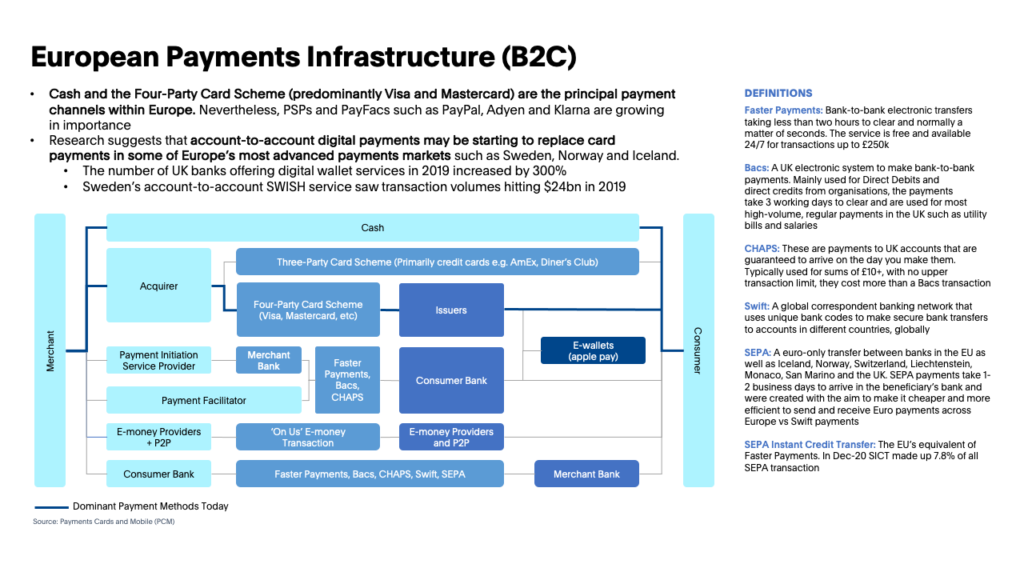
Within B2B payments, which accounted for 80% of the value of all U.K. payments in 2019, Bacs Direct Credit and Faster Payments are the dominant payment methods making up 74% of payment volumes in 2019

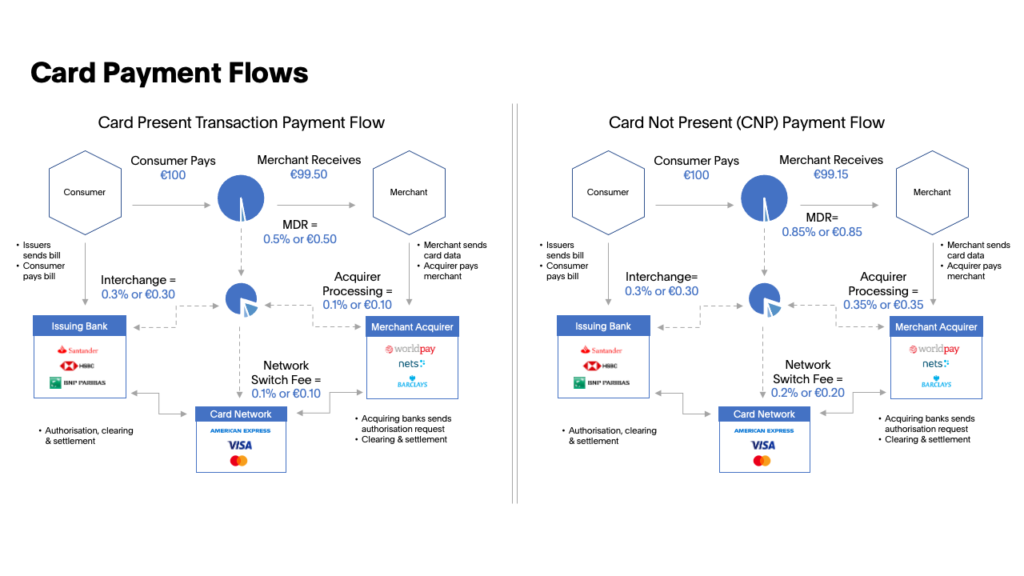
To illustrate a typical payments flow, we will use the Four-Party Card Scheme flow as an example. As payments flow from the consumer to the merchant, each party takes a small fee, as seen in the graphic below. Card-Not-Present (CNP) transactions typically charge a higher absolute fee to merchants versus Card-Present transactions due to greater fraud risk.

Example: Card-Present and Card-Not-Present Payment Flow
 

The current European landscape

Over recent quarters, VC investments into European payments startups have grown an astonishing 942% between Q1’20 and Q1’21. Some notable rounds in the last few months include:

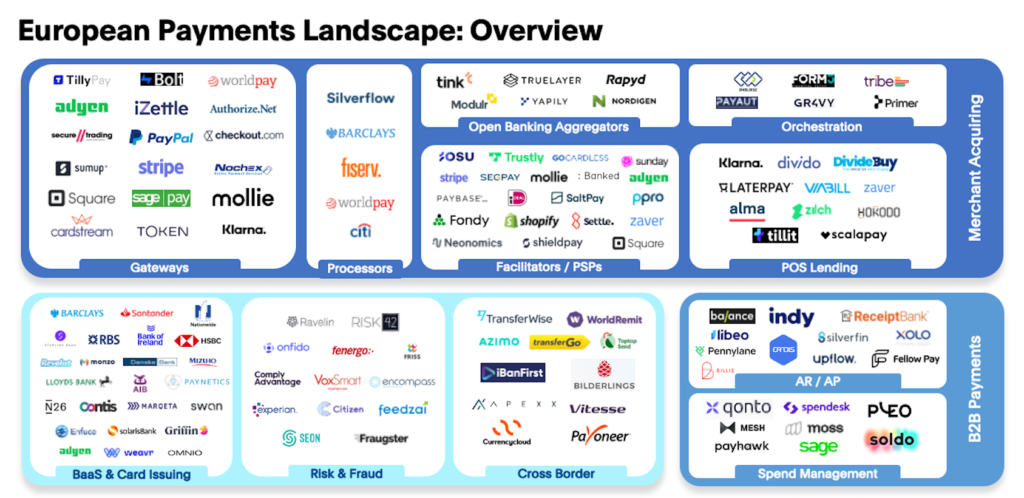
At Sapphire, we segment the European payments landscape into five distinct categories: 

  1. Merchant Acquiring
  2. Issuing
  3. Risk & Fraud
  4. Cross-Border
  5. B2B Payments
Merchant Acquiring

Here, we use the term ‘merchant acquirer’ loosely to cover all players acting within a payment flow,  as often key players take on multiple roles and thus can’t be strictly segmented into one bucket. Innovation across the flow is substantial so for ease of understanding we’ve broken out where we see the opportunities across six key areas.   

  • Payment Gateways: As the dominant entry point for a transaction, payment gateways continue to be hit by waves of disruption. Paypal introduced a gateway for the web, and Square (a Sapphire IPO) innovated on the POS reader by enabling one’s phone to act as the gateway. But opportunity in this space hasn’t been exhausted yet. We are excited to see a new wave of players innovating such as Checkout.com, Mollie and Token.
  • Payment Processors: Payment processing infrastructure continues to be based predominantly on legacy platforms that are inflexible, costly to maintain and require lengthy onboarding processes, ultimately slowing down innovation of the whole card payments infrastructure. We are therefore excited by disruptors such as Silverflow that are building a cloud-native platform that offers simple APIs and streamlined data flows to directly integrate into the card networks.
  • Payment Facilitators: Mastercard and Visa introduced the payment facilitator model in 2011 with early adopters such as Square, Stripe and Paypal proving its viability. Historically, a complex and costly market to enter, the recent emergence of new software platforms and API stacks have eroded barriers to entry and enabled a new wave of players such as Mollie, Sunday, SaltPay and Payosu to compete with the aforementioned first-movers. 
  • Open Banking Aggregators: Last year we wrote about our excitement around Open Banking. We continue to believe PSD2 and Open Banking have opened up many new possibilities for both consumers and businesses. However, in practice, integrating with each bank API is a big task. Thus, we see continued opportunity for players such as Tink, Truelayer and Yapily— companies that are building off open banking infrastructure and acting as aggregators in the market.
  • Orchestration: A relatively new opportunity driven by the explosion of payment methods, players in the payment orchestration space are just starting to emerge and gain traction. Those sitting in this space don’t touch funds, but act as the platform bringing all the different payment flows together. This means they don’t need to be regulated and as such and can serve a global customer base from day one. Companies such as Gr4vy and Primer are building no-code orchestration platforms that replace the in-house payment teams that typically manage this manually, thus making payments effortless for merchants.
  • POS Lending: The traction of older online services like Klarna, Affirm and Afterpay have paved the way for more recent entrants such as Scalapay and Alma. This, combined with the surge in e-commerce usage and the impact of the pandemic on consumer finances, makes installment payments more attractive and has ensured continued opportunity for new entrants in this market.
Issuing

Until recently, the complexity of building highly regulated financial products has been a great constraint on financial innovation among non-fintech companies. However, the emergence of Banking-as-a-Service (BaaS), banks that provide non-financially regulated companies with white-labeled banking services, has driven innovation in the embedded finance space. 

Through simple, easy and fast-to-integrate APIs, BaaS players let companies embed white-labeled banking features into their products and customer experiences, unlocking new opportunities to grow revenues, margins, retention and so on. Notable companies in this space include Railsbank, Solarisbank, Swan.io and Griffin, and Enfuce for issuing use cases. 

Risk & Fraud

All businesses that accept Card-Not-Present (CNP) payments are at risk of fraud, with Juniper Networks estimating that CNP fraudulent transactions will cost e-commerce $50.5bn by 2024. Such fraud incurs chargebacks, costing merchants bank admin fees and potentially putting them on card network operators’ risky list. It is therefore no surprise that several players have emerged to help merchants tackle this problem, such as Feedzai (Sapphire investment), ComplyAdvantage and Seon

B2B Payments

Payments made by businesses accounted for 80% of the value of all payments made in the U.K. in 2019 while only representing 12% of the total number of payments. Even though the B2B payments space has experienced far less innovation than the consumer space, the industry is in the early phases of disruption and the opportunity is vast. We’re excited to observe a new wave of disruptors in B2B payments taking on incumbent solutions, including AvidXChange (Sapphire investment), Pleo, Spenddesk, Soldo, indy and balance

Cross-Border

For many businesses and consumers in Europe, making cross-border payments is a necessity. McKinsey estimates the global cross-border payments flow to be $140T. Like for many geographies, in Europe cross-border payments have been controlled by traditional banks. But traditional banks have been slow to respond to changing consumer demands for embedded FX solutions. 

New players have emerged to take advantage of these opportunities such as Wise (formerly Transferwise) and Currencycloud (both Sapphire investments). We expect that with the rise of additional fintech solutions that the need for efficient, reliable cross-border payments will not go away. 

In short 

Europe has and continues to be a hotbed for payments innovation driven by regulation, real-time payments, changing consumer behavior, globalization and B2B innovation. Standing at $380B today, we believe that the market is only going to grow larger off the back of these trends. 

At Sapphire Ventures, we are hugely excited by the array of opportunities to build companies of consequence across B2C and B2B payments infrastructure and would love to hear from you if you are building a company in the space! Please reach out to [email protected]

all hail happiness

All Hail Happiness: The Gen Z Buying Habit Coming to a Wellness Investment Near You

all hail happiness

Gen-Z knows and cares more about their health and wellbeing than ever before. Because what it means to be “well” today is so much broader than fitness and nutrition – it’s about maximizing all areas of your life, including physical health, emotional wellness, job satisfaction, financial health, a sense of belonging, personal relationships, leisure time, and much more. It demands an ecosystem that’s unique to each individual.

So, the ‘million dollar question’ becomes: how do we prioritize and balance all aspects of our unique life to be healthy and happy? 

Gen Z is leading the health & happiness curve

As an investor who specializes in the wellness economy, I feel an intense responsibility to find and back founders who are building clinically validated solutions that help answer that question. And with 91% of Gen Z experiencing physical or psychological symptoms due to stress in 2021, there’s never been a more important time to do what I do. 

Arguing that today’s young people are more health-conscious than ever is fairly uncontroversial. And plenty of statistical evidence agrees:

Drawing these strands together paints a complete picture of Gen Z’s attitude to health. Increasingly, physical health, mental health, wellness, and lifestyle choices all play equal roles in the pursuit of one ultimate goal: happiness. We call it “All Hail Happiness.”

What makes an attractive wellness investment?

In 2021, the oldest of Gen Z are in their mid-20s – and old enough to make their own buying choices. And in the last few years, the market has noticed. New mobile apps now help young people with everything from meditation and exercise to sleep and mindfulness. Heck, there is even a mobile app and an entire phone to help you spend less time on your mobile device. The pandemic has only accelerated this trend, with more people than ever seeking mental health support – and an explosion in direct-to-consumer apps offering ‘the answer’.

This convergence of consumer demand and technology makes 2021 a really exciting time to be an investor in the wellness space; however, I also see more things promising a silver bullet come across my desk than ever before. As an investor, the goal is to find products and technologies that will catch on, not just as a fad, but as a long-term company of consequence that positively impacts the lives of the next generation. To do that, I focus on three things:

  • But really, does it work?

Whenever I look at a wellness company, my first question is, “does it work?” – where is your clinical evidence, where are your studies, what does the early data show, does this product actually make a difference to people’s lives, and would our LPs actually use this product with their athletes? – and does the science back it up? 

Plenty of new wellness services are making up problems to solve and plenty more are trying to convince people they have problems they don’t. Some of these might catch on in the short term – but if an app doesn’t work, consumers will eventually call it a day. *Cough* *cough* crash diets. 

  • Does it give me time back?

Gen Z grew up in a world where everything is available at the click of a button – they don’t need to go anywhere,  there’s no patience for inconvenience, and the important decision they make every day is how they spend their time.  So, in order to make their lives as full as possible, they demand a connected, digital experience for everything they do. For consumers to really stick with a new product, it must be convenient and time-saving – otherwise, something else out there will win out. 

  • Is it good enough to stick?

Habitual users are a critical measure of an attractive investment. They’re the difference between a short-term fad and a company of consequence. Even if you only attract a small population of users, you can build a large and sustainable business if they use the app every day and swear by its success. It’s reimagining fandom for a new generation.

Breathwrk: Our most recent investment and a perfect storm for Gen Z

Looking ahead to 2021, brands are making the wellness wave increasingly inclusive – focusing on seamless solutions that can make a difference for as many people as possible. It’s why we were so excited to discover Breathwrk – a direct-to-consumer mobile app that offers guided, performance-based breathing exercises. 

  1. It’s science-backed: Increasing research from major universities, like Johns Hopkins, are proving the effects of breathing on our mental and physical wellbeing. As a result, more and more people are adopting the practice. Breahtwrk’s expert-built breathing exercises are proven to reduce anxiety, increase energy, improve focus, and help you fall asleep.   
  2. It’s efficient: breathing works in seconds and has measurable effects on the autonomic nervous system immediately, unlike meditation and other practices. Breathwrk has breath exercises as short as 40 seconds.  
  3. It’s habitual: the app has built-in programs that help users adopt high-performance breathing habits to meet their unique individual needs across four categories: Energize, Calm, Perform, and Sleep. The app notifies users at points in their day when they need to stop and take a breath.

Breathwrk is at the center of every big-market Gen Z movement and hits on everything we look for when it comes to wellness investing. Having gone viral with the help of their “share a breath” feature on Tik Tok, which now boasts 2.3M fans, the app is organically impacting the lives of people everywhere, whether that’s their performance on the field or their sleep at night.

Right now, the wellness sector is one of the best (and most complicated) places for an investor. But with great portfolio companies like Breathwrk joining our family and a highly strategic LP base across global sport, media, and entertainment – with the know-how to validate products and services – Sapphire Sport is one of the most exciting places in the venture capital industry, sitting squarely at the nexus of tech and culture.  Having started at Sapphire just five months ago, I’m thrilled to be building this franchise and couldn’t be more excited about our portfolio – one that will be critical to shaping the lifestyles and more importantly, the happiness of the next generation.