Flipping & Financings: What European Founders Need to Know about Flipping to a U.S. Company Structure

GmbH. SAS. Ltd. For many of us this can be alphabet soup and at the mere mention of legal structuring we yawn. The reality is that compared to U.S. peers, legal structures for European startups can be more complex and exist in a variety of types.

When establishing a new company, most European founders generally don’t spend too much time thinking about where to incorporate their startup. The decision is usually based on where they live and the legal structure of that country. At the beginning of a startup journey, this is generally the smart option. However, as the company matures, legal structuring may be re-visited. For European startups expanding to the U.S., accepting U.S. venture capital financing and/or considering exits (M&A or IPO) in the U.S., the question of flipping to a U.S. legal structure often arises. 

At Sapphire, we strongly believe that companies of consequence can be built from anywhere, and we have backed companies with a variety of legal structures. Some of our European portfolio companies have pursued flipping to U.S. structures, while others have not. We have and will continue to support both choices because ultimately, there is no right answer.

Each startup journey is unique and there are often different pros and cons to consider in a U.S. flip. Because of this, it can often be confusing to founders to understand the tradeoffs and best course of action to take. I recently teamed up with Stacy Kim, London-based Partner at Wilson Sonsini, to sit down with a group of European founders contemplating flipping to the U.S. I want to share some of the common questions we addressed to help demystify the process for founders. 

What is a U.S. flip? 

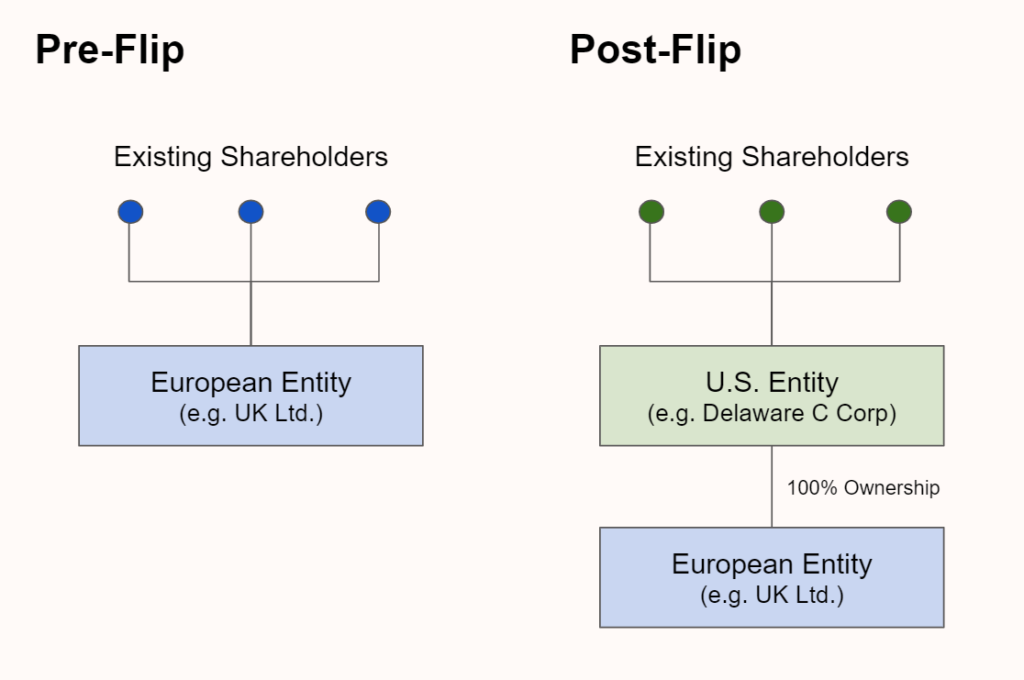
A flip is a shorthand term for a legal reorganization of a startup in the U.S. In practicality, the U.S. entity is almost always a Delaware C Corporation. The flipping process creates a new U.S. entity (i.e. Delaware C Corp) that become a holding company for a foreign entity (i.e. original startup entity). In this process, the shareholders of the original startup entity do a share-for-share exchange with the new U.S. entity. Once completed, the U.S. TopCo fully owns the foreign entity. 

When and why should you consider flipping? 

Founders in conjunction with their board should only pursue a flip when there is a compelling reason to do so. At the early stage, this could be joining a great accelerator program or accepting funding from an early-stage U.S. investor that requires or highly encourages being a U.S. entity. For Sapphire and other sophisticated international VCs, investing in non-U.S. legal structures is not an issue and these firms are experienced in doing so. At the pre-seed to series A stages, smaller U.S. VCs may be restricted by the rules agreed upon with their limited partners or have a strong preference due to comfort to invest in Delaware entities though these behaviors are changing with more U.S. VC interest in the European ecosystem. At the same time, there are great early-stage European VC firms who are more comfortable with and have an easier time investing in their local legal structures. For early-stage startups, the decision can come down to from whom and where the best option for financing is coming from. 

As a startup matures, the time, complexity and cost of executing a flip increases. At the later stages, founders may choose to pursue a flip (or not) based on the trajectory of the business. If the majority of the operations and the potential exit (eg. listing on NYSE / NASDAQ) becomes more U.S. centric, then it may be worthwhile to consider flipping. 

That said, because flipping is a costly process from a financial, resources and time perspective, it is not something that European founders should pursue preemptively. At the early-stage or late-stage, it is always important for a founder (and their board) to have a clear, compelling reason to pursue a flip. 

Practically, how is a flip executed? 

The time and cost of completing a flip can depend on the local jurisdiction and stage of the company. No matter the local jurisdiction though, a flip can be broken down into three key steps: 

  1. Establishing a Delaware C Corp by the current shareholders of the foreign (original) entity 
  2. Exchange 100% of ownership of the foreign (original) entity to the U.S. entity 
  3. Shareholders agree to new legal documentation that matches U.S. style 
What about tax implications? 

The short answer is, yes, there will be some. The long answer is it can get complicated.  Reason being is that the differences across European countries are mostly driven by different tax rules. It is important to consider and weigh the tax implications of completing a flip. Flipping can cause an unexpected tax event for founders and investors. From this perspective, flipping from the UK can be easier than from other European countries. It is best to get expert advice from an experienced lawyer as there can be different creative solutions based on the specific situation. Although tax implications become an important consideration, with expert advice it does not need to become a blocker to flipping.

What can you do to best prepare to flip? 

If a founder is strongly considering flipping the best initial steps to take are:

  1. Start socializing the idea with the board. This way, the board can discuss the compelling reason to flip, seek expert advice and start to discuss the pros and cons. 
  2. Tactically, it can also be helpful to check if there is a drag along clause in the company’s legal documents. If a startup decides to flip, then this clause can help streamline the process with smaller shareholders, though it is rarely used. 
  3. Thirdly, it is best practice to ensure company documents are well organized, executed and clean. This hygiene is important to ensure before and during a flip so that way future investors will not question if a flip was done properly. 
Flipping is Not a Must to Building a Company of Consequence 

Finally, as the European VC ecosystem has matured with a record breaking $20B raised in Q1, we see world-class angels, pre-seed/seed and series A funds that are great at supporting European founders at the early-stage. The belief that in order to be successful a founder has to move to Silicon Valley is long dead and has been disproved many, many times. 

Flipping is not a must to build a company of consequence. In our experience, some of our portfolio companies have flipped and others have not. We continue to believe that global, world-class, visionary companies can be built either way. 


Sapphire & Pendo: Partners in Delighting Users with Better Digital Product Experiences

Pendo was founded in 2013 when former leaders from Rally, Google, Cisco, and Red Hat joined forces to build something they wanted, but never had as product managers—an easy way to understand and act on what truly drives product success. 

“When I founded Pendo, I saw two major trends taking shape. First, it was clear that data was super valuable in terms of the quality of decisions it could inform. And two, data could help guide where to take products in the future. But, it was incredibly hard to get this data, requiring a lot of engineering and manual work,” says Todd Olson, founder and CEO of Pendo.

Meanwhile, a third trend was also beginning to emerge. Companies began to release features faster than ever before, making it difficult for customers to keep up. This exposed a gap for customers, and their user experience, which is the opposite effect any product team and company wants to have. So how could Pendo solve this growing problem?

Pendo understands that the largest and most sustainable differentiator from one app to the next isn’t necessarily based on technical complexity. Rather, the ability for end-users to achieve rapid time-to-value and experience ongoing satisfaction with the product is paramount. At its core, Pendo provides a product adoption platform that improves the user experience with the digital products, apps, and services businesses and consumers use daily.

Early on, here at Sapphire, we believed that Pendo was going to be a company of consequence. That’s why in 2018, we decided to back Todd and the Pendo team by leading the company’s Series D round. Since then, Sapphire has been able to partner with Pendo many times over, delivering useful and valuable services to the Pendo team–from meaningful business introductions to more than half a dozen talent placements, including Pendo’s SVP of Product, Chief People Officer, VC of Talent and the Chief of Staff to the CEO.

“Sapphire’s talent team is the best I’ve ever encountered in the VC ecosystem. They not only bring candidates to the table, but they’re active participants in helping us close key leaders across our business,” says Todd. “Furthermore, they’ve helped us bolster diversity at Pendo, an important area of focus for us, by bringing exceptional female leaders to the company.”

About eight years after its founding, Pendo is transforming how products and apps are being developed and delivered to end-users. Major companies like ADP, Cisco, Salesforce, and many others use Pendo daily to inform product decisions and ensure user expectations are being met. Looking ahead, Pendo is seeing a new opportunity crop up in the area of employee experience. As Todd and the Pendo team continue to help teams understand product effectiveness and success, we’re thrilled to be on this journey together.

We’re so excited that we developed a case study highlighting our work together. Check it out here:

Read the Case Study


Time to Prioritize Preventative Mental Health & Wellness: Why We’re Excited to Back Unmind

“As we enter the next stage in our journey, we’re thrilled to be joined by Andreas and the team at Sapphire Ventures – the shared passion to improve the lives of people around the world was evident as soon as we were introduced. There is an ongoing cultural shift – accelerated by COVID-19 – for organizations around the world to better support and empower their people to live more fulfilling and balanced lives. With the support of Sapphire and our other investors, we’re excited to further scale Unmind’s proactive approach, putting employees in control of how they measure, understand, and nurture their mental wellbeing.” — Founder & CEO, Dr. Nick Taylor

We all understand the concept and importance of mental health. However, for most of us, we’ve been neglecting it our entire lives. Over the past year, the COVID-19 pandemic has only exacerbated these often overlooked and sometimes hidden issues as we are now experiencing elevated levels of stress, anxiety, loneliness and an inability to manage an increasingly strenuous work-life balance. 

Even before the onset of COVID, an estimated 1 in 5 U.S. adults were living with a mental illness, and 1 in 6 employees in the U.K. experienced a mental health issue on a yearly basis, costing U.S. employers $80-100 billion and U.K. employers $45-60 billion per year. All of this due to employee burnout, sick days and presenteeism (coming to work despite poor health and underperforming). One can only imagine what these costs have ballooned to during the pandemic.

While over the past decade the stigma around mental health has been fading as we’ve seen society embrace meditation and mindfulness tools, COVID and its impact has put mental health front and center for organizations. Through our own personal experiences, as well as witnessing the struggles of loved ones and colleagues, here at Sapphire, we believe that mental wellbeing needs to be openly addressed in the workplace and better tools, with preventative care at the core, are needed most.

That’s why, today, we are thrilled to announce our investment in Unmind, alongside our friends at EQT, Project A and Felix Capital. Unmind is a workplace mental health platform that empowers employees to lead more fulfilling and balanced lives. We look forward to supporting co-founder and CEO Dr. Nick Taylor and the entire Unmind team on their journey to improve mental wellbeing in the workplace.

Built on a foundation of preventative, holistic mental health care 

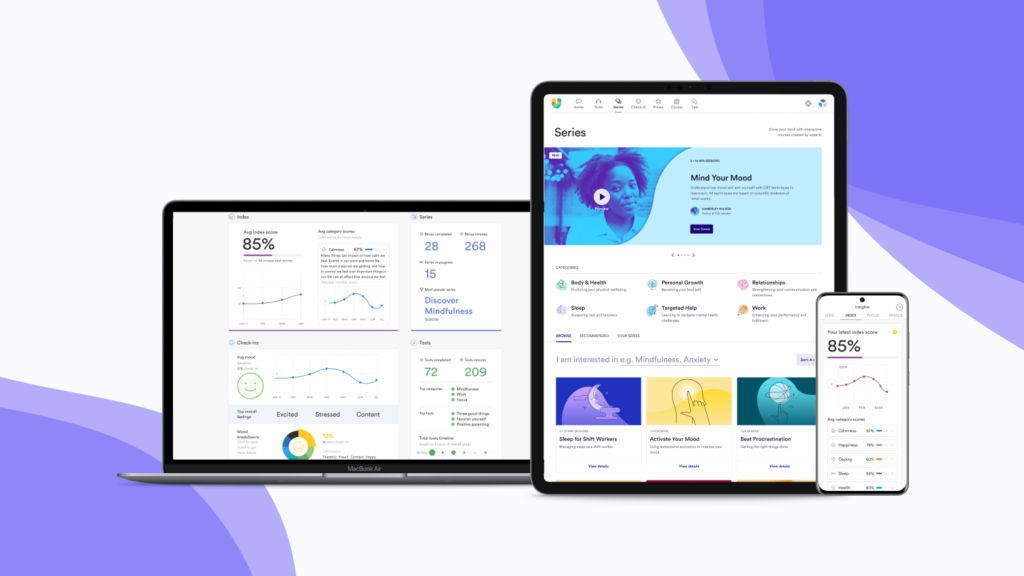
The company provides a B2B2C mental wellbeing platform that empowers employees to proactively measure and manage their mental health holistically through clinically backed assessments, tools, training and integrations to reactive care. On the employer side, organizations are able to analyze aggregated and anonymized data to make informed decisions about their broader human capital strategies, including workplace conditions and how those impact employee mental health.  

The Unmind platform puts prevention at the core of its platform, and we share the belief of the power of preventative mental health care. Deloitte U.K. published an in-depth study looking at the ROI of employer mental health interventions and through this research found that the average ROI is 5:1 for preventative support versus only 3:1 for reactive support. An analogy can be drawn to dental health with preventative health (brushing your teeth 2x a day) being more cost effective versus reactive health (dental procedure or surgery). Similarly, the Unmind platform provides preventative health focused tools to the entire employee base so that they can learn how to proactively manage their mental wellbeing. In the mental health space, Unmind’s platform is uniquely positioned to help employees (and their loved ones through their Plus One Offering) receive the right care at the right time. 

Incredible global traction and an ambitious, mission-led team 

Unmind has seen incredible adoption in Europe, and has expanded to not one but two international markets with people and customers (including Woolworths in ANZ and Uber globally) on the ground in the U.S. and Australia as a result of the platform’s popularity. We look forward to supporting the team’s continued success in the European market out of our recently opened London office and globally. At Sapphire Ventures, we partner with founders building companies of consequence on a global scale and Unmind is exactly that.

Furthermore, we are impressed by Unmind’s world-class team with deep domain experience under the leadership of CEO and co-founder, Dr. Nick Taylor. As a clinical psychologist, Nick witnessed first hand how the traditional approach to managing mental health has failed. As a result, he left the U.K. NHS to start Unmind. Together, with his ambitious and mission-led team, they have incorporated clinically backed research into the product, such as their internally developed mental health benchmarking score, the Unmind Index. We are also excited about the ambitious product roadmap and vision of the team to provide a holistic offering. 

By partnering with Unmind and backing their next phase of growth, Sapphire is excited to continue to build on our long track record of investing in category defining HR Tech and B2B2C companies including investments such as BetterUp, Convercent, Culture Amp and Degreed, and exits such as Jibe, LinkedIn and Livongo.

Sapphire is proud to partner with ambitious teams and companies we believe to be of real consequence. We are humbled by the ambition of the Unmind team to build a truly consequential company to make people’s lives better and are excited to be partners on this journey. 


A Smarter Way to Fight Cybercrime: Why We’re Proud to Lead JupiterOne’s Series B

Fighting against modern-day cyber attacks often feels like a lopsided battle where the perpetrators have the upper-hand due to the sheer proliferation of ways that data, resources and assets can be breached. What’s worse is that this fight occurs in the dark, where businesses have a hard time knowing what they even need to protect. 

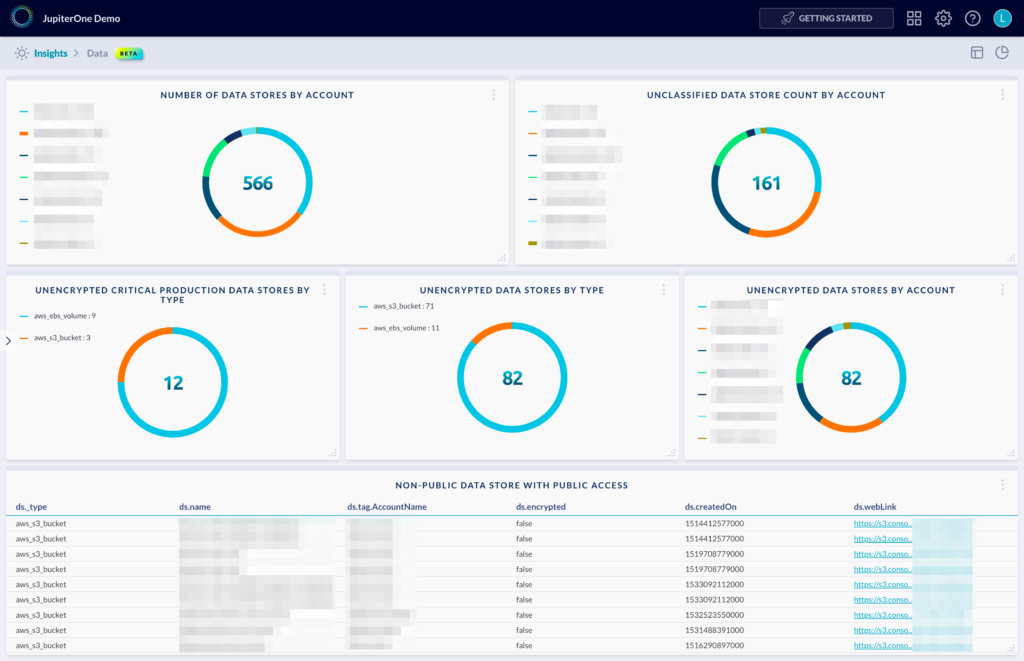
Enter JupiterOne, a startup that aims to shed light on the situation by answering one key question: What do you own, and where are you most at risk from attack? JupiterOne is a cyber asset management company that helps enterprises not only gain visibility into their assets, but also understand the relationships between them. 

Founder and CEO Erkang Zheng and the JupiterOne team are solving this massive problem, and it’s our belief the company will be a genuine game-changer for businesses of all sizes. That’s why Sapphire Ventures couldn’t be more thrilled to back JupiterOne and lead the company’s Series B.

A paradigm shift in cybersecurity 

Traditional asset management tools take a straightforward approach to the problem by focusing on tracking specific, easily definable assets or endpoints in isolation. In comparison, JupiterOne believes securing any enterprise starts by understanding its entire environment. With JupiterOne, there is no limit to the definition of “asset.” Anything, from the infrastructure, to the data, deployed software, IoT devices or even user relationships should all be tracked. And the arduous undertaking of cataloguing and creating a complete inventory is only half the battle.

Without understanding how assets interact, teams don’t see the full security environment, only working with fragmented information that leaves vulnerable blindspots. The second, core piece of JupiterOne’s value proposition is its contextual knowledge base, built on a proprietary graph that specifies relationship mapping between assets. If there’s a breach or vulnerable asset, JupiterOne can trace the extent of any vulnerability to find other affected resources. JupiterOne’s pioneering cyber asset security and governance management ability enables organizations to finally understand exactly where they’re most at risk and how to best counter these threats. This creates an environment where it’s much easier to spot security issues and maintain compliance while swiftly preventing the impact of security lapses and data breaches.

How does JupiterOne do it? They provide a centralized, asset discovery and management engine, which aggregates governance, risk management, compliance, network, endpoint and infrastructure data across an organization’s entire operating environment. These insights are uniquely aligned to security policies, procedures and compliance frameworks to generate a graphical representation of the overall security posture. Resource mapping then automatically detects security gaps for remediation, produces evidence for audits and creates rules for continuous enterprise monitoring to discover relationships and context. This eliminates any guesswork for security operations teams, vulnerability managers and threat hunters.

A novel approach to a huge security problem

JupiterOne is one of the first to solve the almost impossible challenge of tracking an enterprise’s known and unknown assets, and deployments across software, hardware and cloud environments. For any individual organization to maintain asset integrations and consistently update a similar database would be a monumental undertaking, not to mention needing to build out a usable, intuitive graphical interface. JupiterOne has all of this easily at the ready. The company ensures that already overstretched CISOs, security operations and compliance officers don’t have to worry about these complex ongoing manual activities.

By creating a single source of truth of all disparate sources within the enterprise to achieve continuous compliance and optimal protection, JupiterOne maintains its customers’ security hygiene. This is a mission statement that is applicable across industries and speaks to CISOs in all verticals. Ultimately, it’s creating a powerful movement that’s about providing better protection across the whole threat spectrum from mission-critical environments in hospitals that save lives to simply reducing annoying spam emails.

With asset management predicted to become an $8.5 billion market by 2024, we see huge opportunities for JupiterOne.  And with the company’s long-term product vision being the key differentiator, this funding round will help the company maintain a competitive edge against those playing catch up.

A highly experienced security team at the core

Even the best ideas need a team that can execute the big vision. JupiterOne’s founder and CEO, Erkang Zheng is a highly accomplished operator with 16 years of experience in the security space at renowned companies like Fidelity, IBM, Cisco and several others. Erkang is someone who simply attracts brilliant people. 

The arrival of Uber’s CISO, Latha Maripuri to the company’s board of directors, and Sounil Yu, YL Ventures’ former CISO-in-Residence bolster JupiterOne’s already accomplished roster. Maripuri and Yu follow an impressive slew of industry leaders that recently joined JupiterOne’s board of investors including Frederic Kerrest, Executive Vice Chairman, Chief Operating Officer and co-founder of Okta, Sri Viswanath, CTO of Atlassian, Kevin Mandia, CEO of FireEye, and Jason Chan, Vice President of Information Security at Netflix. Adding further prestige to JupiterOne’s investment proposition are its customers, including leading cloud-native organizations such as Databricks, HashiCorp, Addepar, Auth0 and OhMD.

The way we see it, this is just the beginning of our partnership with JupiterOne. We’re looking forward to doing what we can to help the business scale its capabilities across a broader range of industry use cases. For starters, we see opportunities for JupiterOne in cyber governance and compliance management within highly regulated industries and for Legal and IT management teams too. This is an incredible time for Erkang and the JupiterOne team, and we’re thrilled to be on this journey together to make security a basic right for everyone.


On a Mission to Address Every Identity Use Case: Congratulations to Auth0 on Joining Forces with Okta

Earlier this month, Okta signed a definitive agreement to acquire Auth0 in a stock transaction valued at approximately $6.5 billion. Today, the deal closed, and we couldn’t be more excited for Auth0, a Sapphire portfolio company specializing in authenticating, authorizing and securing access for applications, devices and users. This is an extraordinary next step in their journey, and we want to congratulate founders Eugenio Pace (CEO), Matias Woloski (CTO) and the entire team for all they’ve accomplished to-date.

But it’s no less than they deserve. When we first met Eugenio and Matias, we knew they were building a company of consequence. Their hard working and charismatic personalities coupled with the company culture based on the principles of collaboration, experimentation, learning, transparency and passion, which they instilled in the business, makes them one of the most incredible leaders we’ve encountered. Specifically, Eugenio is one of those rare CEOs that has made us better, smarter people, and we’re honored to have worked with him over the last few years. 

How Auth0 simplifies identity management for developers 

Where did it all start though? In 2013, Auth0 was founded with a mission to help companies improve authentication and authorization so that companies’ customers and employees could easily access the information, platforms and resources they needed while also ensuring information and data was safe and secure. 

Over the last several years, the identity and access management IAM industry has exploded due to its growing strategic significance within an evermore digital world that operates across increasingly distributed environments, where ‘identity’ is the unifying means to use and access technology. Today, it’s a critical element of any organization’s security posture because of increased cloud usage, zero trust and digital transformation. And more recently, IAM and Auth0 adoption in particular has skyrocketed during the pandemic with remote work pushing users outside of the enterprise network, retail and entertainment moving to digital. While these factors have accelerated demand, they’re also making delivering effective IAM an increasingly complex task.

Amongst the complexity, Auth0 has emerged as an industry leader, enabling customers such as AMD, Mazda, Pfizer, IKEA and tens of thousand businesses and organizations to solve their identity challenges. The company’s unique IAM technology is designed for developers through an API platform, eliminating the need to create and maintain an authentication codebase or employ multiple identity providers. 

Why we backed the Auth0 

We initially met with Auth0 and Eugenio back in 2016. It was inspiring to see not only their pioneering approach of selling to developers rather than IT, but how they cleverly embraced the growth of APIs as a business model to drive major value in the IAM space. It was clear that their efforts meant that IAM was becoming a highly strategic technology investment. 

We were also excited by Auth0’s rapid growth. They’d already solved complex and large-scale identity use cases for thousands of global customers. So, confident that we’d picked a winner, in 2018 we led a $55 million Series D investment in Auth0. We then led their Series E round a year later and recommitted our belief in Auth0 once again by participating in their Series F

Since then, the company has been fueling the advancement of its universal identity platform, accelerating fresh go-to-market programs and driving global growth. We’ve worked closely with Eugenio and the Auth0 team to evolve its approach to GTM, as well as improve the security, governance and accessibility aspects of its products. We’ve also helped them to think bigger with an ‘enterprise solutions’ focused, mindset. This has generated a much larger footprint across their existing user base representing over 6,000 new global customers and billions of logins secured each month. 

A grand finale to our Auth0 partnership

We’re so proud of Auth0’s management team and their milestone achievement. Eugenio, Matias and everyone at Auth0 have truly built a company of consequence. Their passion and very ‘human’ working culture has enabled them to retain an excellent team that’s maintained its focus while growing so rapidly. 

Auth0 has always been special, and we believe that the future is bright for the company, now as part of Okta. Together, they’ll accelerate their shared vision of enabling everyone to safely use any technology. They have an incredible opportunity to build the identity platform of the future, offering customers workforce and customer identity solutions with exceptional speed, simplicity, security, reliability and scalability. We wish them nothing but success ahead!


Recycling (cropped) - Partners Blog

Fund Recycling Moves the Needle for Both LPs and GPs. Here’s How.

For as powerful of a mechanism as fund recycling can be, we believe it is an under discussed strategy in venture investing. It can transform a good fund into a great fund, and a great fund into an even better one. Often with limited risk, it can boost GP proceeds, LP proceeds and net multiples. Investors ultimately depend on absolute dollars returned (you cannot eat IRR), so we are big fans of maximizing them.

The idea behind recycling is fairly simple. By taking proceeds and re-investing them into companies, GPs can take more shots on goal (in the case of new investments) or capture additional proceeds from existing top-performing portfolio companies (in the case of high potential follow-ons). This allows managers to generate returns on these new dollars and offset the dollars allocated to pay fees, which do not generate any returns. It can be surprising what a big difference there is between the gross multiple on the investments and the net multiple that goes to LPs after fees and carry are deducted, and this can help narrow that gap. Many funds can legally recycle up to 20% but some funds have the capability and aspirations to go even higher.

Fred Wilson recently wrote about how USV routinely uses recycling to boost returns. Brad Feld and Greenspring have discussed how generating a 3x net fund requires a lower gross multiple if you recycle. At Sapphire Partners, we love taking a quantitative approach. To better illustrate how recycling can significantly alter the equation, we put together a simplified analysis to understand the magnitude of impact recycling can have on a fund.

Spoiler: it’s pretty big! 

The Premise

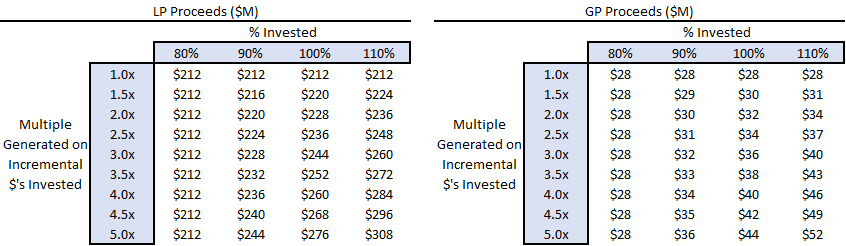
Let’s assume a $100M fund for simplicity. $20M of this fund is paid in fees, and the GP generates a very solid 3x gross multiple on the $80M remainder invested in companies. However this only equates to a 2.1x net return at the fund level due to the fees and carry with $240M in total distributions, of which $212M go to the LPs and $28M to the GP. 

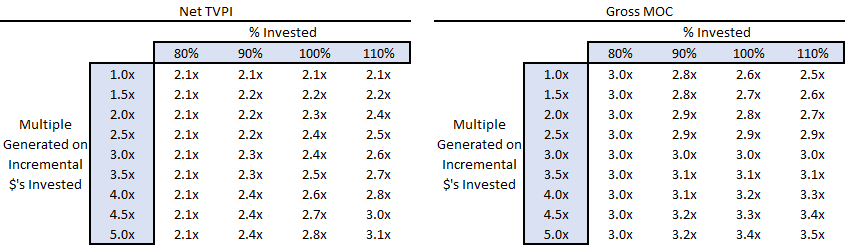
What happens to proceeds and net/gross returns (TVPI/Gross MOC) if this GP uses recycling? Here’s what things look like if the GP recycles between 0% to 30% of the fund, reaching 80-110% invested, and generates 1-5x gross returns on those recycled dollars:

LP & GP Proceeds and Returns Sensitivity Based on Recycled Dollars


Above are various combinations of outcomes, but here are three scenarios to better illustrate the possibilities

Scenario 1: Knock it out of the Park with a High Multiple

The aspirational scenario is a fund reaching fully invested (100%) and generating a high return on those additional dollars. This augments total proceeds and improves both fund level metrics. Let’s say our GP recycles and reaches 100% invested and generates a 5x on those additional investments: LP proceeds grow from $212M to $276M, GP proceeds grow from $28M to $44M, net returns increase from 2.1x to 2.8x, and gross returns from 3.0x to 3.4x. Those are big differences!

Scenario 2: Recycling with Comparable Outcomes Generates Base Case Returns

A solid recycling scenario could mean a fund reaching fully invested (100%) while generating 3x returns (recycled dollars match returns from the rest of the portfolio). In this scenario, LP proceeds grow from $212M to $244M, GP proceeds grow from $28M to $36M, net returns increase from 2.1x to 2.4x, and gross returns remain at 3.0x.

Scenario 3: Recycling but with Lower Returns 

It may be that a GP recycles funds but the incremental investment doesn’t yield high returns. If a GP reaches 100% invested in a fund but only generates 1.5x on the recycled dollars (not a great multiple by early stage venture standards), it still boosts LP proceeds from $212M to $220M, GP proceeds from $28M to $30M, and the net multiple from 2.1x to 2.2x. Note: the gross multiple goes down as the incremental dollars generated a lower return than the rest of the fund. In this scenario, the gross declines from 3.0x to 2.7x. We at Sapphire benchmark returns on net multiple (which is true of most LPs), so even with the gross multiple decreasing, the fund benefits from the increase in net multiple.

Sounds Great, So Why Not Recycle All the Time?

Unsurprisingly, the best case scenario is for a fund to recycle the most and achieve the highest possible multiple on the recycled capital (shocking!), but a key takeaway here is that modest recycling can still have substantial impact on proceeds and net returns, as long as recycled money at least returns capital. 

In these scenarios, proceeds for both LPs and GPs go up and the net multiple significantly  appreciates. In Scenario 2, the net jumps from 2.1x to 2.4x, which meaningfully narrows the gap between gross and net (formerly 3.0x and 2.1x) and could push a fund closer (or into!) the top quartile. A 2.5x multiple would have put this fund in the top quartile 15 out of the last 24 years according to Cambridge. So, the closer this fund can get to 2.5x, the better it will look when compared with vintage year peers. We underwrite Series A funds to generate a 3.0x net or above, so from our point of view, any increase in the net multiple helps underwrite the fund from an LP perspective. 

If recycling feels so obvious, why doesn’t everyone do it? 

  • It’s simple, but you need early exits to have available dollars to recycle. No liquidity means no recycling. This has become increasingly challenging, as GPs are investing in tighter timeframes with fewer early liquidity events. And, as Fred says, you don’t want to sell your big winner early – venture is truly a power law business and if you sell your fund driver(s) early, the returns for the entire fund can suffer. However, if you have a portfolio of, say, 20 investments, odds are there will be a company that exits early because it’s on fire. Or the entrepreneur is done with the journey. Or it doesn’t work but still finds a happy home. Boom, now a GP has dollars for recycling.
  • There is a time value of money (or IRR impact) which our deliberately simple analysis glosses over entirely. Extending the fund life can decrease the IRR. We, and many other institutions, care mostly about net multiples, but not all LPs are the same. And we at Sapphire *do* still look at IRRs.
  • Most cynically, fees taper off as fund lives extend. If a GP is optimizing for carry there is a clear benefit to recycling, but if he or she is more driven by fees, there is a rationale for starting up a new fund earlier rather than elongating an older vintage.

Recycling: The Bottom Line

Fund recycling is a tool that can greatly benefit both LPs and GPs, and we love areas of GP<>LP alignment! It’s important to have plans in place to recycle, and GPs should incorporate recycling into the fund model and legal documents right at the outset. If you don’t have those aspirations, it won’t happen. The resulting increased net multiple can help strengthen a track record and bolster a GP track record for fundraising in the future. 

Sapphire both talks to our managers about recycling and practices it in house. As direct investors, Sapphire Growth has focused on getting to 100%+ of invested since inception. With an explicit focus on being “long-term greedy,” Sapphire CEO and Partner, Nino Marakovic, explains, “recycling boosts LP returns, which gives us an opportunity to do what we love to do for longer.” 

We love geeking out about fund management, and would love to hear other perspectives on fund recycling or different techniques GPs have used to reach fully invested or beyond! Below is a downloadable version of the simplified model for you to adjust the fund size or fees to match your own fund more closely.  

Access Downloadable Model

Click here to access our downloadable recycling model. The inputs (fund size, fee, fund life, carry, and return on investable capital) can be adjusted to test how gross and net returns are impacted based on the various levers. 

Happy recycling!


What is the Open Data Ecosystem and Why it’s Here To Stay

How today’s open data ecosystem companies are bringing the Big Data promise to life

Today’s companies are collecting massive amounts of data to better understand their customers and to make better, more informed business decisions. Frequently, all of this data resides across dozens, sometimes thousands of different sources and in multiple formats, both structured and unstructured. Connecting all of this data and making sense of it is a massive and highly complicated task, but it’s essential. To be successful, companies have to be able to connect the dots across varied data sources and data types. Only then can they realize insights and take meaningful action.

Over the past decade, a series of technologies have come on the scene promising to solve this problem. Led by the Hadoop movement, it first began in the mid-2000s when products and companies started sprouting up, creating an open data ecosystem. This movement towards composable technologies (oftentimes open source, but not necessarily) that integrate with APIs and run on commoditized hardware challenged the status quo of monolithic, interdependent architecture in a big way. By adopting an open, distributed approach on commoditized hardware, these companies challenged the traditional setup of storing and processing data in proprietary, centralized data warehouses. But ultimately, these solutions under-achieved their grandiose promise because they became unwieldy, difficult to manage and economically unscalable. 

More recently, we’ve witnessed the revival of the open data ecosystem. Due to the rise of the cloud, a proliferation of open-source data formats and the arrival of vendors solving for earlier pain points, we’ve seen a new breed of open data ecosystem companies emerge and grow in popularity. These new solutions are able to capture the full scope of data that resides within a company, enabling teams to leverage the data to its full advantage.

At Sapphire Ventures, we’ve been investing in a range of enterprise technology companies spanning data, analytics, AI, open source, DevOps, security and more for more than a decade. Having met with hundreds of companies across these industries over the years, we’d like to think we know these areas well. And it’s our belief that open data ecosystem companies are now perfectly in the right place at the right time. 

Big Data and the Birth of the Open Data Ecosystem

For decades, companies relied on traditional databases or warehouses, a mostly proprietary, centralized repository where structured data was stored and processed. The traditional data warehouse system required buying pricey on-premises hardware, maintaining structured data in proprietary formats and relying on a centralized data and IT department to deliver analysis. 

This system — a RDBMS or traditional data warehouse — worked while enterprises collected a modest amount of structured data. But in the mid-2000s, companies like Google ran into challenges with this model. As pioneers in the internet economy, they had to process more raw data than anyone had before, a meaningful amount of which in non-relational format. Google is just one example of a large corporation that needed a place to centrally process structured data (e.g., relational tables), semi-structured data (e.g., logs) and unstructured data (e.g. videos and photos). 

At the time, there was no supercomputer big enough for this task. So to keep up, Google wired an ever-expanding number of computers together into a fleet. Eventually, this computing infrastructure grew so big that hardware failures became inevitable, and each programmer had to figure out how to handle them individually. To address these challenges, MapReduce, which could process parallely and generate huge data sets over large clusters of commoditized hardware, was born. As The New Yorker put it, they created “a tool that any programmer at Google could use to wield the machines in its data centers as if they were a single, planet-size computer.” One computation could process terabytes of data across thousands of machines, and coders across the company could use the software to draw insights from Google’s large cache of data. It was such a sight to see that Jeffery Dean and Sanjay Ghemawatpublicized their efforts in a 2004 paper titled MapReduce: Simplified Data Processing on Large Clusters.

This famous paper kicked off what we’ll call the first-generation of the open data ecosystem and its first incarnation, Apache Hadoop. Hadoop came to be when the paper caught the attention of two engineers who were working on an open-source web search engine. The duo was so inspired by MapReduce that  they then built a free tool, which they released in 2006. The tool is known as Hadoop, which evolved into a collection of open source projects, which served a significant role in bringing open source from academia to the mainstream. The open-source framework allowed anyone to process massive datasets distributed across computer clusters, making it a hugely attractive option for enterprises, which were collecting more data by the day. 

Now able to collect and analyze huge amounts of raw data, companies turned to cheaper storage in data lakes, which are large pools of structured, semi-structured and unstructured data. Venture-backed companies like Cloudera, Hortonworks and MapR emerged to make Hadoop more accessible to enterprises, which resulted in many of the world’s largest companies adopting Hadoop. Taken together, Hadoop-based data lakes created the first iteration of the open data ecosystem, bringing to life the real promise of Big Data. 

A False Start: Why Hadoop Under-Achieved

Despite its scalability and flexibility at the time, the first generation of the open data ecosystem didn’t achieve the grandiose goals it had laid out. To keep it simple, here are three reasons why Hadoop and the first generation ecosystem fell short:

1. Hadoop was too complex

Hadoop’s philosophy was to integrate as many technologies as possible, trading flexibility, breadth of functionality, and interoperability for simplicity and cost effectiveness. But ultimately, Hadoop was too complex and notoriously difficult for end users to understand and operate. It also required a heavy, IT-centric implementation (needing a large amount of nodes to be effective), so it wasn’t lightweight enough for end users to download for a specific case. Another key challenge for Hadoop was that it was being used for too many things beyond its original intent (ex. interactive analytics wasn’t well supported).  Newly formed big data teams measured their success by volume of data stored, not utilized. Adding to all this was that related VC-backed startups like Cloudera and Hortonworks each tried to address everything on the data stack, dragging the open source project in different directions. 

2. Difficult to make sense of the data 

In a traditional data warehouse, companies carefully modeled their data, defining where information was stored, which was valuable in how it all connected. The process was time-consuming and inefficient (oftentimes taking months and hampered efficiency), but it put structure to data. Hadoop opened up the possibility of indiscriminately dumping data into HDFS and worrying about schema, consumption and management later. With Hadoop, companies could haphazardly dump data into a data lake. Companies would race to collect more and more data, but they weren’t considering architecture design around access, analytics or sustainability. It became difficult for companies to know what was in their data lake and where it came from. And they certainly weren’t able to extract value from it. With tools that could address this problem yet to emerge, businesses collected tons of data, but lacked confidence in consumption. In the end, data lakes turned into data swamps.

3. The economics didn’t work

A few years after Hadoop came on the scene, cloud computing took off in a big way. The cloud made it easier for companies to store data inexpensively on S3, ADLS and GCS, and use services for data governance and management.  Meanwhile, Hadoop was still being used for primarily on-prem use cases, and had to be sold and upgraded regularly by centralized IT teams. Expanding capacity meant buying more hardware, requiring up-front investments and months of planning and deployment. The economics became untenable in the age of the cloud. 

After all was said and done, the draw of the first generation open data ecosystem became its downfall: Freedom became a free-for-all. 

The Open Data Ecosystem Reimagined: You Can Have Your Cake and Eat it Too

Although Hadoop underachieved its promise, the open data ecosystem movement it started (as well as a number of related open source projects such as Apache Spark) is alive and enduring. Its ethos is defined by the following principles:

  • Openness: A shift toward open technologies and data standards, as well as interoperability, instead of being locked in with a single proprietary vendor.
  • Modularity: A move toward a disaggregated software stack rather than monolithic architecture.
  • Diversity: A reliance on a variety of dedicated tools for different use cases, with diverse vendors that compete to drive value for customers.

Along with these principles that are driving an ever-evolving set of open data technologies, a number of key forces have driven the resurgence of the open data ecosystem. With more predictable performance and elasticity in the cloud, query acceleration tech and open source formats that avoid data copies, and better oversight of data contents through associated tech like data governance, you can now have your cake (storing massive amounts of data in open formats elastically) and eat it too (run associated business analytics + AI/ML workloads directly). 

At a higher level, for CIOs and CDOs, if data technologies evolve as they inevitably do, going with a data stack with open standards and open source technologies makes your approach to data that much more future proof. Broadly, we think there are four main trends that make today’s Open Data Ecosystem easier to adopt.

1. The rise of the cloud data lake 

Thanks to services like Amazon S3, Azure Data Lake Storage (ADLS) and Google Cloud Storage (GCS), companies can house structured and unstructured data at scale in cloud-native data lakes. This eliminates the need for expensive, monolithic hardware and enables organizations to scale data volume without associated management overhead. In addition, the storage costs in the cloud continue to drop. As a result, these storage services have become the default landing zones in the cloud, and are often considered the systems of record. Cloud, with its scale and diversity, inherently encourages disaggregation into best of breed, nimble services. Cloud data warehouses, such as Snowflake (a Sapphire investment at IPO), AWS Redshift, and Google BigQuery, while not inherently open, have also tremendously helped bring data to the cloud.

2. Adoption of open-source data formats

More companies are adopting open data formats, such as Apache Parquet (columnar data storage), Apache Arrow (memory format for analytics, artificial intelligence and machine learning) and Apache Iceberg (table format/transaction layer). This makes data more compatible across various programming languages and implementations—including tools that don’t exist yet—rather than depending on a specific tool or vendor, with all the main cloud data lakes supporting these open data formats interoperably. 

3. Emergence of cloud-based vendors to support the open data ecosystem

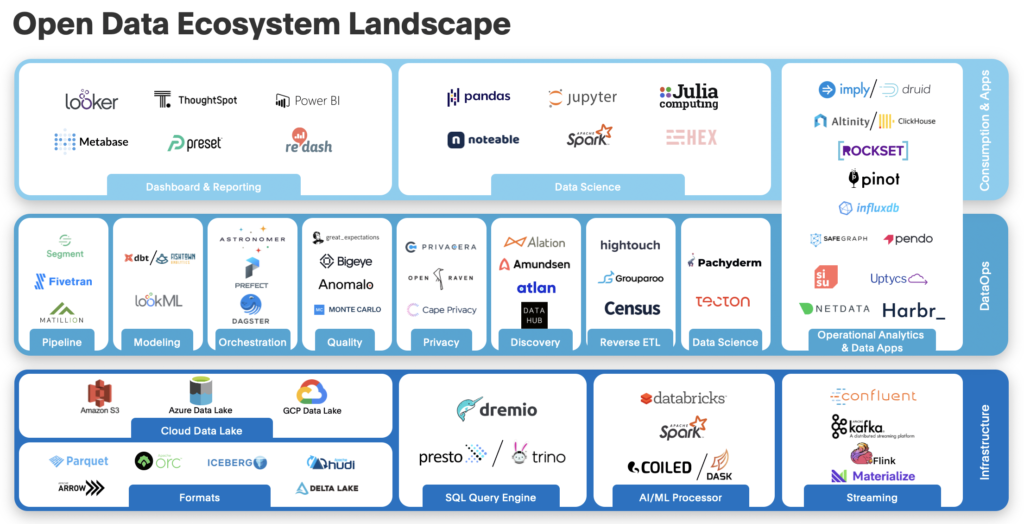
A diverse set of vendors are solving the problems that once plagued Hadoop and the first-generation open data ecosystem, helping make cloud data lakes more manageable. Whereas Hadoop system management was overly complex for users, today’s vendors offer to handle this piece for customers, who can then focus on core business features. Whereas first gen systems still required large capital outlays for on-prem compute and storage, Cloud eliminates the need for expensive hardware to house data lakes, and instead enables resource-based pricing so companies pay based on how much they use the technology. Moreover, tools have popped up that help users manage every aspect of their cloud data lakes: 

  • Running SQL queries directly in a cloud data lake (Dremio*, Trino/Presto)
  • Ingesting data and writing it into open formats (Segment**, Matillion*) 
  • Streaming in data (Confluent, Materialize)
  • Transforming data (Looker**, dbt from Fishtown Analytics)
  • Improving observability and quality (Great Expectations, BigEye, Anomalo, Monte Carlo)
  • Establishing a governance framework (Privacera*, Alation*)
  • Syncing data to operational systems (Hightouch, Census, Grouparoo)
  • Handling orchestration (Airflow, Prefect, Dagster)
  • Providing a flexible and powerful consumption layer for end users (ThoughtSpot*, Looker**)

4. Meet the end user at the right abstraction level

At the end user level,  new developments in the open data ecosystem allow data analysts, scientists and business users to do their work at the abstraction level they like. These data users have little interest in what happens underneath the hood and aren’t too concerned about the associated work such as manual schema changes, resource provisioning, database management and so on required in the first-gen open data ecosystem. Conversely, many vertically integrated tools are at a too high of a level when it comes to abstraction. Many of the “user-friendly,” GUI-focused tools from the prior era don’t provide enough flexibility and depth when the end user wants to go one layer deeper.

While the landscape is still rapidly evolving, tools today are designed with abstraction in mind and help the open data ecosystem meet end users exactly where they are in their needs.
Why We’re Bullish on the Modern Open Data Ecosystem

Just as the ascent of cloud has enabled the new open data ecosystem to flourish, it has also fueled the rise of proprietary cloud data warehouses such as Snowflake (a Sapphire investment made at IPO), which has taken an outsized share as businesses move initial subset(s) of data onto the cloud. Some have argued that Snowflake’s approach, a single cloud data warehouse encompassing every workload, is the only path forward. 

At Sapphire, we believe that the cloud data warehouse and cloud data lake will coexist, and data pipelines will often move data around and between the two. As with nearly all things in technology, there’s no single panacea and the real world answer is far more complicated. Nevertheless, over time, just as application development has been shifting from monolithic architectures to microservices-based architectures, we’ll likely see data analytics workloads gradually shift from proprietary data warehouses to open data architectures. That’s why we’ve made bets on companies in the open data ecosystem like Dremio, Privacera, Alation, ThoughtSpot, Segment and Looker. 

We’re excited about the modern-day open data ecosystem because it comes with numerous benefits for customers:

  • Cost-effectiveness: Cloud data lakes offer the least expensive way to store data today. There is no need to spend time or resources transforming data in order to store or analyze it.
  • Scalability: Companies can easily scale their use of the technology, benefitting from the true separation of compute and storage
  • Choice: Customers aren’t locked in with a single vendor who can set prices and terms. They can take advantage of the best-in-class or highest-value options for specific use cases. Most tools are open-source or SaaS and thus easy to connect and operate. 
  • Democratization: Anyone can access a company’s data through their preferred framework, without having to use a specific tool or format. That means data analysts, data scientists, application developers and others can efficiently make the most of the data. 
  • Flexibility: Customers can use their choice of processing engines (Spark, Dask, Dremio, etc.) and store data in any format they want. This is critical for enterprises that have dated, on-premises storage systems that are difficult and costly to move entirely to the cloud. 

Going forward, we believe companies will turn to both cloud data warehouses and cloud data lakes to serve different needs and derive value from their data for a long time to come. This time, the open data ecosystem isn’t going anywhere. 

*Current Sapphire investments

**Exited Sapphire investments

Thanks to Abe Gong, Balaji Ganesan, Casey Aylward, Colin Zima, Justin Borgman, Justin Gage, Kevin Xu, Tomer Shiran, Tristan Handy, Seann Gardiner, Shomik Ghosh, Slater Stich, Victor Chang and Viral Shah for your feedback. And shout out to my Sapphire colleagues Anders Ranum, David Hartwig, Jai Das and Nino Marakovic for reading drafts of this.


A Startup’s Guide for Opening European Operations

For many startups, the idea of European expansion aligns with a long-term revenue growth strategy. Serving approximately 775M people and nearly $23T in GDP, many companies cite the region as the second largest revenue generator. But making that first leap into Europe can be a daunting task, which involves careful planning, insider knowledge and a heavy investment.

Knowing the European market is also knowing that there is no such thing as the European market. The continent boasts 22 different official languages and can be divided into distinct regions based on political and economic alliances, such as DACH, Benelux, UKI and more. Europe is a unique region in that it is divided into an astonishing number of cultures. Each of these cultures often has their own business practices, nuances, language and more,  requiring different perspectives and significant effort. 

As Andy Champion, General Manager of EMEA for Highspot says, “Europe is a complex mix of markets that vary in size, sophistication, and buyer journeys. Some markets will support a remote sales motion, while others will demand physical presence. Adjusting your Go-to-Market is critical to maximize efficient growth.”

The average start-up expands to Europe between their Series B and C rounds. Knowing how to tackle Europe and the surrounding regions is key to success for those startups that have done this before. For a startup that’s looking to expand into Europe, there are many questions to be answered first:

  • Where should the HQ be? 
  • What will our landing team look like? 
  • Does our product need localization? 
  • How big is the addressable market? 
  • What are our biggest product challenges?

All of these are key questions that need to be addressed in order to put together a cohesive plan for success. To help startup CEOs answer these questions, we’ve created The European Expansion Playbook: Volume 1

In our just released playbook, we focus on opening up operations in Europe. We spoke to several consultants, executives, and experts from our network, including many leaders across our portfolio companies, to understand the key challenges a non-European based company will face. From bank accounts to recruitment, our aim is to guide you in the decision making process and lend a hand in landing in the European market.

Download the The European Expansion Playbook: Volume 1

And don’t miss the upcoming webinar on May 4th at 10am PT featuring from CCW solutions and OpsRamp to discuss how they expanded their operations into Europe, lessons learned, what they wish they could do differently, how geo-political changes impact the region, and tips and tricks for your expansion planning.

Attend the webinar: The Startup’s Guide to Opening European Operations


Reimagining the Workforce Upskilling Experience: Why We’re Excited to Co-Lead Degreed’s Series D

“At Degreed, we’ve always selected investor partners who are great humans, deeply understand our space and believe in our mission. Kevin and the Sapphire team embody that profile. Kevin has been a true believer in what the business can become since day one, and he breaks the mold in what you look for from a true partner to the business and all of its stakeholders. Furthermore, Sapphire has been delivering on the promise of adding value for years, even pre-investment. It’s a VC that we feel is uniquely positioned to open doors to our Global 2000 customers and I’m excited to call them partners.” — CEO, Chris McCarthy

“The only thing worse than training employees and losing them is to not train them and keep them,” said Zig Ziglar, a best-selling American author and speaker who uplifted millions with his motivational messages. This fundamental shift in thinking sparked a major transformation in the way employers view their employees. It was also the catalyst for the creation of the learning and people teams we see today, which are dedicated to upskilling their workforce and progressing employee careers. 

Now, in the age of the empowered employee where workforces expect companies to provide them with learning and development opportunities (and managers see the benefits of doing so), companies of all sizes are allocating resources to help employees grow in their careers and learn the skills they need to be successful. 

But employees don’t always know where to start, what content is available to them or how to most effectively accomplish a desired goal. Enter Degreed. With a bold goal to make skills not credentials the currency of work, Degreed was founded on the core tenet that everyone has a unique learning opportunity that goes beyond a qualification or static piece of paper. 

Degreed is built on peoples’ innate drive to learn, grow, advance and improve themselves by giving them the tools and skills they need to progress—degree by degree. That’s why Sapphire Ventures couldn’t be more thrilled to back Degreed and co-lead the company’s $153 million Series D round.  

A new era of management

Chris McCarthy, CEO, Degreed

Degreed has been one of our longest relationships with a business, starting six years ago with founder David Blake and continuing on with CEO Chris McCarthy, Kat Kennedy (President and Chief Experience Officer), Nathan Kimmons (Chief Operating Officer) and the rest of the Degreed team. At Sapphire, we’ve been increasingly amazed at the opportunity in front of Degreed and by the team’s continued execution over the better part of a decade. Today, Degreed employs over 500 people and supports hundreds of customers in 27 countries around the world. 

As Degreed moves into its latest stage of growth, we are extremely excited as Chris passes the CEO mantle onto Dan Levin. Dan is a recognized and experienced executive who is well-known to Sapphire, having been the COO & President of Box (a former Sapphire portfolio company) for over 10 years. It doesn’t surprise us that Dan immediately recognized the tremendous opportunity with Degreed to continue to build a company that is reimagining the employee learning experience and is making a real difference in people’s lives. We believe Dan will continue to build upon Chris and David Blake’s legacies and lead Degreed into rare air as a generation-defining business.

Personalized learning experiences for all employees

Organizations are under pressure from their employees, and in particular, a newer generation of workers. The latest generation to hit the workforce, Gen-Z, demands greater opportunity and personalization in how they navigate their career, with access to tools and like minded employers who share in their desire to develop within the employee base. 

Traditional Learning Management Systems (LMS) solutions aren’t meeting this heighted bar, creating demand for an emerging Learning Experience Platform (LXP) layer where employees can grow their skill sets through better, customized, learning experiences. With an LXP, employees have the opportunity to take more control of their desired learning path in conjunction with their employer to create a more satisfying, fulfilling and most importantly, productive workforce.  

What makes Degreed so special

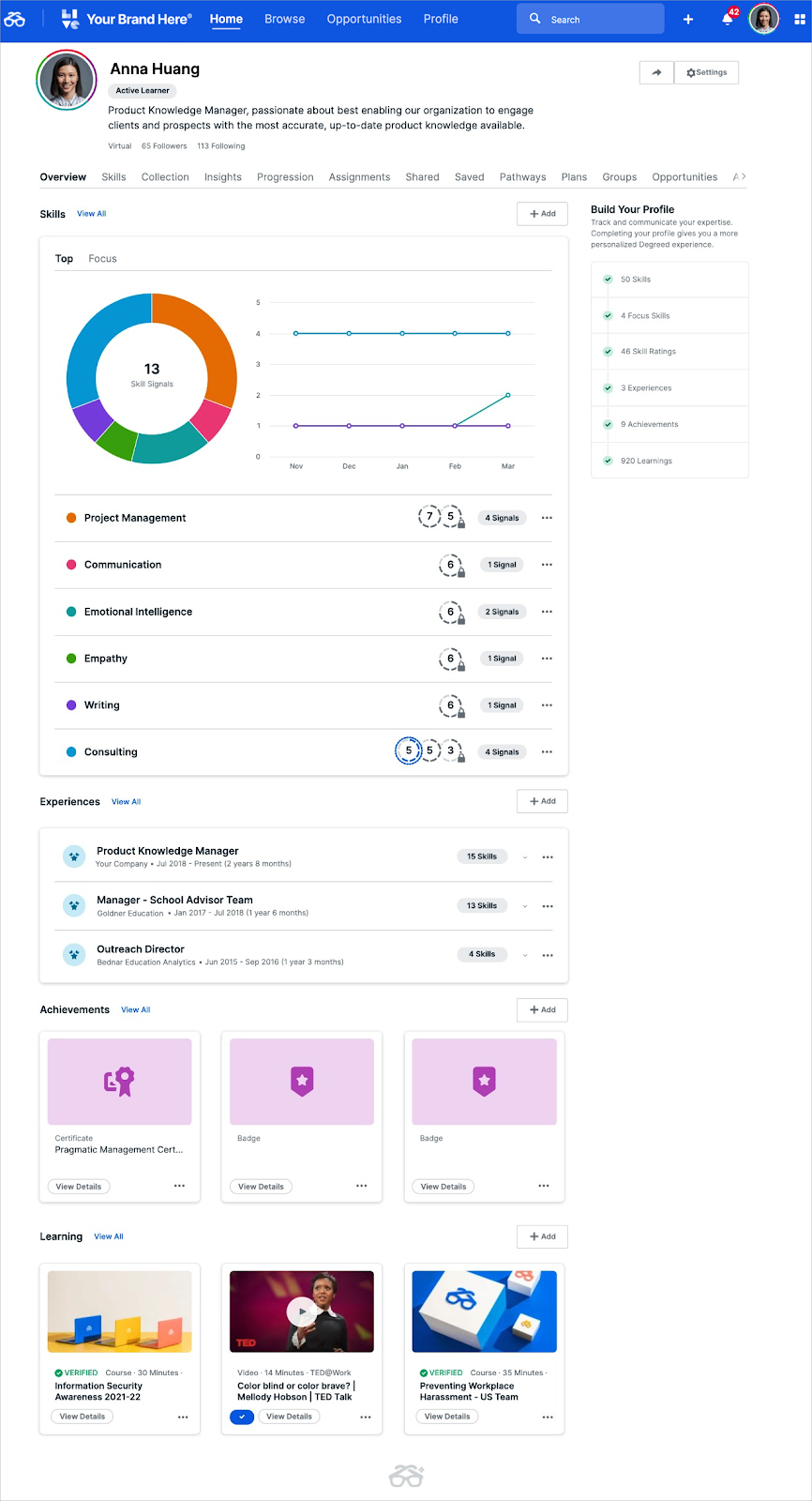
Founded in 2012, Degreed is a single-view platform that acts as a portal to the next step in an employee’s career. Degreed drives skill development and internal mobility by suggesting curated and individualized training journeys, as well as skills paths based on predictive and prescriptive analytics.

Sitting on top of a LMS and curating content from multiple sources, the Degreed platform adopts an agnostic approach to suggesting learning content. This freedom and flexibility is then combined with a powerful analytics layer, which gives management the oversight to identify what employees are engaging with, making it easy to allocate budget to popular content providers with just a few clicks.  

The insights and analytics within the Degreed platform introduce a unique and powerful layer to employees’ learning journey. By gathering vast amounts of data about the content being consumed and capturing information about the outcomes for employees who have completed their training, Degreed is able to identify what works and what doesn’t for every single employee. The platform is fully adaptive too, meaning that every person’s skill path is totally unique and is tailored to suit their learning style. Degreed also evolves along the way as employee preferences shift. 

The aggregation of content, additional analytics and personalization into a single, unified layer marks the creation of a new LXP category, which Degreed created and is at the forefront for. The evolution of this market prompted Gartner to introduce a whole new category within the Corporate Learning Suites sector, and Degreed has been a leader in the Magic Quadrant ever since it acquired Pathgather.

Providing the skills for tomorrow’s workforce

Sapphire is proud to work with and invest in companies that we believe to be of real consequence and that will change the world for the better. Degreed is the embodiment of our philosophy and its values align so closely to ours that we couldn’t be more excited to be partners on this journey.

Degreed’s commitment to personalized learning experiences and its agnostic approach to the educational and training content it delivers, ensures that its users build the skills they need, in the way they want. This makes for a more effective workforce, ultimately leading to a better bottom line for businesses.

For organizations looking to foster a powerful learning culture and upskill their workforce, it’s our belief that Degreed is an essential tool they can’t afford to be without.


The Rise of AB”X” and the RevTech Revolution: Why We’re Backing 6sense

Account-Based Marketing (ABM) is a term that has been thrown around in B2B tech circles for several years now, but it doesn’t quite capture the breadth of what go-to-market (GTM) teams really need in order to drive revenue lift. We’re excited to partner with 6sense, a visionary company that’s driving the RevTech category by shifting the narrative away from ABM to Account-Based Everything (ABX). Our market and customer research revealed that buyers now expect a platform that provides account insights, orchestration and engagement across not only marketing, but all customer-facing teams.

The crux of ABX is to provide customer-facing teams with data and insights that drive timely and personalized engagement with prospect or customer accounts. By adopting ABX, marketing can now home in on the accounts that fit their ideal customer profile (ICP) and determine the best way to engage these accounts based on a data-driven assessment of intent to buy. Sales can finally stop wasting time with accounts that were never going to make a purchase and focus on those showing the highest intent. And customer success teams can focus their time, efforts and campaigns on accounts displaying a higher propensity to purchase more.

6sense: Lighting up the “Dark Funnel”

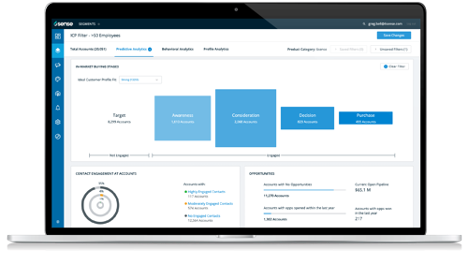
6sense’s ABX platform analyzes data from a variety of first-party and third-party sources to identify accounts, determines how closely these accounts fit the user’s ICP and pinpoints exactly where these accounts are in the buyer journey. No company knows the entire universe of accounts that could find their products useful, but 6sense can light up this “dark funnel” by not only identifying unknown accounts, but also predicting their readiness to purchase.

The whole point of ABX is cross-functional GTM alignment, and no company does this better than 6sense with its CRM integrations that enable sales teams to easily access an account’s behavioral history and intent data. Sales teams also benefit from 6sense’s Next Best Action recommendations, which show the best contacts to engage with next, key talking points and new contacts to uncover.

Orchestrating the Full GTM Strategy

6sense’s technology already delivers significant value by lighting up the dark funnel, but what gets us most excited is 6sense’s focus on closing the gap between account insights and GTM execution. Through integrations with sales engagement providers like Outreach (a Sapphire investment) and marketing automation vendors like Marketo, 6sense’s customers can trigger various types of engagement activities based on an account’s stage in the buyer journey using messaging and content personalized for the prospect. The possibilities are endless, and 6sense continues to raise the bar with the launch of its 6signal Graph to embed insights natively within the sales and marketing software GTM teams already use.

An Experienced Team Relentlessly Focused on Execution

We first met 6sense in 2015 and could tell the founding team was onto something special with its unique 

technology they had built to shed light on the buyer journey. When Jason Zintak joined in 2017 as CEO, he brought world-class operating expertise that has transformed 6sense into the category leader in ABX and helped drive the broader RevTech category. We believe 6sense is the central nervous system of the B2B GTM tech stack. And we are thrilled to officially join the 6sense family on their mission to help GTM teams drive revenue.