No Going Back Now: 10 Enterprise Tech Trends Taking Shape in 2021

Driven entirely by COVID-19, 2020 was the strangest and most unique year of our lifetimes. By June, 42% of U.S. employees were working remotely full-time, according to Stanford economists. That’s almost half of the American population forced to work-from-home. Many companies weren’t well-equipped to handle the transition, and for those that were, the demand on remote systems and tools skyrocketed. 

In an effort for companies to enable a fully distributed workforce, deliver better customer service, update cybersecurity protocols and more, almost overnight, companies across all industries accelerated their digitization initiatives. McKinsey estimates that five years of business digital adoption was compressed into a period of eight weeks. 

All of this is to say that COVID has triggered massive trends to take shape in the enterprise technology landscape, and there’s no going back. Our needs have permanently shifted. Federal Reserve Chair Jerome Powell recently acknowledged that fact, stating that “we’re going back to a different economy” even after the pandemic winds down.

As companies have ramped up digitization, the pandemic caused a lopsided recession. Certain industries like those focused on collaboration, customer service, digital payments and food delivery platforms have boomed. While others have had to completely rethink their business models. As of last month, Shopify’s year-to-date return was $194%, Zoom’s an impressive 507% and Slack was recently acquired by Salesforce for $27.7 billion.  

At Sapphire Ventures, we like to think that we’re clued into top tech trends and startups. And we’ve spent the past year working alongside dozens of companies that have mobilized to meet the challenge of this pandemic and its outcomes, giving us a close view into promising trends for a post-COVID economy. Here are the 10 trends we believe will make a mark on the enterprise technology space in 2021 and long thereafter.

1. The physical workplace will be reimagined and new ways to measure employee productivity and wellness will emerge

When Slack surveyed 3,000 knowledge workers in the U.S. on their attitudes towards remote work, only 12% said they want to return to the office full-time, and 72% said they want a hybrid office-remote working life. While that means a lot less orientation around the office than before, it’s clear that employees still want places where they can get together. They want a home base and the opportunity to meet in person for team events, off-sites, all-hands and so on. And for strategic cases where there are teams that need to work in person, they’ll be able to have a place to gather. The net-net is that offices will be more about collaboration and teamwork than working in a silo.

Another workplace trend that’s taking off is centered around workplace analytics and happiness. The move towards remote work caused companies to take a closer look at how their employees spend their time, and make sure that they’re happy with the work they’re doing. Our current investments in ActivTrak, Brightfield and CultureAmp play in these categories. ActivTrak measures how employees are working and where they spend their time. Brightfield helps businesses manage human capital with the power of data analytics. And CultureAmp analyzes employee happiness and morale. Only happy and productive employees build, sell and support great products, which in turn drives customer success and revenue growth.

2. Zoom is becoming a Salesforce-like platform with new startups launching around it 

In the era of the cloud, building services and products on top of big platforms that you don’t own is going to be increasingly normalized. We’ve already seen hundreds of companies sprout up and be incredibly successful by building on the Salesforce platform. For example, fintech firm nCino, which built its bank operating system on Salesforce, went public this year and surged in trading. Similarly, a large number of startups have been created around the Shopify platform like recent Sapphire investment Gorgias, Shogun and Klayvio–to name a few.

In the post-COVID economy, sales and marketing are going to be deeply tied to the virtual word–more so than ever before. Zoom is going to be a platform that continues to benefit from this trend, and its continued adoption means people are going to build companies around it. We are already seeing startups like Restream, another recent Sapphire investment, provide solutions that easily plug into Zoom. With Restream, companies can host webinars on Zoom and with a simple plugin, livestream webinars across a range of social channels simultaneously.  In another example, Verbit, also a Sapphire investment, can be used to easily transcribe Zoom meetings, share the transcription or search through it. 

3. The multi-cloud is here to stay

According to IDC, more than 90% of enterprises will use a mix of dedicated private clouds, public clouds and legacy platforms to manage their infrastructure needs by 2022. While many larger and older organizations continue to use legacy systems for their needs, more and more are moving processes or almost completely to the cloud. In early 2019, Deutsche Bank decided to accelerate its transition to the public cloud by turning to Google Cloud. And earlier this year, Capital One closed its last physical data center, making it the first U.S. bank to operate fully on the public cloud when it transitioned entirely to Amazon Web Services. 

In the next two years, we will see even more companies adopt cloud services, and they’ll likely work with many at once for different projects. That’s why it’s no shock to us that Gartner predicts that public cloud services will earn $304.9 billion in 2021, up 18.4% from $257.5 billion this year.

4. The rise of developer analysts and the death knell of dashboards 

“Data is the new oil? No: Data is the new soil,” is how the author David McCandless rightly put it. What this means is that data provides companies with the opportunity to build new products, make better decisions and grow their businesses. But in order to do that, knowledge workers are increasingly learning SQL to access, prep and analyze data. As a result, we’re seeing the rise of the developer analyst, which is someone who builds analytical apps that solve a very specific business problem using tools from companies like Fishtown Analytics and Prefect.  

Analysts are tired of having to build analytics dashboards, which knowledge workers use only once or twice before asking for a slightly different dashboard. This trend is driving the need for analytical apps that enable knowledge workers to view and understand complex data on their own. In addition, there is a lot of information stored in existing dashboards. Data storytelling startups like Sapphire portfolio company Narrative Science take dashboards created in Tableau and Qlik and create a narrative describing the data, which is updated as changes in the underlying data occur.

5. Quantum computing is going to boom

We began seeing quantum computing emerge as a trend as early as 18 months ago. Our 2019 CIO Innovation Index report found that CIOs and IT leaders across top organizations were already exploring quantum. The reason for that is simple. Quantum computing accelerates processing. It uses a different kind of physics to speed up and improve encryption, data manipulation, training models and more. Like the semiconductor industry, it can help accelerate AI and machine learning. And it can also open the door for blockchain to make its long-awaited breakthrough, bringing the necessary tools to power ledger technology.

While estimates vary, we know that quantum computing is on pace to become a multi-billion dollar industry, and soon. Quantum computing has been talked about over the last several years as an important area of investment, but its been held back because up until now, its development has mostly taken place in a pre-commercial environment. But recent developments — including Google’s quantum computer, which can perform calculations that would take a classical supercomputer hundreds of years and both IonQ and Honeywell announcing quantum machines with record computing powers—suggest a quantum boom is on the horizon.

6. Semiconductors are going to be sexy again, particularly for AI and 5G

You know you are knee-deep in enterprise technology when you refer to semiconductors as sexy, but you heard it here. As startups aim to leverage the power of AI to do everything from improving the IT help desk experience to better tackling sales forecasting, the demand for chips that can meet the needs of new machine learning models will see an uptick. It has been established for some time that traditional CPUs don’t do what AI needs, which is how NVIDIA rose to prominence when engineers saw the potential for its GPUs.

Wells Fargo analysts have touted the AI chip market as on track to grow to $34 billion by 2023. Meanwhile, a McKinsey study found that semiconductor companies could capture up to 50% of total value from the technology stack as a result of AI. In many ways, the semiconductor industry has the opportunity to massively support and accelerate AI capabilities and innovation.

Semiconductors will also be huge for the move towards 5G, which is still in its early days, but is going to be revolutionary for what our computers and phones will be able to do. Data shows that 320 million 5G subscribers are forecasted in the U.S. by the end of 2025. In order to get 5G into the hands of all of these consumers, semiconductors will be essential in improving cellular networks as we know them. With the power of 5G, consumers will be able to access the internet at extraordinary speeds, which will help create a more connected world, improve video on-the-go quality and usher in the next generation technologies like virtual reality.

7. A new breed of entertainment will be driven by the creator economy

First YouTube and now TikTok. Both have shown that we like to be entertained by short-form videos created by everyday folks. These examples just scratch the surface of what’s taking shape in the year ahead and beyond. We like to watch gamers play each other on Twitch, NBA stars try to copy the cool tricks that high-school basketball players are showcasing on Overtime (a Sapphire Sport investment), and all of our journalism needs are met by the articles on Substack and Medium. 

With COVID-19 disrupting traditional television and cinema entertainment production and distribution, the time is ripe for content creators to deliver a new type of entertainment that’s much more personalized to the consumer. The following Forbes article explores the creator economy at length, noting that there are currently about 50 million global creators with more on the rise. Believe it or not, ask a kid today in the U.S. what they want to be when they grow up and they’ll say it’s a YouTuber—an answer 3x more popular than an astronaut!

8. Open source will keep driving the growing need for APIs

Most people don’t consider that when you turn on a new Netflix show that your viewing experience is run on Linux. All people care about is watching the shows they love, but on the backend, Netflix uses Amazon Web Services with servers that run on the open source OS. From this perspective, there are hundreds of companies just like Netflix. 

Open source has enabled a tremendous amount of innovation, which is why it has become so popular. Over the last few years, big companies have been built on open source platforms. Some have been acquired, like Red Hat, which IBM bought for $34 billion or GitHub, which Microsoft bought for $7.5 billion. And in recent months, Sapphire’s investment in open source company JFrog went public.

What’s clear is the open source ecosystem isn’t going away. Just ask the people who build the technologies we use and love. A survey of 65,000 developers by Stack Overflow showed they prefer to work on open source. However, developers are lazy, they don’t want to download and actually run open source software. Companies that monetize open source projects understand this, so they provide a cloud-based service for developers to access and use through APIs in the software application they’re building. The acceleration in revenues for companies like MongoDB, Elastic, Confluent and so on happened only after they set up a cloud-based service that developers were able to access via APIs. The API economy is also driving a consumption-based pricing model where companies pay for a service only as much as they use it–another big trend that’s taking shape.

9. Corporate security will test WFH boundaries

A new trend that will present both tech and ethical challenges for companies is what it means to work and live in the same place: the home. There will be questions as to how far companies should go down into an employee’s home to ensure that the network, wifi and even the programs they’re running are safe and secure.

Companies will also have to accommodate changing legal environments. This year in California, a new consumer privacy act to protect citizen data took effect and Europe is now in the full swing of GDPR.

10. AI and machine learning will revolutionize drug discovery

AI and machine-learning software will transform the way drugs are discovered, manufactured and tested. We all know the success story of Moderna, which we had the honor of hosting this past fall during our annual CIO Summit. The biotech company was able to create a vaccine over a weekend in early January as soon COVID-19’s genetic makeup was made public. This was possible because of the clever mix of wet labs technology with dry labs techniques–all of which were tied together with AI and machine learning based software. 

Moderna is far from the only healthcare company adopting this approach. Companies like Recursion Pharmaceuticals, TwoXar, Verge Genomics and others are completely changing the way that drugs are discovered. As we head into 2021, the drug manufacturing process will also be re-defined and re-architected by companies like Resilience. And finally, AI and machine learning software will also shorten the time it takes to test and validate the efficacy of various drugs.

 

Diversity in VC: Learnings From an LP Audit and How we Can Make This Better Together

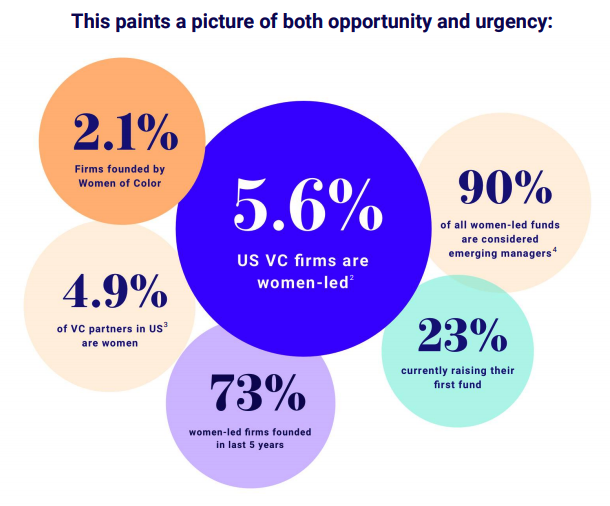
This winter, Women in VC, the world’s largest community of female venture investors, released a report on “The Untapped Potential of Women-led Funds.” The research was stark, if not surprising. According to the group’s proprietary data, 5.6% of U.S.-based VC firms are led by women (with less than half of those being founding partners), and Black and Latinx women each make up just 0.2% of VC partners. These dismal stats have a huge downstream effect as the report points out: a lack of diversity among fund managers directly contributes to the funding gap for women- and minority-led startups.

At Sapphire Partners, we’ve always believed that diverse teams drive strong results. Since our founding in 2012, we’ve invested in early-stage venture funds (predominantly those focused at Series A) across the U.S., Europe and Israel through an evergreen-like structure that allows us to partner with our GPs for the long term. As a diverse team ourselves, we’ve never had a separate bucket for “diversity” dollars, instead directing our core investments to the most promising funds.  

The report ends with a call to action. We took it to heart and wanted to share our response to the report’s recommendations, as well as our general approach to inclusive investing. Increasing diversity in the tech ecosystem is a collective action — No one type of investor or person can do it alone. Here are the steps we took:

1. Do a diversity audit 

As a first step, the Women in VC report suggests gauging the diversity of the managers in your existing portfolio. This makes sense — You have to know where you stand before you can take a step forward. 

In addition to the numbers in the Women in VC report we also looked at those shared by AllRaise and Axios. By AllRaises’s math only 12% of decision-makers (e.g., check writers) at U.S. venture funds greater than $25m are women. This summer, Axios released a study that said nearly 12.4% of decision-makers at U.S. venture capital firms that had raised at least one fund of $100 million over the past 5 years are women, up from 9.65% in a similar study in February 2019. Axios also noted that 61% of the funds they surveyed did not have any female decision makers.  

When we looked at our numbers, we were heartened to see that our portfolio was more diverse than industry averages – noting that the industry averages are depressingly low and there is room for improvement in our numbers as well. In our current active U.S. funds out of all the partners (those with check-writing authority), almost 20% are female partners. More encouragingly, over 50% of our current active U.S. funds have at least one female partner. And the average U.S. fund size we invest in is larger than the $100 million floor Axios set for their study.

We also noted that our investments have become more diverse over time. We think this is a function of both the industry diversifying and with whom we have chosen to invest. For example, if we look at the U.S. funds we invested in during our first three years of LP existence, only 11% had at least one female partner at the time (compared to our current active portfolio that has over 50%). And in our last three years of new U.S. commitments, currently 60% of these funds have at least one female check-writing partner, and 90% have either a female or non-white male partner. 

We look to avoid bias when evaluating investments by using a structured standardized process we put all funds through that concentrates on performance and GP/product market fund fit. Our ability to serve as a permanent source of capital enables us to focus on the funds we believe will generate the highest returns. Lastly, we work hard to keep expanding our networks, amongst GPs, LPs and entrepreneurs.

We’re proud of the progress we have made with our portfolio, but there’s still plenty of room for improvement. In our current active international portfolio for example, only thirty 3% of our funds have at least one female check writer. Thanks to our audit, we can continue tracking improvements over time, and we hope other LPs will join us in moving toward transparency (we’d be happy to share our methodology). 

On a last ‘audit’ note, the Women in VC report stated that female funders are more likely to invest in female entrepreneurs. What if the same is true at the GP/LP level, are female LPs more likely to invest in female GPs? This then begs the question —  how diverse (or not) is the LP world? We couldn’t find any research to answer this question for us so we reflected on our own experience. Anecdotally, most annual meetings we attend have at most  20-30% female representation amongst the LPs present and sometimes I (or my other female colleagues) are the only women. When it comes to the U.S. LPACs (Limited Partner Advisory Committee) we serve on, in about 50% of the time, I (or my female colleagues) are the only female LPs.  This does not of course tell the full make up of a LP team or who the ultimate decision makers are that have decided to invest (or not) into a fund but does suggest to us while the LP world feels more diverse than the GPs in venture, it is still not fifty fifty and potentially the diversity at the LP decision making level is also holding back diversity in tech.

2. Invest out of a core fund

At Sapphire Partners, we invest in all GPs through our main fund rather than carving out a separate “diversity” initiative. As the Women in VC report observes, a set-aside fund for diverse managers can sound like a good thing, but it can also run the risk of limiting the ability of women and underrepresented minority (URM) fund managers to access the larger checks typically reserved for core investments. 

From our point of view, making an unbiased approach the heart of your investing strategy is the key to both greater diversity and a stronger portfolio. Too often, investing in diverse managers is discussed as something LPs “should do.” We think a homogenous lineup runs the risk of potentially overlooking deals outside of one’s network and thereby capping one’s returns. It doesn’t make sense to us that any one demographic would have a monopoly on great ideas, and a wealth of research shows that diverse teams are often more innovative and make better decisions. We believe LPs (and GPs)  that are missing out on diversity might also be missing out on financial gain. 

3. Make connections

Even when we can’t write a check ourselves, we try to build bridges between women and URM fund managers, LPs and entrepreneurs when possible. Every year, our firm holds multiple formal and informal events to build networks, ranging from casual dinners that introduce female GPs to female entrepreneurs as well as ones focused on introducing women and URM GPs to LPs to more formal events hosted by the Sapphire Ventures Talent team. 

As the report suggests, we also make introductions to other potential providers of capital behind the scenes. We look to make introductions across all levels — from associates up to partners. We believe that in addition to supporting and making introductions to today’s leaders, another way the industry will see significant change is if we help establish relationships and support the future pipeline of female and URM GPs, LPs, and entrepreneurs as well. Lastly, when speaking on panels or podcasts, we routinely suggest diverse speakers to join us.

There are plenty of opportunities beyond check-writing for LPs to promote funds led by women and other URM GPs. But here too, avoiding a diversity silo is critical. The Women in VC report stresses the importance of making connections to “gender-neutral capital opportunities,” rather than just introducing women to other women or those in established diversity initiatives.  

4. Be part of the conversation

We started OpenLP, an online community, five years ago to boost transparency among LPs, GPs and entrepreneurs. The LP world historically has been quite opaque and we welcome the opportunity to help foster greater understanding. We have also been honored to participate in conferences that focus on addressing disparities in the industry.  Recently, I moderated a LP panel at the Black Venture Institute and another on how to raise your own fund for Carta’s Table Stakes event, while my colleague Laura Thompson led a panel about GP-LP interactions at the annual All Raise Summit.  

Sometimes, there are also more subtle, informal opportunities. I recently reviewed the deck of a fund manager who emphasized their focus on investing in diversity. Yet all the portfolio photos they chose to highlight in the deck were of white men. They hadn’t noticed the discrepancy until I pointed it out. 

There are hopeful signs that the venture industry is starting to diversify. According to an analysis from All Raise, a nonprofit promoting female founders and investors, a record number of women became partners in U.S. venture capital firms with over $25 million AUM in 2019 (52 compared to 38 the previous year). Over 90% of women-led funds are emerging managers, according to Women in VC, which means we now have an opportunity to turn the tide. There’s a long way to go, but LP dollars and engagement can be a meaningful bridge between where we are today and a more inclusive future. 

LPs have an important part to play in improving diversity in the venture ecosystem. As the ones holding the proverbial purse strings, LPs can make investments, create connections and spark conversations that drive change. Tackling structural challenges can feel daunting, but the Women in VC report spells out tangible steps that any LP can take today to move the needle. 

I look forward to hearing what other LPs are doing. I certainly don’t think we have all the answers, and we have a lot more work to do but we are excited to do this work and to continue to be part of the conversation.


Revolutionizing Customer Service for e-Commerce: Our Investment in Gorgias

When it comes to customer service, it’s three strikes and you’re out. More than half of today’s consumers switch to another company after just a few bad experiences, losing companies $75 billion annually. With so much at stake, it’s critical for online merchants to get customer service right. 

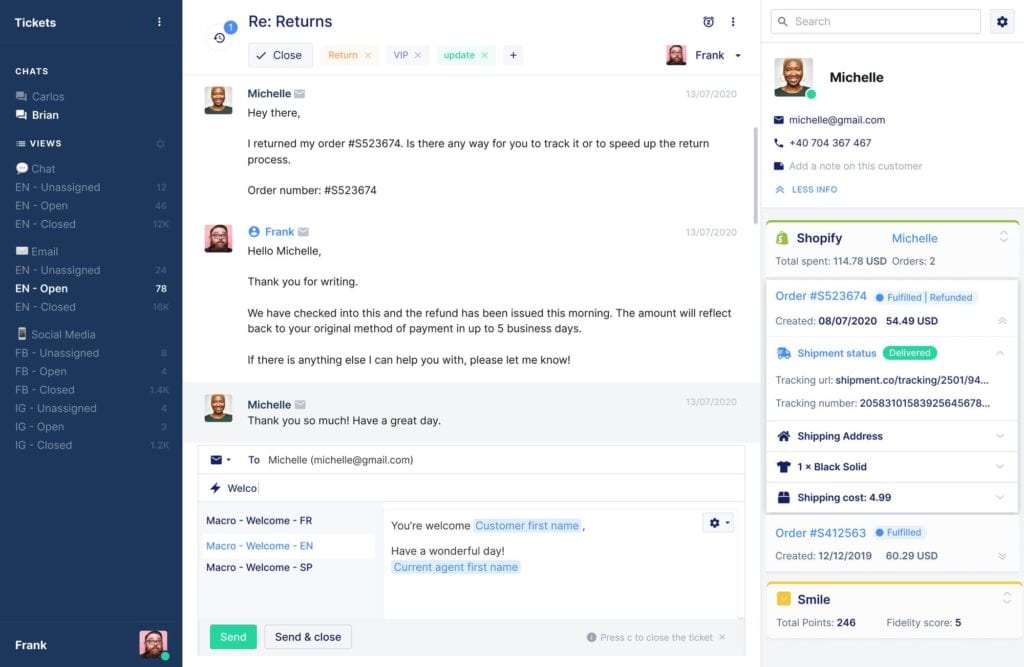
That’s why we’re excited to lead Gorgias’ $25 million Series B. Gorgias delivers best-in-breed customer service software for e-commerce merchants, serving 4,500 online stores across Shopify, Magento and BigCommerce. By unifying customer conversations across email, messaging, social and other channels, Gorgias builds a 360-degree view of the consumer, enabling merchants to easily deliver exceptional service.

It’s an incredible time to be in e-commerce and we are thrilled to partner with Founder and CEO, Romain Lapeyre, and the entire Gorgias team as they shape the future of service for online merchants. 

The Explosion of the e-Commerce Ecosystem 

In 2019, consumers spent $602 billion with U.S. e-commerce merchants, representing 16% of retail sales. When COVID-19 halted in-store shopping, online sales exploded. In the second quarter of 2020, $1 in every $5 in the U.S. was spent online—the highest e-commerce penetration ever. A widespread transition to e-commerce that would have taken years happened in just months, creating a tremendous opportunity for e-commerce merchants.

When Shopify went public in 2015, there were 162,000 merchants on its platform. Today, Shopify has over one million merchants, and there are another 250,000 and 90,000 merchants on Magento and BigCommerce, respectively. The explosive growth of independent online merchants first gave rise to the big platforms. Now, we’re seeing an entire ecosystem of enablement players being built for e-commerce. 

At Sapphire, we’ve been following the growth of e-commerce for more than a decade, and we’ve seen a number of leading players emerging in their categories. One or our investments, Attentive, a mobile messaging platform is making it easier for brands to engage with consumers on-the-go. Klaviyo is transforming the email marketing space, ReCharge is taking a new approach to subscriptions and payments, Shogun leverages no-code to help brands easily build websites, Bolt and Fast enable instant checkout, Loop instantaneously handles returns and of course, Gorgias, is revolutionizing customer service with an easy-to-use, lightning-fast, and customer-centric platform. 

We also believe the best direct-to-consumer (DTC) merchants differentiate by delivering exceptional customer experience. DTC brands care deeply about building customer trust and gaining customer love and slow, non-contextualized responses to customer inquiries just won’t cut it. To stand out from the pack, the most successful e-commerce brands must develop a holistic view of their customers and provide rapid, personalized support on all channels their customers engage with. And this is exactly what Gorgias delivers to their fast-growing D2C merchants. 

Gorgias: A Category Leader Purpose-Built for e-Commerce 

While customer support isn’t a new software category, traditional ticketing platforms like Zendesk break-down when high volume requests flow in from multiple channels. Traditional platforms are based on a limiting ticket-based framework that is unable to capture key customer contextualization like past purchases and returns. And for small and medium sized merchants that may be graduating from an inbox to service software for the first time, a solution like Zendesk is often too complex and expensive. 

With Gorgias, e-commerce merchants receive a dedicated solution with key integrations out-of-the-box. Gorgias allows service agents to respond to high e-commerce ticket volumes across multiple channels at lightning fast speeds, and importantly, unifies customer conversations and activity in one central platform. Taking a page from CRM providers, Gorgias is reinventing what modern customer service for e-commerce looks like.

An Ambitious, Experienced and Global Team Ready to Scale

I first met Romain roughly two years ago for lunch in San Francisco. His hunger and passion for re-inventing the customer support space by making service agents more productive thereby allowing merchants to differentiate on customer experience was palpable. Shortly after, I went on a walk with Alex Plugaru, Gorgias’ CTO and co-founder. His drive and focus was eerily reminiscent of my conversations with Romain. It was clear to me why they’ve been such a great duo.  

Today’s consumers expect better, more personalized experiences with the brands they interact with. We are thrilled to partner with Gorgias as they deliver exceptional customer service for e-commerce merchants and help shape the future of customer support.


Since we Last Spoke: StackHawk’s CEO Joni Klippert on Helping Developers Secure Code as They Write It

Last month, Sapphire invested in StackHawk, a cybersecurity startup that’s revolutionizing how developers secure their code. In short, StackHawk brings together DevOps and cybersecurity in the open-source world, and is taking a brand new approach to an existing sector of security called Dynamic Application Security Testing (DAST). With its platform, StackHawk enables software developers to make sure that the software code they’re producing is secure as they’re writing it, and prior to release.

Joni Klippert, CEO & Founder of StackHawk

The way StackHawk attracts customers is also unique. As a product-led growth company, they’ve been able to show value to users in just 15 minutes, which is challenging and rare to do in the security space, which is often complex, time consuming and expensive. 

I’ve had the opportunity to speak with StackHawk founder and CEO Joni Klippert many times during the past year. I find her story to be especially interesting, so I sat down with her recently for a quick Q&A. Here’s more on why Joni decided to start StackHawk, the company’s journey to date and details on the company’s new Free Plan that’s helping lowering the “Security Poverty Line.” 

Why did you decide to start StackHawk?

I’ve spent my entire career grooming to be ready to start a company (whatever “ready” means). 

After completing my MBA program, I launched a career working at various technology companies with a focus on customer development and product for early stage startups. At each of those companies, I was focused on making a part of the software delivery lifecycle more efficient–building tools for software engineers. Over the years, I amassed a great deal of DevOps industry knowledge.

That experience brought me to VictorOps, a startup I joined at the seed stage. As I helped build the business from the ground up, I knew I wanted to do it again. But next time as the founder and CEO. After VictorOps was acquired by Splunk in 2018, I was in a position to take on the personal risk of starting a company.

After the VictorOps acquisition, I spent a couple of months interviewing industry experts to find the right market opportunity. A mentor told me “leverage your unfair advantage.” That meant using my knowledge of DevOps to address a gap in the market. I wanted to further create efficiency in modern software delivery and build a product that focused on the end-user (developer) first. 

During my many conversations, I started to zero-in on the challenge of automating security in the development process. Interview after interview I heard the same thing–annual security audits were not enough in a world where we deploy software to production many times per day. People were no longer satisfied with point-in-time value for their security solutions. The market needed something that was easy to automate into CICD and that checked for security bugs with every release. 

I set out to build exactly that: A tool that would “shift application security left” by giving developers the power to test for vulnerabilities before production. 

What is going on in the industry right now that’s driving demand for a solution like StackHawk?

DevOps has fundamentally changed how we build software. In 2009, when Flickr announced that it was deploying software 10 times per day, that seemed like insanity. But now, it’s the norm and DevOps is no longer cutting edge. 

But when it comes to security, DevOps hasn’t kept up. Today, most software in the security market seems unaware of modern software delivery and is still driven by manual, infrequent processes like penetration testing (pen testing) and audits. There is no way for manual security processes to meet the speed of DevOps–no matter how many job openings we post, or teams we create. Manual testing will always be the bottleneck in an otherwise automated software delivery lifecycle.

Both users and end-customers deserve better. 

Can you talk a little bit about your journey since starting StackHawk?

My journey since starting StackHawk has been focused on three key areas: team, tech and customers.

Team: I have been building relationships with the investment community since I started working in tech in 2010. I am fortunate to have a strong syndicate of investors that supported StackHawk’s first Seed Round in July 2019, and our most recent addition, Sapphire Ventures, who led our Series A in October of this year

I am also lucky to have founded StackHawk with two incredible people–Scott Gerlach (CSO) and Ryan Severns (COO).

Scott’s experience building security organizations at companies like GoDaddy and SendGrid has given him the ability to approach AppSec understanding developers and security teams. His ability to reconcile two different points of view is invaluable as we build out our platform.

I worked with Ryan previously at VictorOps, where he rose through the ranks of data and analytics to eventually run all of marketing. He is a positive, upbeat work-horse who is a key reason we have been able to scale our go-to-markets effort so quickly.  

As we’ve grown, we have assembled an experienced, hardworking, dedicated (and unbelievably funny) team. It’s great to see everyone learning from one another and having a great time building out this product!

Tech: When it came time to build a product that would shift security left, we quickly realized that Dynamic Application Security Testing (DAST) was a gaping hole in the market that needed to evolve.

We set out to build a DAST platform that would: 

  1. Be dead simple to configure and run
  2. Handle modern applications 
  3. Have clear, prioritized, highly actionable output
  4. Integrate into an existing CICD workflow

We realized we could bring a product to market much faster if we relied on available open source tools as the underlying scanning technology for our platform. We chose OWASP ZAP as our underlying technology and built enhancements that streamlined ease of use. Shortly after we began working with ZAP, we met the project’s founder, Simon Bennetts who went on to join our team. 

Since we released our first Beta, we have been relentlessly executing against our initial vision. We have been cutting new releases every week including a GA in September of 2020. We also just launched a Free Tier of our platform. Now any engineer can quickly test the security of their application or underlying microservice without spending a dime.  

Customers: It’s one thing to have a vision and execute on a product. It’s another to see your customers believe in and use the product as you had intended. At StackHawk, most of our customers are running our technology on every pull request/merge. They check for AppSec bugs in the pipeline, on microservices. This means new bugs are easy to identify and fix, and critical bugs never make it into production. 

As our Beta testers have been converting to paid users and inbound interest continues to grow, we feel confident that the platform we have built truly serves the needs of developers. 

When a developer starts a trial of StackHawk, they average about 15 minutes from signup to first completed scan of their application. This time-to-value is unheard of when it comes to security products. We’re excited to continue to invest in product-led-growth and offer customers quick value in a world of bloated, over-priced security products that take months of managed services engagements to roll out. 

What are you looking forward to as you move into your next phase of growth?

We are laser-focused on going to market with a strong product and value proposition. 

Seeing that come to life so far has been amazing. We are excited to iterate and improve as we build a product with unparalleled value in the CICD pipeline. We look forward to continuous improvement of our scanner’s capabilities and providing more integrations for development teams. It’s our goal that the platform will fit seamlessly into any pipeline. 

As we build out the StackHawk platform, we have also been working to assemble the right pieces for our go-to-market engine. We are refining messaging and targeting, as well as building out our sales and marketing teams. But we know driving adoption doesn’t stop there! As a company, we are embracing product-led growth. Our entire organization–from marketing, to sales, to support, to development–has to work together to delight our users and drive conversion. 

Lastly, we look forward to investing in and growing the ZAP community. With Simon on board, we have a direct link between our two organizations and finding ways to leverage this is a big focus for us going forward. Whether it is through direct contributions back to the open source or helping teams scale ZAP utilization by layering in StackHawk, we know there is so much opportunity to work together.

Why are you excited to partner with Sapphire Ventures?

There are so many reasons to be excited about partnering with Sapphire Ventures! 

Sapphire has amazing experience in working with many security developer-focused companies. Current investments like Auth0, Uptycs and InfluxData, as well as exited companies like JFrog (NASDAQ: FROG) and Sumo Logic (NASDAQ: SUMO) show Sapphire knows the industry, and knows it well.

And with that expertise comes knowledge of the right partners. We have only been in the Sapphire portfolio for two months, and the firm has connected us with incredible people. From other founders, to press contacts to later stage investors, Sapphire gives access to people who provide incredible value to our business. 

Last but not least, Sapphire is made up of some of the kindest people in the VC community. From the partners to the portfolio growth staff and the operations team, I feel lucky to have such a warm, welcoming, supportive team helping StackHawk reach our goals. 

Are you doing anything to help companies get started with StackHawk given the current economy/these unusual times?

Part of our goal with StackHawk is to “lower the Security Poverty Line,” no matter the circumstance. Beginning a security program has traditionally meant hiring a leader of the function, having them build out a team and investing in enterprise security tools that are out of the reach of most companies. 

At StackHawk, we just announced a Free Plan that allows companies to get started with application security testing for a single application. From there, we offer really friendly pricing that supports the idea of an entire engineering team using the product (10 seats for a single team) and up to 10 applications as most of our customers are modern development teams that want to be scanning microservices rather than parent domains. 

We also offer a deep discount for startups. Companies need to meet the criteria, but then it’s only $79 per month for a single team plan. There is no excuse to not start scanning your apps for security vulnerabilities at that price! And as always, we are free for open source projects. 

We want all of our customers to feel that StackHawk is here to support them. For early stage companies, we want to help them in shoring up the security of their applications. Established companies that may be using an incumbent vendor have the opportunity to substantially save on their annual spend. 


Since we last Spoke: Uptycs’ CEO on Providing Security Analytics for Everyone & Partnering with a VC that Knows Enterprise Tech

Earlier this year, Sapphire led a $30 million Series B financing round in Uptycs, a startup that’s revolutionizing cybersecurity by providing enterprises with a SQL-based security analytics platform for performing intrusion detection, vulnerability management, incident investigation, workload protection, security audits and compliance checks. 

Ganesh Pai, Founder & CEO of Uptycs

Several trends have driven the need for cybersecurity solutions like Uptycs. To address the threat of cyber attacks, enterprises have been running agents from siloed security applications. In addition, ephemeral workloads in modern infrastructure has caused the amount of security telemetry (hence noise) to explode. Enterprises are also increasingly protecting non-Windows operating systems. And now, remote work has raised security risk, making products like Uptycs mission critical.

We first met with the CEO of Uptycs Ganesh Pai and the company’s co-founders Mike Hluchyj and Uma Reddy at the end of 2019. While we were impressed with their differentiated product, we were equally amazed by the comradery of the founders who have been working together for more than 20 years, and have a proven track record of creating great products. 

Now that Uptycs and Sapphire are partners, we have the pleasure of speaking with Ganesh and his team often. Several months after the company’s Series B, we sat down with Ganesh to talk about why he started Uptycs, how he plans to provide security analytics to everyone and why he decided to partner with Sapphire. 

Why did you decide to start Uptycs? 

The original idea was for Uptycs to provide companies with a way to observe debugging and diagnostics, at scale. An easy way to measure system availability is called uptime, which is where the name Uptycs came from. It represents uptime analytics. 

Very quickly, we realized that the same structured visibility could be applied to cyber security. That’s when we firmed up our mission–we wanted to deliver security analytics for everyone. We realize that it’s a bold mission as cyber security is an incredibly noisy domain. There are many vendors out there providing a litany of solutions. However, the problem of observing and securing diverse computing environments at scale persists. Our goal to solve these problems drove us to launch Uptycs.

 What is going on in the industry right now that’s driving demand for a solution like Uptycs?

There are a few key digital transformations underway that are generating demand for a solution like Uptycs. Three notable ones are:

  1. The movement of production endpoints (such as servers and containers) to public clouds. Cloud security is a top buying center.
  2. The spike in remote work, where the productivity endpoint (laptop) is now location agnostic.
  3. The rise and continuous dominance of SQL in modern security operations.

These trends are generating demand for security visibility and protection, which Uptycs is here to help address. 

Can you talk a little bit about your journey since starting Uptycs? 

In a span of four years, we’ve been fortunate to raise three rounds of funding (Seed, Series A and Series B), hit product-market fit with marquee customers, see patterns of repeatable sales and set ourselves up for growth. Over the years, we’ve faced the usual challenges and excitement one might associate with a journey like ours. However, our successful execution is a result of our strong vision, ability to stay the course to build a platform with a high-caliber team and our focus on customer success. 

What are you looking forward to as you move into your next phase of growth?

It’s easier said than done, but I’m looking forward to:

  • Building a strong customer base and community
  • Adding more capabilities to our product to reach wider audiences
  • Growing our product and developer teams
  • Scaling our go-to-market efforts to drive sales and awareness for Uptycs

Why are you excited to partner with Sapphire Ventures? 

Sapphire’s expertise with enterprise B2B companies, and their approach to identifying patterns of success is what got our attention. Solid references coupled with a sound approach to investing by a team that has been together for a while, and that has endured the ups and downs of markets over time, convinced us to partner with Sapphire. In just a couple of months post-investment, their Portfolio Growth team has been a great partner to Uptycs.

How do you plan to leverage the latest investment?

The latest round will be used to grow Uptycs. Primarily, we’re investing in employees, tools and processes that will:

  • Support large enterprise customers
  • Develop sales and marketing machinery
  • Improve the product experience

Are you doing anything to help companies get started with Uptycs given the current economy? 

The Uptycs Security Analytics Platform, coupled with the osquery agent, makes it easy for organizations to get remote visibility into their productivity endpoints (such as macOS and Windows) and their production endpoints (such as Linux and containers). 

We’re pleased to offer a free trial that provides companies with an easy way to experience our platform. Given the current environment, we’ve been extended the free trial to those companies that need it. 

Additionally, we provide free training to help our customers, and we’ve championed the osquery@scale conference as a way for practitioners to share their insights and experiences with others. The osquery@scale conference videos, which we’ve made available in full, are a meaningful source of education that aligns with our mission to provide security analytics for everyone.


The (Tele)doctor Will See You Now: How COVID-19 Has Accelerated HealthTech Adoption

It is not the strongest of the species that survives, nor the most intelligent, but the one most responsive to change.” – Charles Darwin

In recent years, the gap between technological innovation and adoption in healthcare has increasingly become more pronounced. On one hand, the healthcare industry has been able to produce CRISPR gene editing (modification of the genomes of living organisms), cloning, bionic eyes and a number of other incredible, science fiction-like innovations. But on the other, before COVID-19, the industry primarily operated on and still very much operates on pen and paper. It’s perplexing that decades after electronic health care records have become the norm, HIPAA compliant digital intake forms are still not yet commonplace. 

This dichotomy doesn’t stem from an absence of new and exciting technologies in the space, often created and pushed forward by operators. Many health tech start-ups like Doximity, Medable (a recent addition to the Sapphire portfolio) and ZocDoc were started by physicians and clinicians who spotted areas in their work that could be solved by technology. The challenge lay in the hurdles associated with scaling these kinds of technologies systemwide. Within healthcare especially, and like many highly regulated industries, there are constraints around setting standards from a regulatory perspective (which are there for good reason!) and more nefariously, the general inertia that often plagues any big system.

While the technology that enables telehealth and digital intake form signing have been available for decades and offer clear benefits when compared to traditional methods, adoption has been slow to take-off. For better or worse, the onset of COVID-19 quickly exposed the many limitations and weaknesses within the current healthcare system such as a reliance on delivering care at physical sites, which can often introduce inconvenience, inflexibility and barriers to the best access and the best care for patients. As a result, the pandemic has been a tremendous catalyst for accelerating technological adoption in the healthcare industry, altering the regulatory landscape and cutting through inertia, in order to build the foundation for a new normal. 

A recent report by McKinsey revealed that during COVID-19, providers saw 50 to 175 times the number of patients via telehealth than they did before. This temporary spike in utilization appears to have changed consumer behavior and preferences that may long outlast the pandemic. According to the same study, only 11% of consumers used telehealth services in 2019 whereas now, 76% are interested in using telehealth going forward. Pre-pandemic, low utilization was partially due to structural factors like low reimbursement rates from carriers but arguably, the greater reason was simply patient familiarity with in-person visits. In a very short period of time, the conditions that the pandemic placed on the healthcare system has very rapidly changed how the industry operates, as well as consumer behaviors, opening the door for technological adoption now and in the future.

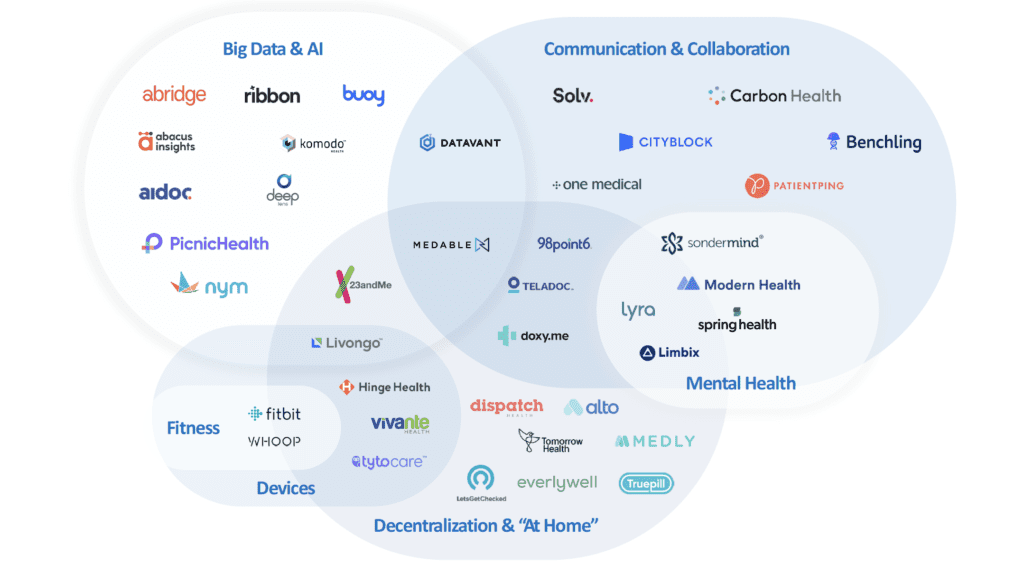
Within the healthcare industry, we’re seeing increased technological adoption from COVID-19 across three key dimensions: Big data and artificial intelligence (AI), communication and collaboration, and decentralization and the movement towards at-home care. Let’s explore each of these trends in detail. 

How Big Data and AI Help the Industry Leap Forward 

There are endless examples of how AI can help improve different industries, job functions, work processes and more. But in healthcare, AI holds the opportunity to be truly transformational for the benefit of people. Whether it’s deep learning in the field of computer vision to read x-rays or harnessing the power of big data for contact tracing, scientists and researchers are developing tools that I believe will dramatically improve the availability and quality of care.

The importance of leveraging big data and AI technologies within healthcare was highlighted at the start of the COVID-19 outbreak when the term “contact tracing” entered popular vocabulary as governments and research institutions around the world scrambled to understand and contain the virus. Other AI use cases during the pandemic include data visualization tools that leverage GPS information to map COVID-19 cases and utilizing predictive analytics as part of the search for a vaccine. The value of big data and AI has been little doubted in healthcare, but the recent events have put both into the limelight in a major way from a deployment perspective. 

While COVID-19 has emphasized how big data and AI can work to help in the instances of massive healthcare emergencies, use cases expand far beyond this and we highlight a couple below:

  • Using healthcare data to glean insights to better deliver care. Data in the healthcare industry is often fragmented and siloed. Komodo Health recently introduced a Healthcare Map, which is built on patient-encounter data and data algorithms that gives customers like pharma companies visibility and the ability to glean insights to help accelerate innovation. Datavant is another company in the space that helps stitch siloed data together using tokenization technology so customers (including Komodo Health) can form comprehensive datasets to run their algorithms on. 
  • AI for diagnosis. We rely on healthcare professionals to interpret tests and symptoms based on their training and experience, but with advances in technology, technology is offering a helping hand. Aidoc, for example, uses computer vision and AI to help detect and pinpoint critical anomalies for radiologists by analyzing medical images and patient images. Another startup, Buoy Health, analyzes symptoms communicated by users, producing a list of possible diagnoses based on 22,000 clinical papers, and from there interacts with users via an AI chatbot.

Communication and Collaboration Tools Drive Efficiency and Improve Patient Experience

Communication and collaboration, both internally with patients and across the healthcare ecosystem, became a challenge overnight when shelter-in-place orders rolled out across the country early this year. The shift left healthcare organization leaders and regulators searching for viable solutions that were enabled by existing basic technologies that consumers already use and are familiar with, such as messaging, text and video. After months of engaging with patients virtually and digitally, the ROI from these methods was clear. Healthcare professionals are able to save a tremendous amount of time, collect tons of rich and accurate data, which they can run analytics on, deliver real-time capabilities to their patients and better execute multi-party coordination.

The federal government also benefited from the move towards digital healthcare. It took the lead in utilizing digital communication methods by setting up a digital portal and requiring certain healthcare facilities to report COVID-19 cases and deaths at least once a week to the CDC. The amount of data that was required to be reported on and the general time-sensitive nature of the work meant that traditional methods like fax and mail were no longer an option. While barriers to virtual and digital communications existed prior to the pandemic, including reimbursement and regulatory restrictions, they went away almost instantaneously. Furthermore, for telemedicine, remote-care reimbursement was expanded and HIPAA penalties were waived. Many state health agencies also reduced state licensure barriers, allowing providers to practice across multiple states. Below are a few innovative companies focused on digital communication and collaboration that have taken off during this time, and are expected to be popular in the future:

  • Virtual Visits and Mobile-Based Care. Alternatives to in-person visits including televisits and mobile-based care spiked during the pandemic, which increased demand for companies like 98Point6  that offer on-demand primary care services via text, as well as for telehealth services from providers like Teladoc and Doxy.me
  • Mental Health. As a subset of virtual and mobile-based care, mental health services in particular saw expanded utilization. Companies like Lyra Health and Spring Health connect users to licensed therapists virtually and also offer other forms of care via digital content. 
  • Instant Digital Scheduling and Coordination. Increased inbound inquiries tested the limits of relying on the traditional method of handling appointments by phone, opening the door to text and chat as popular alternatives. Existing tech forward providers such as One Medical already offered online and mobile bookings and communication channels. And Solv helped customers conveniently book same-day in-person appointments and instant video visits as easily as it is to book a restaurant reservation on OpenTable. 

Decentralization and “At Home” Care Delivers Better Results, Faster

Decentralization is the distribution of authority and control from a central agency to local administrative level. Simply stated, it’s moving healthcare into the community and home. The benefits of decentralization include greater access to healthcare, better care, increased transparency and accountability, and improved speed and cost. On the flip side, decentralization often increases complexity in coordination and negatively impacts things like data collection and analytics. But these new challenges represent opportunities for healthcare technology companies–new and existing–to tackle.

The shift towards decentralization is starkly illustrated by clinical trials. Clinical trials have long been the primary method for testing and validating new drugs and therapies. Historically, over 70 percent of potential clinical trial participants live more than two hours away from the nearest study center, which greatly limits access and engagement. COVID-19 massively disrupted clinical trials worldwide as thousands of trials were suspended and new patient enrollment stopped entirely during lockdowns. The result? Significant ramifications on drug development timelines and long-term effects on medical science. While decentralized trials existed pre-COVID-19 on a very limited scale, a massive shift to decentralization was almost immediately triggered. A component of the broader theme of decentralization is the move towards at-home care. Instead of having to go to a facility, using technology, people can collect and self-report data, mail in tests and have virtual consultations from the comfort of their homes. Here, we explore a few of the technologies and applications enabling localized delivery of care:

  • Decentralized Clinical Trials. By removing the barrier of having to physically travel to a study site, clinical trial participation is now an option for many more people around the world, ultimately enabling better discovery of therapies and drugs. Medable offers an end-to-end global platform that enables decentralized clinical trials by connecting patients, sites and clinical trial teams. 
  • Care and Testing from Home. It’s possible now to get tested on a variety of different conditions and traits at home. Examples include 23&Me (a Sapphire investment), Everlywell and  ModernFertility–to name a few. It’s also an option to have prescription drugs delivered to your door by using companies like Alto and Medly. And last but not least, people can track their health via wearables and devices like FitBit (another Sapphire investment) and  Whoop.

The Market Opportunity for HealthTech Has Never Been Greater

The pandemic has accelerated the adoption of existing healthcare technologies, and has paved a way for new technologies to positively impact the healthcare ecosystem. The unprecedented market opportunity hasn’t escaped investors as there has been a rush of venture funding in the sector. According to Rock Health, U.S. digital health companies raised $5.4B in venture funding in the first half of 2020–on track to be the largest funding year ever. 

During COVID-19, technologies like Zoom and Instacart have boomed as companies and consumers raced to respond to the unique conditions brought on by the pandemic. In the healthcare space, the natural innovation cycle that may have taken several years has been accelerated into one, creating a new operating baseline. The move towards more digital technologies and tools in healthcare has resulted in a recent McKinsey report to estimate that up to $250 billion of current U.S. healthcare spend could potentially be virtualized. 

At Sapphire Ventures, we’ve backed innovative companies in the digital health space for years, including 23&Me, FitBit, Medable and Livongo. We believe 2020 has opened the door to a massive acceleration in technological adoption in healthcare, and believe that these recent behavioral shifts will allow new Companies of Consequence to emerge.


Ushering in a New Era of Online Banking: Why Sapphire Ventures is Excited to Partner with Current

“When I look for investors, I look for real business partners—those who I feel have shown a genuine interest in our business from the very first conversation, and will be there for the long-haul. Kevin and the Sapphire team have stayed close to us since we were a fraction of the size we are today, helping us shape the business as we’ve continued to build the future of banking. We are incredibly excited about working with them.”  Stuart Sopp, Founder and CEO of Current

There is a commonly used adage that the 50 largest banks are worth over $50 billion. The number is actually closer to about 41 of the world’s largest banks1 that have a market cap of more than $50 billion (10 in the U.S.), still making the global banking industry massive. For an industry so large, there’s been a lack of innovation and significant disruption in the space until recently. What we’re seeing today are outdated solutions and brands being replaced by a new generation of no-fee, mobile-first, branchless online banks.

That is why Sapphire Ventures couldn’t be more excited to announce our investment in Current’s $131 million Series C2 funding round. We strive to help entrepreneurs build Companies of Consequence, and we believe that CEO Stuart Sopp and his team are doing just that for banking, one of the world’s largest markets. 

Current, a rapidly growing challenger bank founded in 2015, is poised to upend a multi-trillion dollar market by providing accessible and affordable banking to the next generation of consumers. After meeting countless startups in the broader online banking space, we immediately gravitated to Stuart’s drive and maniacally product-first vision, as well as the most compelling unit economics we have seen in the industry. 

Here’s more on why we’re looking forward to partnering with Current:

A rapidly growing sector with a solution for everyone

The global banking industry as a whole represents a massive market opportunity worth trillions of dollars. Within this vast market, we’re especially interested in online banks, which are booming amid a generational shift. The digital bank startup industry was worth more than $20 billion in 2019 and is projected to reach $471 billion by 20273

Current provides premium banking services for everyone, regardless of age or income. But the company started out by first targeting Millennial and Gen Z consumers who are driving the shift towards mobile-first solutions that offer digitally-native features with brands that are different than the ones their parents used. Data shows that a whopping 92% of millennials4 say they would choose a bank for its digital services. Furthermore, younger customers have a high distrust of traditional financial institutions, whose reputations have suffered due to high-profile scandals and hefty fees for banking services. 

Current is also seeing a strong following with essential workers, and ethnically and economically overlooked populations5 who have found in Current a solution that works specifically for them. The company’s goal is to lower the barriers to financial inclusion, something traditional banks are not set up to provide.

A next-generation, digital-first bank that stands out 

Current, a branchless, mobile-first bank based in New York, has gained incredible traction in the online banking world. The company offers checking accounts featuring faster direct deposits, free overdraft up to $100, a points system for cash back, instant refunds on gas holds and more, all without any hidden or overdraft fees or minimum balance requirements.

Current derives revenue primarily from the fees merchants pay when users swipe their cards, which means its growth potential directly correlates with the rising spending power of consumers as they continue to grow in life. 

One of the most impressive aspects of this success has been how Current has done it, matching their strong growth with equally impressive unit economics, something we rarely see in the challenger bank space. Current has achieved this by offering a solution people actually want and by building a cloud-native and horizontally scalable technology stack that brings core pieces of banking infrastructure in-house, resulting in meaningful cost savings that can be passed onto its users. 

A visionary leader with strong industry experience

Founder and CEO Stuart Sopp brings with him a deep expertise in the banking industry, including as Head of Trading at Morgan Stanley and Citi. He is product focused and puts the consumer experience first in every circumstance. With a personality that will control any room and a strong team behind him, including executives from Zynga, Topps, Paypal, BlueVine and others, we feel that Stuart is well-positioned to change the banking space forever. 

We’re excited to have Current join a long list of Sapphire portfolio companies in the fintech space, including AvidXchange, Currencycloud, Feedzai, IEX, OnDeck, Square and TransferWise. The investment also fits within our slate of consumer-focused companies, such as 23&Me, Cazoo, Fitbit, LinkedIn and Sun Basket. We look forward to partnering with Current as it reimagines banking with consumers’ best interests in mind!

1www.advratings.com
2www.prnewswire.com
3www.businesswire.com
4www.americanbanker.com
5www.cnbc.com


Near-Perfect Transcription with a “Human-in-the-Loop” Approach: Our Investment in Verbit

We’re excited to share that last week, Verbit announced its $60 million Series C funding round, which Sapphire led. Verbit offers a best-in-class transcription and captioning platform that combines the efficiency of artificial intelligence with the accuracy of human transcription. 

There are a number of reasons why we chose to partner with Verbit. First, the market for automatic transcription was already booming pre-COVID, but adoption recently accelerated as organizations quickly shifted online. Second, the near-perfect accuracy of Verbit’s “human-in-the-loop” transcription model has given it a strong customer base among legal and educational institutions and positioned it to emerge as a market leader. And last but not least, Founder and CEO Tom Livne is a passionate leader who saw firsthand the issues associated with transcription while working at a law firm. 

Here’s more on why we’re so excited about Verbit: 

A sizeable market experiencing accelerated growth

The automatic transcription and captioning market is rapidly growing and as such, presents an exciting investment opportunity. That’s because highly accurate transcription is an essential service for higher education institutions, the legal industry, media and entertainment and other market sectors.The education and legal transcription markets alone are worth $5 billion because academic institutions are required to transcribe massive amounts of audio and video content in order to be compliant with federal regulations, and the legal field needs exact records of court proceedings in order for lawyers, courts and more to do their jobs accurately.

Recent advances in automatic speech recognition (ASR) technology, which enable transcription accuracy of up to 90% and transform audio into text in a matter of minutes, have made this an attractive industry. Before COVID-19, automatic transcription across all sectors would have been worth more than $30 billion by 2025. That’s an impressive number that’s likely now much higher due to the aftermath of the pandemic. The rapid transition to an online world has only driven demand for transcription as many organizations have moved operations online, producing much more audio and video content than before. 

In the near future, Verbit aims to expand its automatic transcription service to new sectors, including government, finance and the enterprise. In addition, Gartner estimates that call centers will use speech-to-text technology to transcribe 40% of all inbound queries by 2025. It’s clear that we have only scratched the surface of the potential of automatic transcription.

Combining the power of human and machine for near-perfect accuracy

Rather than offering an AI-powered platform on its own, Verbit uses a “human-in-the-loop” approach to achieve the +99% accuracy that its customers need. The company taps the speed and cost-effectiveness of machine-generated transcription and refines the results using a marketplace of 22,000 freelance transcribers in 120 countries. As a result, Verbit can provide near-perfect transcription at scale, with a faster turnaround and more affordable price than human transcribers. Human input also provides a feedback loop that helps train its speech recognition algorithms to become smarter and faster over time. 

Verbit appeals to enterprise customers, which require almost 100% accuracy, which is why the company also offers best-in-class professional services to its customers who help guide them to make the most out of the platform on a daily basis. 

Looking ahead, Verbit plans to use this additional round of funding to add new product capabilities to serve the finance and insurance industries, cultural institutions and call centers. In addition, Verbit has a promising strategy to supplement organic growth by acquiring small legacy vendors in the space. The company has already demonstrated this by completing its first acquisition of a transcription provider focused on the enterprise and higher education, and moving most of its customers to the more efficient Verbit platform. 

An experienced founder focused on growth

Founder and CEO Tom Livne is a former lawyer who early-on saw the potential for AI to transform the costly and time-consuming process of transcription that has historically been done by stenographers. A second-time entrepreneur and former paratrooper in the Israeli Special Forces, Tom is an out-of-the-box thinker with a proven track record of growing successful businesses. We’re impressed with his clear dedication to rapidly expanding the company and his focus on execution. 

Here at Sapphire Ventures, we believe in Boring AI — the idea that AI will have the greatest impact in solving what most may consider mundane problems in the enterprise, not the sexy (yet rare) use cases that grab headlines. We’ve invested in a number of AI and machine learning startups over the last several years, including current investments such as Clari, an AI-powered revenue operations platform for B2B organizations, and Moveworks, the first autonomous AI platform for resolving enterprise IT issues. We’ve also invested in numerous Israeli-based companies including JFrog, Kaltura and Monday.com. We’re excited to have Verbit become our latest partner in deploying AI to make everyday business processes more efficient — and we believe its future will be anything but boring!


medable social card

Leading the Way in Decentralized Clinical Trials: Why Sapphire Ventures is Excited to Partner with Medable

We’re excited to share today that Sapphire Ventures is leading Medable’s $91 million Series C funding round. Seemingly overnight, COVID-19 forced the healthcare industry to break through decades of systemic inertia and rapidly accelerate digital transformation. Now more than ever before, there’s a massive opportunity for healthcare technology companies to pave the way for a new and better status quo–especially in the clinical trial space.

Medable’s mission is to deliver effective therapies to patients, faster by providing software that enables decentralized clinical trials. We believe that the company’s cloud-based, end-to-end platform is a best-in-breed solution to enable remote clinical trials. Medable’s approach substantially reduces trial times, increases patient access and improves the patient experience, ultimately resulting in better trial outcomes. To help set new standards for clinical trials that will become the new normal long after the pandemic has passed, Medable is working closely with some of the world’s largest biopharma companies and clinical research organizations (CROs). 

Medable’s co-Founder and CEO Michelle Longmire, a Stanford-trained physician, and her team are well-positioned to seize this transformative opportunity in healthcare. Here’s more on why we’re so excited about Medable: 

An urgent healthcare opportunity for a lasting transformation

Despite the proven benefits of conducting clinical trials digitally, healthcare organizations overall have been slow to adopt the approach. Regulatory barriers and privacy considerations in the healthcare industry have contributed to slow uptake. But perhaps an even bigger obstacle has been the lack of change in a field that still often relies on healthcare professionals capturing outcome assessments from patients at a clinical site on pen and paper. 

The pandemic served as a shock to the system and opened the floodgates for the rapid adoption of healthcare and remote telemedicine technology, including clinical trials. As a result of COVID-19, about 80 percent of non-COVID-19 clinical trials were stopped or interrupted, and new studies couldn’t enroll participants. The disruption caused costly delays for pharma, biotechnology and medical device companies working to get new drugs to market. With the traditional methods of conducting clinical trials no longer a viable option, the industry has rushed to invest in software that enables decentralized clinical trials (DCTs). 

Current events aside, the surge in demand for digital and DCT enablers is predicted to take off thanks to the myriad benefits of decentralization. Today, fewer than ten percent of the U.S. population participates in clinical trials, which usually require in-person visits to a facility. Taking trials digital widens the global pool of participants, leading to more and better data, time and cost savings for pharma companies, and faster and more effective drug development that benefits us all. It’s no wonder that global spending on clinical trials is estimated by Grand View Research to reach $69B by 2025.

Best-in-breed technology that serves top global customers

Medable is primed to meet the unprecedented demand for digital and decentralized clinical trials in the industry today. Its modern, flexible and cloud-based platform features unique modular technology that maximizes the benefits of digital in individual studies. Medable also offers enterprise data and operational capabilities that ensures the interoperability necessary for seamless data capture across users and systems across just about any outcome assessment, device or digital endpoint.

Medable includes solutions for remote patient screening and enrollment, telemedicine (TeleVisit), remote eConsent (TeleConsent), and remote electronic Clinical Outcome Assessments (TeleCOA), which powers real time remote patient monitoring to track and analyze trial progress in real-time. Medable also offers solutions that leverage wearables and other devices to seamlessly capture patient data. And it provides patients with engaging apps. In other words, Medable delivers all of the elements needed to run a fully decentralized clinical trial. To top it off, Medable apps are available on web, mobile and tablet and feature slick, consumer-grade interfaces to optimize the user experience. 

Founded in 2015, Medable already counts the majority of the largest 20 biopharma companies in the world  among its customers. As a pure-play software vendor, Medable also partners with top global CROs, which are both customers and key distribution partners into the biggest global biopharma companies.  

A passionate team that combines medical and tech expertise

Co-Founder and CEO Michelle Longmire is a Stanford-trained physician who is passionate about improving human health and saw an opportunity to do so by becoming a company builder. She co-founded Medable alongside CTO Tim Smith, who is a second-time entrepreneur in the space, having previously founded a company that implemented Salesforce in large hospital systems. Michelle and Tim are deeply mission driven, tenacious leaders and they’ve built a team of seasoned executives driven by excellence, commitment and integrity—including EVP of Sales Eric Peper, SVP of Strategy and Solutions Ching Tian, and VP of Customer Success Jared Klingeisen who all bring deep expertise in the healthcare industry.

This latest funding round will enable Medable to meet surging demand by staffing up  go-to-market and customer success teams.

We’re thrilled to have Medable become the newest addition to Sapphire’s portfolio of healthcare technology companies. Our earlier healthcare technology investments in Fitbit, 23andMe and Livongo have taught us that digital platforms can improve healthcare outcomes and create meaningful Companies of Consequence at the same time. We’re looking forward to partnering with Medable on its mission to accelerate the discovery of innovative medical treatments and improve healthcare for all. 


While the Work is Never Done, Here’s How Leaders at Culture Amp, Outreach & Pendo are Working to Get D&I Right

Diversity, inclusion and equality is not only the right thing to do, but it drives real business results. Recent data shows that: 

  • Higher representation of women in C-suite level positions results in 34% greater returns to shareholders
  • Organizations with above-average gender diversity and levels of employee engagement outperform companies with below-average diversity and engagement by 46% to 58%.
  • Companies with higher-than-average diversity had 19% higher innovation revenues.

Driven by the recent and tragic news cycles over the past few months, there’s been a stronger focus for companies to get D&I right. While we all know there are clear benefits to achieving equality, it can be a challenge to attain parity. I recently spoke with CEOs and D&I leaders from three of our portfolio companies, Culture Amp, Outreach and Pendo, to hear about how they’ve incorporated D&I into their company culture, how they hold their leadership team accountable and how they measure success.

While the work is never done when it comes to diversity, here’s what Culture Amp’s Director of Equitable Design & Impact Aubrey Blanche, Outreach CEO Manny Medina and Pendo CEO Todd Olson had to share:

How is D&I incorporated in your company culture and strategy?

Culture Amp’s Director of Equitable Design & Impact Aubrey Blanche

Culture Amp: We take our culture as seriously as we take business growth. In fact, that’s why the two strategies are held accountable at the company level. As a part of our culture strategy, we have gone beyond committing to diversity and inclusion programs by aiming to build a structurally equitable organization. This year, we are deeply focused on evolving as an anti-racist company. While we recognize that committing to progress is the first step in the journey, we have been careful not to replicate the pattern of promises without dedicated resources to achieve pledged outcomes. 

To that end, we recently released our 2020 anti-racism plan, which looks at all areas of the business, including employee education, leadership accountability, knowledge management and all talent processes and programs. We hope that by sharing this plan publicly, we are able to continue to lead the industry and inspire our customers to build companies that are culture-first for everyone.

Outreach: We made diversity, equality and inclusivity a core value of Outreach from the very beginning. While we have several self-created groups within the company, we are in the process of building a more comprehensive program around these groups. One thing that I’m especially proud of is the fact that we work hard to give voices to others. We acknowledge and celebrate holidays from across many different cultures. For example, we made Juneteenth a company holiday. We’ve also conducted trainings on the inclusion of trans people. Right now, we are kicking off deeper D&I trainings across the company. This is a journey and we need to bring the whole company along. 

As an immigrant to the U.S., I think it’s very important to create an environment where others like me can feel safe. Our hiring process never asks for anyone’s immigration status. If you get a job at Outreach and need a visa, that will never disqualify you. And we will do what it takes to make sure you can legally work in the U.S. We also offer benefits around helping people get green cards or citizenship. The concept of creating a safe space is what really drives our culture. 

Pendo: I’m proud to say that Pendo’s culture is open and transparent. Transparency is easy when everything’s running smoothly. But when there’s a foundational quake, like we’ve seen throughout society in recent months, organizations can retreat to a protective mindset. Pendo didn’t. In fact, we turned to the principles that underpin the organization and leaned on them for direction. “Show me the data” is a tenet. So we shared our D&I data and publicly committed to improve. “Brutal honesty” is another value. Leadership was honest with itself–we needed to self-educate, so we brought in prominent members of our community, namely the mayor and a former state supreme court justice, to deepen our relationship with civic leaders.

We also turned inward and leaned on the Pendo team for guidance, in particular or employee-led affinity groups. These groups helped highlight areas for improvement that we might not have fully recognized without the input from a diverse group of Pendozers.

What’s the role of the leadership team in leading by example and driving change when it comes to D&I?

Culture Amp: CEO and leadership buy-in is critical, but insufficient to drive progress. Leaders must also be accountable and transparent in their work, specifically to the underrepresented people D&I and/or equitable design programs are designed to support. We consider this non-negotiable, and are proud that as a part of our commitment to evolving as an anti-racist organization, we are requiring all of our leaders, Director level and above, to establish their own anti-racism education goals, and our metric of success considers only the experience and input of our black employees. 

Outreach CEO Manny Medina

Outreach: I believe D&I starts at the top. You can see at the board level and at the leadership level, we have a gender and racially diverse group of people. Three out of four of my direct reports are women and 40 percent of our company’s leadership are women. Representation is hugely important. Employees need to see themselves reflected in their leadership. We are doing everything we can to make sure we create a diverse team–starting with our exec team down. 

Pendo: We have a very passionate, community-minded team at Pendo, making this such a compelling company to be part of. But at some point, what leadership says needs to give way to what leadership does.

I mean this part broadly–it relates to Pendo certainly, but it’s bigger than any organization. When it comes to driving change, part of what you do is binary. For example, you increase diversity numbers throughout the organization or you don’t. Those metrics largely speak for themselves. But some of what you do is more subtle. Perhaps there are behaviors that you may have once tolerated, that now you don’t. Acting more decisively, self-educating, being vulnerable–these are some of the ways leaders lead by example.

I don’t believe the team expects leadership to have all of the answers. But leading by example requires executives to ask better questions and, critically, persist in championing the importance of D&I, especially when the media has shifted its focus to other stories.

What processes and tools are required to drive cultural change?

Culture Amp: In order to drive progress, companies need a variety of tools to:

  • Measure the current environment and future progress
  • Transparently track goals and metrics associated with all D&I and equitable design programs
  • Capture feedback and performance that minimize the potential application of human bias

Culture Amp leverages its own products to achieve these goals. We rely on our Engagement platform to measure the experience of Campers from all backgrounds, and track changes in the experience over time. Our platform also allows our managers to understand the most important areas of strength and opportunity within their teams and departments, and provides inspiration to take action based on the results. Our Performance platform provides us with a way to be truly transparent with our employees and accountable to driving real results, using our goals tools. Our Performance product has also been shown to reduce gender-based bias in feedback, and helps us ensure that all of our employees are evaluated fairly–far more effectively than any training might accomplish.

Outreach: A lot of people use culture as a way to create uniformity within an organization. But culture is ever-evolving–it doesn’t stay the same as you grow and add new people. It’s like making soup –each new person brings their own flavor into the mix. Your organization has to embrace diversity, inclusion and equality in order to evolve your flavor, or culture.

The key is creating an environment that allows for open and safe communication. I try to be as open and transparent as I can be with the entire company so everyone knows it’s encouraged to have that type of dialogue with each other. People need to feel safe that they can voice their opinion when something isn’t working or highlight areas we could be doing better. 

Pendo CEO Todd Olson

Pendo:  Some of the tools we lean on are Slack for our affinity group discussions, as well as 15Five and Looker for transparency in the way we manage the organization. We also have bi-weekly Town Hall meetings in which the C-team answers anonymous questions submitted by the team. Ultimately, D&I change hinges on a cultural change, and leadership is responsible for establishing the cultural norms. D&I progress and cultural progress are intertwined. So tools and processes that help sow the seeds of culture, are the same tools and processes that help make the workplace more diverse and inclusive.

What does success look like when it comes to D&I? 

Culture Amp: Ultimately, there is no “end game” with D&I. We are always learning new ways to consider how to build a better workplace for everyone. That said, there are some useful benchmarks to consider. For representation (what we call “diversity”), companies should look to ensure that their offices reflect the communities in which they reside. In terms of equitable experiences (both inclusion and broader experiences), companies should look to see that no groups have a significantly different experience (often this means bringing them to parity with majority or over-represented groups). 

Outreach: The first step is figuring out exactly what you want to measure. Setting the goals too early may lead to the wrong results. It’s better to declare a general intent and make it achievable. For instance, we want to increase the percentage of black people in the funnel and then we can measure the number of black people we hire. Then, you can work as a team to come with new ways to increase that number. You have to inspire people to go on the journey with you. 

Tracking is harder without the mechanisms to move the needle. We let our team create internal affinity groups and come up with ideas about how to attract more of their groups–be it LGBTQ, people of color, Latinx, etc. Then, we put those ideas into our recruiting efforts, see what works and make it a formal process. 

Pendo: The box is never checked. You’re never “D&I Certified.” There’s no Good Housekeeping Seal of Approval here. Success is a dynamic, self-adjusting culture that constantly demands the organization to improve by challenging assumptions and jarring leadership out of cultural complacency. Progress can be observed in the evolving composition of our workforce. It looks like a more diverse leadership team. It’s building a future generation of Pendozers from candidate pools that we haven’t historically recruited from. Progress can also be seen in changes in employee Net Promoter Scores–both broadly throughout the organization, as well as scores among our underrepresented minority teammates. It looks like an office design that takes into account the needs and gifts of neurodiverse colleagues. It’s also a recognition that the more successful the business is, the more weight our voice will carry in our community.