Pioneering a Better Way to Work: Why Sapphire Ventures is Excited to Partner with ActivTrak

We’re thrilled to share that Sapphire Ventures is leading ActivTrak’s $50M Series B funding round. Launched as a SaaS application in 2012, ActivTrak is a leader in workforce productivity and analytics software, which is an area of increased importance for companies today. While it has always been a priority for companies to understand and improve how their employees work, it’s especially important in the current remote work environment and will continue to be in a post-COVID world. 

ActivTrak is pioneering a better way for teams to work together, and we couldn’t be more excited about it. Here’s why we chose to partner: 

Leading in a fast-growing, increasingly valuable market

There are a few reasons why we believe ActivTrak is in the right place at the right time. First, existing workplace management tools have typically focused on monitoring employee productivity and identifying illicit behavior. ActivTrak’s platform goes beyond these basic capabilities by helping companies identify popular apps and get rid of unused ones, ensuring employees have the tools they need and reducing unnecessary costs. ActivTrak also helps detect patterns in behavior, benchmark across peers and industries, coach employees and improve overall team effectiveness. Very large companies have the tools and resources to address some of these pain points, but until recently smaller and mid-size companies have been left flying blind.

Second, the pandemic has forced businesses to reimagine where and how their employees work. Some companies have shifted to a fully remote workforce, while others are expected to have flexible work-from-home policies in the future. While many employees have returned back to work over the last couple of months, a third of U.S. employees are still working from home, with another 25% working remote part-time. With so many employees working in a hybrid or distributed environment for the long term, it’s our belief that companies will invest in the necessary technologies to better understand how their workforce is working, and ensure employees have access to the tools to get their jobs done. 

And third, the timing couldn’t be better for a company like ActivTrak to scale. Looking at the data, the global user activity monitoring market is estimated to be $1.3 billion in 2020. And the industry is projected to expand in the next seven years with an average CAGR of 22.5% that will see the market reach $5.4 billion by 2027. 

Giving companies the tools they need to improve their teams
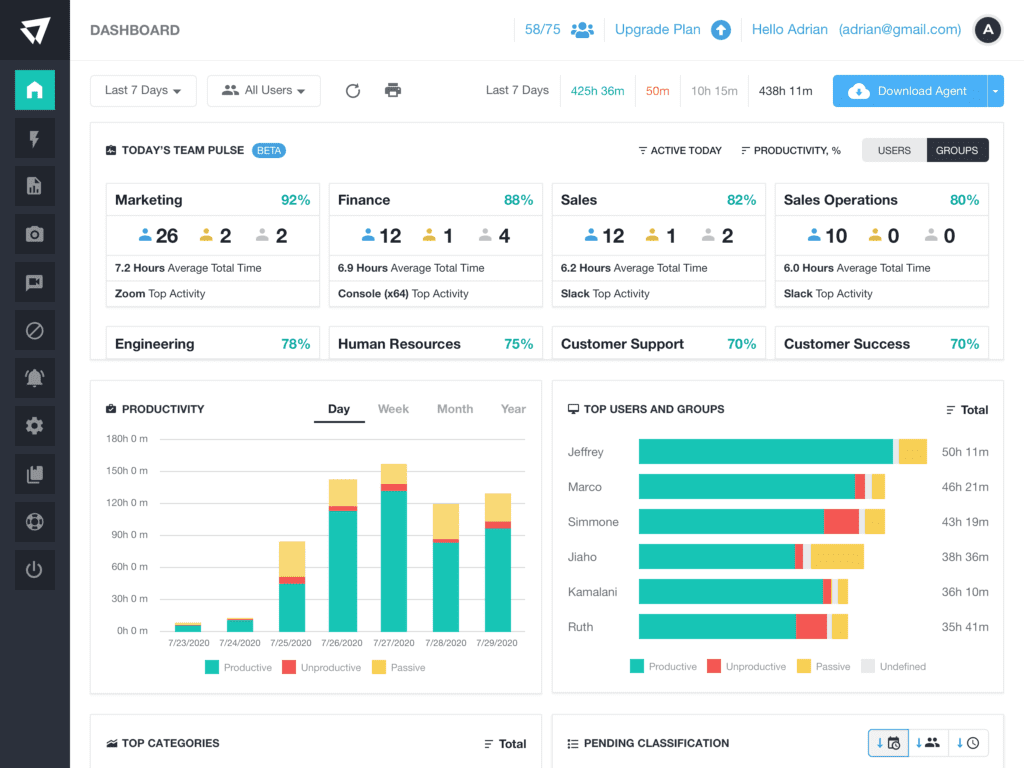
ActivTrak's workforce productivity and analytics dashboard

ActivTrak’s cloud-based platform allows teams to understand how people work based on user activity data that’s collected and analyzed from the websites and applications employees regularly use. The data is populated into a real-time dashboard, which companies and their different teams can integrate with additional tools such as business intelligence (BI) solutions. 

With ActivTrak, teams can observe workforce behavior, learn behavioral patterns, glean insights around performance correlation and see which apps and tools are used the most in the workplace. Employers can use this information to optimize specific workflows and workforces by coaching employees to perform more effectively. ActivTrak encrypts all data and stores the information using the Google Cloud Platform (GCP), which also allows companies to leverage GCP’s capabilities for analytics, AI and security.

ActivTrak’s key features include:

  • Dashboard: Quick visual summaries of key user activities with drill down for further details.
  • Activity Reports: Reports that locate unbalanced work time patterns, measure employee productivity, identify top performers, and understand application and website usage patterns.
  • Team Productivity Pulse: Live dashboard with snapshots of team member productivity data, employee availability status such as active, passive or offline, applications being worked on, and the number of hours worked and most often used work application for each employee.
  • Activity Alarms: Pre-built or customized alarms used to set boundaries or restrictions on social media site usage, monitor USB device activity to protect copying of sensitive data and establish user risk scores with severity levels to understand activities out of compliance.
  • Activity & Productivity Classification: Library of applications and websites employers use to understand how employees work. ActivTrak automatically classifies productivity and categories of common applications and websites, but it can be customized for an organization or team’s unique needs.
  • Data Connect: Analytics feature that provides customers with direct access to key user behavioral activity data to query against and integrate with external BI data visualization tools like Tableau, Microsoft Power BI, Google Data Studio and other business data sources.
  • Website Blocking: Prevents visits to websites to ensure productivity and security.

This is just the beginning for ActivTrak. The company’s 2021 roadmap includes benchmarks of baseline behaviors for users to improve on, as well as access to a personal productivity dashboard so employees can receive insights into their own work habits in real-time. ActivTrak is also boosting integrations to commonly used tools, having recently added Microsoft Teams so that insights can be delivered to users within their existing workflows.

Experienced leadership and expertise puts ActivTrak ahead of the curve

ActivTrak was founded eight years ago with the mission of helping companies understand how their teams perform. Since then, the Austin-based company has brought on new CEO Rita Selvaggi, CRO Justin Endres, CMO Shanel Vandergriff, Head of Operations Heidi Farris, VP Products Javier Aldrete and SVP Engineering Matt Finlayson among others, and has grown to be recognized by SXSW as a leading innovator and by PCMag as the best monitoring software for productivity tracking.

Prior to ActivTrak, Rita, Justin and Shanel held senior roles at AlienVault, the cybersecurity firm that was acquired by AT&T in 2018. Before that, the trio also worked together at SolarWinds leading up to the company’s IPO in 2009. We were drawn to the team given their proven track record of building great technology products and profound operational experience with high-velocity mid-market sales models. Their first decade of working together was an incredible success, and we expect the coming years to be no different. 

We also connected with Rita and the team on a personal level. They are down to earth, yet incredibly driven individuals. And both Nino and Rita share a Croatian and Italian background. Nino is Crotian and spent several years living in Italy, and Rita is of Croatian and Italian heritage.

ActivTrak’s best-in-class platform, paired with a management team with a sterling track record, has us looking forward to a bright future and the opportunity to build a company of consequence. 

 

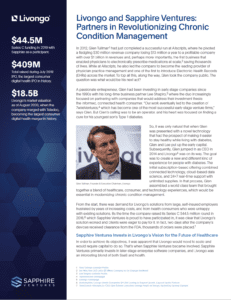
Livongo and Sapphire Ventures: Partners in Revolutionizing Chronic Condition Management

Launched in 2014 by Glen Tullman, Livongo was founded to empower people with chronic conditions to live better and healthier lives, beginning with diabetes. More than six years later, Livongo has gone above and beyond its initial offering to help people around the country manage numerous chronic conditions. And in July 2019, Livongo went public, marking the largest digital health IPO ever. Most recently, the company announced a merger with Teledoc, valuing the company at $18.5B and becoming the largest consumer digital health merger in history.

From the start, there was demand for Livongo’s solutions from large, self-insured employers, frustrated by years of increasing costs, and from health consumers who were unhappy with existing solutions. By the time the company raised its Series C $44.5 million round in 2016, it was clear that Livongo’s solution worked and clients were eager to pay for it. In fact, two days after the company’s devices received clearance from the FDA, thousands of orders were placed.

Sapphire Ventures is proud to have participated in Livongo’s Series C fund raise, and since then, has partnered with Glen and the team to help place several key executives, facilitate meaningful business introductions and drive awareness for Livongo and its mission to improve the health and living conditions for meaningful sections of the population. We are so excited by Livongo’s journey and our partnership that we captured our  journey together in the following case study.

Read the case study here


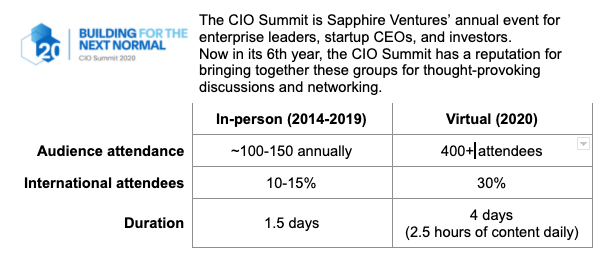
Building the Next Normal: 5 Key Insights for CMOs Delivering Virtual Events from Someone Who Knows

Like most companies, Sapphire Ventures converted all of our marketing events to virtual experiences at the outset of the Covid-19 pandemic. 

And, like many others, we initially thought of Zoom as our default home for events for the foreseeable future.

However — while Zoom (and Google Hangouts and Microsoft Teams) have served us well for webinars, roundtables and virtual cocktail hours — we quickly realized it would take far more functionality to to deliver the immersive, high-quality experience we wanted for Sapphire’s annual, large-format CIO Summit. 

Even in our initial steps, we quickly realized producing virtual events requires thought, time, organization and planning on par with any similar in-person event.

For CMOs currently developing their own event strategies, here are five key insights essential to producing a virtual summit from beginning-to-end.

1. Set the stage: A virtual event is not “just another” online meeting 

Without the physical venue, the medium is the message with virtual events.  That’s why a lowest-common denominator tech experience like Zoom or Teams doesn’t translate well to hosting a multi-day event with 30+ sessions, 50+ speakers and hundreds of C-level attendees.

When you move to a virtual summit, Dwight Eisenhower’s quote “Plans are useless. Planning is everything” becomes even more applicable. That’s because in addition to your typical content and event plan, you’re going to have the added complication of delivering your event to and from everyone’s home.  The best laid plans go out the window as soon as your speakers’ Wifi goes down, someone looks like they’re broadcasting from a cave due to poor lighting, or the dog will bark at the most important part of a keynote.

You have to accept that you can’t control everything, but once you shift your mindset from this being “just another Zoom” and start planning for what could happen, you’ll be able to focus on the attendee experience you really want to deliver — and where things are likely to break. 

Spoiler Alert: Something will “break” during your event. Take my word for it. In the planning process, identify what levers and knobs you can pull in the moment to avoid failure.  In Eisenhower’s words: “planning is everything.”

2. Don’t cheap out: virtual and physical events are more alike than you think

In my experience, a quality virtual event is no less expensive or complex to produce than a physical gathering. Full stop. 

When we started working on the CIO Summit, I was stunned at the initial cost estimates. I knew we would need to pull down a whole new technology stack, but I thought for sure that would still be a fraction of what a comparable, in-person event would look like.

Then, after receiving almost identical bids from several production agencies, I realized we were thinking about it all wrong.

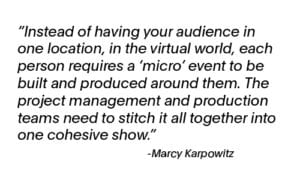
“For in-person events, you are generally dealing with one venue or vendor that covers an array of costs: the space, existing infrastructure, and an execution and support team,” explains Marcy Karpowitz, owner of MKMCreative and our eventual partner on the CIO Summit. “The same goes for your A/V where you have someone delivering sound, lighting, technical expertise, etc. Some of the fixed costs are spread across multiple speakers or activations, which provides the opportunity to move budget around and potentially gain economies of scale. In the virtual world, you have to purpose-build the infrastructure around the show’s objectives, elements and each participant’s needs.”

Because of this purpose-built model, costs tend to be higher as no “off-the-shelf-one-stop-shop” virtual solution exists. That means you have to stitch together a variety of solutions to deliver the seamless registration, content, and networking experiences you want attendees to have.

You have to realize that in a virtual environment, your company has become a media company and your content is a product you are selling.  To be successful you have to take on the cost of producing and distributing your content.  Few CMOs are used to paying the full cost of distribution, which means the cost of the additional technology, equipment, and expertise can be surprising if you’re still thinking about this like a physical event.

3. Plan with strategic intent: Virtual events are conversation starters, not deal closers

Historically, most marketers think about events as moments in time; they’re programs you produce and then you move on. In the virtual world, you have the opportunity to shift your organization’s perspective from events as a point solution, to their being the start of a community you can engage – through multiple channels, campaigns and points in time.

In other words, if you’re not thinking about your virtual event as the start of a year-long campaign, you’re leaving value on the table. 

That means CMOs need to allocate more time, planning and resources to post-show activations (more on this #5 below) across your go-to-market organization. To maximize the value of the larger audience you can reach online, you need to develop customer journeys that keep the conversation going. This will require an audience-based approach where your touchpoints can vary from direct email to social to sales outreach and even follow-on events. 

4. Package the value: Virtual events provide better data, but value can be difficult to articulate

I’ve talked to numerous people who have had difficulty selling even their long-time sponsors on virtual event sponsorships. I attribute this to two issues:

  • Event producers haven’t been able to articulate the true value of virtual events.
  • Sponsors haven’t shifted their mindset to embrace the inherent benefits of digital.

In a physical world, sponsors were happy to have their brand associated with a show, speakers on stage. They could pick up some business cards (or scan some QR codes) at their booth, network in the crowd, and look potential customers in the eyes. All of the same opportunities exist with virtual events, only with greater value because of the richer targeting and engagement data.

For example, in the virtual world, not only can you get someone’s contact information, you can see what sessions they say they’re interested in, what sessions they actually went to, how long they stayed, who they shared your content with, whether they asked a question, and whether they took any follow up action. All of these are more granular signals of purchase intent or interest in a sponsor’s offerings.  

Event producers need to spend more time articulating how companies can take advantage of this value, and marketers on the sponsoring side of the equation will need to evolve their thinking. One sponsor who at our CIO Summit, Silicon Valley Bank, is already ahead of the curve.

Rather than relying on the same activations used in-person, SVB delivered: 

  • Highly-quality explainer video detailing their services that ran before every main session
  • Senior executives to deliver an overview of each day’s content and its relevance to SVB’s mission 
  • Downloadable market report as value-add content to what was being delivered on stage.

5. Prioritize post-show activities: You don’t get to strike the stage and go home

In organizing a typical in-person event, most time and resources go towards the pre-event and day-of efforts: attracting registrations, programming the content, delivering the content. Once the post-show clean up is over and you’ve handed off the leads to the sales team, there’s relatively little marketing follow-up required.

Virtual events are completely different. The investment of marketing resources needs to be evenly distributed before, during and after the main event. That’s because the virtual world generates so many assets, data, and interactions that your marketers not only should, but must, plan on leveraging them after the show, or you risk losing the majority of the potential value you created.  

Shifting your mindset to think of virtual events as a starting point — and not a singular moment in time — can help you realign your efforts and priorities.  Your investment in post-show planning and activities is where you will earn this value.

Building for the Next Normal

Most of us look forward to a world where we can host in-person events again. While virtual events have their unique advantages, they can never replace the energy of a conference full of intelligent colleagues and competitors, where the chorus of conversations strike new deals, partnerships and friendships.

While physical events will return in some capacity in the future, the trend of virtual and hybrid events will continue to accelerate. They, too, have their unique advantages, especially in efficiently bringing together parties across geographies. And so all marketers will need to adjust to the digital environment knowing that technologies, best practices and even relationships with our audiences are all rapidly evolving.

For marketers planning a virtual event, I wish you the best and hope these insights help you deliver an amazing experience. If you have additional lessons you’d like to share and best practices from your own virtual event experience, I’d love to hear about them at [email protected].

Introducing the CRO Edition of the 2020 CIO Innovation Index: Startup Engagement Trends for Today’s Revenue Leaders

If it wasn’t evident before, it sure is now. The enterprise technology landscape is evolving, and it’s evolving fast due to COVID-19. As a result, the way in which startup sales teams are engaging with enterprises is changing too. 

Last month, we released the 2020 CIO Innovation Index: Startup Engagement Trends for the Crisis CIO. We surveyed 100+ CIOs, including IT leaders at AEG Worldwide, Avnet, Blue Diamond, Flex, Kao and Kraft Heinz to understand what emerging technologies enterprise CIOs are prioritizing, how they’re working with startups and what CIOs themselves are doing to drive innovation.

As we evaluated the data and trends, we realized the report has implications for startup CROs and revenue leaders, so we developed the CRO Edition of the 2020 CIO Innovation Index. This new report gives startups visibility into where enterprises are looking for startup technologies, provides them with guidance on how best to get noticed and how to develop successful commercial relationships with them.

So how does the 2020 CIO Innovation Index help CROs and startups? It provides data-driven evidence on key go-to-market strategies such as:

  • How COVID-19 has impacted enterprise technology buyers priorities
  • The role of proof-of-concepts in enterprise sales processes and the keys to making them successful
  • The technology areas where enterprises are more inclined to work with startups versus incumbent technology vendors
  • The best ways to get your startups and solution noticed by CIOs and large enterprise IT buyers
  • Ways in which CIOs are working with startups beyond being buyers of technology

Our hope is the data and subsequent GTM strategies in our report help you lead your revenue-driving organization to continued success in 2020 and beyond!

DOWNLOAD THE REPORT


Securing Apps From the Very Beginning: Why Sapphire Ventures is Excited to Partner with StackHawk

Sapphire Ventures is excited to lead StackHawk’s Series A funding round, and to work with founder and CEO Joni Klippert and the team. StackHawk is an innovative cybersecurity startup that sits at the intersection of what we believe to be two of the most robust, high-growth technology investment sectors: DevOps and Cybersecurity. As software eats more and more of the world, it’s critical to ensure that this software is secure.  

By bringing together developer operations (DevOps) and cybersecurity in the open-source world, StackHawk is taking a brand new approach to an existing sector of security called Dynamic Application Security Testing (DAST). With its platform, StackHawk enables software developers to make sure that the software code they’re producing is secure as they’re writing it, and prior to release.

Here’s more on why we’re so excited about StackHawk:

Baking security into the software development lifecycle

Most of the time, developers build and publish code to live environments before security testing takes place. If errors are found, the security group has to work with developers to make updates. Not only does this allow security issues into live environments,  but it can lead to tension between developers and the security group.

In addition many legacy offerings, which are still frequently used today, were built for security and not development, so they operate on software already in production. As a result, traditional DAST tools are expensive and are primarily used after a product has shipped, if at all. StackHawk introduces a new way to uncover security flaws by finding vulnerabilities early in the software development process. This is part of a new and growing “shift left” movement, which delivers numerous benefits to developers and the companies they work for, including cost cutting due to less testing required, a quicker path for apps to get to market and fewer unexpected errors when an app goes live.

With its developer-first approach, StackHawk provides a set of workflows and integrations around a core DAST engine based on an OWASP open source web-app scanner called Zed Attack Proxy (ZAP). StackHawk can be integrated into a project’s CI/CD pipeline from the start, ensuring common vulnerabilities are found and resolved before an application is in production. The platform is deployed via Docker and integrates with tools already used in the development workflow like Jenkins, GitHub Actions, and CircleCI (a Sapphire investment), as well as workflow tools like DataDog, Slack and Jira.

A burgeoning market with opportunity for rapid growth

StackHawk is well positioned to succeed in a growing business segment. The application security market was recently valued at $2.8 billion, and is expected to grow to $9 billion by 2022, according to MarketsandMarkets estimates. The increased usage of gaming apps, social media platforms and ecommerce apps are all key drivers of economic activity.

Meanwhile, as app usage rises, the attack surface for applications is quickly expanding. Cloud and mobile apps, APIs and IoT solutions are all areas where we expect to see more security risk. As the number of exposures for these apps increases, so too will the need for security. 

Last but not least, today’s apps are more frequently built on open-source components that can benefit from testing, a fact painfully borne out by the 2017 Equifax breach resulting from an Apache Struts RCE vulnerability. The data breach exposed the personal information of 147 million people, making it one of the largest cyber crimes related to identity theft. 

A team with success to look back and forward on

StackHawk was founded in July 2019 by Chief Executive Officer Joni Klippert, Chief Operating Officer Ryan Severns and Chief Security Officer Scott Gerlach–a trio with an impressive record well before their latest project.

Prior to StackHawk, Joni oversaw product and Ryan was responsible for marketing at VictorOps, an alerting and incident management company bought by Splunk in 2018 for $120 million. Scott was head of security for Twilio and SendGrid. The three founders have a proven track record of serving customers in DevOps and security. Furthermore, Joni is a charismatic and intelligent leader, and the team is extremely knowledgeable of the space, which shows. In our discussions, we were especially inspired by their motivation to become the most developer-friendly security product.

With this new funding, we are excited to see the StackHawk team continue to expand its Dynamic Application Security Testing capabilities, grow the open source ZAP project and get their product in the hands of the growing ranks of DevOps teams at companies both small and large. 

We’re excited to have StackHawk  join a long list of developer-focused Sapphire portfolio companies, including current investments such as Auth0, CircleCI, Contentful and InfluxData, and recently exited companies such as JFrog (NASDAQ: FROG), Portworx (Acq. by Pure Storage), Segment (Acq. by Twilio) and Sumo Logic (NASDAQ: SUMO). And we couldn’t be more thrilled to partner with StackHawk on its mission to make the digital world safer for thousands of developers and millions of users!


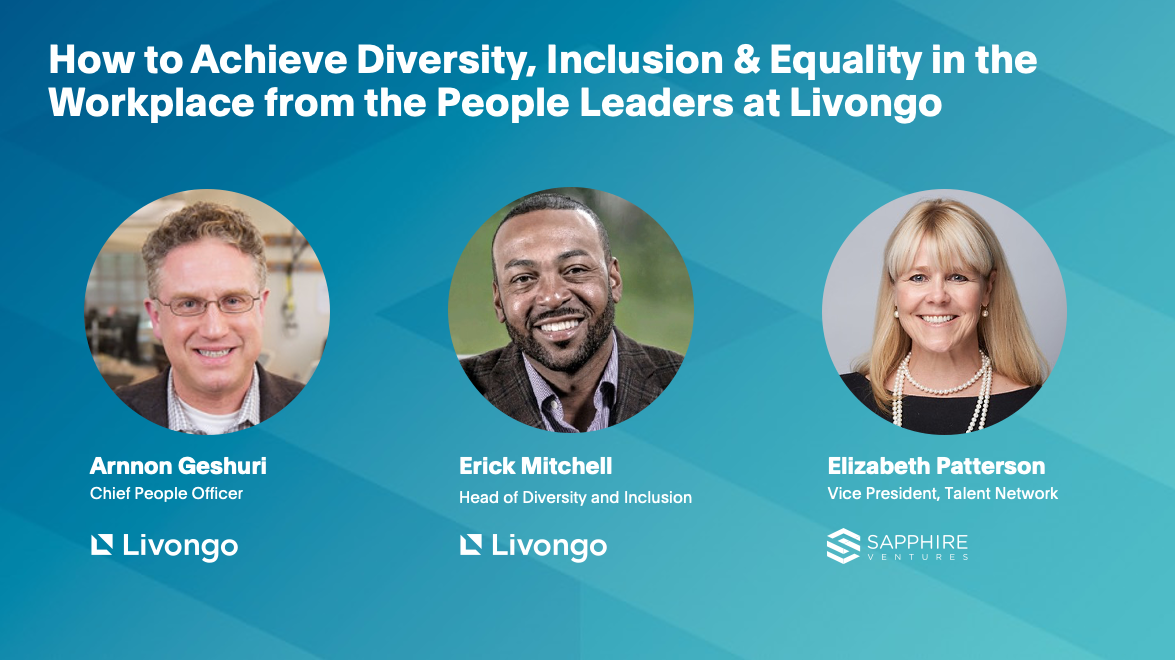
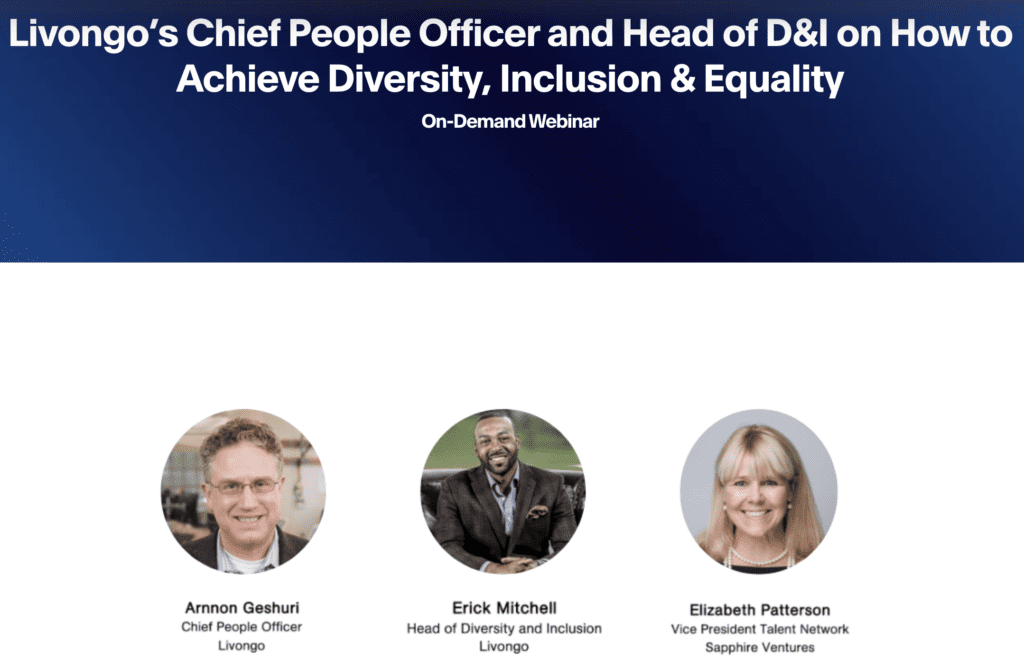
How to Achieve Diversity, Inclusion & Equality in the Workplace from the People Leaders at Livongo

When Arnnon Geshuri joined Livongo in 2017, the healthcare company had approximately 100 employees. No stranger to growth—previously a human resources leader at Google and Tesla—Geshuri guided Livongo’s workforce as it multiplied to more than 700 this year.

Livongo, a leader in chronic condition management, reached a $18.5 billion merger agreement with Teledoc Health and previously, a Sapphire investment, has been different from much of the tech sector.

While the broader tech industry has struggled to move the needle for years on changing the makeup of disproportionately white and male workers, Livongo has been able to achieve gender equality and has prioritized diversity and inclusion efforts in order to boost employee engagement and reduce attrition.

This emphasis on equality in the workplace has led Livongo to report an attrition rate of less than five percent and an employee engagement score that’s consistently around 85 percent. But the work is never done when it comes to diversity, inclusion and equality. Earlier this year, Livongo hired Erick Mitchell as head of D&I to bring his years of experience in working on ethics and diversity issues in the public and private sector to the company

Last week, Sapphire welcomed Arnnon and Erick to talk about how Livongo has been able to achieve diversity, inclusion and equality in the workplace and to share best practices for other companies who want to improve representation in their workforce.

TUNE-IN TO THIS ON-DEMAND WEBINAR 

In this hour-long webinar, you’ll learn from these people leaders about how diversity, inclusion and equality can stimulate business growth and make for a stronger, better workforce. Topics include:

Diversity, inclusion and equality need a structural foundation:

Arnnon and Erick kick-off the webinar by explaining how Livongo has built its organizational practices around six core tenets:

  1. Fostering a culture of learning
  2. Encouraging the sharing of ideas
  3. Full leadership support, across the  C-suite 
  4. Hiring for culture add, not culture fit
  5. Emotionally intelligent managers that listen
  6. Using feedback and data to identify gaps

“When you build all six of these together, you really create the virtuous cycle,” said Erick. “It’s self-correcting and the trajectory is quite extraordinary. And then you can rest your D&I efforts on top of a healthy environment.”

Companies have to acknowledge faults and set accountable goals

Achieving diversity, inclusion and equality isn’t easy. It takes understanding where you need to improve and clear metrics that hold the entire business responsible. Erick explains how “being vulnerable and transparent” about data helped Livongo obtain gender equity. In a major step, earlier this year, the company made all of its D&I statistics available internally

“Acknowledge where there is room for improvement,” he said, adding that companies should set accountability goals around D&I like they would around any other project. “We didn’t just talk about diversity and inclusion, we made it a corporate goal that we expected people to meet.”

Solving unconscious bias is a business imperative, but it’s only one piece: 

Arnnon and Erick also address how to deal with unconscious bias, while situating it as one part of a larger set of diversity obstacles. “We look at it from a business standpoint,” said Erick. “Where could our biases be creating barriers to our relationships with clients, to us better understanding our members? From a sales perspective, could our biases be impacting the way we are reaching out to clients or even who we determine a client could be?”

Livongo, however, doesn’t tick one box and then pat itself on the back, Arnnon explained. “A lot of times companies will go in and just say, all right, recruiting: let’s do unconscious bias training, let’s check a box and we’re good,” he said. “That doesn’t work. It only addresses a small fraction of the ecosystem that you have to analyze and look at from start to finish.”

Start now! 

The biggest key to diversity, inclusion and equality, according to Erick, is getting your act together immediately. “Start now. It is so much harder to change a culture, processes and norms down the road,” he added. “I understand with startups its growth, growth, growth, but make sure that your people, your organization, your culture is growing with you.”

Hear from these thoughtful leaders on diversity in technology and how any company can improve their diversity efforts. The conversation with Sapphire is presented here in full.


Since We Last Spoke: Highspot’s CEO on the Importance of Business Agility During COVID-19 and Beyond

The age-old cliche “expect the unexpected” has turned into words to live by in 2020. Many businesses have felt this firsthand, having to rethink how they operate and drive revenue. While some industries have seen a surge in demand, others have been forced to get creative in order to stay afloat. Throughout it all, one thing’s for certain: agility has been key, and it will remain a priority post-COVID-19.

Highspot, a leader in revenue enablement and a Sapphire portfolio company, has been helping companies drive revenue since its founding in 2012. During these changing times and beyond, we believe that Highspot’s technology platform empowers businesses to get the most from their customer-facing teams. Just last week at the company’s first-ever customer conference Spark 2020, Highspot announced its unified revenue enablement platform, introducing new capabilities that allow revenue leaders to drive consistent revenue performance and connect go-to-market initiatives to business outcomes. 

Following the event, I caught up with Highspot CEO Robert Wahbe to hear about how Highspot is advancing the enablement category and helping companies everywhere thrive in any economy.  

Can you tell me about the current state of the enablement market?

It’s an exciting time to be in enablement. I remember when we founded Highspot in 2012, sales enablement was a nascent category. Fast forward eight years later, and the market has taken off. Enablement now empowers everyone who interacts with the customer, and analysts regard it as a multi-billion dollar category as companies across industries and geographies rely on it to drive growth.

The remote reality has only accelerated the pace of digital transformation and the need to unify go-to-market teams–revenue leaders are using enablement as not only a primary lever to virtually enable people today, but also to ensure they can drive business outcomes regardless of the environment tomorrow. In short–a huge opportunity lies ahead for enablement. Investors like Sapphire Ventures have taken note, and at Highspot we’re grateful to have their support as we continue to advance the category.  

We keep hearing that it’s a lopsided recession where certain industries are booming while others are just hanging on. How can the right kind of enablement support both sides of the spectrum?

It’s true–the effects of this downturn have been unequal. But regardless of economic opportunity, all companies need a cohesive approach to enabling their teams to respond with agility and turn strategies into action in the face of change. 

For businesses facing headwinds, customer acquisition is more difficult than ever. This makes customer retention the key to survival. Enablement supports post-sales teams in delivering amazing, holistic customer experiences that keep customers satisfied. It also gives sales teams the best chance at success, preparing them for the new reality awaiting them in the field. 

Companies flying on tailwinds were equally unprepared–facing challenges in the form of unexpected opportunities. Take Zoom for example: before the pandemic hit, Zoom was a popular business app. Now, it’s a cultural phenomenon. Many businesses that experienced rampant growth may not have had the necessary resources and processes in place to keep up, let alone capitalize. As leaders ask how they can enable their teams to make the most of the new opportunities that no one saw coming, they are turning to enablement to arm their teams with everything they need to know, say, show and do to make each new conversation count.  

Agility is incredibly important right now–no matter the industry, team or department. How does enablement drive agility for businesses? 

Enablement brings go-to-market teams together. From sales to marketing, each team has a clear picture of what the other teams are doing and what they’re working on together. When teams are in lockstep, it makes your organization more nimble, faster to act and ultimately, more efficient and effective. These functions can adapt more quickly, staying aligned in the midst of change.

What’s more, an end-to-end enablement platform that offers content, guidance, training, coaching, engagement and analytics helps companies get the most from their customer-facing teams. You can give your teams content paired with guidance on how to use that content, train them on it, measure how it’s working in the field, and then iterate to improve–all in relatively real time. With enablement, teams are much better prepared to respond to the unexpected than they would be otherwise. 

There are a lot of companies in the sales tech and enablement space. How is Highspot transforming the industry?

Our team is committed to the technology, function, practice and people of enablement. We believe there is incredible potential when individuals unite under a common mission, and as such we’ve made huge investments in supporting our community–from holding a customer conference designed to support knowledge sharing, to investing in Sales Enablement PRO, the world’s most sought-out source of sales enablement expertise with 10,000 members across the globe. Together, we can push the boundaries of our industry farther than Highspot ever could alone. 

From a technology perspective, Highspot strives to deliver beautifully-designed software with a spark of magic. For decades, enterprise software has been complex, difficult to use and even more difficult to learn. Highspot turned this norm on its head by using the principles of consumer design, inspired by popular applications. Just as Pinterest and Spotify delight users with flexible content organization, Highspot does the same for customer-facing teams around the world.

We remain focused on building capabilities natively with our extensible platform. This allows us to provide a user experience that is seamless and intuitive. Many of our features are powered by the same foundational technology, which reduces learning curves. For instance, if you’re a sales trainer and you know how to use SmartPages to make a play, then you already know how to create a training course. 

You recently launched new product capabilities to better help CROs and their teams drive revenue. Can you talk a little bit about that?

Introducing our unified revenue enablement platform at Spark 2020 was a milestone moment. Highspot now delivers content, guidance, training, coaching, engagement and 360-degree analytics–all wrapped up in one seamless solution. We’re proud to bring our customers industry-first capabilities that will fundamentally change the way they run their businesses. 

CROs can use Highspot’s Scorecards to answer three foundational questions: 

  • Does my customer-facing team understand the strategy? 
  • Are my customer-facing teams executing the strategy? 
  • Is the strategy driving business results? 

With a holistic view of the impact of go-to-market initiatives, leaders can pinpoint what’s working, what’s not and take action with their teams in real-time. The end result–consistent revenue performance and a direct line from go-to-market initiatives to business outcomes.  

What were some of the most interesting learnings coming out of your first customer conference Highspot Spark 2020?

As much as the current reality has been challenging for many companies, the recurring theme from our customers is that now is a time for reinvention. By using the current events as an impetus for change, enablement teams can reimagine everything from onboarding to outreach–improving internal experiences for teams and external experiences for customers. 

Many of our customers spoke to the broadening scope of enablement and how they are elevating their function to earn a seat at the table as a strategic business partner. There is a heightened need to get scientific about maximizing enablement’s potential–using data to quickly pivot strategies. 

And through it all, as things continue to inevitably change, teams of all sizes and industries are bringing the human element of business front and center–focusing on how they can improve company culture in a remote world, care for their people and delight their customers. At the end of the day, what will always matter most is putting people first. 


The Rise of Digital B2B Payments and Why We’re Excited about AvidXchange

The global payments market is enormous. The industry is $240 trillion in size, which is larger than the global GDP of roughly $85 trillion*. Over the past decade, startups and established players have capitalized on this opportunity by modernizing the payment process for consumers. But the business-to-business payments space, which is actually much larger than consumer payments, remains antiquated and ripe for disruption.

In recent years, consumers have benefited from payment innovations such as contactless payments, mobile wallets and other forms of digital payment-taking. For most of our personal finance needs, we no longer have to step foot into a bank, carry a credit card or write a paper check. These innovations, which have modernized and helped how consumers transact, have also improved the payment process for merchants. All of which have been made possible by disruptors in the space like Square, a Sapphire Ventures investment, which went public in 2015, Stripe and many others. 

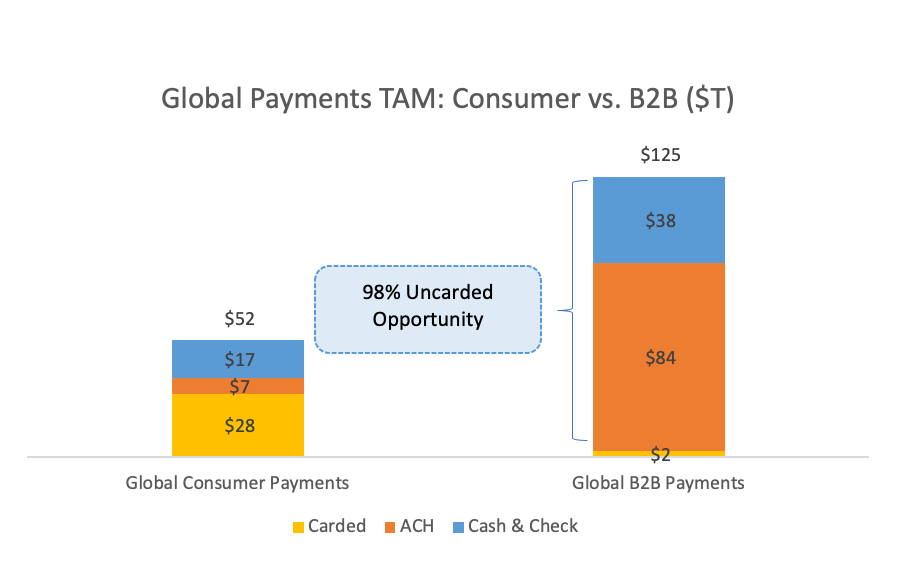
Interestingly enough, the B2B space has experienced far less innovation, despite it representing a bigger piece of the overall payments market. While the B2B payments total market size is at $125 trillion**, amazingly, less than two percent of B2B payments are made via credit and debit cards versus 54 percent for consumer payments***. The vast majority of invoices are still requested by mail and via paper or are emailed with PDF attachments, at best. And 98 percent of B2B payments continue to be made by writing paper checks and through bank ACH processing****.

Source: Credit suisse nice report – Payments Processors FinTech USA.pdf

For these reasons, we believe B2B payments to be one of the most interesting areas in fintech right now. The industry is in an early phase of disruption, and as we look ahead, the opportunity is vast. That’s why we’re excited to share that Sapphire has recently invested $35 million in AvidXchange, a leading B2B payments company that automates accounts payable and payment processes for the middle market.  

Sapphire Ventures and AvidXchange partner to streamline the B2B payment process

AvidXchange is a leading fintech company that provides B2B payment automation for thousands of businesses and their suppliers, processing more than 12 million payments annually*****. AvidXchange’s platform starts by digitizing paper or PDF invoices and automating accounts payable workflows. By digitizing these processes, and integrating with dozens of enterprise resource planning (ERP) and accounting systems, AvidXchange reduces the need for tedious paperwork. The result is an entire payment process and workflow that is faster, better organized and less error-prone from invoicing to payment.

By serving its invoice-paying customers, AvidXchange has also built a massive network of more than 680,000 suppliers across multiple industries. These suppliers benefit from the online workflows, and are able to receive expedited payment through virtual cards or AvidPay Direct, an enhanced ACH payment offering. As more invoice-paying customers onboard their suppliers, the AvidXchange network becomes a familiar standard both to buyers and suppliers, and increases the value to each side of the network. We believe network effects are a very compelling growth driver, as we’ve seen in other Sapphire portfolio companies like LinkedIn, Square, Docusign, OnDeck Capital and Ticketfly.

We’re thrilled to partner with Mike Praeger, the company’s co-Founder and CEO, and his team in their mission to automate B2B payments. Mike started AvidXchange 20 years ago as a small entrepreneurial group in Charlotte, North Carolina. Since then, the company has grown to become a leader in the digital B2B payments space with 1,500 employees worldwide.

We believe that there is a tremendous runway for growth for AvidXchange, and are excited to be part of the company’s journey in helping businesses embrace the future of payments.


*Global Payments Report 2019: Amid sustained growth, accelerating challenges demand bold actions

**Credit Suisse Report: Payments, Processors, & FinTech

***Credit Suisse Report: Payments, Processors, & FinTech

****Credit Suisse Report: Payments, Processors, & FinTech

*****Accounts Payable Automation | AP Software


Abstract city

The Startup’s Guide to Cloud Marketplaces eBook: How to Get Started and Drive Revenue with this Growing Sales Channel

The concept of marketplaces isn’t new. In fact, they’re prevalent in our everyday lives. Companies like Uber, Airbnb and Zillow have changed how we get around, plan vacations and buy homes. Behind these experiences are marketplaces that connect people willing to provide a service to consumers in need, and they have become an essential part of the many different decisions we make.

This same marketplace pervasiveness has transcended enterprise SaaS and B2B sales, and has transformed how buyers discover enterprise technologies. Called cloud marketplaces, this new and increasingly popular channel enables brands to digitally procure innovative technologies. And it’s a trend that’s taking off. Forrester estimates that by 2023, 17% of the $13 trillion U.S. B2B procurement market will be transacted online.

For startups, the benefits of being part of cloud marketplaces such as Amazon’s AWS Marketplace, Google Cloud Marketplace and Microsoft Azure Marketplace are huge. Those that leverage this emerging channel can:

  • Close larger deals
  • Shorten sales cycles
  • Reduce the complexity of navigating customer procurement processes 

Cloud marketplaces are also an attractive option for large enterprises with existing relationships with cloud vendors. Companies that turn to cloud marketplaces for new technologies benefit by:

  • Being assured that startups have met a certain level of security standards required by the cloud marketplace provider
  • Knowing they can retire the purchase value for startup technologies against their annual cloud spend commitments
  • Experiencing a much simpler procurement process, which standardizes contracts for buyers and sellers of software on the marketplace’s terms and agreements

The next wave of software sales is being heavily influenced by the rise of cloud marketplaces as large enterprises leverage them as part of their broader cloud IT procurement strategy. While the benefits of cloud marketplaces can be enormous, it’s a nascent channel for most startups and their revenue leaders. 

To help CEOs and go-to-market (GTM) leaders navigate and identify ways to leverage cloud marketplaces, we created The Startup’s Guide to Cloud Marketplaces eBook. In interviewing over 20 alliance executives from companies such as MongoDB, Snowflake and Sumo Logic, as well as cloud executives from AWS Marketplace, Google Cloud Marketplace and Microsoft our goal is to help startups:

  1. Decide whether their company should sell through a cloud marketplace
  2. Determine which cloud marketplace(s) to sell-through
  3. Demystify facts from fiction regarding cloud marketplaces
  4. Provide best practices on how to sell via cloud marketplaces effectively

                            Sapphire Ventures: The Startup’s Guide to Cloud Marketplaces from Rico Mallozzi

Please reach out with any questions: [email protected].

Baby, You Can Drive My Car ♫: Our Investment in Cazoo’s £240M Series D

Cazoo vane dropping off a car at a person's house

Cars have been symbols of personal freedom since long before the seminal Beatles song. But while owning a car is associated with choice, control, and independence, people rank buying a car as one of their least favorite experiences. The car dealer and an opaque and arduous process stand between them and the open road.

Online car marketplaces as well as car comparison and car discount sites have not significantly alleviated the pains of car buying. The experience has essentially stayed offline with low consumer satisfaction and trust and as one that many loathe.

Cazoo is setting out to fundamentally change the way used cars are purchased by enabling consumers to select from thousands of cars online, purchase the vehicle, and arrange delivery to their home in 72 hours. In the background, Cazoo utilizes proprietary data and pricing algorithms to purchase vehicles and offer consumers the best price. Cazoo then fully reconditions every car to ensure quality before listing them on the platform for purchase. Every car comes with a 7-day money back guarantee and a 90-day warranty and consumers can also obtain financing.

Today, we are thrilled to announce our investment in Cazoo’s £240M Series D financing joining world-class investors, including General Catalyst, Octopus, LocalGlobe, and Stride, among others.

We believe Cazoo has all the ingredients to build a category defining company.

Used cars are the largest retail segment of the UK economy with 8 million cars transacted worth £50B last year, according to the Society of Motor Manufacturers and Traders (SMMT). It is a highly fragmented market with over 12.5 thousand retailers and the largest having less than 3% market share. Of the cars traded, less than 1% are purchased online today. This compares to 61% of UK consumers who are willing to buy a used car online, according to CarGurus’s UK Sentiment Study. Covid-19 has accelerated this strong sentiment, and we believe that the resulting long-term macro trend of shifting from offline to online underpins the bold trajectory of Cazoo.

At Sapphire Ventures, we strive to partner with founders who have the vision and ambition to build Companies of Consequence. Alex Chesterman is that founder. We admire Alex for his unique ability to not only spot changing consumer trends in large markets, but also to execute on those opportunities flawlessly as evidenced through his prior companies Zoopla and LoveFilm. At Cazoo, Alex has put together a world class team that combines scaling experience and execution excellence, and we believe Cazoo is well on its way to becoming a European Company of Consequence.

Cazoo has already achieved impressive traction in its first year of operation with its differentiated business model in a large and untapped market. In addition to its large market, visionary leadership and experienced team, Cazoo also has the advantage of being able to look to America where Carvana and Vroom, two publicly listed companies, have established a successful playbook for the category. Cazoo may be able to leverage learnings from these companies in addition to benefiting from the structural advantages of the UK market with no slowing in sight to expand globally.

We are excited to be riding shotgun with Alex and team proverbially, and we look forward to supporting Cazoo in the next phase of company building.

“I am delighted to welcome Sapphire Ventures to our all-star investor syndicate and have their support for the next stage of our journey,” says Alex Chesterman.

The whole Sapphire team is buckled up and looking forward to the ride, or in other words:

Beep-beep’m, beep-beep, yeah