Sapphire & ThoughtSpot: Partners in Democratizing Data for Everyone

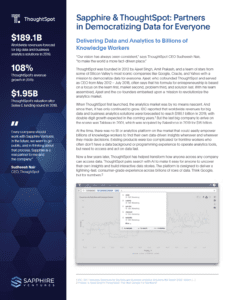
When ThoughtSpot first launched in 2012, the analytics market was by no means nascent. And since then, it has only continued to grow. IDC reported that worldwide revenues for big data and business analytics solutions were forecasted to reach $189.1 billion in 2019, with double digit growth expected in the coming years. But the last big company to arrive on the scene was Tableau in 2001, which was acquired by Salesforce in 2019 for $16 billion.

At the time, there was no BI or analytics platform on the market that could easily empower billions of knowledge workers to find their own data-driven insights whenever and wherever they made decisions. Existing products were too complicated for frontline workers who often don’t have a data background or programming experience to operate analytics tools, but need to access and act on data fast.

Now a few years later, ThoughtSpot has helped transform how anyone across any company can access data. ThoughtSpot pairs search with AI to make it easy for anyone to uncover their own insights and build interactive data stories. The platform is designed to deliver a lightning-fast, consumer-grade experience across billions of rows of data. Think Google, but for numbers.

We’ve always believed that what ThoughtSpot was building is revolutionary, so in 2018, we invested in ThoughtSpot’s Series D funding round. In 2019, we reaffirmed our commitment to the company by participating in ThoughtSpot’s Series E. Over the last few years, we’re had the privilege of partnering with CEO Sudheesh Nair and his team many times over. From helping to recruit key roles, to facilitating valuable business introductions and advocating for ThoughtSpot through our marketing and communications efforts, we’re excited to be on this journey together. So much so that we’ve pulled together a case study to capture our story to-date.

Read the case study here


Congratulations to Sumo Logic on the IPO! And for Revolutionizing DevSecOps with Continuous Intelligence

Today is another exciting day at Sapphire Ventures! Sumo Logic (NASDAQ: SUMO), a leader in continuous intelligence and one of our portfolio companies, became a company of consequence and went public on the NASDAQ Stock Market.

With its Continuous Intelligence Platform, Sumo Logic enables its customers to parse information collected from their enterprise apps and integrations to help pinpoint operational and security issues. Since its founding in 2010, the company has been a key player in the DevSecOps space, which stands for development, security and operations and is the philosophy of integrating security within DevOps. It involves creating a ‘Security as Code’ culture with ongoing, flexible collaboration between release engineers and security teams. Ultimately, the goal of DevSecOps and Sumo Logic has been to create new solutions for complex software development processes within an agile framework. 

We’re incredibly proud of the leadership team at Sumo Logic, and their achievement of leading the company to this point. From the time we first invested in Sumo Logic three years ago, we were certain that it would become a company of consequence, and we’ve been honored to partner with the team along their journey.

Release Software Faster, Secure Loopholes and Better Deliver Solutions with Sumo Logic

We live in a hyper competitive world where organizations can succeed or fail based on real-time intelligence. In other words, a company’s livelihood depends on how it understands and responds to what is happening inside their business, and the infrastructure that runs all its critical systems. 

Sumo Logic’s Continuous Intelligence Platform enables businesses to automate the collection, ingestion and analysis of application, infrastructure, security, and IoT data to derive actionable insights within seconds. The company helps customers:

  • Monitor and troubleshoot applications and cloud and on-premise infrastructure
  • Manage audit and compliance requirements
  • Rapidly detect and resolve modern security threats
  • Extract critical key performance indicators (KPIs) from various types of machine data to gain visibility into customer behavior, engagement and actions

Sumo Logic addresses the gaps in intelligence that arise from siloed development, operations and security teams. With Sumo Logic, organizations can implement a modern DevSecOps operating model, which involves ongoing, flexible collaboration among developers, release engineers, and security teams. The platform also automates the processes between software development and operations teams in order to build, test, secure and deploy modern applications faster. Simply put, Sumo Logic enables DevSecOps teams to gain more insights and intelligence in order to release software faster, optimize processes, secure loopholes and better deliver digital solutions to customers. 

Sumo Logic and Ramin Sayar Prove DevSecOps to be a Massive Opportunity 

We’ve been following Sumo Logic since 2013. And over the years, we’ve seen it evolve into an enterprise cloud-native analytics platform for DevSecOps teams that manage the transition of enterprise infrastructure from data-centers to public and hybrid clouds. While back then this was a growing market and one we felt was propelling forward, what struck us as more important was that the company had brought in Ramin Sayar as its new CEO at the end of 2014. 

Prior to Sumo Logic, Ramin spent nearly 20 years working in product management, strategy and leadership roles at enterprise technology companies including VMware, HP Software Technology, TIBCO and AOL. Since Ramin joined Sumo Logic, he accelerated the company’s transition to focus on the enterprise. So in June 2017, Sapphire Ventures led Sumo Logic’s Series F $75 million funding round. Since our investment, it has been extraordinary to see Ramin and his team grow the company across product, talent and revenues. 

“One of the reasons we partnered with Sapphire back in 2017 was because the investment team had a strong understanding of the market and business critical fundamentals that are required for a company to scale up to and through an IPO,” said Ramin Sayar, CEO of Sumo Logic.

Leading up to today’s IPO, the Sapphire investment and Portfolio Growth teams have worked with Sumo Logic on many different activities. Sapphire helped facilitate numerous customer and partner introductions, provided go-to-market support, helped with talent needs and enabled Sumo Logic to gain broader exposure across the enterprise community with various executive and industry events. We’ve had a fun ride together and are excited for this next stage of growth for Sumo Logic.

“Sapphire’s passion and commitment to helping Sumo Logic over the past few years has been impressive. As we approached going public, Sapphire was there with us lock-step, asking the right questions and providing useful advice. They have the best mix of investors, operators, technologists and services professionals. And they have a massive network to help with a variety of needs, which is probably one of the best kept secrets in the industry,” said Ramin Sayar, CEO of Sumo Logic.


Congratulations to JFrog! An Iconic IPO that Highlights the Coming-of-Age of DevOps

Today is an incredibly exciting day at Sapphire Ventures. Our portfolio company JFrog (NASDAQ: FROG), which is transforming how enterprises manage and release software updates, went public on the NASDAQ Stock Market. 

More than 10 years ago, the JFrog team developed the world’s first universal artifact platform. Artifacts are a by-product of the software development process, and the metadata accumulated about artifacts is essential for reusing code and improving the build process. Artifacts are commonly stored in a repository like JFrog so they can be retrieved on demand and shared across teams. By enabling software development and deployment teams to continuously and securely build, deploy and run software updates, JFrog ushered in an entirely new era in Development Operations (DevOps). 

We couldn’t be more proud of the JFrog management team, and their outstanding achievement of building a company of consequence and leading the company to become public. From our very first investment in JFrog in 2016, we knew what they were doing was special, and have been fortunate to have been part of their journey to-date.

JFrog Makes Software Liquid By Enabling Continuous Updates and Eliminating Versions

The majority of today’s businesses are software companies. As such, they depend on software to create applications and experiences to better engage with their customers, partners and employees. Which is why the continuous and reliable release of new software has become mission critical. Companies that fail to keep their software current or react to problems with timely updates risk losing  revenue, harming their brand’s reputation and even worse, threatening human safety and lives. 

As companies race to rapidly release software to meet the demands for new applications and ongoing updates, they need a new platform to support them. The traditional approach of different teams developing and deploying software is time-consuming and no longer effective. JFrog’s DevOps platform has played a powerful role in improving the process of building, securing and deploying software in this new era of infinitely scalable cloud computing.

JFrog changed the paradigm by encouraging collaboration and communication between software development and deployment teams, which has accelerated the pace of work, accommodated faster release schedules and improved the quality of software. With JFrog, there is no end state when it comes to software updates–it’s an always-on process that’s secure, continuous and delivers value to users, ultimately enabling a world of version-less software.

Our Big Bet on the JFrog Team, Company Vision and Future of DevOps Pays Off

Sapphire Ventures first met CEO and co-founder Shlomi Ben Haim and the JFrog team in November 2015. One of the first things that stood out to us was JFrog’s highly efficient financial metrics, which they continue to deliver on today. It was unlike something we’ve seen before. But even more appealing was the product vision JFrog’s Chief Data Scientist and co-Founder Fred Simon and Chief Technology Officer and co-Founder Yoav Landman outlined. The DevOps platform they were creating would accelerate the building and deployment of software, and made us believe that JFrog was on its way to become a company of consequence.

In January 2016, we participated in JFrog’s $50 million Series C financing. At the time, this was one of the largest DevOps investments made by a venture firm, and it was Sapphire’s first bet in the DevOps space. But Atlassian had just gone public around that time, so we were convinced that DevOps would be a huge market. It became clear to us that all software would be eventually developed, deployed and operated by the same team, which had to be agile and collaborative to respond quickly to customer demands and changing market needs.

Four years later, and we’ve been able to partner with Shlomi and JFrog many times over across our investment and Portfolio Growth teams, supporting business development, talent and more. Over the last several years, we’ve been able to build a true partnership and are thrilled for JFrog and this next chapter of the company’s growth as a public company. 

“We’re pleased to have partnered with Sapphire for more than four years now. From the beginning, the team has felt like family and we’ve received incredible value from the investment and services teams. It was extremely important for us to choose the right partners as we scaled the company. It’s not only about growth, but also the technology and community and, more than anything else, the culture that you care about as a founder. Jai Das has led this partnership on Sapphire’s end, and his vast experience as an investor coupled with the mindset of a developer is a unique combination you don’t see that often in the VC market–this has been a perfect match for us throughout our work together. I’m grateful and honored to be part of the Sapphire family both pre- and post-IPO.” — Shlomi Ben-Haim, CEO and co-Founder, JFrog.


Multiple people on a Zoom meeting

Virtual Annual Meetings are Here to Stay: Best Practices for Re-Imagining the AGM for our Remote World

Love them or hate them, virtual annual meetings (AGMs) are here to stay for now. I for one am a huge fan of annual meetings and think they are one of the more valuable interactions between LPs and GPs. I believe they’re so important that last year I published this piece providing GPs with an LPs perspective on how to run a high-value AGM. I followed up with some initial tips as the world started to change in March with all of us sheltering in place. 

Unfortunately, rather than being a temporary fix, it looks like AGMs will be held virtually for the foreseeable future. Given this shift, and my observations from numerous virtual annual meetings I have attended in the last couple months, I wanted to update our recommendations in advance of the Fall (now virtual) annual meeting season, and highlight how to adapt best practices from IRL to make the virtual format an asset, not a limitation.

Woman attending virtual meeting on laptop

My Advice for a Well-Run, Virtual AGM:

Before I begin, I want to note that there is no single recipe for success. The most successful AGMs are authentic to your culture and take the characteristics of your platform into consideration while providing your LPs with an engaging and informative experience.  My advice breaks down into 3 different categories: 

1. It’s (still) about the content —

At the end of the day, the main objective of an AGM is still about sharing information. LPs still want to know about the investments and any updates to the team and strategy, with a focus on information that cannot be gleaned from just reading quarterly reports or emailed communication. Since that generally includes topics such as segmenting the portfolio, sharing projections for funds’ ultimate returns, new investments or near-term liquidity, here are some considerations for handling those conversations in a virtual AGM:

  • Send decks in advance. That way you don’t need to read the material during the meeting and people can formulate questions in advance so the dialogue will (theoretically) be higher quality. 
  • Don’t practice “Death by PowerPoint.” If you have slides, great, but don’t just project / talk to slides for multiple hours. You need to think of the virtual AGM as more of a broadcast. To keep the energy up, you need to switch content formats and speakers, and it’s always more engaging to look at humans than PowerPoint.
  • CEO presentations are still important; hearing the story directly is always the best. We have seen various formats including 5-10 minute, well-edited videos by CEOS, panels of CEOs, or short individual presentations followed by Q&A. I’ve always been impressed with LocalGlobe’s thoughtful approach to incorporating the community with a separate virtual day with short company presentations that also involves other investors and founders. 
  • Don’t forget to discuss capital calls. One topic that LPs have been more interested in now more than historically is a rough capital call schedule (for the rest of the year). The stock market has gone back up to a high, but if the market shifts, it is helpful to have this information. 
  • Zoom on the Offensive:
    • You might be able to reach more people virtually within an LP organization since meetings are not confined to people who can travel or fit in a specific venue. Think of expanding your audience as a potentially good investment so more of an LP’s team is familiar and up to speed for the next fundraising. If you’re comfortable with it, you can also invite prospective LPs to your virtual AGM. We’ve seen numerous GPs do this over the last few months and expanded their relationship with prospective LPs for future funds. Ourselves included.
    • Inserting some pre-recorded or higher-quality video segments can help maintain the energy and help with your transitions between topics. Don’t do the whole AGM pre-recorded though. If the whole thing is pre-recorded, why bother having the meeting? Don’t lose the “realness” and spontaneity that comes from a live event.  
    • Breaking out smaller groups can actually be easier using Zoom. For example, you could use breakout groups with CEOs after their presentations so LPs can ask questions. Break-out rooms give the structure for smaller groups although if your LP base is small enough, you can just do it as a full group and let folks ask questions.

2. Be creative about interactions with your team and others in the “room” — 

One of the biggest elements missing from in-person AGMs are all the unscripted interactions that take place around the meeting. This includes interactions within your team and with LPs, which provide LPs with opportunities to ask specific questions, and get to know your team better. Additionally, LPs lose the time with other LPs or attendees to network, share insights or discuss trends. To help bridge this interactions gap:

  • Make sure you have multiple team members speak, and highlight any changes in the team as LPs cannot “see” the room.
  • Zoom on the Offensive:
    • As mentioned, you can use the breakout feature to make smaller groups. Perhaps breakouts can replace the coffee and cocktail conversations. One successful approach we have seen at conferences that could be transferable is assigning attendees to breakouts with various partners to talk about the market or for general Q&A.
    • None of the AGMs I’ve been to have done this, but I think it would be awesome to create an interactive portion of an annual meeting to get LP’s feedback on the market. What are LPs seeing/doing? Europe sounds like it is back up and running so are European LPs having a different business travel/meeting experience then we are in the US? Would endowments share what they are thinking about for 2021? What about hospital systems? It would be great for everyone to benefit from the insights but perhaps just those interested could go to a LP Zoom break-out post the annual meeting?
    • It’s also easier to do surveys, hand raising and other interactive elements with virtual meetings. Take a moment to ask the audience about their views or perspectives on the environment or other topics.
    • If a meeting is too large, the LPAC serves as its own type of breakout. You can hold the LPAC on a separate zoom either before or after the annual meeting. They can pre-run the deck if using it before to see if folks have questions/comments or do it after to get feedback or additional market sentiment.

3. Virtual is a different beast.  Design your day for the experience you want your audience to have.

  • Do the basics right. This isn’t just “another Zoom” and you should invest time into making sure you have a good tech foundation. Make sure to test your tech platform, have reliable wifi, and have a better webcam and mic set up than your laptop. At the same time, don’t worry too much about being perfect. Dropped coverage, slightly rocky speaker transitions or some type of technical issues may / will happen. They are common and we are all human.
  • Choose the right event platform. In terms of how you deliver your AGM, LPs are comfortable with Zoom, and most if not all already have it set up, so that is an easy option but there are plenty of virtual meeting platforms out there if you want to develop a different experience. 
  • Shorten the overall time of your AGM. It’s unlikely you want to sit straight for an 8-hour board meeting and it’s equally hard for an LP to be glued to a screen for that amount of time. We’ve found the ideal length of a virtual AGM is 2-3 hours. If you feel that you have a lot of essential content, you can break the meeting into two shorter sessions done on different days. Additionally, we would like to be there for the entire meeting, but the realities of sheltering in place can make it difficult. It is helpful to send a detailed agenda with a timeline (that you stick to) in advance to facilitate self-service of content.
  • Build in breaks. Even a shorter meeting could use some 5-10 minute bio breaks so that those of us with you don’t miss something important.
  • Take questions in multiple formats. Zoom can be hard for big groups to interact, and some people are shy or don’t want to ask a question when they don’t know who is “in the room.” For all of these reasons, it’s helpful to take questions both live and via chat.
  • Don’t forget to build memorable moments. Even when you have to host your AGM virtually, there’s still the opportunity to add small touches that will make your AGM more memorable. Do not feel like you have to send SWAG, but if there is something that you feel brings people together or makes the meeting feel more personal, by all means. T-shirts are always great but creative ideas could include cocktail kits or branded masks. We just had a couple GPs ask for our addresses and we are looking forward to what shows up in the mail.

We are all looking forward to being back together again in person at annual meetings. Between now and then we will all continue to live and learn the remote life and do the best we all can do. If you have other best practices from remote annual meetings to share, I’d love to hear from you. See you all in person as soon as we can.


Zoom’s Head of Global Business Development and Channel On How To Integrate Alliance Strategy With Revenue Strategy

Forming a strategic alliance with another company can help startups expand into new markets. While this may work in theory, partnerships sometimes fall apart due to misaligned revenue goals.

As a startup, before you invest too much time and resources into building alliances, it’s important to set goals based on product, revenue, or market penetration and growth, and gain buy-in from key stakeholders. The result of a well-integrated alliance and revenue strategy can enhance the value of your product, increase your marketing return, and accelerate pipeline and sales. 

To find out how companies can ensure that their alliance strategy delivers on revenue goals, I spoke with Laura Padilla, head of global business development and channel at Zoom.

Laura has spent herentire career building strategic partnerships that drive revenue. She firmly believes that alliances must be built around strategic growth goals, which requires a thoughtful allocation of time and resources.

Based on my discussion with Laura, here are the necessary resources, measurements and objectives that every startup should consider when aligning their alliance strategies with revenue objectives.

Build an alliance strategy around your product

One would think the first step in aligning alliance with revenue strategy would be to focus on your sales organization, but Laura suggests centering partner relationships around your company’s product goals first. That starts with assessing how each alliance decision you make helps to support your product strategy and proliferate your product’s adoption.

Once your company and partners are aligned on where the product is headed, you can begin discussing shared use-cases and integrations with partners. For example, partnerships helped catalyze Zoom’s growth beyond its core video conferencing services to a complete unified communications as a service (UCaaS) offering. This also allowed the company to gain traction with new customers and markets. 

Laura says that, ”Zoom Phone launched about a year ago, and the UCaaS community is highly entrenched with master agents—IT consultants who are experts in selling telephone communications and are well known for selling cloud PBX.”

The master agent networks were considered domain experts to the Zoom Phone’s product target audience, which made it clear that Zoom needed to build an alliance strategy with them. As a result, Zoom created a master agent program, which in 3-months grew to over 1,700 sub-agents who refer business to Zoom and receive ongoing commission payments based on referred leads. The quick success of the program is a direct result of making sure the product aligned with the channel. 

When creating partner programs, product teams need to have a central role. Master agents are one example of aligning sales with product strategy. Another is Zoom’s focus on its platform and marketplace where it’s expanding its APIs and SDK’s to ISVs looking to integrate their services with Zoom and offer a new value-added service. 

“Zoom’s partner team is working closely with product to find the right application integrations, build a platform story, and gain access into new verticals, customers and markets,” Laura says. In doing so, Zoom is able to expand use cases for its product, reaching new verticals such as healthcare and education. This is done through popular industry-specific external application integrations to Zoom’s products. For this to happen, the product team has to be willing to make the product accessible through APIs and SDKs. And the alliance team has to understand the product vision to identify the right partners to align with their vision.

Lastly, a company’s partnership should be assessed through two lenses when it comes to your product: does the partnership provide you with more access to your existing customer communities, or does it expand use-cases to help increase the addressable market for your product? If it doesn’t accomplish either goal then it most likely isn’t worth the invested resources.

Develop common goals and revenue objectives

Fighting internal and external battles can make partnerships unsuccessful. But creating common goals with your partners tied to revenue can help keep everyone aligned. Laura recommends quarterly reporting to keep track of these goals.

Identifying with your partner what those common goals are can be a challenge. Typically, Laura looks to achieve these four key characteristics in a partnership to best align on goals:

  • Do you both have executive sponsorship? Determine if both parties will invest the necessary resources and time to make this a success.
  • Are your product roadmaps aligned and committed to joint product integrations? Make sure what you are trying to build aligns to your shared objectives and that both of the companies involved product teams are committed to building a joint offering. 
  • Are you and your partner aligned on GTM strategies? Develop a mutual action plan on marketing, sales, and support.
  • Do you deliver market leadership to other organizations? Are you and the partner benefiting by gaining access to a new area, or strengthening your respective market leadership?

“You’ll need clear guidance on how success is defined, and sometimes it could take years of working with a partner in order to develop confidence around long-term returns,” Laura says. And once you have defined mutual goals it will usually result in a successful partnership.

“When both companies have shared [revenue and product] goals, and when executives are aligned around that, they unblock your partnership team to do the work they need to do,” Laura says.

Hire the right people to nurture alliances

To combine partnerships with revenue goals, you’ll need to create a specialized team to marry those functions and get projects across the finish line. “Partnerships are all about building trust, and your team is the ambassador of that trust,” says Laura.

Here’s how to structure your alliance team:

  • Hire an alliance manager. This person must be good at influencing all stakeholders in order to obtain buy-in for the alliance strategy.
  • Involve the product team. They’ll execute on building integrations and achieving shared product goals with the partner company.
  • Invest in partner sales personnel. Establish quotas or other revenue driven metrics for partner sales teams to help the company achieve the mutual revenue targets you define with your partners.

To drive a modern alliance strategy, hire people with a technical skill set to work closely with the product team. They’ll have to understand the ins and outs of your product and be connected to the design team to ensure customers engagements with technical integrations lead to the desired experience and conversion.

“We spend a lot of time [with the product team] on design. The hardest part is filling alliance roles…that can work with our design team on ways that help drive conversion. The best candidates were product managers in the past, and now they want to move into business development,” Laura says.

The alliance manager is also a critical position that’s tasked with driving shared goals between your company and the partner company. They will help establish cross-functionality, manage teams, and report to internal stakeholders on how the alliance strategy is doing against shared goals–both in terms of revenue and product roadmaps.

Measure your alliance strategy’s contribution to revenue

As the famous management thinker Peter Drucker’s said, “If you can’t measure it, you can’t improve it.” 

With partnership strategy, a truer statement could not be made. It’s very easy for a company to invest in channels and partners without ever tracking whether they are driving real business value. To do so, Laura suggests identifying the right KPIs for the right partner type. If your partner is a reseller, a technology partner, or ISV focusing on building a new value added service to resell, you will want to track them differently and as follows below:

Channel Type Desired Outcome KPIs
Traditional Partners: Resellers, VARs, GSIs Drive net new pipeline, increase adoption in existing customers through relationships and purchasing. fulfillment Number of qualified leads, new logos acquired, direct revenue generated 
Technical partnerships requiring Integrations Influence your company’s revenue rather than drive direct revenue. Utilization of integration, co-marketing activity, number of top-of-funnel leads, decrease in cost per leads
Platform or developer integration partners Build on top of your APIs and SDKs to bundle your solution into their offering. API and SDK utilization, revenue generated from monetization of API’s


The modern partnership is evolving

Technology is rapidly evolving. It’s changing how individuals and companies work, communicate, and reach constituents. And the modern partner ecosystem is changing too. 

Business development leaders need to think outside of the box and reimagine what partnerships matter to their company. They will have to determine how to approach these partnerships in the right way, and how to monetize them. 

The traditional VAR reseller model is evolving to be more focused on affiliates, referral partners, consultants, marketing partnerships, and platform partnerships. This requires a lot more strategy and thinking from leaders about how your partnership objectives are centered around product. You’ll need mutual goals and the right skills on your team to be successful. 

If you can follow the framework outlined above you will be well on your way to developing innovative and rewarding partnerships that drive revenue.


Investing in the Future of Live Video: Why Sapphire is Excited to Partner with Restream

We’re excited to announce today that we’re co-leading the $50 million Series A financing for Restream. Restream is a SaaS platform that allows video creators to easily live stream to multiple social media platforms such as Twitch, YouTube, LinkedIn, Twitter, Facebook and more than 30 other platforms simultaneously.

Over the last several years, live streaming has steadily gained momentum as a popular way for companies, entertainers, influencers and anyone who wants to broadcast video to reach wide audiences. Streaming technology is now sufficiently cheap and accessible to integrate into existing consumer products, such as social media and mobile apps, giving everyone the ability to stream or consume live video anytime, anywhere. COVID-19 has accelerated and amplified the live video phenomenon, and we expect these trends to continue to play out in a post-COVID environment.

When we first met Alex Khuda and the Restream team, we knew they were on to a big opportunity. The explosive growth and proliferation of use cases experienced by Restream in the past year has been impressive. Professional sports leagues are broadcasting games across social platforms via Restream, Global 2000 corporations are turning to the company to market their events, and thousands of churches bring people together through Restream’s live streaming platform. With this new funding, we’re thrilled to help Restream take live video to new levels. Here’s why we’re looking forward to partnering.

Helping broadcasters reach audiences unlike ever before

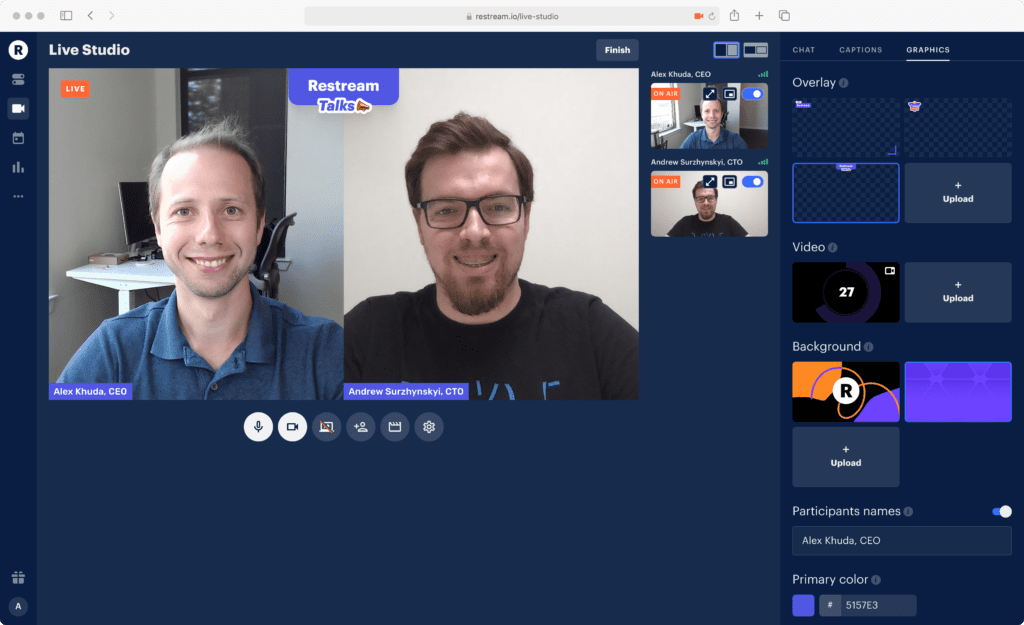
Restream makes broadcasting to a global audience simple. The platform removes the need for users to download streaming software by offering broadcast services directly from the browser. This ease of use has led to more than 95 million broadcasts delivered to over one billion viewers since the company launched. And by using its own infrastructure rather than relying on a cloud provider, Restream is able to support a community of more than two million creators that broadcast eight million monthly live streams to 750 million monthly viewers around the world.

With the launch of Restream Studio earlier this year, streamers are able to deliver a unified experience from original content creation to broadcasting to multi-streaming–all by using Restream. In addition, Restream’s analytics functionality helps users determine aggregate interactions across social media platforms, which is a particular advantage for enterprise broadcasters that use live streaming as part of their broader marketing strategy.

When Restream first launched several years ago, its initial adoption was particularly strong in the gaming community. Since then, Restream has grown to support a variety of verticals, such as politics, entertainment and corporate marketing. And the company has amassed 40,000 subscribers and 12 million users worldwide.

Restream is the first company we’ve seen that targets multi-platform live streaming as a core use-case. Along with Restream Studio and its analytics features, we believe that the company is well-positioned to become the de facto platform for streamers.

A sizeable market opportunity that’s ripe for expansion

We believe that Restream is in the right place at the right time. The global video streaming software market is growing 23 percent annually, and is expected to surpass $10 billion by 2023. A key reason for the growth in live streaming technology is that it has now become cost-effective enough to mass-produce and integrate into existing customer products and social media apps. This creates opportunities for brands and influencers to expand their market reach, and we believe Restream is well positioned to capitalize on the demand.

Over the last several months, Restream and the live streaming industry overall have benefited from mandated remote work and shelter-in-place orders, which have accelerated the need for live streaming capabilities. All types of businesses, organizations, creators, and individuals are turning to live streaming to take their events to the digital stage. For example, Presidential candidate Joe Biden has been using Restream regularly to engage voters on the campaign trail. Major technology companies like Salesforce have been relying on Restream to host webinars, conferences, and live talks. And this past April, The World Health Organization (WHO) used Restream to host the largest digital concert in history, One World Together at Home, reaching 25 million viewers cross-platform and raising over $120 million for COVID-19 relief efforts.

Experienced leadership with the right technical expertise

Alexander Khuda (left), Andrew Surzhynskyi (right)

What drew us to Restream wasn’t just the product and market opportunity, but also the company founders. Restream was founded in 2015 by Alex Khuda, CEO, and Andrew Surzhynskyi, CTO, both of whom are graduates of the National Technical University of Ukraine.

As we got to know Alex and Andrew, it became clear that they had the right expertise to build a platform that will revolutionize how live video content is distributed. As experienced developers and entrepreneurs, Alex and Andrew are product-centric and mission-driven. We’re excited to work with Alex, Andrew and the Restream team.

Together, we’ll amplify live video and pave the way for next-gen broadcasters!


3 Strategies Software Companies Can Borrow from the Open Source Cloud Playbook

Open source software has taken over the world. From contactless mobile payments to online grocery shopping, open source plays an important role in enabling the tech stack of every major company. However, a significant pain point is the complex infrastructure and system management involved in implementing and running the specific open source technology. Instead of dealing with configuration and infrastructure administration, companies and their developers prefer to spend resources on activities related to core business applications.

Fortunately, end users can now bypass complex infrastructure tasks as open source companies roll out fully-managed cloud products. The shift to the cloud has resulted in significant efficiencies for open source providers including faster monetization and scale. This is a critical development in the evolution of open source as a commercial model: the open source cloud.

While not every software company is open source, any infrastructure software company can take a page from the open source cloud playbook. Before we dive in, it’s important to understand how open source has evolved as a commercial model.

The evolution of open source as a commercial model

In the 1950s and 1960s, almost all software was written by academics and corporate researchers. Open source software was typically offered as a free add-on with hardware purchases. Projects were generally distributed under the principles of openness and cooperation. This meant that source code and modifications were made freely available for developers to share knowledge, fix bugs and create new functions. In fact, software was not considered copyrightable before the 1974 Commission on New Technological uses of Copyrighted Works (CONTU), which argued for the extension of copyright laws to computer programs.

Nevertheless, as operating systems and compilers evolved, software production costs dramatically rose relative to hardware. To increase revenue, selling software under a proprietary license became the norm, and the conventional wisdom was that open source would not work as a commercial model. After all, it’s hard to charge for “free” software. In addition, there is the classic tragedy-of-the-commons problem where most developers who use open source never contribute back meaningfully, according to Stack Overflow’s 2020 developer survey.

However, starting with Red Hat, open source companies have come a long way over three generations of monetization models. Let’s take a look:
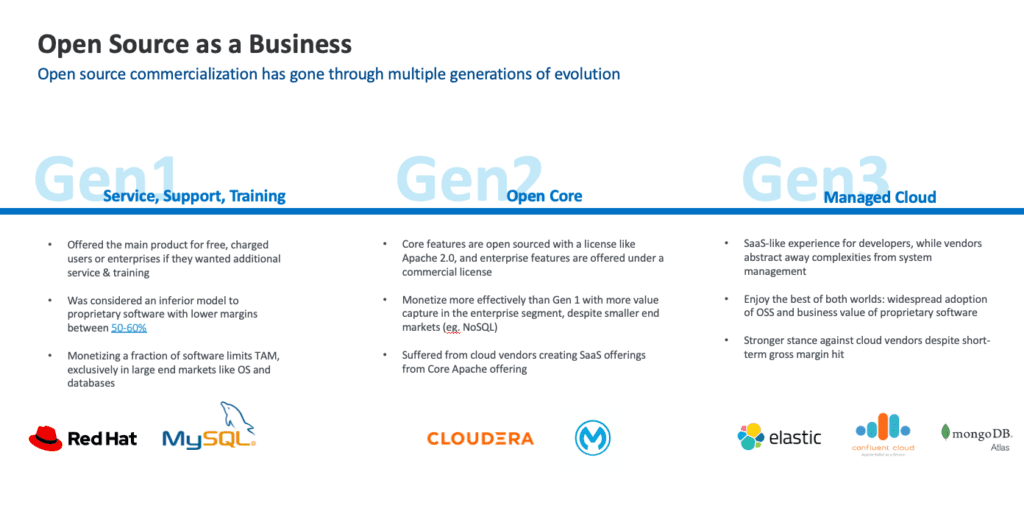
  • The first generation (Gen 1) of open source was all about selling technical support and training around the proprietary software. This approach helped address enterprise concerns regarding using open source at a large scale. But from a commercial standpoint, Gen 1 largely sold services and thus only captures a fraction of the total addressable market.
  • The second generation (Gen 2) introduced the Open Core model, which provided a way for open source companies to productize open source by surrounding core open source technologies with proprietary enterprise features (think fleet management, RBAC, advanced analytics, etc.) As a result, customers got to enjoy an enterprise-ready version of the open source product. While this was a step forward for open source, the onus of running the software package still would fall on the customer. An on-premise open core model precludes companies from getting the full benefits of bottom-up adoption of open source (for example, enterprise-scale deployment still requires heavy IT involvement), resulting in similar drawbacks traditional proprietary enterprise sales models showed. In addition, cloud vendors such as AWS created first-party SaaS offerings around open source projects, which took value away from the original open core vendor.
  • The third generation (Gen 3) solves the pain points of the previous generations by providing a managed cloud version of the open core product. The Gen 3 model handles system management of the specific open-core solution so customers and end users can focus on building better core business features with open source without worrying about system management. By centralizing the previously distributed complexity of managing infrastructure, Gen 3 provides open source vendors the best of both worlds: widespread adoption of open source and the business value of proprietary software. Companies realize these benefits by packaging not only an open core product, but also the resources (ex. compute and storage), and infrastructure management expertise (ex. labor savings). The technological complexity is hidden from view and managed by professionals, so customers can just enjoy the results. 

Naturally, open source software companies began to shift from the Gen 2 phase to the Gen 3 managed cloud phase much earlier in their enterprise life-cycle. For example, MongoDB and Elastic rolled out a cloud version around the time they went public. The current generation of high-flying open source companies such as Confluent and Databricks made the transition to the cloud when they hit an earlier revenue scale. Fast forward to today, many newer open source companies start by going cloud-only from day one. For example, a new set of companies such as Cypress monetize through an extension model — a separate paid cloud product that serves as a commercial extension to a completely free open source core. The open source product provides the developer a low-friction way to try the product. Once the usage propagates to other team members, the need for collaboration, governance and workflows lead the customer to the commercial product.  In this case, the value lies not so much in compute and storage or complex infrastructure management, but in providing a system of engagement that allows end users to tap into best practices

We recognize that not every infrastructure software company can be open source, but we do believe that any software company can learn from Gen 3 open source’s approach by adopting fully-managed, easy-to-use, freemium experiences. By applying the following three strategies, any software company can take a page from the open source cloud playbook to drive up sales velocity and realize better unit economics.

1. Consumption Pattern: Streamline monetization with resource-based pricing 

As open source companies move to a managed model, frictionless deployment and maintenance become key benefits. Enterprise end users demand turnkey solutions that deliver fast time-to-value and low ongoing overhead. By helping developers seamlessly bring projects to production, Gen 3 startups are also driving up sales velocity.

Simplified adoption streamlines the monetization experience for first-time users. Under a more traditional per-seat model, customers typically begin onboarding with a free version of the software, and value organically increases as they invite other team members. 

While some Gen 3 companies adopt more traditional pricing models, managed cloud models also lead to the proliferation of resource-based pricing. Monetization begins as users pay based on workloads, as well as processed and stored data. Although resource and usage-based pricing has traditionally been sold at a discount compared to subscription models due to potential volatility, the model better aligns customer value and pricing. Because of stronger alignment, companies such as MongoDB (Atlas) and Twilio have built very effective land-and-expand models and are seeing consistently high net dollar retention rates. 
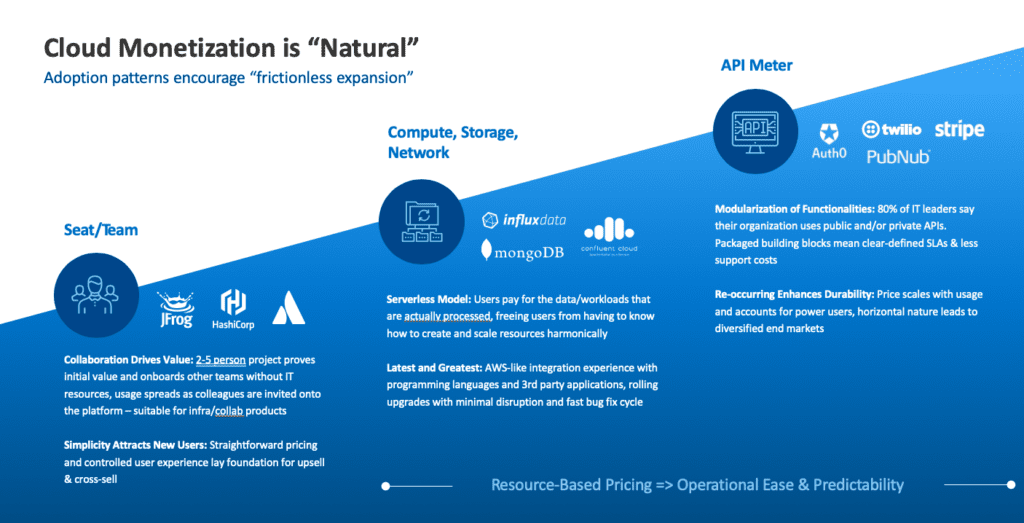
Done well, resource-based pricing enables companies to better capture the upside of expansion. “What we find is customers may just have one app and then that app grows,” said Dev Ittycheria, CEO of MongoDB. “But more typically, we find as soon as they launch one app, they very quickly start launching other apps because they find the value [of Atlas, MongoDB’s cloud database service] so compelling.”

The bottom line is that the cloud expands the total addressable market for open source offerings. The freemium model drives usage, and shifting to the cloud helps monetize that usage. Here’s how the cloud streamlines monetization: 

  1. Bottoms-up model drives monetization for free users — One of the hardest psychological monetization thresholds is to convert users from paying nothing to paying something. Cloud streamlines that experience and creates the potential to grow with the customer. 
  2. Accessible to companies that don’t have systems management — Cloud enables faster time-to-value, and managed products boost customer retention rates. End users love trying new products, but don’t enjoy deploying and managing infrastructure. Enterprises don’t want to invest in another generation of system administrators.
  3. Ride the wave of enterprises moving to the cloud — Due to COVID-19, enterprises have accelerated their move to the cloud for both greenfield projects and mainframe offloads. By simplifying the transition to the cloud, cloud products increase project success rates for those in pre-production. As a result, they become a department or firmwide application.

2. Product: Design products that deliver immediate value and reduce complexity 

What makes open source so powerful is that it’s driven by a passionate end user community. There’s a constant feedback loop enabling customers to work with open source cloud companies to improve the overall user experience. While the community aspect is very unique to open source, every company can design the product for their customer journey with the cloud acting as the feedback loop, providing granular visibility into future adoption and user behavior.

At the adoption phase of the customer journey, the cost of implementation is a key inhibitor to adoption. In some ways, the best counter-example is Amazon Web Services (AWS), whose 1st-party SaaS products “check the box,” but usually don’t match all of the features a best-of-breed vendor offers. Nevertheless, AWS oftentimes becomes the preferred choice because of the advantages associated with an out-of-the-box integration. Companies find that the seamlessness makes up for the nice-to-have features. Providing a product that offers low cost implementation, or low cost integration is crucial to adoption and driving immediate value. 

We witnessed how product design can drive customer value with MuleSoft (a Sapphire Ventures investment that was acquired by Salesforce in 2018), which provides integration software for connecting SaaS and enterprise applications in the cloud. At the time of our initial investment in 2011, MuleSoft only provided an on-prem solution, which was the case with most vendors in the ecosystem. The integration market was largely off cloud. So the strategy to roll out an Integration Platform as a Service (iPaaS) based on the Mule open source ESB known as MuleSoft’s CloudHub was not an obvious strategy. Starting as early as 2012, MuleSoft CloudHub went to market with what were then-fledging, but are now public SaaS ISVs, providing out-of-the-box integration from their SaaS application to other SaaS applications or on-prem systems like Oracle or SAP.

Coinciding with the rise of SaaS, MuleSoft’s CloudHub provided a cloud-age value prop: lightweight modules, pre-built turnkey connectors and a managed experience. This quickly drove faster adoption for MuleSoft and positively impacted the business. For large customers who weren’t ready for the cloud, MuleSoft introduced the Anypoint platform, which enables node deployment across on-prem and cloud. This flexible deployment approach removed friction by including a full platform for architectural flexibility, giving unlimited non-production cloud cores for free and showing consistent ROI measurements that beat the model and accelerated the jump to ELA (Enterprise License Agreement). In this case, MuleSoft didn’t lead with cloud in the sales pitch, but the cloud was a key enabler for faster adoption and expansion.

Product Design: Control Plane & Data Plane

That said, abstracting complexity away from the customer has its costs. By managing the complexity of running a specific service for the customer, vendors are indirectly taking control away from the customer. The cloud product itself has to have a solid data plane, providing capacity (as in CPU, memory, network, storage, etc.) so that the core application can actually run. The main challenge in building the data plane is to get the right set of infrastructure personnel (oftentimes very different from the core application team) who know how to architect the cloud product for performance, scalability and availability requirements. 

On the other hand, despite getting less attention, the control plane, which decides how the service operates and exposes APIs to define, deploy and lifecycle a platform or service is equally important. Vendors have to give customers the right level of control. This is especially true for the enterprise developer and end user community who want a simple, well-integrated user experience. The analogy here could be buying sneakers. For most customers, a 0.5 increment between size 7 and 8 is good enough. However, your most sophisticated customer (who might be willing to pay more) might demand size 7.2225, and have complete control over their cloud experience. Balancing simplicity for the majority of customers while satisfying optimization needs for sophisticated users is an important consideration. Ultimately, the product should give customers the option to toggle between price and capacity, and provide a consistent experience across different deployment models. 

3. GTM economics: The free trial is the holy grail

The cloud offers granular visibility into the customer journey. This feedback loop allows companies to see how customers navigate the signup process, how usage changes, and when customer success should get involved. That’s why the freemium model becomes a critical part of the go-to-market process. Perfecting the free trial experience is critical to generating strong usage and engagement, which in turn streamlines the sales process and leads to greater expansion opportunities down the line.

JFrog, a Sapphire Ventures portfolio company, is a DevOps software startup that has mastered the freemium experience, in our opinion. A vast majority of customers start using JFrog through the open source or free trial. These can be consumed either as a self-hosted downloadable solution, or as a SaaS cloud service. The company has built a predominantly inbound sales motion based on structured processes with a sizable data science team using analytical data derived from the funnel including usage patterns and other indicators based on aggregated data from SaaS. This funnel machinery allows JFrog to deliver value at each stage of the customer journey.
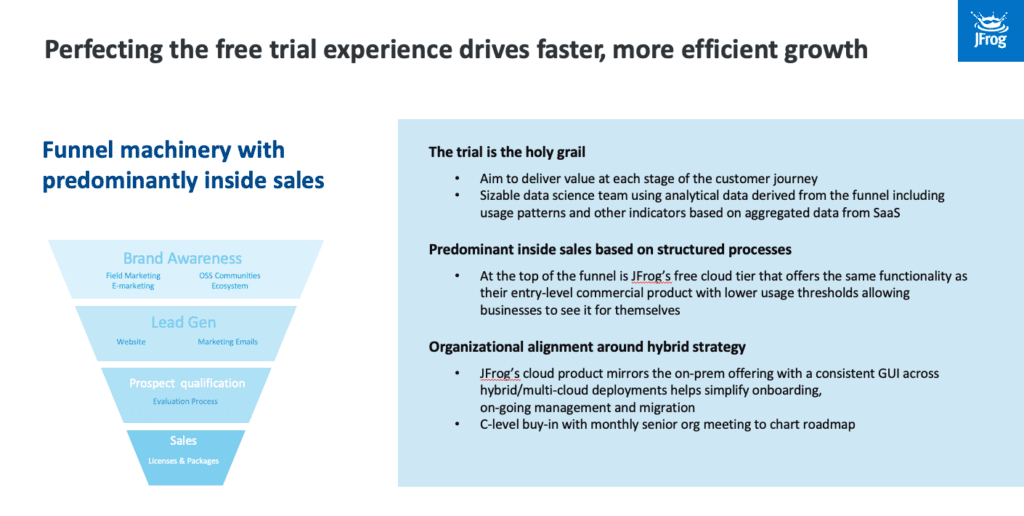
To reduce friction, at the top of the funnel is JFrog’s free cloud tier that offers the same functionality as their entry-level commercial product with lower usage thresholds allowing businesses to see it for themselves. The next solution tier addresses the needs of enterprises and their premium solution is for organizations looking for a complete DevOps platform that contains all of JFrog’s product offerings. JFrog aims to generate awareness and usage amongst developers and technical buyers as part of their software delivery toolchain and DevOps processes. This includes support for open source initiatives and memberships with foundations like the Cloud Native Computing Foundation and the Continuous Delivery Foundation, and open source programs such as GoCenter, ChartCenter and ConanCenter. This flexibility and openness of the platform means that in the end, JFrog can integrate with and empower a full DevOps ecosystem.

For customers who are moving to the cloud, the JFrog Platform delivers tools in an all-in-one experience that empowers organizations, developers and DevOps engineers to meet increased delivery requirements. The fact their cloud product mirrors the on-prem offering with a consistent GUI across hybrid/multi-cloud deployments helps simplify onboarding, on-going management and migration. While customers can be on different points of their cloud journey, JFrog offers a single pane of glass to fit their heterogeneous environments. This includes on-prem, private cloud or public clouds, and across workloads and applications — from legacy apps to cloud-native microservices. As a result, JFrog has the ability to scale and support customer’s needs regardless of their size, location or environment.

Cloud Economics: LTV/CAC

In the end, a well-run managed cloud model drives better LTV/CAC (Lifetime Value/Customer Acquisition Cost). A welcoming freemium experience creates a strong customer community and lowers sales friction, thus driving down CAC. As developers become aware of open source cloud solutions and begin evaluating services for free, the option to upgrade to a paid enterprise customer becomes simpler. Managed cloud solutions provide faster time to production and the ensuing renewal and expansion discussions are lower-touch than a traditional wine-and-dine sales model.

On the LTV side, one drawback of the managed cloud approach is that software companies will see a short-term hit to gross margins. However, over the long-term, adopting a freemium-based open-source cloud strategy will drive greater lifetime revenue. Pay-as-you-go pricing and reduction in resource requirements drive expansion and sustainable revenue growth. On the COGS (Cost of Goods Sold) side, higher utilization will grow into fixed costs. In addition, higher margin products such as marketplace apps and data connectors create opportunities to expand top-line growth. Over time, the short-term tradeoff in gross margins pave a path to more sustainable long-term revenue uplift. 

What are you building?

Two things can be true at the same time: 

  1. The full benefits of the open source commercial model will not be replicated. And we can expect the open source that we know today to continue to evolve and thrive.
  2. Non-open source companies can take a page from the commercial open source playbook. 

The three strategies discussed can be applied to any non-open source business.

Here at Sapphire Ventures, we’ve been fortunate to partner with many open source companies. We have also been fortunate to partner with non-open source companies that have adopted some open source principles. To check out all of Sapphire’s investments, visit: https://sapphireventures.com/companies/

If you’re building an open source company or a company that adopts open source software principles, we’d love to hear from you: https://sapphireventures.com/contact/


Since we Last Spoke: CircleCI’s CEO on Automating the Complexity of Writing and Delivering Software, and Partnering with Sapphire

Just as COVID-19 began to emerge as a healthcare and an economic threat in early April, Sapphire Ventures was proud to have announced its investment in CircleCI. Since then, the need for tools like CircleCI, which enable development teams to quickly release trusted code by automating the build, test and delivery process, has only accelerated.

Many companies are now software ones, rapidly releasing new software and applications to meet the demands of customers and partners. The challenge is that traditional software development and deployment processes are slow and inefficient, making it difficult for companies to move fast. By adopting DevOps tools like CircleCI, companies can accelerate software development and deployment with a holistic approach that encourages collaboration and communication between teams. With CircleCI, software teams can automate repetitive tasks while building and deploying software, scale execution and support, be more productive and reduce the complexity of managing different environments.

CircleCI CEO Jim Rose

When I first met with CircleCI’s CEO Jim Rose more than four years ago, he was one of the only CEOs focused on the DevOps market and who understood how profoundly it was going to change the way software is built and deployed. Over the past few years, I have watched Jim execute on his vision building CircleCI into a leading DevOps company. I’m excited to be on this DevOps journey together with Jim and the broader CircleCI team. Following our recent investment, I recently sat down with Jim to discuss why he joined CircleCI, the demand for DevOps and partnering with Sapphire. Here’s what he had to share:

You joined CircleCI a few years after it was founded. Can you talk about when and why you joined? 

CircleCI was founded in 2011. I joined in 2014 when CircleCI acquired Distiller, a mobile testing app I founded with our current CTO Rob Zuber

As a six-time founder, it would be fair to call me a serial entrepreneur. Perhaps surprisingly, most of my companies before Distiller (and then CircleCI) were in the consumer space. What unites those experiences is a relentless focus on quickly finding product-market fit by solving real problems for users, and constantly iterating, refining and pivoting until you get there. That ability to deliver change quickly is what we provide at CircleCI. 

CircleCI is the leading platform for continuous integration and continuous delivery. CI/CD is the practice of building, testing and deploying incremental changes in your codebase so that you can deliver value to users faster, at a higher quality and at scale. Writing software and delivering it to users is still an incredibly complex process. We automate that complexity so teams can focus on solving problems for users. 

We’re the factory floor for digital goods.

What is going on in the industry right now that’s driving demand for a solution like CircleCI?

There’s so much uncertainty in the market right now. The transition to working from home has a huge impact on how teams operate, but the demands for getting software to market have not let down. In fact, the need for engineering teams to deliver updates and features have increased as companies are scrambling to adjust to rapidly changing market conditions.  

CircleCI is an automation solution for helping teams get code to market more quickly, so we’re seeing a big uptick in interest due to that increased urgency for companies to be more agile. A lot of teams had DevOps initiatives on their roadmaps already, but shelter-in-place has accelerated that need to transform their processes and tooling. At a practical level, if you were managing your build pipeline on machines under a desk in your office, all of a sudden that becomes an untenable way to solve the problem of getting code to customers. Enter CircleCI.

Can you talk a little bit about your journey since joining CircleCI?

It’s been fun for us to see how our growth and maturation has matched that of our customer base. When we started, our customers were mostly small startups. Now, we’re also working with global, Fortune 500 companies. 

Recently, our focus has been on international growth. In 2018, we took our first step to investing in our global customer base and opened an office in Tokyo. We did a lot of research and spoke to our existing customers. Based on those conversations, we decided against going with traditional operating models of expansion, where you set up a sales office and focus on building a base from there. Instead, we focused on building localized customer support to make sure we were helping our customers be successful with CircleCI. 

What are you looking forward to as you move into your next phase of growth?

We’re seeing more companies waking up to the reality that the world is being eaten by software. They’re realizing that their relationship with customers is being intermediated by a screen, and that screen is being driven by a piece of code. 

When CircleCI started, CI/CD was a kind of niche, bleeding-edge practice. Now, we’re seeing the market accelerate like never before as companies prioritize automation and continuous delivery systems. No matter what market you’re in, speed and quality are incredibly important. The ability to create change and put it into the hands of the customers as quickly as possible is key. We’re motivated to be the mission-critical component to help our users stay resilient.

Why are you excited to partner with Sapphire Ventures?

When I approach fundraising, it’s more about the people behind the investment that I’m interested in, rather than the dollar amount. 

You, Jai, and the team at Sapphire Ventures have decades of experience in the enterprise software market and deep knowledge in the DevOps space that is invaluable for us as we continue to grow our business. We’re proud to join the other DevOps companies in Sapphire’s portfolio including Auth0, InfluxData, JFrog, PubNub and Sumo Logic.

How do you plan to leverage the latest investment?

Over the last nine years, and especially over the last two years, we’ve seen more traditional companies realize that they’re also software delivery companies in many ways, and so they’re trying to adopt continuous delivery practices. Many of these are well-established, more recognizable brands, but they’re earlier in their digital transformation phase. 

They require more education, support and assistance to help them and their team get up to speed. Our latest round of capital allows us to create dedicated tools and resources, along with specialized teams to guide these customers along their adoption process, while ensuring reliability and stability in a market full of uncertainty.

From a product perspective, we’re doubling-down on our insights and extensibility capabilities to continue supporting our users to solve the most complex software delivery challenges. 

Are you doing anything to help companies get started with CircleCI given the current economy? 

We’ve always had a freemium model in place and find it useful for small or one-person developer teams to get their products or services up and running quickly.

It’s free to start building on CircleCI and only requires a GitHub or Bitbucket account to sign up.  

Want to hear more from Jim alongside CircleCI CTO, Rob Zuber and CRO, Jane KimApply to attend the Sapphire Ventures CIO Summit 2020.


The 4 P’s of Fundraising for Emerging Managers

This article originally appeared in the Kauffman Fellows Journal.

Raising capital as a first-time venture capital manager (or “VC”) is always challenging – primarily due to a lack of track record and performance coupled with not knowing or having access to prospective limited partners (those entities or individuals who invest in venture funds or “LPs”). This dichotomy can become more pronounced and exacerbated when capital becomes tighter, and events or other in person means for meeting people go virtual, further limiting access, for example, during the COVID-19 pandemic.

However, even a pandemic doesn’t stop all new managers from securing capital. Despite the fact that recent fundraising has been dominated by established funds, some capital is still directed to new managers who can prove their value and differentiate themselves to LPs. Looking back further in time, even when limited partner capital was scarce due to economic recessions, first time funds continued to be raised then too. Sapphire Partners engages with dozens of emerging managers every year, and those most successful in raising capital traditionally follow these four P’s of Fundraising.

1. Patience

Fundraising as a first-time manager almost always takes longer than you anticipate, and it’s likely to take even longer in a capital-constrained market, where you can’t meet LPs in person. Keep this in mind when speaking with LPs about your fundraising timeline, and with entrepreneurs about your ability to invest.

In general, we believe LPs move as slowly as they need to get excited about, and comfortable with a VC.  Also, unlike a VC who has a certain time frame to deploy their capital into new portfolio companies, LPs do not typically have the same legal construct obligating them to make new VC relationships. Instead, LPs have the option to continue to invest their capital in their existing portfolio. As a result, fund managers need to have patience and focus on building relationships over a long period of time, anywhere from months to years. This process may be even longer for emerging managers and first-time funds who do not have a track record that helps LPs get excited.

We know that emerging managers are eager to start investing as soon as they can.  However, since LPs are looking for a relationship that will last years if not decades, you should view the fundraising process as the dating period before jumping into marriage. 

For LPs, it’s essential to build trust and understand the character of an emerging manager. Ideally, LPs like to see you in action – observe your strategy and how you perform over a period of time before investing. Further, when an LP invests in a fund they are mentally also assuming they will be with this VC for a number of funds. LPs look to make relationships with VCs that will last decades, this is also different from how a VC invests in a portfolio company. For that reason, LPs often prefer to get to know a VC across cycles. That’s one reason so many of your fundraising meetings may be relationship building rather than capital accumulating. That means you have to be patient, but also…

2. Persistence

As an emerging manager, be prepared to hear “no” a lot.

Unless you’re a manager coming from an established firm, with a strong, transferable track record, and a following of LPs waiting for you to break out and start your own fund, you will likely have dozens if not hundreds of LP meetings.

While hearing “no” all the time can be demoralizing, it’s important to recognize how small the LP world is. LPs talk to each other and run references as part of their diligence process. As an emerging manager, character references are one of the more concrete data points an LP can grasp given the lack of track record.  But even if you get a “no” this time around, that does not mean it’s a “no” forever.  You need to be persistent in building and maintaining those relationships as you develop your reputation. Find opportunities to remain top-of-mind for LPs and think of each touchpoint as building toward the next fund.

There will be a lot of passes and it will be psychologically discouraging, but you will find LPs become interested at some point in the future. Take advantage of these meetings and use them as an opportunity to receive constructive feedback. Every LP has different preferences and is looking for different attributes in a VC at different points in time.  Or in other words, each LP you will speak to will most likely have their own portfolio construction and return objectives which could be very different from the next one with whom you speak. LPs just need to know that you fit their portfolio needs, which is when you need to be…

3. Persuasive

Being persuasive means refining your message to be absolutely convincing in the shortest period of time possible. After all, your years of relationship building may come down to a single 30-minute Zoom call that seals the deal with an LP.  The market is overflowing with venture capital firms, and you need to clearly define what differentiates you and why this LP needs to use one of their few bets this year on you.

Your deck needs to be tight – concise and compelling. To minimize the amount of work that you have to do in LP meetings, do the legwork upfront. Make sure your deck is so comprehensive yet succinct that an LP can look over it and know who you are, what you’re going to do, your edge, and so on.

Do not waste precious meeting time going through items that are better read in a deck. Make sure all the most crucial points are conveyed in the deck.

Where you want to focus the meeting is your story, the way you pitch the LP, and the ensuing conversation. Present the right details at the right time and reference the supporting evidence in your deck. Manage the pitch to make sure you get through everything you need to. Here are a few things I will want to understand for the single VC starting a fund:

  • Your background and track record (or lack thereof)
  • Why you’re starting the firm
  • How are you qualified to manage and run your own fund?
  • How are you going to find your deal flow?
  • How are you going to win?
  • Why would an entrepreneur pick you?
  • What’s your edge over another GP?
  • What’s your approach to portfolio construction?
  • Are your aspirations and vision for the future great enough for me to be interested, but also grounded in executional potential?

If you’re a team of multiple venture investors coming together to form one VC, you’ll have a few more questions to answer, especially if you’ve never worked together:

  • Why did these people decide to come together to start this firm? How do they know each other? Can these people work together successfully for multiple funds in the future? What do each of them bring to the table?
  • Are they going to break up after this fund?
  • Is the team capable of seeing a fund through to liquidation?

Identify all the potential risks and find a way to mitigate them for LPs.  Don’t have your potential LP sit there and wonder how they’re supposed to be comfortable with those issues.

All of this should be communicated in that short window of time, keeping in mind that all the traditional qualitative components of diligence — where a fund gets to know the partners and can see the dynamics of the partnership at play — are a bit more complicated in the current virtual environment.

References are even more crucial in times like this. Having a list of LP, VC, and founder references identified and ready to share will help tremendously. If you don’t have references or a track record, as many emerging managers don’t, focus on what you can control, such as your strategy and fund construction.

As you pitch, you’ll naturally become better at refining your message as you get feedback and practice.  Focus your efforts on clearly articulating your strategy and differentiators.

Don’t be afraid to follow up with LPs and try to move things forward, but don’t forget that LPs move at our own pace.  You want to be persistent but not pushy, and ultimately, you’ll need to be…

4. Pragmatic

Your approach to fundraising and your differentiators need to be pragmatic.

For first-time managers, LPs might want to write smaller checks to reduce their risk. Take the money – the first fund is hardest to raise and LPs tend to be more loyal to existing managers. You want to take that first step, even if it’s not as large of a step as you were hoping.

You also need to know when to call a fundraise “done,” have a first close and start investing. Know what your ‘minimum viable fund size’ is to execute your investing strategy and when you hit it – go for it. As an emerging manager, your reputation won’t be made during fundraising, it’s made with investments, and you want to start doing that as soon as you can.

Finally, remember that your fund size should be contingent on your strategy, and based on fund math rather than vague ambitionDemonstrate that you’re not just picking $100 million as your fund size because it sounds great. Showcase the math behind why, and how, you arrived at the number.  Simply put:  X# of companies with X% ownership to produce $X return.

Applying the Four P’s

The current environment has accelerated a number of trends that could make it more challenging for emerging managers to fundraise.  Realistically though, the fundamentals of which LPs will invest in shouldn’t change too drastically. We don’t expect VCs to have a crystal ball that sees into the future, which is why we want to be comfortable and excited about your approach, team and differentiation.  Being Patient, Persistent, Persuasive and Pragmatic will help you convince LPs to come on this journey with you.

Best of luck.


Introducing the Sapphire Ventures CIO Innovation Index Special Report: The Impact of COVID-19 on Enterprise Innovation

Earlier this year, Sapphire Ventures conducted its second annual CIO Innovation Index survey, which explores how CIOs and IT decision makers are adopting emerging technologies and engaging with venture-backed startups. The first edition of the CIO Innovation Index released last September was our first-ever study to capture how enterprise IT leaders interact with startups. This year, we’ve built on that foundation by collecting year-over-year data, and diving deeper into areas such as the proof-of-concept process

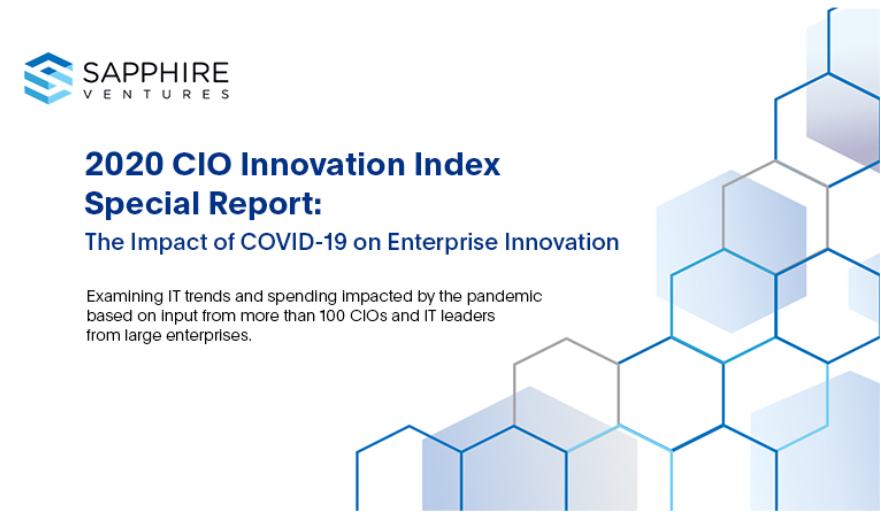
Because we fielded our survey as COVID-19 began to emerge as a global threat, we asked questions specific to the pandemic to understand how enterprise IT organizations have been grappling with the changing environment, and the impact on startup engagement. Ahead of our 2020 CIO Innovation Index to be released next month, today we’re releasing our CIO Innovation Index Special Report: The Impact of COVID-19 on Enterprise Innovation. Based on input from more than 100 CIOs and IT executives from large enterprises, the report examines IT trends and spending driven by the pandemic. Here are the major takeaways:

Despite uncertainty, budgets remain steady as spend shifts to critical technologies

The CIOs and IT leaders who responded to our survey anticipate IT vendor spend to stay constant (46 percent) or increase (40 percent), with the remainder expected to decrease spend in 2020. Part of the optimism in these numbers can be attributed to demographics. About half of our respondents work for companies within recession-resistant industries such as healthcare, government, telecommunications and education, which analysts cite will increase IT spend. In addition, 94 percent of respondents work for companies with more than 5,000 employees. Due to their larger reserves, these companies are less likely to reduce IT spend.

While our data shows that IT budgets aren’t shrinking for many CIOs, spend allocation is quickly shifting. CIOs and IT decision makers report plans to reduce investments in legacy modernization, hardware, recruiting and “non-essential” technologies. On the other hand, cybersecurity, automation, collaboration tools and cloud computing technologies are seeing an increase in spend. These trends are in line with what we’ve been hearing from the 50+ CIOs that we’ve spoken with over the last few months.

CIOs are prioritizing digitization initiatives due to COVID-19

According to McKinsey, COVID-19 has become a major catalyst for the continued and, in some cases, accelerated digitization of companies worldwide. Our special report finds that 64 percent of respondents have plans to stay on track with or increase their digital transformation initiatives in 2020. 

For those CIOs who are accelerating digitization projects, the primary focus has been on improving customer-centric operations and IT capabilities. As companies look to deliver fast, personalized and seamless customer support, and to enable a remote workforce almost overnight, IT, sales and marketing, and customer support are the top three areas of accelerating digitization for those surveyed. 

CIOs are eager to work with startups, most feel they’ve been key to remote work

The CIO Innovation Index is an important measure used to determine how interested and willing enterprises are to work with innovative startups. We recognize that COVID-19 has caused companies and their IT organizations to pivot their strategies and investments, which has a direct impact on startup adoption. 

As investors of companies of consequence, we were pleased to find that 85 percent of enterprise leaders are equally or more likely to work with startups since the onset of the pandemic. Startups are viewed as a critical component to achieve digital transformation, which has been more important than ever. Furthermore, startups that have enabled tighter security and improved collaboration, for example, have played an important role in the move to remote work for a majority (76 percent) of companies.

Access the Special Report: The Impact of COVID-19 on Enterprise Innovation

The Special Report reflects our findings on the early impact of COVID-19 on enterprise innovation. We’re looking forward to releasing our full 2020 CIO Innovation Index in early September.