Leaders from Auth0 and Segment Share How Globally Distributed Teams Drive Innovation

For the majority of companies, COVID-19 and the resulting worldwide shelter in place orders caused a massive shift to remote work. While at first the move seemed temporary, working from home has become an indefinite reality. And while many of us are still figuring out how to balance childcare, home offices and more, some workers are enjoying the flexibility. A recent Chameleon Collective study found that 25 percent of workers surveyed anticipate shifting to permanent, 100 percent virtual work after the pandemic, up from eight percent of the respondents before the pandemic.

As remote work becomes the norm, companies are racing to adapt while also driving innovation, ensuring customer success, keeping their employees happy and moving their businesses forward. We realize how challenging this can be, especially for companies that aren’t used to being remote. Recognition, career growth and burnout are just some of the areas that can be difficult to manage in the current environment. Fast Company recently examined the topic of burnout in detail, reporting on data that found that nearly 60 percent of employees are currently feeling burned out. 

Many companies are viewing remote work as somewhat of a social experiment to see if it can be done successfully. But for others, it has long been the norm. We recently spoke with leaders from two Sapphire Ventures’ portfolio companies, Auth0’s CEO, Eugenio Pace and Segment’s Chief Product Development Officer, Tido Carriero, to understand how they’ve been able to successfully drive product innovation across their global teams since long before COVID-19. Here’s what they had to share.

Innovation thrives in a remote work environment when it’s ingrained in a company’s culture

A company culture that aligns with the way employees think and work will keep them motivated no matter where they’re physically located. GitLab, a fully remote company since its inception, and one that values “permissionless innovation” proves this point and also found in its Remote Work Report  that 56% of remote workers indicate everyone in their company can contribute to process, values, and company direction.

Eugenio Pace, Auth0’s CEO

To keep employees excited about doing their jobs in a remote environment requires a special kind of culture and set of values. For example, Auth0 was founded on the belief that work is something you do and not a place you go. “Based on this belief and our team values centered around collaboration, communication and culture, we set out to create a place that people truly enjoy working at–a place where meaningful contributions happen,” Eugenio Pace, Auth0’s CEO, told us. To ensure innovation thrives across its team that’s distributed across more than 35 countries, Auth0 has seen success by following four principles:

  • Trust, not chair time: Trust and a philosophy of work based on results and not on chair time are at the heart of a successful remote culture.
  • Communication is your #1 tool: Communication should be frequent. Trust is built from both the bottom up and top down. Multidirectional communication is critical.
  • ‘Flexibility’ frame of mind: Encourage teams to devise their own schedules so employees can complete work when feeling most productive and collaborative.
  • Talent first, timezone second, location third: By enabling team members to do their best work regardless of location, companies will be able to hire a diverse mix of people from different backgrounds and skill sets–a team that is also naturally closer to your customers.

Segment takes a similar approach. The company encourages open lines of communication with its “Creating Clarity” core manager value, which is especially important for the product team. Its purpose is to ensure that all communications and processes aid in creating clarity for the team. “Creating Clarity is about making sure that every employee on my team knows how their work fits into the overall team mission, department mission and company mission,” says Tido Carriero, the company’s CPDO. 

Segment has also created a culture of trust, well-being and one that encourages organic innovation. Tido shies from tools that measure innovation in terms of engineering metrics. Instead, every six weeks, he meets with engineering and product teams to discuss what they’ve spent time working on and achieved. Every other meeting, which takes place at the end of the quarter, Segment’s CEO attends. The meetings have been an effective way for Segment to make sure there’s company-wide alignment around measurement and business outcomes, while also enabling employees to focus on the work that they enjoy doing.

With offices and employees all over the world, Segment is passionate about sharing ideas and working together across roles, levels and geographies. But it can be difficult to do. “It can be hard to get different perspectives if you aren’t seeing someone or a group of people very often face-to-face, but it is achievable with the right culture,” says Tido. “It’s important to make sure that ideas aren’t all coming from HQ and that they’re not coming from a specific group like the company’s founders or executives, but rather are distributed throughout.” 

When a company’s workforce is primarily or entirely distributed, innovation has to be ingrained in a company’s culture in order to build visionary products. Both Auth0 and Segment have determined that innovation is a key value early on. “Innovation does not change during times of uncertainty, it only becomes a stronger commitment,” says Eugenio. “One of our values centers around continuous improvement, experimentation and getting better one step at a time, together.” 

Promote taking risks and making mistakes in the interest of innovation

While Amy Edmondson of Harvard Business School introduced the concept of Psychological Safety more than 20 years ago, Google reinforced its importance in the well-known study, Project Aristotle. In short, Google found that psychological safety was the number one determinant of high performing teams. The study was so popular that over the years, many companies began to adopt psychology safety principles and trainings.

Psychological safety means team members feel accepted and respected in their roles, and a psychologically safe team is one that’s safe for interpersonal risk-taking. The concept is especially important for technical teams developing new products, technologies, services or tools as this type of innovation requires risk-taking, requiring teams to have open and honest interpersonal communication to invent new offerings. Studies have also shown that groups tend to innovate faster when a sense of safety exists because mistakes are uncovered faster and teams are able to find better solutions to problems without fear of being wrong. 

One of the most important questions companies are grappling with is how to ensure this type of environment persists for teams when they aren’t face-to-face, encouraging them to take risks and therefore innovate. Both Segment and Auth0 understand the importance of creating a safe space for employees to take risks and make mistakes as they’ve both adopted specific philosophies, traditions and strategies to ensure the learning and growth that accompany innovation are constant for their teams. 

Segment’s Chief Product Development Officer, Tido Carriero

Segment’s Tido encourages risk taking amongst his technical teams at Segment by holding regular hack-a-thons called Hack Weeks. “We tend to have a very ‘bottoms-up’ philosophy around generating product ideas and making sure the best ideas win,” says Tido. “We do this by encouraging creative exploration during Hack Weeks. Normally, we hold an in-person Hack Week once a year, but this year, Segment will host two including our first ever all-virtual Hack Week. This way, engineers, project managers and designers have ample latitude to explore ideas during normal working hours.” Hack-a-thons, even virtual ones, are a great way to provide employees with an opportunity to explore creative ideas. Furthermore, when it comes to creating an environment that champions risk taking, Tido and his technical colleagues lead by example by contributing to the Segment Engineering blog, which details various product and feature journeys, including the mistakes made and encouraging others to learn from them as they build products.

Auth0 equally promotes taking risks in the interest of driving innovation. “We don’t see innovation as gigantic steps, but rather as a daily practice. Each one of us can innovate everyday, contributing to furthering the company as a whole,” says Eugenio. For Auth0, an important company value is N+1>1, which centers around continuous improvement, experimentation and getting better one step at a time, together. N+1>1 is comprised of four primary principles:


  • We embrace data-driven experiments to gain insights into our business.
  • If we are not making mistakes, we’re not making progress. N+1>N
.
  • We question the status quo constructively.
  • Our personal and team growth is a result of asking for help, learning something new every day and taking action instead of standing on the sidelines.

More than ever, collaboration tools are critical to facilitating innovation

Auth0 and Segment have also adopted numerous collaboration tools to keep their teams and employees better connected and motivated in order to innovate. Auth0 has been remote since its founding, which means the team has been leveraging collaboration tools since 2013. That said, the company is constantly evolving the technologies it uses to better engage and collaborate with employees. While every team is different at Auth0, it has generally seen success with tools that promote clear communication and collaboration.

  • Slack: Auth0 has a developer DNA, and Slack was one of the company’s first tools, but it continues to serve the company well in terms of project-specific channels, status updates, surveys and allowing teams to react and respond to ideas in real-time.
  • Zoom: Boring conference calls rarely spark creative ideas. Auth0 has found video conferencing to be not only productive and personal, but it can inspire ‘watercooler’ conversations about environments, as well. Innovative ideas often stem from these moments and bond teams.
  • Donut – Auth0 uses a Slack app called Donut that pairs employees with other employees across the company, at random and at all levels. It’s a great way to get face time with those employees that someone wouldn’t normally interact with. We’ve seen that everyone walks away with something valuable and a new Auth0 friend.

Segment is also turning to virtual conferencing and hosting watercooler chats amongst team members. It’s product team is also digitally whiteboarding by using a tool called Figma, which enables employees to post virtual Post-Its and has been a great tool for real-time collaboration with designers. On Fridays, Segment hosts a virtual hangout for the engineering, product, design and security teams. The hangouts involve Pictionary, speech and debate tournaments, puzzle hunting, trivia and other mind-moving games.

Fully remote companies and teams will emerge from this crisis 

In some cases, we’ve already seen companies like Twitter and Square announce that they’ll be moving entirely to a remote workforce. While Segment isn’t quite there yet, Tido says, “My team is definitely considering more of a shift to remote work. Before COVID-19, 30% of our engineering team was working remotely. After COVID-19, I expect that more of the company will want to move remote.”

It wouldn’t surprise Tido if more than 70% of the engineering team works from home on the other side of the pandemic. Looking ahead, Tido believes, “We’ll see many more 100% remote companies. I boldly predict that half of all companies started from here on out will be 100% remote!”

Eugenio and the Auth0 team agree. Eugenio and Matias Woloski co-founded Auth0 while living in two different countries, 7,000 miles apart. The remote-friendly and globally distributed company has been able to grow to 650 employees in just a few years. Prior to the pandemic, more than 50% of its workforce worked remotely. “Looking at product development and global innovation, the movement to a remote workforce unleashes a bigger talent pool that otherwise would not be available,” says Eugenio. “By hiring for talent first and geography second, leaders will be able to put the best possible team in place to contribute to the success of their products and their company.”

When asked about what the future of remote work looks like, Eugenio says that leaders must take what they have learned during these times and reshape their workforce operations. He says, “While not all companies will stay remote, I hope the situation we are in now will help remove the stigma around remote workers. I also hope companies will see they don’t need a huge office for employees to work in every day. Instead, companies will benefit from more flexible spaces that are closer to their customers.” Auth0 thinks of its offices as embassies–places where employees can drop in and work, and also places for hosting events, and connecting with customers and the local community. 

Auth0 and Segment have proven that innovation can happen anywhere, including one’s home. What matters most is having the kind of culture that promotes and encourages new ideas and creativity, as well as risk-taking and collaboration. And while the impact of COVID-19 is uncomfortable in more ways than one, the pandemic has shown to company leaders and employees alike that new products can be built and market-moving ideas can be born from a remote work environment.

 

Open Banking & Beyond: What’s Next for European FinTech Infrastructure?

Sapphire Ventures has had a long history of investing in fintech companies around the world, having backed Square (NYSE: SQ), IEX and OnDeck in the US, one97 in India, and Currency Cloud and Transferwise in the UK. As fintech companies continue to bring innovative solutions to the market around the world, we’ve recently taken a closer look at the fintech infrastructure sector. Over the next couple of months, we plan to share our perspectives on this topic in a three-part series covering fintech in the European market, global payments and core banking. Here, we begin with part one focused on European developments.

Europe as a Global FinTech Leader

The same global trends that impact fintech infrastructure globally apply to Europe. Banks and financial institutions are serving an increasingly international customer base and their offerings are being unbundled.We believe fintech is shifting from a vertical to a horizontal sector as companies move to embed financial products into their offerings. This is a trend we believe is here to stay and relies on the development of a robust infrastructure layer. 

Europe has been at the forefront of fintech infrastructure innovation due in part to the role of regulation. The European Union enacted PSD2 (Payment Services Directive 2) requiring banks to open up their data to third parties, and the UK implemented a similar regulation with Open Banking. It goes without saying though, one cannot generalize advancements across the entire European continent. The European market is a summation of distinct markets with differing characteristics. There are nuances between economies and cultures, as well as varying levels of adoption of fintech solutions. 

However as a whole, Europe has moved faster than other geographies to embrace an open and API-centric banking model. According to Tracxn, 53 percent of Open Banking startups worldwide are headquartered in Europe. As a critical hub in fintech, Europe continues to push the frontier of innovation. 

The Rise of Open Banking 

Over recent years, we’ve seen a rise of Open Banking startups building out a connectivity layer between traditional financial institutions and fintech companies to aggregate and share banking data. Solutions have evolved from rudimentary screen scraping to incorporating open APIs made possible by PSD2 and Open Banking. 

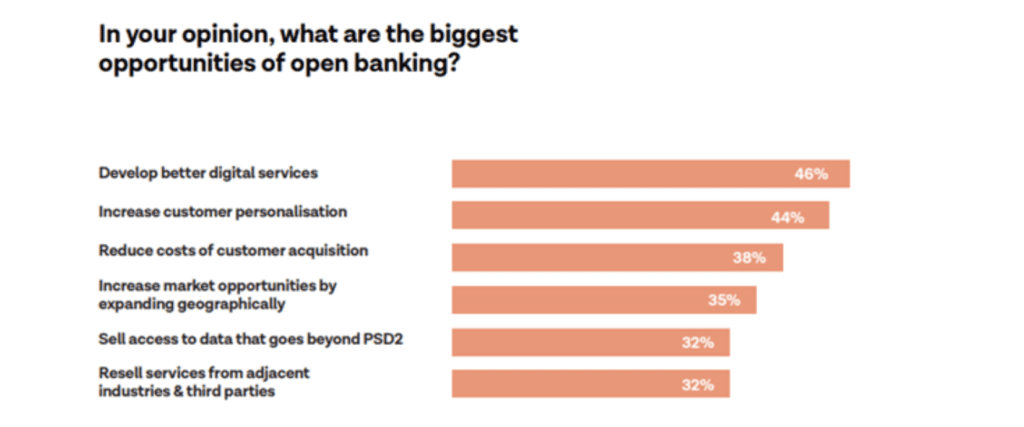
These new companies benefit consumers and businesses by providing greater control over financial data, easier access to financial services and facilitating the creation of new products. A recent survey conducted by Open Banking startup Tink found financial executives across 17 European countries were positively inclined towards the Open Banking movement with 46 percent believing that the development of better digital services is one of the biggest opportunities.

Source: Tink Report Inside the Minds of Europe’s Bankers.


As of today, the European Open Banking landscape remains heavily fragmented. Startups are mostly working with banks and financial institutions in their home market before expanding internationally. Out of the Nordics, there are players like Tink and Nordic API Gateway; out of the UK, there is Truelayer and Yapily; and out of Germany there is Deposit Solutions, Ndgit and FinTec Systems. We predict that in the short to medium term there will be consolidation in the pure connectivity space. In fact, we’re already seeing the beginnings of this with Tink’s recent acquisition of Eurobits in Spain.

The Shift to Open Finance

As the Open Banking sector continues to develop, the new adjacent space of Open Finance is emerging around it. There is a tremendous opportunity in this new space for the businesses and services that are being built on top of the connectivity layer made possible through Open Banking. 

There are a number of different approaches to this new and broader space extending beyond Open Banking. Almost all of the existing Open Banking players are introducing value-add services, such as KYC/AML credit scoring and others on top of their API networks. There are also a number of Banking-as-a-Service (BaaS) players that are providing easy access to third-party services and applications like Bankable and Solarisbank, for example. Other players are focusing on specific use cases like FidelAPI with loyalty points and Bud with analytics, amongst others. In the bank-to-bank payments space, new companies like Primer and Banked are developing new infrastructure to take on PayPal and the other payment giants. And in accounting and financial tools, startups like Codat are expanding API connectivity beyond banking to accounting data.  

Although there are varying approaches to a more holistic Open Finance offering, the difference between where value is created versus captured in the fintech infrastructure sector is clear. The first wave of Open Banking focused companies are creating value through exposing and connecting banking data. But the next wave of players building applications and services utilizing this data are better positioned to capture the value of the vast market opportunity in Europe. 

What’s Next?

As this next wave of startups mature, Sapphire Ventures is looking to continue to partner with entrepreneurs to build Companies of Consequence in the fintech space. We welcome the opportunity to connect with European teams building Open Banking or Open Finance. Please reach out to us here: https://sapphireventures.com/contact/

And stay tuned for parts two and three of our deep dive covering payments and core banking infrastructure coming soon!


Since we Last Spoke: UJET’s CEO on Reimagining How Consumers Interact with Businesses and Finding the Right VC Partner

Last month, Sapphire Ventures led UJET’s $55 million financing round. UJET’s cloud-native customer support software helps companies across industries transform how they deliver multimodal omnichannel support. While the demand for personalized customer support across channels has been a trend we’ve seen grow over the last several years, COVID-19 has accelerated the need for instantaneous, helpful and multichannel service. As noted in a recent blog post by Cathy Gao from our investment team, 47 percent of customer support teams reported a 51 percent increase in inbound service requests since the beginning of the pandemic starting in mid-March, according to a recent Intercom survey.

Founder and CEO of UJET Anand Janefalkar

As businesses race to improve their customer support strategies and technologies, UJET is well equipped to help. Since we first met with Anand Janefalkar, Founder & CEO of UJET earlier this year, we’ve been excited about his passion around what he and his team are building, and the market opportunity for the company. I always enjoy speaking with Anand, and as a member of UJET’s board, we’re often in touch. On the heels of the funding announcement, I sat down with Anand to ask him a few questions about why he started UJET, the company’s next phase of growth and teaming up with Sapphire Ventures.

Here’s what he had to share:

Why did you decide to start UJET?

Prior to UJET I held roles at tech companies such as Jawbone and Motorola. It was there where I not only helped build, but truly realized the power and untapped potential of smartphones and cloud becoming even more ubiquitous with upcoming high-speed wireless technologies. I saw how the devices that I helped build were able to enable consumers to better connect and interact with one another. But while smartphones were revolutionizing the way consumers interacted with one another, little was being  done to modernize the way consumers and businesses interact. This got me thinking.

Consumers are able to communicate with one another where, when and how they want–across social media platforms, text messaging, phone, you name it. And they can connect both visually and contextually. Yet when someone needs support and has to connect with a business, they are thrown into a ridiculously outdated experience. 

The motivation for UJET came to me after numerous, frustrating customer service experiences. The path became clear, it’s going to take someone who understands modern smartphone era technology and the user experience, not someone who has been knee deep working with legacy technologies, to build a team that re-imagines the way consumers and businesses interact with each other.

What is going on in the industry right now that’s driving demand for a solution like UJET?

Even before the pandemic, companies were migrating to the cloud, adopting modern and cloud-native Contact-Center-as-a-Service (CCaaS) solutions. Leveraging the cloud has not only helped businesses digitally transform their customer service from an operational perspective, it has helped them rethink the way they interact with their customers, providing a curated journey that builds trust and ultimately, brand loyalty. 

COVID-19 has taken the adoption of CCaaS solutions and pushed it into high gear. Business continuity planning is no longer just a checkbox, but is a day to day mode of operation. Companies must adapt to these challenging conditions and leverage new technologies such as UJET in order to facilitate a robust, secure, scalable and best in class “work anywhere” toolkit. 

Can you talk a little bit about your journey since starting UJET?

I started UJET in July 2015. Since then, we’ve scaled our platform and built a stellar team all through the lens of the user experience. Today, UJET has more than 100 employees and we continue to grow rapidly. Our platform enables mid to large enterprises to operate all over the world, servicing consumers in 22+ languages and in numerous remote agent and team settings without requiring a single download, let alone additional hardware than what’s already being used to check work email. 

What are you looking forward to as you move into your next phase of growth?

This is really just the beginning of our journey to foundationally disrupt the customer service sector. 

Category-leading companies have started to see support as an integral part of the product or service being delivered. That’s how today’s consumer perceives customer support–it’s just as important as the “thing” they’re buying. Incidentally, these same companies are also in the process of refactoring their product and service to be smartphone-centric and cloud native. This intersection of timelines presents an unprecedented opportunity, which UJET is uniquely positioned to lead. 

Closely behind is another transformation taking place in the customer service space. Assisted AI and conversational AI interactions are increasingly being adopted by enterprises, which UJET approaches as automating and channel steering based on the urgency and complexity of the issue, rather than shoehorning it into obsolete channels or one-size-fits-all approach of the legacy providers. 

Both waves are huge growth catalysts for UJET and we look forward to leading the evolution of this sector into an ultra modern one. 

Why are you excited to partner with Sapphire Ventures?

In my opinion, Sapphire Ventures is one of the top enterprise SaaS investors. The firm has a track record of investing in incredible software companies. Sapphire Ventures brings a proven team that can cover an array of critical functions that are instrumental for our growth stage. Since the very beginning of our conversations, it became clear that the Sapphire team envisions an enterprise software world that is closely aligned with our objectives, and we’re stoked to be on this journey together.

How do you plan to leverage the latest investment?

We’re eager to continue innovating and scaling our platform and teams. We have a tremendous customer base with some incredible success stories that need to be communicated globally. This investment will be utilized towards marketing those stories and growing the go-to-market teams domestically and internationally. Additionally, investing in the launches and continuous advancements of our AI and ML offerings will be another prime focus. 

Are you doing anything to help companies get started with UJET given the current economy?

UJET is making it easier for businesses to rapidly transition their support toolkit into a modern, location or premises agnostic one by providing free access to our platform for up to three months. The platform provides companies with the channels they need in order to provide fast and reliable support for their customers, while also allowing their teams to safely work remotely. The onboarding process is quick and only takes a few minutes. Agents located anywhere in the world can be up and running without a single download or installation by simply utilizing a Chrome browser with a stable Internet connection. 


Beezer Clarkson

What You Need to Know About Fundraising This Year

This article originally appeared in the Kauffman Fellows Journal.

We’re a little over half-way through 2020 and COVID-19, rollercoaster equity markets and record unemployment rates have dominated the 2020 fundraising narrative.  The fundraising discussion seems to shift daily from gloom and doom to cautious optimism that the COVID fallout won’t be as bad as predicted.  At the same time there are also still traditional venture-cycle liquidity considerations at play that may impact fundraising no matter what the final toll of COVID ends up being.

So where are we at so far? Just the first six months alone has seen a whooping ~$33BN raised by US venture funds through June 30.[1]  This is a significant number and equivalent to what has been raised in a full 12 months in years past. It is hard to see the second half of the year raising as much as the first half, but if it does – that would put 2020 as the most money raised by US venture funds since 1999.

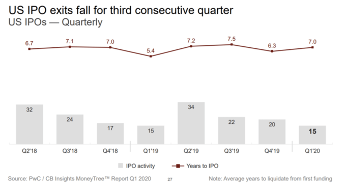
Source: CBInsights Quarterly IPO Trends

What could make for a tougher next six months? Liquidity is one concern. As most people in the industry know, liquidity is a critical component of keeping the venture ecosystem going. Outside of a brief spike in Q2 2019, mainly due to a swath of high-profile tech companies like Uber, Pinterest, Zoom, and Slack, IPO activity had been on a downward trajectory with Q1 2020 being the third consecutive quarter of decline. M&A is also a meaningful source of liquidity, but with the M&A outlook for 2020 skewing downward, there could be a continued lack of liquidity that may limit future investment in venture — particularly among emerging funds without established track records.

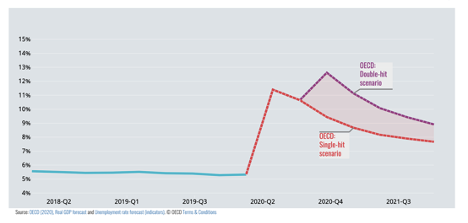
Weighing on many peoples’ minds is the question of whether we are already in a recession. If we’re not already, it seems pretty likely that one is coming.[2] How will the world react once we are all firmly on the other side of shelter in place and dealing with what looks like pretty extensive unemployment? The stock market is way up recently but there is no guarantee that it will stay there. Those of us that have been through economic cycles before also know amazing companies continue to emerge in downturns, and GPs need capital to fund those companies.

Source: OECD Unemployment Projections Q2 2020 and Forward

If you’re a GP looking to fundraise the second half of 2020, here’s what you need to know from the LP point of view.

1.   The Experience Premium

A huge amount of money has been raised so far in 2020 and the overwhelming majority of it has gone into follow on funds, with only 3% of the money raised in the first half of 2020 going into first time funds.[3] Out of the almost 100 funds raised since January, some 21 were mega funds ($500+ million), and they account for 68% of all dollars raised.[4] In particular there are  firms like Sequoia who are able to raise more than $7 billion despite the current conditions. Why? Market and human psychology show that LPs are more comfortable with battle-tested managers in times of uncertainty. 

The gross majority of funds that have raised year-to-date have established brand names, market positions, LP bases, maturing track records, and in many cases realized returns, as well as critical experience in weathering downturns. Crisis or no crisis, these are all signals that LPs value. In an uncertain market like the one we face today; these attributes can be even more attractive.

2.   To Raise or Not to Raise

With such a potentially bleak outlook on the market, why would a GP raise capital now? Despite COVID, shelter in place, and few IPOs, it’s not illogical for GPs with established LP bases to raise now. 

First, GPs may want to raise capital to have dry powder to take advantage of investment opportunities in a recession.

Second, venture firms with established LP bases have almost undoubtedly told their LPs about their upcoming raises so they could budget accordingly. Circumstances can always change but presumably most LPs have planned ahead and have pre-determined capital waiting for their established GPs.

Finally, there is no guarantee that next year is going to be any better. If we go into a full-blown recession, if schools do not re-open, hospitals remain stressed and the stock market heads south there may be fewer LP dollars available to put into funds. This likely drives some urgency to raise now while there is money available.

A component of this is to get ahead of any additional “denominator effect,” in which a decline in the stock market, or pervasive recession affects the LPs’ ability to invest in venture as an asset class. LPs that invest in both public and private sectors often determine how much to allocate toward venture capital as a percentage of total assets. The amount that gets invested into venture capital naturally decreases if the value of their public assets decrease.

As a result, venture funds that try to raise later, during a more pronounced recession coupled with a downturn in the stock market, might face the hard truth that money has dried up– or at least that’s what the fear is. Right now, with the stock market way up, it doesn’t look like the denominator effect is going to be a factor, but if things change and the market goes sharply downward, the denominator effect could become a significant issue for some.

3.   Beat the Odds

The good news for you is that LPs with a dedicated venture program understand that smart investing requires investing in up and down markets alike– and they allocate (as well as reserve) capital accordingly.

The same logic is true of venture funds and great performing funds can be started during downtimes as well as good. For example, Andreessen Horowitz’s first fund was raised in 2009, and Lowercase Capital’s famous first fund was in 2010— both years when venture fundraising was under extreme pressure. It will be exciting to see which of the new funds coming to market now in this uncertain market will become the future’s great funds.

Money from LPs dedicated to venture will still be there, and notably, strong emerging managers can be “haves” alongside established managers. This is true even in uncertain markets.

You know the “battle-tested” experience we spoke of in point #1? This is where emerging and established managers GPs can build that track record by actions such as:

  • Building up an angel investing track record  
  • Picking the right companies that become future breakouts and securing meaningful ownership in these companies
  • Holding multiple closes in your fundraise to show momentum
  • Helping existing investments weather the COVID storm and raise subsequent rounds from strong firms
  • Demonstrating early liquidity in your investments to either return capital or recycle

Final Thoughts – How to Attract LPs and Improve Your Odds of Raising:

Whether you have an established track record, or are more of an emerging manager, there are best practices all GPs should remember when fundraising:

Give advance notice: For any of you who plan on fundraising in the next 12 months and haven’t told your LPs yet, do so now. We need the heads-up to plan.

Prep for diligence: Expect LPs to want to understand what is driving the underlying performance of your individual portfolio companies.

We’ll ask you what your unrealized valuations are based on. Where does the growth and revenues of your portfolio companies come from? Is it based on other startups that might get caught sideways trying to fundraise, or from companies that will still be able to pay their bills if the market dips?

Some companies will be better at navigating COVID headwinds and tailwinds. Despite all the COVID/SIP challenges, many companies are thriving in this market (remote learning, telemedicine) while others (the travel industry, service sectors) are working hard to weather the storm. H2 metrics and market conditions in the remainder of the year will help us get a better understanding of what to expect in 2021.

We want to know how you’re thinking about the next few years. With the boom times calming down, knowing how your fund and your portfolio companies plan to navigate through this current change is critical.

Leverage your LPs: If you have existing LPs, ask them for introductions and to give you market feedback. Ask them about what they are hearing and what LPs are actively allocating to venture. Since folks are not traveling, and annual meetings and other events where LPs/GPs typically meet have all gone virtual, it can be incredibly hard to meet new LPs.  In this environment, finding new ways to be introduced, leveraging your network, doing research, and speaking with fellow GPs who have successfully raised is even more important.

Be patient: It’s true there are funds that can raise despite all the global uncertainty, but this is not true for everyone. Can you slow your roll and fundraise in 2021? For funds that are establishing their track records, or that need more time for their companies to develop, consider using the rest of this year to develop your portfolio.  Instead of fundraising, help your portfolio raise their next rounds, and either wait to fundraise yourself or do a minimal viable fund size close now and give yourself a year to raise the rest. It’s true no one knows what next year will look like and it could be an even tougher time to raise then now but having a portfolio that is growing and hopefully thriving during COVID will give you a solid base to show to LPs.


Since we Last Spoke: Q&A with Contentful’s co-Founder Sascha Konietzke and CEO Steve Sloan on the Opportunity Ahead and Partnering with Sapphire Ventures

Last month, Contentful, a global leader in headless content management, announced its Series E $80 million funding round, which Sapphire Ventures is proud to have led. Since first meeting the team six years ago, and subsequent Series D investment in 2018, we continue to be excited by the leadership team, market opportunity and technology platform, which enables companies to manage and deploy content across channels.

It’s always a pleasure for me to connect with Contentful’s founder and Chief Strategy Officer Sascha Konietske and CEO Steve Sloan. As a member of the board, the three of us are often in touch. Following the company’s Series E announcement, I sat down with the two leaders to reflect on Contentful’s journey to-date, discuss what the future holds for headless CMS and chat a little bit about partnering with Sapphire during such unusual times.

Here’s what they both had to say:

Founder and Chief Strategy Officer Sascha Konietzke on Starting Contentful, Bringing Headless CMS into the Mainstream and the Company’s Next Act

Let’s dive in. Why did you decide to start Contentful?

Back in 2007 when the very first iPhone was released, I was working with agencies to build first-generation mobile apps for brands. Many of these mobile apps contained content such as product information, marketing offers or points of interest. 

At that time, content management systems (CMSes) had been around for many years, but they were all optimized to manage page-centric HTML websites—not to serve content to native mobile apps.

As a developer, I was frustrated with the status quo and thought there must be a better way. When I didn’t find anything online, I experimented with building a solution myself, which led to the founding of Contentful.

You’ve come a long way since starting Contentful in 2013 in Berlin. Since then, the company expanded to many locations including San Francisco. Can you share some thoughts on expanding to the Bay Area four years ago?

From the beginning, Contentful was architected and optimized to run on public cloud infrastructure. Because larger European companies were slow to embrace cloud services, we spent many evening hours working with U.S. companies. They were some of our earliest adopters and to this day, the majority of our revenue comes from the U.S. market. As our customer base grew, we realized that it became increasingly difficult to serve U.S. companies well from so far away.

We knew we had to build a physical presence in the U.S. to continue on our high growth path. The only questions were: When and where do we go? The East Coast would have been easier in terms of time zone and travel, but in the end, we couldn’t resist the pull of the Silicon Valley ecosystem to take Contentful to the next level. It’s the epicenter of the worldwide developer ecosystem, and we wanted to hire and learn from experts in scaling B2B SaaS companies.

Since opening our San Francisco office in 2016, we’ve grown the location to more than 100 amazing team members. Initially, building a second office on the other side of the world was challenging, and our support resources were limited. But, in addition to all the benefits of being part of the San Francisco ecosystem, the process of setting up the new office helped us improve collaboration amongst all of our teams across regions and time zones. We learned that we could no longer just rely on conversations in one office for critical communication.

Since the last funding round, you decided to move into more of a strategic role as Chief Strategy Officer. Can you talk a little bit about what you’ve been doing in this new role?

Since starting Contentful in 2013, we’ve been growing rapidly, roughly doubling our revenue year-over-year. As CEO, I was often involved in the day-to-day operations, and in helping the business keep up with its aggressive growth trajectory. While operating and scaling the company has been an amazing learning journey, and a lot of fun, I am a product person at heart and missed being close to our customers and product. Personally, I wasn’t completely satisfied serving as CEO. I wasn’t able to find the time and mental space to think long term and strategically about what comes next. 

In my new role as Chief Strategy Officer, I can now focus on exploring the future and visualize what the next act is going to be for Contentful. The market for content management is vast, and there are many more ways we can help our customers. I love figuring out exactly how we can help them and bring new solutions to market.

Contentful hired Steve Sloan as CEO in November of last year. How are you and Steve working together to expand upon the original mission of Contentful?

Steve has tons of experience in scaling different kinds of companies at much larger sizes, including those specializing in developer tools and marketing technology. I have years of experience in content management and historical context on how Contentful evolved, and what we’ve tried in the past. So we make a good pair.

When working together, we combine both perspectives to determine our future direction, not just for the company and our product, but just as importantly, for our culture and how we come together as a team.

Sapphire Ventures is excited to lead Contentful’s Series E funding round. We believe there’s a lot of opportunity ahead for the company. What excites you most about this next phase of growth?

When we were a tiny startup, we were nimble and could turn on a dime. But, we often lacked the necessary resources to tackle important priorities, and our API-centric approach to content management was still nascent in the market.

Today, our technology and the headless CMS market that we pioneered has reached mainstream adoption. Companies around the world are rapidly adopting Contentful, often for creative use cases that we never dreamed of.

We now have about 400 team members helping us achieve our mission. They are delivering value for our customers across all departments at an incredible and ever-increasing pace.

I am excited about the digital experiences our customers and partners will build on our content platform in the future, and how our team will continue to grow and improve.

Sapphire Ventures also led Contentful’s Series D. Why did you choose to partner with Sapphire not just once, but twice?

Prior to raising our Series D round, we already knew the Sapphire team, and particularly you Andreas, pretty well. We had been in touch periodically, so when we were ready to raise our Series D round, it was natural for us to have a conversation. At the time, we were at the beginning stages of selling our product to larger enterprises, so we decided to partner with Sapphire to help us navigate the complexities of going upmarket into the enterprise–an area the firm has clear expertise in.

I’m pleased to say that Sapphire and the firm’s ecosystem delivered on that promise. Sapphire enabled us to break into the enterprise over the last two years. We now work with more than 200 global brands such as Spotify, Urban Outfitters, Jack in the Box, The British Museum, Xoom, Lenovo, Telus and Intercom. 

The momentum is exciting, but our journey upmarket continues. I see Sapphire as an essential partner in helping us along the way. It’s the venture firm with the most experience in enterprise products. So when Sapphire approached us about leading the next round, we already knew how helpful you and the team could be.

CEO Steve Sloan on Joining Contentful, the Growth Opportunity Ahead and Partnering with Sapphire Amidst a Pandemic 

Steve, you recently started as Contentful’s CEO. Why did you decide to join the company?

I was introduced to Sascha in the summer of 2019. After our first few meetings, I was still getting to know the business, but got very excited about the chance to work with Sascha. Culture is formed from the beginning based on the values and beliefs of the founders. Contenful’s founders, Sascha Konietzke and Paolo Negri, are smart, humble, customer-centric, team-oriented leaders. Their values line up very strongly with my own and I started to imagine how much fun it would be to work with them, shoulder to shoulder, for a long time, as we built on the success they had already achieved.

Then, I spent time understanding how developers were using the platform. I started to see Sascha and Paolo’s insights about the future of content platforms. These were related to the trends I had seen working with customers in prior companies. The huge opportunity became clear to me. The approach they created is very different from what came before and is ideally suited to the next evolution of digital experiences. 

It is extremely rare to find a combination of founders who share your values, a product with massive market opportunity, and to find yourself in a moment where a new company can emerge as a leader for the long term. I was, and am, incredibly thankful to join this team.  

You’ve now been with the company for about eight months. What are some of your initial observations? 

We are in the early chapters of the digital-first era. Digital is the new front door for virtually every business on the planet, and consumers have high expectations. It has been exciting to work with the brands that are leading the way. They are creating the experiences that will differentiate them and ensure that they will be the leaders in this next chapter. 

In this next stage of growth, Contentful will continue to expand globally. We have hubs in Europe and North America, but there’s a big opportunity to serve every brand in the world. Additionally, each week customers ask us to help them solve new problems and partner with them as they create compelling digital experiences. This round of funding will enable us to invest in global go-to-market efforts, and to expand our product and engineering teams to help our customers in new ways. 

We continue to live during unprecedented times with companies across all industries being impacted by COVID-19. Can you talk a little about the impact on your business?

This is a challenging moment for all of us. At the outset of the pandemic, Sascha led a team, in collaboration with several technology partners, to create an easy and free way for organizations to update their communities in the midst of this crisis. We have also worked with a number of customers who have accelerated their digital transformation projects to work through the crisis more successfully. 

For many brands, the digital experience is the only experience they can offer to their customers. They have been able to rely on us for the platform, tools and advice to quickly pivot their businesses. We’ve seen years of progress happen in a matter of months. These forward-looking, customer-centric brands are using the adversity of the moment to lay the foundation for their long-term success. 

Sapphire has known Sascha for a while now. We’ve been able to partner very well together for the last several years. But you’re newer to our firm. Why did you decide to partner with Sapphire Ventures?

As Sascha noted, we initially partnered with Sapphire Ventures in our Series D because we were adding a go-to-market motion that focused on enterprise customers. Since investing, you (Andreas) and the Sapphire team have helped us with advice and introductions to prospective Fortune 500 customers. 

For the Series E, there was another important reason to partner with Sapphire. We started to talk about raising this round before the impact of the pandemic was clear. In the middle of the fundraising process we spoke with a number of other firms about leading the round and were presented with other term sheets. However, in March and April, lots of investors started to get very nervous about, well, everything. 

In the midst of the growing crisis you and the Sapphire team never blinked. Sapphire really saw the long-term opportunity and even increased its commitment. Building a company is incredibly hard, and each company will have twists and turns along the way. Partnering with a team that is committed for the long term, especially amidst deep uncertainty, is a massive advantage. We are so thankful that Sapphire is on this journey with us.


5 Strategies That Will Define the Crisis-Era CIO Post COVID-19

By Sapphire Ventures

As we move into the fifth month of quarantine, working from home is looking more indefinite than temporary. As a result, CIOs are developing strategies to support longer term remote work and enable company-wide digital transformation, not in a matter of years but months.

Since the onset of the pandemic, Shruti Tournatory, VP of Business Development from our Portfolio Growth team has met with more than 50 CIOs and IT leaders to learn about their experiences navigating the post COVID-19 world. 

In speaking with dozens of IT executives, including leaders from companies such as Citrix, Sinclair Broadcast Group and DocuSign, Shruti and her team observed a set of critical strategies (and technologies) that will define the crisis-era CIO in the post COVID world.

Strategies include:

  • Building IT elasticity
  • Championing innovation
  • Doubling down on cybersecurity
  • Ensuring a consistent flow of trusted information
  • Advocating for employee wellness

For more perspectives from Shruti read the following TechTarget article:

Post COVID-19 strategies for CIOs on leading through crisis


The Ultimate Stress Test: How COVID-19 Is Accelerating the Evolution of Customer Support

“Only a crisis — actual or perceived — produces real change.” — Milton Friedman

Canceled flights, missed food deliveries and delayed packages, oh my! The flood of customer inquiries in the past few months has stress-tested even the most advanced customer support organizations. According to a recent Intercom survey, 47 percent of customer support teams reported a 51 percent increase in inbound service requests since the beginning of the COVID-19 pandemic starting in mid-March. The same report shows that the complexity of these interactions has also grown as customers increasingly turn to the mobile web, apps, social networks and other channels to engage with brands.

To adapt to these challenging conditions and tackle these new problems head-on, customer support leaders are turning to next-gen technologies. Below is an examination of how the healthcare crisis has accelerated the shift towards innovative customer service solutions and a spotlight on key areas of focus for the future of customer support.

Reducing load during peak phone volumes

The primary goals for self-service are to enable customers to quickly and easily resolve their issues and to reduce the number of inbound calls into the customer contact center. For many companies, self-service can mean a static FAQ page, but more innovative organizations are adopting advanced solutions such as knowledge management systems to serve up personalized and contextualized responses. Knowledge management systems store and retrieve real-time information related to customer questions and issues. Over time, these systems learn common patterns and quickly suggest solutions. Self-serve platforms like Zoomin are also able to tap into other repositories of product information including Pendo or GitLab for an even more personalized self-service experience. 

While customers often turn to phone calls as their primary support modality for urgent or complex requests, calls are one-to-one interactions and therefore, not easily scalable for a company. When service inquiries dramatically spike as they have been during COVID-19, a logjam situation occurs. To help customers in need fast, companies are adopting a deflection strategy whereby they encourage customers to connect with them across other channels including conversational AI, texting, in-app messaging and online or expert communities. 

  • Conversational AI bots and virtual agents offered by companies like Acquire and Replicant resolve basic questions without any agent interaction.
  • Texting and in-app chat offered by companies like UJET, a recent Sapphire Ventures investment, provide quick response times compared to email, which often may take a full business day or more to process. Agents can also handle more than one interaction at a time. 
  • Online communities and experts provided by companies such as Directly allow customers to get support from a wider network. For example, Instacart recently launched “Shop Talk” which is a virtual community for shoppers to assist each other on service issues, and Airbnb leverages members of its “superhost” network. 

Intelligent self-service, triage and automation tools are key to better volume management, increased agent productivity and enhanced customer experience. 

AI-based tools that boost agent productivity

In addition to customer service challenges, practically overnight, COVID-19 forced companies to navigate their call center workforce becoming fully remote, which has led to declining productivity and agent frustrations.

Startups leveraging voice AI to understand calls and extract key insights are useful in helping prepare agents and providing guidance during a live customer session. These tools can also give managers insight into overall agent productivity, as well as help train and onboard new agents, which can be incredibly challenging in a remote environment. Here are a couple of companies that are leveraging voice AI to boost agent productivity:

  • Observe.AI uses voice AI and real-time sentiment analysis to automatically analyze 100 percent of calls for quality assurance, compliance monitoring and training for customers like Root Insurance
  • Cresta is an agent assist tool that can reduce time per session. In a 2017 study, IBM found that agents spent 75 percent of a six-minute customer service call doing manual research with only 25 percent of calls being valuable to customers.

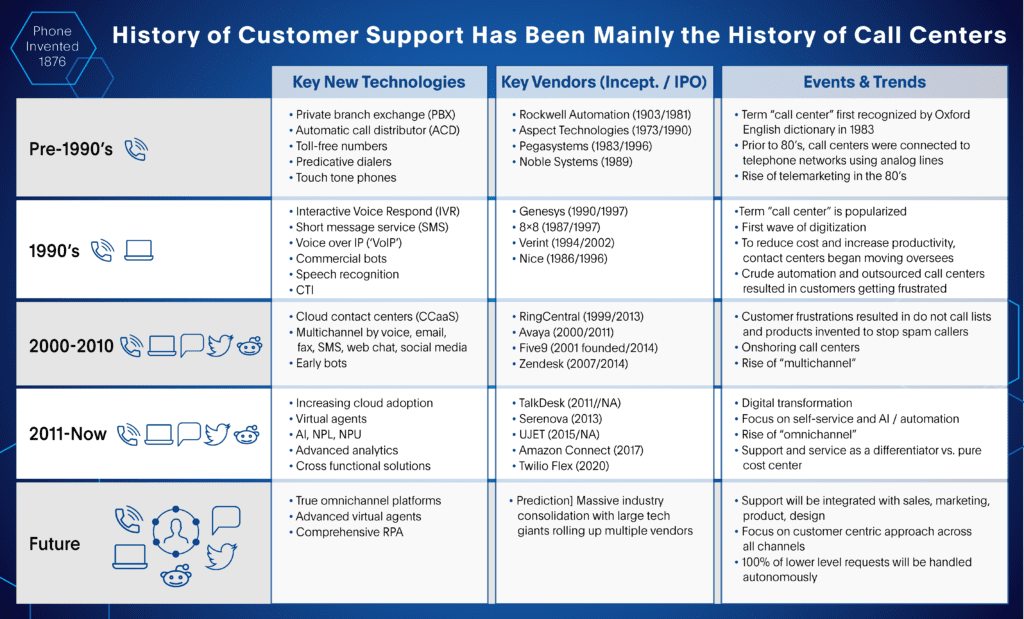
It’s easy to understand why there has been so much attention on AI and automation in customer support after reviewing how much money is spent to help resolve customer issues. Customer support is incredibly labor-intensive. Five9 finds that today, roughly 90 percent of customer support spend is on labor and only 10 percent is spent on software. To address this level of manual work, a major wave of technological innovation in customer support occurs roughly every decade. Changes in customer support technology have affected the types of roles and skills required for frontline support agents. 

In the future, advanced AI technologies will automate the majority of basic questions and requests, and the role of agents will evolve into specialized and often technical customer experience experts. 

Cloud tech provides flexibility and scale for next-gen customer support

Technological frictions arising from a remote work environment are further driving the shift to the cloud. The migration to the cloud is still in its early innings with about 15 percent industry penetration in customer support, according to Five9. Part of the reason why cloud penetration in the call center space has lagged behind other enterprise software categories like CRM, HCM, and ITSM is due to the complexity of all the underlying technologies needed to operate a call center in the cloud. We expect COVID-19 to accelerate cloud adoption ahead of the average eight to ten year technology refresh cycle seen in the industry. 

While customer support has traditionally been thought of as a call center, the pandemic has highlighted the importance of this business function within the broader umbrella of customer experience. By handling a customer issue during a time of great urgency and duress with grace and efficiency, a company can gain a lifelong customer, while a clumsy fumble can create significant and permanent damage to a brand. As brands race to find optimal ways to serve their customers and deliver truly differentiated experiences, customer support leaders will continue to adopt technologies that not only empower their agents to be successful and provide key customer service insights, but also work seamlessly with sales, marketing and product teams.


Revolutionizing Customer Service with Cloud-Based Multichannel Engagement: Why Sapphire Ventures is Excited About UJET

We’re thrilled to announce today that we are leading UJET’s $55 million financing round. UJET’s cloud-native customer support software helps companies across all industries transform how they deliver multichannel support to customers in need. Pre-Coronavirus data shows that 56 percent of people have stopped doing business with a company because of poor customer service.The demand for fast, effective and personalized customer service has been growing for some time. We believe COVID-19 has accelerated the need for companies to adopt a platform like UJET as they tackle a massive uptick in inquiries due to cancelled flights, missing packages and more.

UJET empowers companies to reimagine customer support by providing them with an all-in-one platform that enables them to create intelligent workflows, make data actionable and create a modern business model that’s immersive, engaging and delivers a one-of-a-kind customer experience. We are looking forward to supporting UJET on their journey to revolutionize the customer support and contact center markets, and helping them build a Company of Consequence.

Here’s why Sapphire Ventures is excited to partner with UJET:

Contact Center as a Service (CCaaS) takes customer support to new levels

Contact centers have been critical to customer service, sales and marketing workflows for the past three decades. Over the years, much has changed as the industry experienced several waves of technological innovation. The first wave took place in the 1980s and 1990s alongside the rise of telemarketing. Companies like Genesys and Avaya capitalized on the digitization of telephony by offering on-premise unified communication platforms to enterprises. 

The migration to the cloud triggered the next wave of innovative customer support companies led by companies such as  Five9 and Nice inContact. As seen with other enterprise software categories that have moved to the cloud like CRM, HCM and ITSM, cloud contact support has offered enterprises a flexible and scalable alternative to difficult to implement and manage legacy on-premise solutions. Contact Center as a Service (CCaaS) solutions have done well as more enterprises move their contact centers to cloud platforms, but the shift is still very much in its early innings. Five9 estimates that CCaaS solutions only have 15 percent market share because of the complexity of existing on-premise software used by companies with tens of thousands of customer support agents, but we are optimistic about the opportunity ahead.

We are now entering a new wave of innovation in the cloud contact center space where multimodal omnichannel and AI are key components of what’s next. We believe that UJET is building the next generation CCaaS solution with its highly scalable and reliable platform that brings together multiple channels of contextual data to provide personalized customer journeys and leverages AI to enhance agent efficiency–all in an effort to improve the customer experience. 

Most recently, COVID-19 tested call center operations, exposing platforms that are flexible and adaptable and those that aren’t. While technology refresh cycles typically happen eight to 10 years in this market, we believe that the pandemic has sped-up the need for more innovative and scalable CCaaS solutions like UJET. That’s why UJET is now powering the world’s largest cloud contact center with over 22,000 agents on a single tenant, enabling UJET to grow licenses by 400 percent in the last 12 months.

Voice, messaging and mobile are transforming the customer experience

Whether chatting with a service bot online or messaging a customer service rep in-app, customers today rely on multiple channels to reach support agents. UJET goes beyond voice and IVP customer support, enabling companies to engage with their customers on the channels they prefer including web messaging, text, in-app and more. 

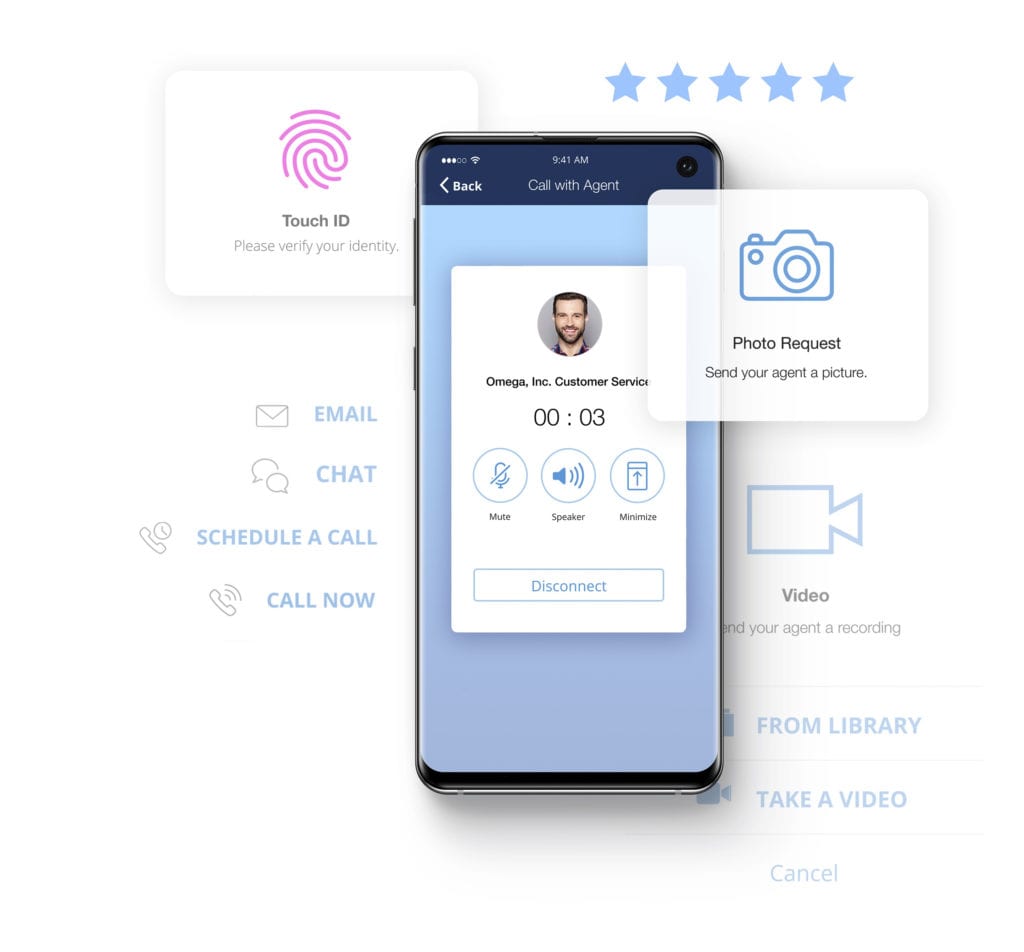
UJET also offers mobile features unlike we’ve seen before such as user authentication via a smartphone camera to enhance customer interactions and increase support efficiency. On the agent side, UJET’s integrated omnichannel solution connects the customer to the right agent quickly. While customers wait to connect to an agent, UJET offers features like Wait-Time Messaging (automated information requests while on hold) and photo or video requests (sending media directly to agents) to reduce the time it takes to resolve an issue. Companies that are able to provide seamless, differentiated and speedier customer support improve the overall experience, resulting in brand loyalty. That’s especially the case in times of high stress as seen more recently.

Reimagining customer support with an all-in-one platform.

AI-powered virtual agents are expected to dominate contact centers

We recently heard Five9 say that 90 percent of all customer support cost is spent on labor and only 10 percent on software. When looking at these figures it’s easy to understand why virtual agents invoke so much excitement. Compared to the earlier generation of this technology, virtual agents today are far more sophisticated, benefitting from NPL and NPU advancements in the last few years. In fact, Gartner predicts that 40 percent of contact center interactions will be fully automated by 2023. Because virtual agents alleviate much of the total cost involved in delivering quality customer support, innovative companies are in the process of rolling out these in-demand solutions. Soon-to-be released, UJET is developing its own virtual agent for automating customer support interactions that will reflect UJET’s mobile-first approach by leveraging smartphone capabilities. More to come here!

Differentiated leadership and a committed team

Founder and CEO of UJET Anand Janefalkar

Time and time again, the companies we’ve seen succeed in their journey to become a Company of Consequence typically have a differentiated founder and team. UJET’s founder and CEO Anand Janefalkar doesn’t have a contact center industry background. His story is unique in that he was compelled to start UJET because of an extremely poor experience he had with customer support and call center agents. He persuaded Joerg Habermeier who was previously at Facebook to join his company as VP of Product, and hired engineers from cloud-native and cloud-scale companies to rethink how to build a cloud-native, cloud-scale and mobile-first CCaaS platform. Most recently, UJET brought on Darcey Harrison as the Chief Revenue Officer (CRO), Vasili Triant as the company’s Chief Business Officer (CBO) and Baker Johnson as VP of Marketing to round out their go-to-market (GTM) team and help the company grow to the next level.

“We’re very excited to partner with Sapphire Ventures, a well-known and respected VC firm that’s known for its enterprise software investments,” said Anand Janefalkar. “Since meeting earlier this year, the Sapphire team has been energized by what we’re doing in the customer support space, and has been committed to our vision. This round of funding will allow us to drive product innovation, build out our go-to-market strategy and support our growing customer base during this unprecedented time in history and beyond.”

With this new financing round and with the support from Sapphire’s Portfolio Growth team, we’re excited to see UJET continue to help enterprise customers provide best-in-class customer experience by driving adoption of its cloud-native and mobile-first contact center and customer support platform.


Welcome to Agile Content Management: Why Sapphire Ventures is Excited to Continue to Partner with Contentful

We are excited to announce today that we are leading Series E $80 million financing in Contentful. We have known Contentful for more than six years now and this is Sapphire Ventures’ second investment in the company after having led the Series D financing round in 2018. 

Investing in companies during unclear economic times can be tricky, but as a venture capital firm, we’re familiar with making investment decisions amidst uncertainty–everything is a trade-off between risk and return. Still, a global pandemic like this one is an exogenous shock that puts a big wrench into that equation. So, what gave us the confidence to once again invest in Contentful? The short answer is, Contentful has grown substantially, as has market demand, since our initial investment.

5 reasons why we’re excited about Contentful

Agile content management is now mainstream

Since pioneering headless CMS six years ago, Contentful has been transforming how companies manage and deploy content across channels. Early on, Contentful’s API-first solution targeted developers who became early adopters. As the company built a strong following among developers over the years, creative, marketing and c-level stakeholders became aware of the advantages of a modular and flexible content architecture. 

Today, digital is quickly becoming the premier channel for every business. And while the web is foundational, the proliferation of mobile, social, voice, virtual and augmented reality require a cross-channel approach to content. Executing a cross-channel content strategy requires a modern and agile content management platform like Contentful. Traditional CMS suites are page centric, built for websites, have a monolithic core and are architected for single servers, which is why more enterprises and digital natives prefer to assemble a modern tech stack out of best-in-class components, over an integrated CMS suite.

Contentful has evolved into a platform of services

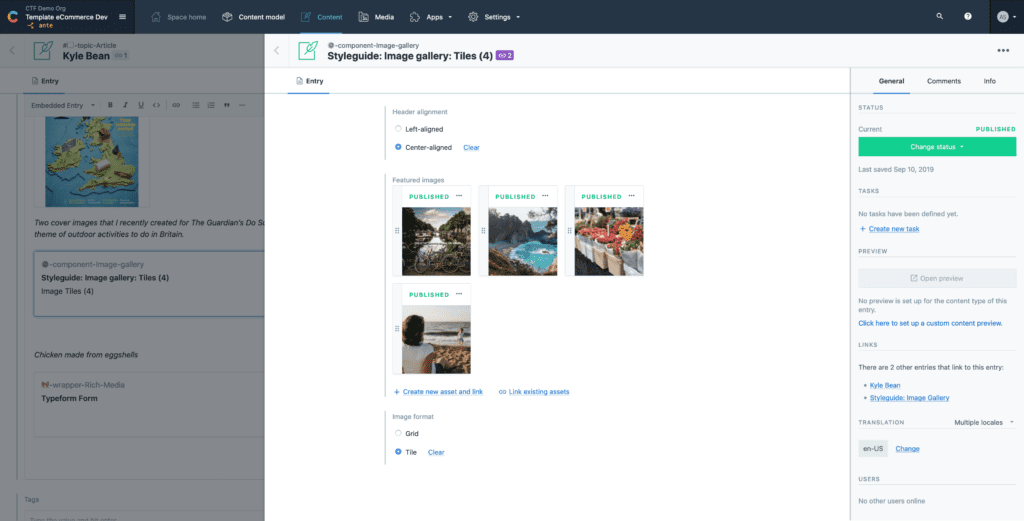
Contentful makes it easy to manage and deploy content across channels.

Within the Contentful solution, content is organized flexibly in modular pieces making it adaptable, channel independent and reusable. The cloud native architecture enables decoupled and scalable management of content delivery, and the API-first approach enables strong integrations with third parties. 

Building on the extensibility of its platform, Contentful released the App Framework earlier this year, which enables programmatic scaling of digital experience services such as optimization, analytics, collaboration and translation. This provides more agility and flexibility for teams, while enhancing the robustness of content operations governance. These characteristics make Contentful future-friendly and an integral part of the next-generation Digital Experience Platform (DXP) stack.

The company built the largest partner network in the industry

Contentful’s growing ecosystem consists of 300 partners, including solutions partners, technology partners and top global agencies. Digital agencies and system integrators such as Accenture, Publicis, Huge, Valtech and AKQA are leveraging Contentful to help customers build unique and consistent digital brand experiences across devices and channels.

Steve Sloan came on board as the new CEO

About a year ago, Contentful’s co-Founder Sascha Konietzke made the decision to move away from his CEO position into a more strategic one as Chief Strategy Officer. Following a very careful and intentional search, the company brought on Steve Sloan to lead Contentful as CEO. Steve was a fantastic fit right away. He connected with Sascha and co-Founder Paolo Negri instantaneously, and for the last several months has been focused on expanding upon their original vision.

A leadership change is never easy, always risky and not something boards take lightly. Eight months into Steve’s new role, and I don’t think any of us could have wished the transition to have gone any better. Steve has impressed me in a big way–not only with his insights and sensibility during the process of winning over the teams in Berlin and San Francisco, but also with the great leadership he has shown in this time of crisis. 

A number of seasoned executives joined Contentful

Since our Series D investment in Contentful, the company has hired eight senior leaders, including Steve. We are impressed by the exceptional talent these individuals bring to the table, and by how they have naturally come together as a team.

While the business impact of the pandemic is uncertain, I think it will create opportunities for some companies, particularly those that embrace digital-first strategies, to become stronger and outperform their competition. We believe Contentful is one of those companies–a company we believe to be of consequence. 

The way I see it, Contentful has all of the necessary ingredients to be successful: an agile and differentiated platform, a large developer network, robust ecosystem of partners and a world-class team. This, coupled with the tailwinds for digital that has been more recently amplified by the crisis, makes us optimists for the long term and the future of Contentful.


Revolutionizing Cybersecurity with Osquery and SQL-Powered Analytics: Why Sapphire Ventures and Uptycs Chose to Partner

We’re excited to announce today that we’re leading $30 million Series B financing for Uptycs, a start-up that’s revolutionizing security analytics by providing enterprises with a SQL-based security analytics platform for performing intrusion detection, vulnerability management, incident investigation, workload protection, security audits and compliance checks. Uptycs is able to do all this across a company’s server endpoints (such as Linux VMs and containers) within data centers, cloud providers like AWS, Azure and Google Cloud, and productivity endpoints such as macOS and Windows.

A cumulation of several trends has driven the need for cybersecurity solutions like Uptycs. Firstly, to address the growing threat of cyber-attacks, enterprises have increasingly been running agents from siloed security applications. In addition, the emergence of ephemeral workloads in modern infrastructure has caused the amount of security telemetry (hence noise) to explode. Enterprises have also seen a demand to protect non-Windows operating systems, such as macOS on productivity endpoints and Linux on cloud workloads. And more recently, mandated remote work has increased security risk, making products like Uptycs mission critical.

Uptycs pairs Osquery, a best-in-class open-source endpoint agent, with a proprietary SQL-powered analytics platform to enable a unified view of server workloads and endpoints across heterogeneous environments (like the public cloud, on-premise, laptops and more) for security analytics and performance monitoring. Inspired by how Salesforce and SAP have changed the CRM and business process industries with SQL based applications, Uptycs built a platform that uses SQL to extract operating system information with Osquery agents as tables and relational databases, and translates them into security analysis use cases and eventually, performance metrics visibility.

With the new funding, we’re excited to see Uptycs continue to support its enterprise customers, augment its marketing and sales capabilities, improve product development and expand product capabilities. Meanwhile, our Portfolio Growth team, will be supporting Uptycs in its mission to help modern enterprises adopt its SaaS-based approach to using Osquery for security analytics and performance metrics of cloud workloads and endpoints.

Making security analytics accessible since its founding

Uptycs was founded in 2016 by Ganesh Pai (former chief architect at Akamai Technologies), Uma Reddy (former VP of engineering at Sonus) and Mike Hluchyj (former CTO, carrier products at Akamai), who currently serves on the company’s board. Their goal was to make security analytics easily accessible—especially for enterprise customers that are faced with a massive shortage of cyber-security talent. According to Cybercrime Magazine, there will be approximately 3.5 million unfilled cybersecurity jobs by 2021.

Uptycs addresses the shortage in security talent by using Osquery, an open-source agent developed at Facebook that allows users to write SQL queries to explore operating system data for security analysis and for obtaining performance metrics. Uptycs is growing in popularity among enterprises because its SQL-based platform makes it easy and accessible for someone with the ability to write SQL code to easily become a security analyst. Having seen the adoption of SQL-based analytics tools like Looker, a previous Sapphire Ventures investment, we believe that Uptycs is on the right path to democratize the market for security analysts, making it much more accessible.

A quickly growing market opportunity

When looking at the overall cloud security market, we see an impressive opportunity for growth—for the industry and specifically, for Uptycs. Recent data from Grand View Research shows that the cloud security market size is expected to reach $12.63 billion (13.9% CAGR) by 2024.

We believe enterprises will adopt security solutions like Uptycs for their security needs because of its easy-to-use, open-source based approach. As we look at the technology landscape, open-source platforms are gaining more and more traction because they’re distributed widely, embraced by developers and allow for collaboration across enterprises. In addition, open-source agents reduce blind spots, especially for cloud workloads.

Helping customers secure their systems

It’s not enough to deploy an open-source Osquery and collect an onslaught of system activity. That’s why customers are turning to Uptycs to help answer: “Now what?”

The Uptycs security platform uses data across the entire fleet of Osquery agents to run correlations and identify anomalous activity. The platform is capable of managing and contextualizing system data from 50 to 500,000+ endpoints—providing the who, what, when and where at the individual- server workload and laptop levels.

Uptycs has already seen success with its enterprise customers.

  • Provides API for payment processing: Deployed on mostly macOS laptops, Uptycs eliminates the need to recreate detection and alert logic every time a new tool is added. The Osquery API helps enterprises with tool consolidation—they just punch a few lines of code and get the data they need immediately.
  • Integration focused ISV: By using Uptycs, the company was able to complete a comprehensive asset audit for compliance requirements on all their 1000+ servers.
  • Next-gen DevOps provider: Working with a remote team, Uptycs was tapped to manage assets and ensure device authentication and authorization. This solves such problems as determining whether or not a user is authorized to log in at 4a.m. from Europe.

Trusted Uptycs leadership and industry expertise

Ganesh Pai, Founder & CEO of Uptycs

Although we feel vendor fragmentation and marketing hype create challenges in understanding the differentiated value that security companies deliver, we firmly believe security is critical to the success of every company, and Chief Information Security Officers who have a lot of purchasing power would agree. We’re hyper-focused on investing in startups like Uptycs that not only provide a differentiated product, but are evolving into a platform.

We’re also excited about the Uptycs team. Co-founders Ganesh Pai, Mike Hluchyj and Uma Reddy have been working together for more than 20 years. They know the security industry incredibly well, have a proven track record of working together and create great technology products. Ganesh, Mike and Uma sold their first company, Verivue, to Akamai. After two years at Akamai, the co-founders and their talented engineering team decided to start their second company together, Uptycs. This time, with a bigger, more relevant challenge to work with.

We’re thrilled to be a part of this journey with Uptycs. Here at Sapphire Ventures, we have a long history of partnering with Boston-based companies, including the likes of DataRobot and CloudHealth (acquired by VMware), and we’re pleased to add Ganesh and Uptycs to the portfolio. We are all looking forward to helping build another company of consequence with Ganesh and his team!