Is PropTech the Solution to Real Estate’s COVID-19 Slump?

COVID-19 has had an immediate impact on almost every industry. Almost overnight, consumers and professionals alike have rapidly adopted new technologies and tools to communicate, transact, work and live. The real estate industry is no exception, but probably not how you’d think.

While in previous economic downturns we saw the residential real estate market and the services that support it plummet, that’s not the case today. In fact, new home sales rose 21% last month from a year earlier despite nationwide lockdowns . And record low inventory and declining mortgage rates continue to support pricing strength and buyer demand. In addition, the pandemic has accelerated the digitization of real estate in a big way with agents and brokers turning to technologies to manage the sales process–from conducting virtual property tours to moving legal paperwork to the cloud to close deals remotely.

In contrast, commercial real estate markets—particularly office and retail—are being impacted quite differently and in many cases negatively. Because office closure requirements and mandatory remote work are still very much in place for many businesses, many businesses are either letting go of their leases or are continuing to pay for them despite a halt in foot traffic.

But there’s a silver lining: Whether you’re in residential or commercial real estate, embracing technology will help win over buyers, sellers, residents and tenants. Property technology, or PropTech, has been helping real estate companies gain a competitive edge for years. COVID-19 has accelerated the trend by creating the forcing function the real estate industry needed to upgrade its processes and tools.

Automated tools help agents deliver a better customer experience

Today’s consumers are tech-savvy. Home buyers and sellers have come to expect the same seamless and convenient experience they get when shopping on Amazon, ordering from DoorDash or communicating on Zoom. Now more than ever, and thanks in part to COVID-19, consumers are used to communicating virtually and transacting remotely.

I’ve said in the past that I believe automating the real estate transaction is the next $100 billion opportunity in real estate. And while the real estate industry has historically been slow to adopt technology, COVID-19 appears to be accelerating its adoption in many ways:

  • Document management DocuSign, a previous Sapphire Ventures investment and now a public company, has been the go-to resource for digitizing legal documents. More recent entrants like Notarize and Snapdocs are enabling further digitization and online workflows, and have experienced rapid adoption in the wake of COVID-19.
  • Closing efficiencies — A cadre of PropTech startups, including Modus, JetClosing, Spruce and Endpoint, have all significantly streamlined transactions and sped up the closing process.
  • Transaction volume increases Side, one of our portfolio companies, is a full-service support system that arms top-producing agents with robust technology that helps them grow their business without having to worry about straining their operations.

PropTech solutions are modernizing the buying and selling experience, speeding up the process beginning-to-end. Electronic signatures, document checklists and cloud storage services help agents and buyers collaborate virtually and easily keep critical files in order. Real estate businesses that adopt these technologies will delight consumers and emerge from this downturn in a stronger position than their competitors. On the flip side, failure to adopt tech tools the simplify real estate buying and selling can lead to a poor customer experience, which is not worth the risk in the current economic climate.

Commercial real estate moves to digital to boost tenant retention

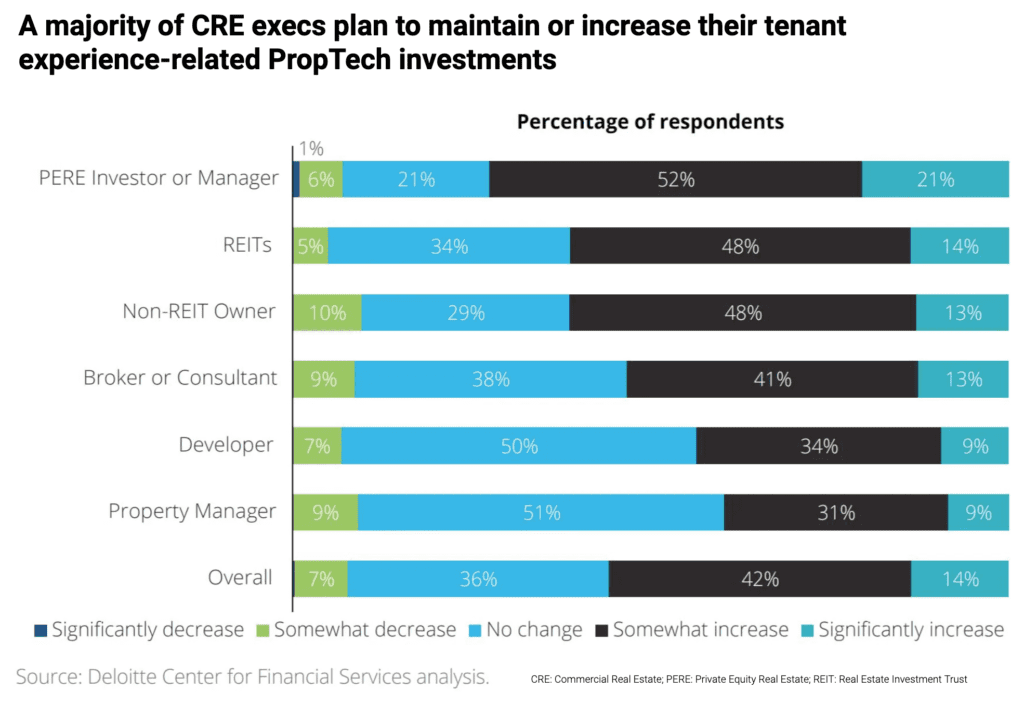
According to a Deloitte survey published before the pandemic, 56 percent commercial real estate executives said they plan to increase their investments in tenant experience. Digitizing the workplace was already top of mind for industry leaders. But now as many retail businesses reopen and employers develop their return-to-work strategies in a post COVID-19 world, it’s a critical time for PropTech startups in the commercial real estate sector to adapt to new tenant needs, and fast.

PropTech startups have been developing innovative new office technologies for years, but they’re now more timely than ever. For example, Density uses computer vision technology to measure the movement and density of people in an office, which will be a key tool in determining return-to-work strategies for many building owners and employers. HqO, another start-up, creates software that helps office buildings operate digitally. Tenants can use HqO’s app to enter the building, order meals for delivery and even find nearby fitness classes. Property owners use the real-time data to optimize features based on how tenants are using the building. And newer companies such as SmartRent design custom device packages based on information gathered during on-premise inspections of community properties. Landlords are able to facilitate lease management, move-ins/move-outs and work orders directly from one app—an essential capability in a world where in-person interactions are no longer an option.

Given the rise of digital adoption in consumers’ everyday lives, tenants (both residential and commercial) are increasingly expecting properties to offer easy-to-use technological features. Property managers and landlords must move fast to stay ahead of these expectations by working with startups to improve operations.

Buyers and sellers rely on data platforms to make intelligent decisions

PropTech is increasingly being used to provide an information edge for buyers and sellers, and across both residential and commercial real estate. Another one of our portfolio companies, Reonomy, is an AI-powered commerce real estate database consisting of 49 million listings, which helps lenders, brokers and investors win more business and make faster decisions. One of the company’s features alerts customers if a property is in need of a repair—a smart finding that can save investors a bundle on long-term maintenance costs.

Specific property details, such as owner information, property valuation, land use and historical transactions, are essential to securing undervalued properties before the competition arrives. That’s why PropTech startups are building databases to streamline the real estate discovery process.

In another example, startups such as Placer and LocateAI are helping retailers determinate where to open new locations based on traffic patterns. These tools are also essential for helping determine lodging needs, which is an industry on pace to lose up to $400 million in room revenue per day. LocateAI data shows

that hotel traffic in certain cities are well ahead of the nation, which can be useful for discovering relative investment opportunities. Based on LocateAI’s data, Seattle appears to be one city that has almost fully recovered from its COVID-19 related slump in hotel and motel traffic (+12.6% traffic growth in May compared to February versus the national average of -24.3% during the same period).

The information edge will become more important as more data becomes accessible. The real estate industry is in the midst of a technological transformation and the competition will be fierce. But we believe PropTech will help empower those in the industry willing to turn to data to help make informed and strategic decisions—whether opening a new retail store or buying personal property.

PropTech is the next big opportunity to modernize real estate

Startups are at the forefront of a major shift to the digital era, offering tools such as virtual tours and AI that will help real estate professionals stay competitive. New and emerging technologies will help accelerate the closing process and enable accurate information flow between buyers and sellers.

When it comes to administrative work and document-sharing, manual tasks are a thing of the past. PropTech solutions such as automated document management and cloud storage create efficiencies that help agents grow their business and improve customer service. We’re also noticing a rise in digital platforms that can streamline property management, personalize the on-premise experience and ultimately, boost tenant retention. And AI-powered database services provide an information advantage for deal sourcing and property due diligence.

Real estate is one of the largest asset classes in the world, which is why we see massive potential for disruption. It’s been long overdue, and we’re excited for the industry’s next innovation wave and look forward to more startups leading the way.


Business people working together

4 Ways RevOps Can Help Build Certainty During Uncertain Times

It’s hard to think of another moment in time where we have had so much uncertainty about business continuity. The good news is, there’s a way to come out of this unique situation stronger. Startups that index towards efficiency and sustainability will not only have strong cash on hand, but they’ll also have the systems and processes in place to make decisions based on future go-to-market expectations. 

We recently published the following Customer Assessment Model to help companies maintain growth in Q2 and beyond. In this post, we want to share another valuable strategy to drive business efficiency and sustainability. Enter Revenue Operations, or RevOps. With RevOps, companies create the flexibility they need in their revenue processes in order to adapt to ever-changing market conditions.

Companies are moving towards end-to-end RevOps because of its ability to combine sales, marketing and customer success. It’s an attractive approach for most companies. But before you make the leap, first understand how it’s different from the Sales Operations functions of the past. After all, they’re both in charge of driving revenue.

So, what’s the difference?

At its very core, sales operations is about optimizing the sales funnel by closing more deals, faster and at a larger size. Sales operations is a great place to start, but RevOps takes us one step further by thinking more holistically about the revenue function.

In their early stages, companies often think about the immediate, short term goals of the business, such as initial customer acquisition at all costs. Doing that leads to a bloated cost of acquisition and a failure to consider the entire customer experience, which ultimately drives long-term revenue growth and retention–the lifeblood of a sustainable organization. Losing sight of the customer journey is a problem that can only be solved with marketing, sales and customer success teams working together. RevOps bridges these siloed activities, and as a result, helps drive revenue.

RevOps is more than a new function

RevOps is a movement that’s gaining traction–especially among B2B companies– because it spans the entire customer lifecycle.

I reached out to Karan Singh, VP of Revenue Operations at Procore Technologies to get his perspectives on RevOps, and what he believes are the four ways businesses can apply RevOps principles in order to grow long-term revenue and reduce uncertainty. Here’s his take:

1. Create a connective tissue between sales, marketing and customer success

At most companies, sales, marketing and customer success teams work in silos. As we know, this leads to inefficiencies and unhappy customers. When sales teams are focused on closing as many deals as possible, while marketing is focused on generating leads, neither team has the tools or metrics to make decisions based on the long-term value of the  customer. This results in lower customer retention and declining revenue growth over time.

For a company to be successful, marketing and sales need to align to business goals. If marketing and sales teams are focused on getting any customer through the door, they can miss out on catering to a particular kind of customer with a better chance of retention and value.The problem is that marketing and sales rarely agree on what an ideal customer looks like because incentives are rarely structured around customer fit–sales metrics, such as short-term quotas and deal size, don’t tend to work that way.

RevOps serves as the connective tissue between sales and other revenue functions– bringing them all together. Companies that invest in RevOps can drive hierarchical change that strengthens collaboration around a core strategy. Driving that change starts with distinguishing roles and responsibilities. Sales focuses on the single function of pure selling, marketing oversees the factors that drive revenue and customer success is responsible for retaining and expanding revenue. RevOps encompasses all of these revenue-driving functions, and serves as a strategic overseer of core revenue teams, making it easy for stakeholders to engage with a single point person on the overall revenue process.

Here’s how to build the connective tissue:

  • Establish Center of Excellence functions: In order to scale RevOps, companies should consider creating specialized sub-functions (COEs) that dictate strategy, systems, enablement and insights roadmaps for the overall revenue organization. These specialized functions interact with each other to build a cohesive roadmap for the revenue organization so that it can be successful. 
  • Have a single point of contact for those on the front line: In addition to your COEs, consider rolling out Field Operations. FieldOps is a team on RevOps responsible for interfacing with marketing, sales and customer success. They’re the  dotted line between your stakeholders and the centers of excellence.
  • Create a feedback loop to capture front line discovery: Pressure test your corporate strategy by having FieldOps gather information to build context and clarity. Stakeholders often try to implement new strategies without having front line input. Having a feedback loop avoids creating a vacuum, and ensures that there’s stronger adoption from your stakeholders when you roll out changes.

2. Align execution with business strategy

Organizations that treat operations as a service team and not as a strategic partner tend to lead by solutioning versus strategy. The approach can be problematic as a company grows. When existing problems aren’t addressed (as a result of failing to consider the full customer journey), issues are fixed with a band-aid approach–by using systems to solve for process issues that will break as the company scales. Businesses should align on business strategy first (i.e. ensure it’s clear what the long term goal is) and then focus on execution via systems and process, followed by technical solutioning and implementation.

RevOps is key to aligning execution to strategy. Because RevOps serves as the hyper-communicative collaboration engine for the organization, it can easily align roadmaps given it spans all areas of revenue, help support execution through programs and manage projects that ensure the business maintains its north star. 

In addition, RevOps can measure against strategic objectives via pre-established KPIs. Being data-driven is one of the hallmarks of a strong and successful RevOps organization. By quantifying strategic initiatives, it’s much easier to get ahead of underlying problems. For example, RevOps can use customer success metrics to figure out which products are resonating with customers, or it can determine how much additional revenue is being brought in from each strategic initiative.

To combine process with tools, RevOps leaders can follow this roadmap:

  • Build your process around project management and collaboration. Define your process and prioritization techniques that can do extensive discovery.
  • Use a CRM tool to execute on the day-to-day. This shouldn’t be your be-all and end-all, but is an important component. Make sure to focus on the strategy piece and bring the ideas from your centers of excellence to life.
  • Forecasting is the foundation for all strategies. Know your KPIs, where the business is trending and where there’s opportunity to expand. And avoid technical debt!

The net-net is that strong RevOps creates a better customer buying experience, which will deliver revenue, retention and loyalty that scales. The key is to have constant communication, shared metrics and a strong process that ultimately leads to a better customer experience.

3. Strengthen your RevOps muscle to manage change

Getting RevOps right can help your company position itself for ups and downs. We all know there’s great uncertainty in any business, especially in the current climate. Certain factors are out of our control, but you can control your process—and the ability to mitigate risk.

That’s why, companies should be proactive versus reactive to changing business conditions. To get started, first strengthen RevOps by having solid FieldOps in place. You want to build out that FieldOps function right around the $50 million run-rate to build the muscle memory from the start. FieldOps may not be hugely valuable from day one. The investment early on is about teaching and coaching stakeholders on how to work with operations.

Next, make sure that stakeholders aren’t approaching the centers of excellence with changes they want to see happen. For example, a SalesOps leader may say they need a new technology and then give instructions on how to implement it. The moment something like that starts happening, you no longer have subject matter experts driving decisions that only subject matter experts should make. FieldOps should provide feedback, pressure-test solutions and push back when necessary.

With discovery input from FieldOps, RevOps is able to deliver a prescriptive roadmap to get in front of issues—from the field to the boardroom. The process has to be data-driven and flexible. You can’t take a wait-and-see approach. And always make sure to measure and refine your strategy and process when necessary.

4. Give RevOps a seat at the leadership table

One of the most foundational things you can do to ensure your revenue organization will succeed is to give RevOps a seat at the leadership table. The RevOps team is key to prioritization, helping the business make informed decisions cross functionally. The only way RevOps will work effectively is if it’s able to have strong handoffs between groups and efficiency within the organization.

Unlike other departments, RevOps is focused on strategy and process–its also hyper-communicative and focused on bringing cross-functional teams under a single umbrella with shared metrics. This ensures that everyone is working towards delivering results for the company as a whole over the long-term.

The role of a sales operator, marketing operator and now revenue operator is probably one of the most strategic roles at every B2B software company.


Sapphire ventures coronavirus prospect social card

How to Build a Prospect Risk Assessment Model

In our recent post on ways B2B companies can build revenue resiliency, we wrote about the importance of rigorously assessing the risk of your current and potential customers based on the recent shocks they are experiencing. What makes this economic disruption and the impact it is having on businesses unlike any other is the uneven and global effect it is having on companies. In some instances, companies are experiencing a tailwind from these events and as a result have seen a surge in demand for their product or service, while many others are facing detrimental headwinds.

Many of our portfolio companies are in the process of assessing existing customer and prospect risk–something they’ve been doing since the onset of the pandemic, but has now become much more difficult because of it. With the new quarter upon us, we know many CROs and sales leaders are once again taking a look at the next three months and are mapping out how best to navigate what’s ahead.

That’s why the Portfolio Growth team at Sapphire Ventures pulled together the Prospect Risk Assessment Model. This model is a framework for CROs and sales teams to leverage so that they can better measure and understand how potential customers are being affected by the crisis. By utilizing the following framework, which looks at four key factors, teams can adjust their GTM motions across a continuum of potential changes for each prospect rather than making a binary choice that will be less effective:

  • Location: Evaluate how your prospect has been impacted by COVID-19 based on their geographic location.
  • Size of Business: A prospect’s size (via employee count and/or revenue) is a relevant indicator of financial strength and how IT budgets may be impacted by COVID-19.
  • Industry: COVID-19 has created a wide range of business impacts across industries and sub-industries. As we know, some are being hit more than others.
  • Solution Relevance: COVID-19 is causing businesses and IT organizations to look for technologies to solve time-sensitive pain points.

View the Risk Assessment Model Here:

Our hope is that this framework provides a model that you as a CRO or sales leader can use to understand how this disruption may impact your business relationships, sales discussions and commercial opportunities. We believe that those that respond quickly with tailored GTM motions will be able to continue to strengthen their relationships with prospects, preserve ARR and identify new revenue opportunities.


Podium social card

Modernizing the Way Business Happens Locally: Why We’re Excited About Podium

Earlier this month, Podium announced it closed a $125 million Series C funding round, and Sapphire Ventures is excited to have participated. The way we see it, Podium’s customer interaction software is unique because it’s transforming how local businesses interact with their customers. Fast Company agrees, listing it as one of the World’s Most Innovative Companies for 2019.

While these are difficult times for local businesses, Podium’s platform is making it easier for them to stay in business by improving how they engage with their customers throughout the lifecycle–from product or service discovery to purchase and loyalty. More than ever, we believe that local businesses need new and creative digital channels to better communicate with their customers.

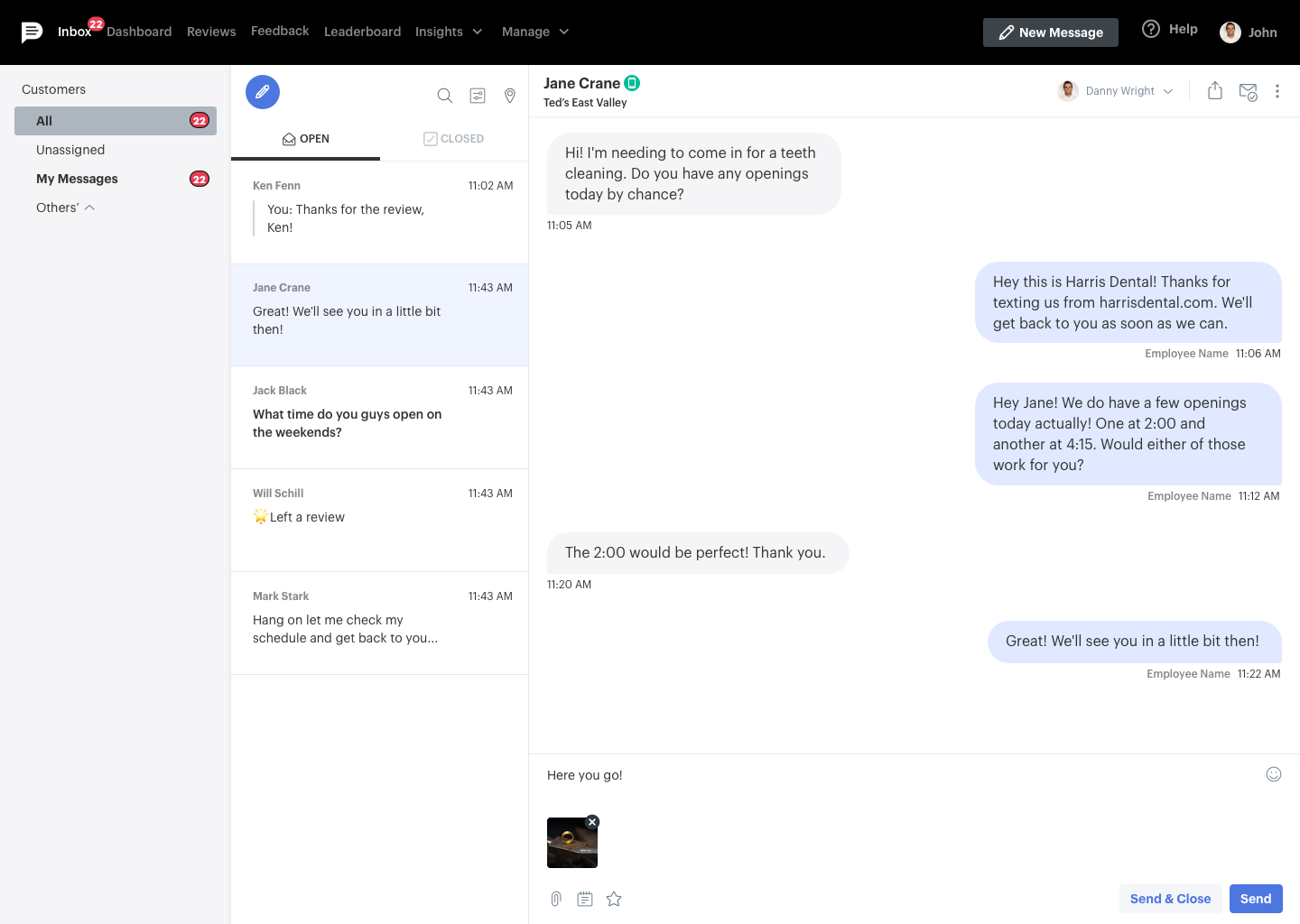
Podium’s platform enables local and small businesses to manage customer interactions across multiple channels such as webchat and text message. They can also manage reviews and feedback, and even accept payments. In addition, Podium provides employees with teamchat, enabling them to manage conversations internally and receive analytics on the engagement of their customers.

Podium makes it easy to chat with customers, manage feedback and pull insights--all within a single platform.

Why We’re Committed to Podium’s Vision 

We believe in Podium and are committed to the company long-term. Here’s why:

The Technology Opportunity:

According to the U.S. Small Business Administration, there were 30.7 million small businesses in the country in 2019, accounting for 99.7% of all companies. We believe that despite the economic weight they carry, small businesses, and especially local businesses, have been historically overlooked. They have been slow to adopt technologies that will help them engage with today’s consumers on the channels and in the moments that they prefer. Think of it this way, a consumer can go on Amazon, make a purchase with a single click and receive a package the same day. Customer service is simple and in most cases self-serve. Contrast that experience with servicing a car or finding a home service professional. They’re dramatically different experiences when they don’t need to be.

Shifting Consumer Behavior:

How consumers shop has changed over the last several decades. One of the biggest disruptions we’ve seen is online reviews. According to Spiegel Research Center, nearly 95 percent of shoppers read online reviews before making a purchase. Consulting online reviews is how consumers start their discovery process and how they choose what to buy. And increasingly that goes for any sort of purchase people make. People turn to online reviews for everything from finding a healthcare professional to selecting a car repair center to a B2B product. By using Podium, businesses can keep track of their online reviews, chat directly with customers and handle payments right within Podium. 

Strong Leadership Team:

When we look at companies, one of things that motivates us most are the people. Podium’s CEO Eric Rea has a fantastic personality–it’s a great blend of being optimistic and aspirational, yet practical and disciplined. This permeates across his executive team and the company culture. We’ve known Eric for years, and know that he understands the needs of local businesses. His father owned one, so the story is personal to him and we can see his passion for the work he is doing. It’s incredibly contagious!

CEO Eric Rea on Starting Podium, Teaming Up with Sapphire and Helping Small Businesses in a Time of Crisis

Leading up to the funding announcement, Eric and I spoke a lot about Podium, including why he decided to start the business, what he hopes to accomplish, why he’s excited about partnering with Sapphire Ventures and what his team is doing to help local businesses during the pandemic. Here’s what he had to say:

Why did you start Podium?

We started Podium to modernize the way business happens locally. The inspiration came from my dad’s tire shop. Despite being a successful business that provides an awesome in-person experience, the tire shop lacked the messaging tools needed to survive in a modern economy. Innovation for the last decade has largely been focused on building the online economy instead of local businesses like my dad’s.

Up until recently, the main ways my dad communicated with his customers were a landline phone and mailers. These legacy solutions were inefficient as society has shifted towards online discovery and messaging. Podium’s tools use messaging to help small businesses convert website traffic, schedule appointments, provide customer support, take payment, receive feedback, reviews and more–all by using the messaging platforms that customers are already using. 

What’s driving demand for your platform?

Consumer expectations around how they interact with family, friends and businesses have forever changed. In the last five years since Podium was started, it has become progressively easier to show every local business the need to add messaging products to their toolbox. The way we see it, it’s clear that messaging is the future of customer interaction–no matter who you’re interacting with. 

Since the COVID-19 crisis, messaging has quickly become one of the only ways small and local businesses can do business. This giant shift is most likely going to permanently alter the way that people make buying decisions, and will only increase the need for local businesses to run their business using Podium.

Why did you decide to partner with Sapphire?

When you are seeing the type of growth that Podium has had over the past five years, it’s common to hear proposals from investors about how they have a comprehensive, value-add approach to investing. The real task is to separate out those who are just saying that from the ones who actually walk the walk. Sapphire has proven over time that they deliver. 

And Rajeev brings deep SaaS knowledge and valuable insight into our business model. Podium has been incredibly blessed with partners who have been able to level up our business. I see Rajeev as being one of those people. Overall, we’re thrilled to have Sapphire join our growth story as we work to become a world changing company.

What’s your goal with this latest round of funding?

We believe that any business that interacts with customers through a physical location will benefit from Podium’s messaging tools. Podium is working with 45,000+ small businesses today, and there are still millions out there that could improve how they interact with their customers. With the latest funding round, we plan on scaling Podium to meet the demand of this market size, which we’re looking forward to doing!

How are you helping local businesses in need right now?

Since the pandemic began, local businesses were one of the greatest hit sectors. Many of them have been operating for decades. And almost overnight, they all had to completely adapt their operations in order to be safe and remain open. 

Podium recognizes the critical need that messaging and contactless payments provide in this environment. That’s why we immediately created Podium Starter, a no-cost version of Podium that gives US-based local businesses with two or fewer locations the basic tools they need to get started in messaging. Local businesses will now easily be able to convert the surge in website traffic into transactions using webchat, take contactless payments and use messenger to coordinate curbside pickup, arrange delivery options or any other customer service related conversation. 

Adverity social card

Solving Marketing’s Top Challenge: Why Adverity and Sapphire Ventures Chose to Partner

These continue to be uneasy times for many around the world, but today, we’re excited to announce that we’re leading Series C financing in Adverity, a marketing technology company founded by Alexander Igelsböck in 2015 that’s dedicated to delivering data intelligence to marketers. Adverity has raised $30 million in Series C financing, bringing the total amount raised by the company to $50 million.

With nearly 7,000 marketing technology solutions available, marketers are using many different products to achieve their goals. As a result, they’re unable to get a unified view of their marketing performance and investments. And they’re having a difficult time reporting on their campaigns and outcomes. Ultimately, marketers are spending more time and resources than necessary because they’re manually stitching together data from disparate systems to develop reports.

We believe Adverity solves this massive marketing problem by providing companies with a business intelligence and analytics solution specifically designed for marketers. Adverity has a deep understanding of hundreds of marketing applications including advertising, social media, CRM, analytics apps and more. Its platform has made it simple for marketers to integrate any data source and deliver a single view of marketing performance, enabling them to continuously assess and optimize investments.

We’ve been making investments in marketing technology solutions such as ExactTarget, Marin Software, Krux and Segment since Sapphire started, so we believe that we know the industry well. Most recently, we’ve been interested in companies that are able to answer some of the most foundational marketing questions: “How can we see all of our marketing activity in one place and understand where to make the right investments?” 

Adverity, which works with companies such as IKEA, Red Bull, Mediacom, Mindshare and IPG, helps marketers address these challenges. The platform is able to import data from any source, automatically process and clean it with the power of artificial intelligence, and then visualize it so that it’s easy for anybody to understand and take action on.

We’re also big fans of the three charismatic founders of Adverity: Alexander Igelsböck, Martin Brunthaler and Andreas Glänzer. Prior to starting Adverity, Alexander led a startup incubator in Austria (KochAbo GmbH) and before that, served as a product management leader at VeriSign Inc. where he met Brunthaler who was on the engineering team. Andreas grew his career in sales, having spent several years at Google and iProspect. 

Why Adverity Chose Sapphire Ventures

For Adverity, we were the right partner because as CEO Alexander Igelsböck puts it, “With their global network of experience and expertise, partnering with Sapphire Ventures will continue to accelerate us in this period of sustained growth, helping us to realize our global ambitions.”

Adverity was started to help marketers see true value from the vast amounts of data bound up in the hundreds of spreadsheets and reports that they try to make sense of on a daily basis. “We started Adverity to create ‘a single source of truth’ across departments so that all teams could work from the same data set rather than in isolation,” says Alexander Igelsböck. “By creating a ‘single source of truth’ with our platform, customers have been able to see the tangible business impact of marketing activities while improving performance.”

“The investment from Sapphire Ventures will allow Adverity to continue to evolve and develop new tools to address the challenges of marketing data complexity. It also means we can expand our technology and commercial teams in the pursuit of this, which is something we’re very excited about,” says Alexander Igelsböck.

We recognize there are unsettling times, but Adverity is hiring. If you’re looking for a new job, check out their Careers page: https://www.adverity.com/careers/


3 Start-Up CEOs Share How to Get Through This Economic Downturn

No one could have predicted that an international healthcare crisis would have caused the economic downturn we find ourselves in. But one thing is for certain, we knew a slowdown would come. The markets have been performing well for too long, according to all historical benchmarks. And when that happens, as history shows, a financial reset will typically take place.

That doesn’t change the fact that every economic downturn is painful. People lose their jobs, companies fold and morale takes a hit. But as with every recession, society adapts and perseveres. It will take some time to get through this hump, but on the other side of it new jobs will be created, groundbreaking companies will emerge and life will resume.

Since the onset of the pandemic, we’ve been in close contact with the CEOs of our portfolio companies. In conversations with these seasoned leaders, a few of them shared learnings from previous recessions, including advice to weather the storm and what they fear most, which we wanted to share here.

Ramin Sayar, CEO of Sumo Logic

Sumo Logic is is a cloud-based machine data analytics company focusing on security, operations and BI use cases

I, like most of the Sumo Logic management team, have lived and worked through the dotcom crash and the 2008 financial crisis, which gives me and my team a real appreciation for just how difficult it can be to not just survive, but truly thrive and grow during these periods.

Fear is fueled by the unknowns, and the COVID-19 crisis is full of them. But, if there is anything that we have all learned from the past crisis is that you have to take action immediately. At Sumo Logic, we activated an Emergency Management Committee, which is a cross-section of leaders and functional experts. We did this early on and launched three parallel workstreams:

  • A team that addresses the health and productivity of our employees.
  • Another that focuses on the health of our service and the customers we serve.
  • Lastly, a team dedicated to the health of our business.

We immediately created a COVID-19 war room that provides real-time updates to executives and employees, as well as customers through different communication vehicles.

  • We are very much still in the middle of this crisis, so here’s my advice for other start-up CEOs:
    Be as transparent and as communicative as possible. Share everything you know and ask for feedback from everyone.
  • Plan for every possible business and emergency scenario. Operate with urgency on things like ratcheting back investments so that you have options down the road if the market downturn gets worse and/or goes on for longer than expected. This way, as the situation changes, there’s a playbook in place based on various scenario plans with associated operational KPIs and business gates that allows us to execute collectively versus thrashing in times of high emotion.
  • Now is the time to lead with empathy, compassion and conviction. This is the time that your employees, customers, shareholders and community need resilient and decisive leaders. Challenging moments such as these will help further galvanize a strong culture and a focused team, if done right.

Jesse Levin, CEO of Brightfield

Brightfield is a workforce analytics company that helps the Global 2000 design their workforce precisely right.

8 Lessons to Survive, and Thrive, During Difficult Times:

  1. Double Down on the Core and Tighten Execution. There is always more return here than you think through short-intensive, campaign-level focus across functions. By tightening execution and focusing on your core product, you’ll be able to boost collaboration and engagement amongst teams and colleagues. Use the recession to kill any zombie projects or products that may represent recurring revenue.
  2. Everyone Is a Customer. Figure out ways not to let short-term economics get in the way of the immediate ability to be useful to segments of your market that may be non-viable in the short-term. For example, in software products where the marginal cost of use is near zero, figure out if there are ways to provide trial usage (if you’ve verified it’s with the true economic buyer). Customers and prospects remember who invested in them at the bottom of a cycle and, in my experience, do find ways to balance the karma scales (at least in the short run) when the market comes back.
  3. Focus on Cash Not Cost. Suddenly, cost savings are urgent again, which is great for companies with a tangible value proposition with hard-dollar savings measures. That said, remember that while cost is nice, cash rules. So, push hard to determine how features of your product/service don’t just support forward cost avoidance but can actually enable immediate cash realization.
  4. Ensure Your Leaders Are Comfortable with Imposter Syndrome. The pandemic recession has some attributes that are similar to past cycles, many that are not. Thus, your leaders must exhibit confidence and clarity even when they don’t know what’s next. Great leaders show their true colors by getting better when the moment calls and that’s where we are right now.
  5. Blur the Lines Between Service and Software. If you don’t provide a mission-critical product to the enterprise, then figure how to be mission critical. Crisis environments are not the time to teach customers about your business model. This isn’t a time to be shiny and new, it’s a time to be trustworthy and functional.
  6. Convert Your Workforce Mix. What’s different about this recession than those of the past is that the percentage of the workforce that “matters” that is on contract (i.e., not a FTE) is 40%, on average, and, in many companies at or above 50% (e.g., Google, Microsoft, Cisco, etc.). Often these roles are more expensive on a bill-rate basis, but may be longer-tenured than many of your full time employees and are working on more strategic projects. Where that individual may have preferred contract work in the past due to the possibility of a larger paycheck for the next gig, companies have the opportunity to save 20 – 70 percent on a dollar basis by converting the contractor to an employee. In reality, companies may not only get better savings but more productivity from that team member.
  7. Boring is Beautiful. My first company went public in 1999 with a subscription B2B software model before SaaS was a thing. We did our IPO roadshow behind Pets.com. We had this wonderful IPO pitch about recurring revenue, terrific cash flow visibility, wonderful negative working capital attributes and so on. No one cared. All they wanted to know was what our “eyeball acquisition strategy” looked like. I am sure Pets.com had a great eye ball strategy. But you know who isn’t around anymore? Pets.com.
  8. Have a Strong POV for How to Help Customers Accelerate Out of the Turn. This is a once in a generation opportunity for companies to transform processes that they may have not had an excuse to do so. For example, in a supply chain of scarce commodities (say, talent for example), suppliers like staffing firms, independent contractors, consultants and outsourcers may have had a lot of leverage in negotiations. Not now. Many buyers are using this opportunity to reconstruct and focus their supply chains. Now is the time to use buying leverage and shift the balance of power. Depending on what side of the market you are on, be prepared to take advantage of the changing market dynamics to outcompete competitors unwilling to innovate at your pace.

Sudheesh Nair, CEO of ThoughtSpot

ThoughtSpot is a search and AI-driven analytics platform that empowers anyone to explore, analyze, and share data-driven insights instantly and simply.

What is your biggest fear?
On the personal front, I’m similar to everyone else. I fear the impact COVID-19 could have on my family and loved ones. As a CEO, however, fear is not the emotion I’m feeling now. I’ve been through downturns before. While a major economic downturn is damaging, strong companies come out on the other side stronger than before. I’m focused now on making ThoughtSpot one of those companies by taking any slowdown as an opportunity to pay down our debt. I’m not talking literal debt, but instead, technical debt, sales debt or culture debt. Too often, leaders can’t stop the momentum of the company to address it.

Think of it like a traffic jam. If everyone is in gridlock and the ETA is 90 minutes before you can get moving again, you can either stay in your car, or pull over, get out and have a meal so you’re refreshed and ready for the rest of the drive. COVID-19 provides the same opportunity for businesses to slow down and adjust the course.

Did you go through the 2001 and 2018 crashes? What lessons did you learn?
I went through both. In 2001, I was an entry-level employee and in 2008, I was a mid-level manager. In both cases, I found executive teams following the same formula: go into a dark room, make major decisions opaquely and then communicate them in perfect, marketing approved communications. The problem was nothing was believable. It was too polished, and no one had insight into the process.

I knew if I ever had to lead a company through a crisis like I am today, transparent, authentic and frequent communications would be critical. Your team needs to know more than just what decision was made, they need to know how a decision was made. And they need the opportunity to understand this not just once a month, but on an ongoing basis as the situation evolves.

What piece of advice is resonating with you now as the crisis intensifies?
“Grant me the serenity to accept the things I cannot change, courage to change the things I can and wisdom to know the difference.” This quote from theologian and ethicist Reinhold Niebuhr is more relevant now than ever. The first two points around acceptance and courage are obvious, but it’s the last point that resonates with me the most. We need to understand there are some things we cannot change during the COVID-19 crisis, and in that understanding, we can find some modicum of peace.


Virtual video conference

How CIOs are Navigating a Mandated Remote Workforce

In response to guidelines from the World Health Organization and local governments, many companies have mandated a mass switch to remote work nearly overnight. This transition has placed immense pressure on organizations and individuals to quickly adapt to a new working environment all while also responding to the rapidly evolving public health crisis, increasing economic instability, and sharp swings in consumer behavior. 

In the midst of this situation, we found we were hearing a number of common challenges and questions from IT leaders within our network, so we’ve started conducting virtual roundtable discussions with enterprise CIOs on top-of-mind issues. 

The onset of mandatory work from home policies have raised a number of challenges, and also opportunities, for CIOs and their teams, so we decided to have our first CIO roundtable focus on the topic of “strategies for supporting a remote workforce.” In partnership with our friends at Emergn, we convened a group of eight CIOs and senior IT leaders (from industries such as food & beverage, logistics, manufacturing, software, and telecommunications) to discuss their organization’s transition to remote work, including learnings and best practices thus far.  

Here’s what we’ve learned:

1. Companies are embracing speed over perfection

Speed to delivery is becoming absolutely critical in the midst of COVID-19 instability. This is resulting in a different relationship between speed and risk within enterprises. According to one CIO on our call, the motto now is “a less than perfect interaction with a customer today is more valuable than a perfect interaction in a month.” Organizations that previously delivered 100% perfect solutions are pivoting to delivering at 50-60 percent and iterating from there. This increased agility and flexibility is a new capacity that is likely going to become table stakes: CIOs aren’t looking to slow back down. 

This also creates potential opportunities for nimble startups to step up.  In our CIO Innovation Index data, Sapphire found that over 50% CIOs reported “faster pace of product delivery” as a top benefit of working with startups.  This very attribute could help emerging technology startups shine in the current business environment.  

2. IT teams are shifting priorities in response to rapidly changing business needs 

Most CIOs report that their tech stack for remote work has held up well so far, and users have been self-servicing for support (rather than calling the IT helpdesk, for example) more than ever before. IT teams are shifting their priorities to support crucial areas including: supply chain, digital customer engagement and enabling remote development organizations. This has implications on the composition of their technology portfolios and highlights a potential need for automation tooling, especially areas that may have been deprioritized. Tools like Moveworks can resolve IT Service Desk support issues automatically, freeing up resources to focus on mission-critical priorities.  On the developer front, tools like CircleCI are helping technology organizations build, test and deploy applications faster than ever and AIOps platforms like OpsRamp are coming to the rescue of IT Ops teams and helping simplify the management of IT assets.  Meanwhile, solutions that enable seamless digital communication with customers and prospects can help keep engagement strong while in-person interaction is limited. Engagement platforms like Podium can be especially crucial, particularly for businesses that interact with customers on a local level. 

3. Organizations should be thinking about enabling virtual communities

One of the biggest challenges here is the cultural and behavioral impact of shifting to remote work during an international crisis. Fostering community through virtual tools (whether it’s a Zoom happy hour, team Slack channel or online yoga class) is an excellent way to combat isolation. Plus, celebrating the messy facts of “business as usual at home” with kids, pets and tiny apartments can keep spirits up. CIOs are keeping a pulse on how their workforce is coping, and tools like CultureAmp are offering free Emergency Response Employee Engagement survey templates so that businesses can assess employee morale, make informed decisions and do the right thing by their people. Some organizations are also seeing creative ideas spring from virtual “bake-offs” and collaborative forums. 

4. Leading with compassion is crucial

In such an uncertain time, IT leaders are committing to empathetic leadership. This means being flexible with employees dealing with the new dynamic of balancing work and home life, and encouraging employees to set “office hours” and disconnect outside of them to prevent burnout. 

5. Open, intentional communication prevents panic

Especially with the high volume of information surfacing every day, the development of a single point of truth for COVID-19 information and internal communications can reduce inbox noise and fear of the unknown. One CIO leader we spoke to has a meeting with the leadership team every morning to edit policies and circulate information by region. 


If you’re a CIO or senior IT leader looking for further insights and the opportunity to discuss relevant topics with peers, we’d love to have you join an upcoming roundtable! Email Annie Warner at [email protected] with your interest. 


Business abstract graphic

5 Ways CROs Are Building Revenue Resiliency

You are a CRO who just closed an excellent 2019, had an energizing sales kickoff that aligned everyone around a strong strategy, and your first quarter is shaping up to be another record quarter. Then COVID-19 hits. Your teams have to quickly move to a distributed work environment, travel comes to a screeching halt, and all deals now have to be closed virtually. These changes have not only impacted how teams work together but have also critically affected customer purchasing habits and priorities.

At Sapphire Ventures, we know none of us alone will have all the answers to this challenge, so we have been hosting CRO forums to discuss what’s been working and what hasn’t for CROs and their teams. While CROs’ response to this crisis will continue to evolve, we wanted to share what we’ve been hearing and advising to-date. Here are some measures that CROs may want to consider now to incentivize prospects, overcome objections, engage customers with empathy and build confidence around your revenue process. 

1. Realign Your Sales Team

Unquestionably, you should focus on any customers who are experiencing time-sensitive pains from this crisis that your specific technology can help address. Outside of those potential customers, it is wise to assess the impacts of this current pandemic. In a spin on William Gibson’s infamous quote; this crisis is already here- it’s just not very evenly distributed. Unlike previous recessions, where all industries were negatively impacted to varying degrees, the current recession has created outsized tailwinds and headwinds for certain industries. For example, grocers, CPG, telecommunication, gaming, and media companies are all experiencing a surge in business. Other industries such as hospitality, energy, financial services, and retail have been severely negatively impacted.

It behooves you and your company to be cognizant of this fact and adjust your sales segmentation accordingly. While you shouldn’t completely write off an industry, you also don’t want a salesperson repeatedly contacting a prospect that is in no position to have a meaningful or relevant conversation right now. You risk both having your company look tone-deaf and your salesperson burning out. Rally around your existing customers in the industries that have been negatively impacted by this crisis, but think about reassigning a portion of your sales team to industries that are experiencing a boon from the change in economic activity. 

2. Adjust Your Messaging

What resonated with a prospect only a month ago may no longer work. At Sapphire, we have reached out to our CIO network to get their feedback, and it’s clear that recent events have shifted their businesses’ focus, attention, and time. More importantly, people are being impacted on a personal level on one of Maslow’s most basic needs–health. 

Coach your sales team to engage with empathy and acknowledge the fact that we are not operating in a business as usual environment. Realize what initiatives and drivers may be a priority today for your prospective customers. Drivers such as business continuity, efficiency, user simplicity, collaboration, and productivity have taken a front seat at many companies. As a member of our CIO network has noted even now in the downturn, “Money will flow to business and IT pain points.” Identify how your solution helps to support these priorities and focus on establishing your messaging around these new areas of critical needs for your customer. For example, as most companies have been thrust into a distributed work environment, you may want to discuss how your solution enables collaboration, provides a single view of the truth, and also emphasize its simple implementation and user-friendly design. 

Another good idea is to take the time to build objection documents for your field teams. Record every objection they are hearing from customers. Then, work with your sales enablement team to create thoughtful responses that your sales team can utilize in these scenarios.

3. Double Down on Existing Customers

While it may be challenging and time-consuming to engage with new prospects today, you and your team should pay particular attention to existing customers. To preserve your existing ARR, it’s paramount that these customers do not churn. The only thing worse than not booking new business is losing existing business. Lean on your customer success team heavily to make sure your customers are maximizing the full benefit of your solution and empower them to partner with your sales team to engage in expansion opportunities. 

As my colleague Jai noted in his recent blog, this is also an excellent time to listen to your customers on potential product features they have been asking for, but you haven’t had the chance to attend to. By doing so, you can build product features that continue to differentiate your company from your competitors, expand your offering, and improve customer satisfaction. 

These efforts will not only help to preserve ARR, but prepare your company to come out of the downturn stronger.

4. Keep Prospects Engaged

While sales teams are always hoping to drive adoption, they should be adjusting their messaging from “here is why you should buy solution xyz” to also “let me educate you on how we can help even if you are not ready to buy today”. It’s about building a relationship as a trusted advisor and helping prospects become smarter about the space your company operates in until this period passes.

To do so, think about lightening or removing approval processes for your sales team to engage in activities such as trials, POCs, educational workshops, or complimentary assessments, so that they can respond quickly with a compelling opportunity if they receive an objection. For more information and tips on how to increase your success rates on POCs, you can read the blog we published on this topic here.

The key is to keep prospects engaged such that when this crisis subsides, you have a robust pipeline of prospects who are already educated on the space you operate in and are ready to have meaningful sales discussions.

5. Be Flexible, But Know Your Value 

The new reality we live in most likely means budgets may be eliminated or severely constrained at some companies. It’s important to work with your prospects and existing customers to make sure they can find ways to add or retain your solution. For those industries and companies that are most impacted, you may want to look at one-time discounting, spreading payments out quarterly or monthly, or deferring payments. These decisions need to be made carefully and with alignment from your executive team, but being flexible with your customer now could pay dividends later. 

This does not mean automatically caving to your customer’s price discount requests (especially if it’s a company that has not been as negatively impacted). It’s important to understand your solution’s value and rationalize your price accordingly. You may want to consider pricing your solution against business value delivered (i.e. increased productivity, active users, key metrics, business results). In these scenarios, customers only get billed for their rate of usage of your solution or against predefined business benefits they experience. That sends a strong message to customers that your company is aligned around their success and gives them confidence that they will only be billed for value incurred.

That also goes for your suppliers. If you truly need to, don’t hesitate to ask your suppliers if they can be flexible around your payment terms, so that you can properly manage working capital and navigate this time of uncertainty. 

Great uncertainty undoubtedly causes discomfort for companies and customers alike. However, those CROs who choose to use this ambiguity as an opportunity to evolve their GTM motion, expand their product offering, strengthen customer relationships and educate prospects will be better able to navigate these current choppy seas and emerge even stronger.


Julie Cullivan and Shruti Tournatory head shots

From CXO to Board Director: A Discussion with Julie Cullivan

Julie Cullivan and Shruti Tournatory head shots

Listen to Podcast

Shruti Tournatory interviews Julie Cullivan about the journey she took to her first board of directors role, the interview process, the difference between a board director and board observer role and more.  Listen to the full podcast.

The transcript of the conversation below has been lightly edited for clarity and length.

Shruti Tournatory  

Hello, everyone, I’m Shruti Tournatory, Vice President of Business Development at Sapphire ventures. And I am joined today by Julie Cullivan, Chief Technology Officer at ForeScout, a public cybersecurity company leading in the device visibility and control spaces. 

Julie and I will be having a conversation today about: 

  • how to find and select board roles
  • how to interview for them, and 
  • some of the unique rewards and challenges of serving as a director

This is of course, the virtual version of Sapphire Ventures’ Board Readiness Workshop series that we as a firm kicked off in 2019 with a goal of convening a community of women executives and CXOs who are seeking board roles and bringing them together with seasoned female board directors that have already walked that path. 

Julie, welcome!  My first question to you, Julie, is you’re obviously a seasoned executive, having served in a series of executive roles at a host of large tech companies. You joined your first board-director position with Axon which is a law enforcement tech company in 2017. And then, later in 2018, you took on a second role as a board observer with Cobalt.io a VC background start up, and also a company you had been advising in the past before taking on the board observer role. What motivated you at that point in your career to pursue new board positions?

Julie Cullivan  2:13

Well, it’s interesting. I think what happened is I had stepped into the CIO role at Fireeye. and realized during that transition that I needed to build a network of strong technologists, but was able to actually build a network of really strong women in technology. During some of those engagements and networking events, I connected with Coco Brown, who was starting to think about, “hey, we need more diversity on boards.” 

Every strong woman executive I talked to was thinking about board work, how do I help facilitate, make that happen for more women?  So that was my sort of initial thinking that maybe this is a path I want to take, and I always thought it would be something that I wasn’t quite ready for yet. But you know, hey, it’s something to be thinking about. 

And honestly, through engagement with some of these amazing women that ultimately ended up building out Athena Alliance, I started to realize that, you know, there’s no time like the present to get started on trying to make it happen. Because you really never know how long it’s gonna take.

Shruti Tournatory 3:20  

Can you talk a little bit about how you found each of these board roles, so your board director role with Axon and then also talk about the board observer role and the engagement you had with Cobalt.io because VC backed startups can sometimes have slightly different sort of selection processes. How does that discovery process like?

Julie Cullivan  4:06  

I started advising with Cobalt.io when it was just an incubator through the Stanford accelerator, and they had a program where they would match operational executives with incubator companies to try to help them coach them along their journey. And so I got involved with them, I think it was actually in 2013-14 so I’ve been working with them for a long time. 

Eventually, as they were starting to grow and scale, they started to look at independent board members, but also started to look at what kind of operational experience would we like to have be more engaged at the board level? I don’t have an official board position, I get to sit in on board meetings and help where I can, but I’m not an actual independent board member.  There’s just a variety of things that I think I can offer operationally, you know, sort of guidance and experience for them, that you don’t necessarily always get with an investor that’s sitting on a seat. 

Now as far as Axon, that definitely came my way through being, an active and engaged member of the Athena Alliance. Axon technologies’ CEO Rick Smith is a real forward-thinker, real visionary. He was very interested in more board diversity. And so he connected with Athena Alliance and very proactively said, “Hey, I’m looking to fill out an independent board seat with more diverse candidates, but I’m not sure how to go find them.”

He was able to partner with Athena to come up with a long healthy list of really amazing women that could come in and help them and, as that process pushed forward, I continued to sort of stay on the shortlist and ultimately ended up being a great match on both sides in terms of: I felt like I could close some gaps that they were looking to fill on their board makeup and they were willing to take a chance on a first time board member.

It was really a long path. It takes much longer than I think anybody realizes to earn a board seat.  It’s not as structured as when one goes in interviews for an actual, operational, hands-on role.  It can take a lot of sort of quiet times and other things happen in the bigger world that slow things down. But ultimately, after about, a good nine months of engagement, they were ready to make a an offer and things proceeded from there.

Shruti Tournatory  7:00  

In terms of the actual composition of the interview process, was it sort of a process where you had to meet with all of the board members?  All of the executive leadership team? 

Julie Cullivan  7:30  

I think I heard it really well said a couple weeks ago. I was at an event and somebody was talking about board work. And they said, “if you’ve been on one board, you’ve been on one board, because every board is different in terms of how they might go through the non gov process” or who do they engage in the board search, etc. 

In my particular case, it started with the CEO. Once the initial engagement and conversation was “Hey, this is somebody that I would like to have, you know, continue through the process,” I spent time with the non gov chair, spent time with the chairman of the board, spent time with three independent board members.  They were all very interested and engaged in the process and wanting to bring people in the people wanted to interview and make sure that I would be a good fit. 

And also, I will say that in this particular case, they’ve got several board members that have been engaged with the company for many, many years — there are many ups and downs. And they feel like their board service on this company — it’s a company on a mission — the board members are very married to that mission and they wanted to make sure whoever they brought in understood that this was not just “show up” every quarter to a board meeting.  They expected a level of engagement and that everybody on the board be contributing at the same level. 

Shruti Tournatory  9:12  

What is a competency, or a couple of competencies, that you feel really differentiates the skill set that is expected of a board director versus an operational leader?  Often in conversations about how executive leaders that are operational leaders how they can make it to board roles and thrive there. 

I’ve often heard the distinction been made between having a certain governance skill set as a board director, which is different from being an operations leader, leading sales or technology or whatever the function might be.  What is a competency or maybe a couple of competencies that a board director is expected to have that maybe isn’t necessarily expected of an operational leader?

Julie Cullivan 9:52  

I think that a lot of it is having a sort of a consultative approach, right to how you engage with the executive team.  Because you’re no longer saying, yes, you can do that. No, you can’t do that. It’s trying to sort of influence, and understand, and question, and pull the thread to make sure that your experiences can help benefit them as they move forward on whatever that strategy might be. 

Second, more of it is being able to engage in a way and influence based on the experiences that you have, but also understanding that in the end, they have to go execute and make these things happen. And so I think that’s been some of what I have learned. I mean, I’ve tried, as my career has grown, to take a more consultative approach than, like, “I know the answer, and this is what we should do.” And so I think it’s making sure that you’re able to engage in that level without making people feel like “Oh, I know, because I’ve done this before. I know all the answers.”  It’s letting people kind of get to those answers in their own way sometimes.

Shruti Tournatory  11:08  

Switching gears a little bit. You are in a small but growing rank of enterprise CIOs and technologists, who are finding their way into the boardroom. It’s an interesting dichotomy in the sense that, on the one hand, every company, regardless of industry today, talks about how they want to become a technology company and how they want to leverage the power of technology. On the other hand, there’s been some analysis around the lack of pure technologists at a lot of company boards. I mean, certainly some companies are stepping up to get more technologists on boards. I think there was a study by Deloitte recently that showed that less than 10% of companies in the S&P 500 have pure technologists on their board today. 

So thinking about your background as a CIO as a chief technology officer now, in what ways, if any, was being a CIO, an advantage to you, or something that you leveraged or highlighted in the board search process? And during actual board service?

Julie Cullivan  12:20  

Yeah. So, you know, certainly when Axon was embarking on their looking to bring in some diversity, they were also looking to fill other areas where they might not have had as much sort of experience or expertise. And they were certainly looking for somebody that had a strong security and technology digital-transformation background because that is something that they were going through at the same time, and as they were doing a lot of this technology transformation. You know, they wanted to make sure that we’re thinking about it from a security data privacy, etc. 

There are definitely a set of skills that I had some strong experience in, particularly in the scale area around that all.  So we’re a nice fit along with a diversity angle. 

And I know that as people are looking at board service, they get a lot of different advice from “Hey, you need to be very, you know, laser focused on what your superpower is”, versus “Oh, I’ve done a bunch of different things,” and making sure that you can really kind of articulate where you can most bring value. But what’s interesting is I was very focused on trying to make sure that they understood what I could bring to the table from a security and technology perspective. And they actually were like, that’s awesome. But the fact that we see you’ve got channel, go-to-market, sales strategy, scale, all these other things that you’ve done as well made it that much broader of a set of things that I could potentially provide help from them on. 

Additionally, there’s that voice of the customer angle as well. So even though I may not be a law-enforcement agency buying law-enforcement technology, but I do know, right when I buy subscription technology when I’m buying cloud technology when I’m doing these types of things, I know what my expectations are of the supplier or vendor or partner in those scenarios. So I think there’s a lot of different ways the technical background can really contribute to, you know, the conversation in a lot of different areas. For me, specifically, it acts on I am on the audit committee and my role is around risk around security and those types of things, but also risk around infrastructure systems, you know, business continuity, all these other things that are important to them. So I think there’s ways to kind of find how you make those an important part of current audit committees that are already underway.

Shruti Tournatory  14:38  

What do you believe, is sort of the biggest reward of being a board director? The mixing of goals worth pursuing, and investing precious time and effort for female CXOs who are already in executive management roles, or what have been sort of the the biggest rewards from your perspective of either being a board director or board observer?

Julie Cullivan  15:00  

So I will say, I mean, I really do enjoy the role very much. And for me, one of the things I love about it is that people always say, “Oh, when you’ve been an operator for a long time, it’s very difficult to become the board advisor” and that, “you’re the kind who wants to always get your hands in there and whatever they say nose in hands out.” I will tell you what, those enhancements are not nearly as difficult as a transition as people make. So I kind of I feel like what I enjoy most about it is: I’m contributing in a way that then I am not necessarily responsible for doing all the execution as well, right? So I’m able to engage and and, you know, like I said, leverage experiences or lessons learned that I’ve had and be able to really, you know, help them in those areas, but then in the end, know that I’m handing it to them and they’re going to go off and make these things happen. And do what needs to be done and that will stay engaged along the way. 

I find that it’s a time commitment, but it’s a different type of energy. And I also know how sometimes when you’re in the role, you’re in the thick of things, you’re working side by side with your colleagues and peers, you might have a real strong thought or opinion or recommendation on something, but because your peers, working together everyday, you don’t necessarily bring the same gravitas to the conversation. Whereas, I feel like as a board member, it’s like, there’s a lot more like really wanting to hear what it is that I have to say. And, and willing to sort of take that, sort of suggestion, feedback and incorporate it. 

So I find that the role itself is,  some things about it that make it more, I don’t know more rewarding in some ways. Because, you’re sort of, letting them go make it happen. Whereas when you’re in an operating role, you’re recommending, you’re advising, you’re creating a strategy, but then you’re also responsible for executing on the entire thing. So it’s a big time commitment. 

But I will say that I was well prepared for that in the sense that I had had a lot of people make sure I understood not just as I was going through the [board[  journey, but from Axon themselves as to what their expectations were. And I feel like is, and as women, we juggle things very well. So you figure out a way to make those things happen. And like I said, there’s something rewarding about it, so you don’t actually mind the extra time.

Shruti Tournatory   17:44  

So one of the scenarios in which the board of a company really comes into sharp focus and becomes particularly active is in crisis scenarios, whether we’re talking about a takeover situation proxy battle, M&A — although not all of those necessarily have to be crises. But those are definitely areas where a board is expected to take a very, very active role in navigating companies through difficult times. And we are now needless to say, as we are sheltering in place here as we speak.  We’re facing an unprecedented crisis as an industry, as a society, and as a global economy with the current pandemic.  What role does a board of directors play for a company, any company, in any industry in times of crisis, like this? What is the opportunity for impact that a board can have? And what is really expected of a board during sort of defining moments like the one today?

Julie Cullivan  18:47  

It’s interesting timing, because we had our last board meeting on March 13. Right, so that is when I would say still, even earlier that week, we were all kind of like “how serious is this?”  It took on a whole new meaning and we happen to have a board meeting that day virtually. 

We had moved to virtual board meetings a couple of times a year, already having no idea that COVID-19 would take place. So it just was sort of, you know, luck of the draw that our Q1 board meeting was already planned that way. 

Anyone I think officially announced as a national emergency that very day. And so the real fascinating thing about it was that a board member sitting in Silicon Valley versus a board member sitting in Seattle versus a board member in Virginia how uniquely different the perspectives were, depending on where you were physically. The different levels of, you know, sort of seriousness and concern kind of started with Seattle. I would say even Virginia was a little like, “Gosh, we still seem to sort of be operating business as usual.” So it was kind of fascinating timing wise that we all happen to be together. 

I was able to share some of the things that we were doing at ForeScout, because being the chief people officer, I was was in the thick of things — not to mention also having to make sure everyone could be remote on a moment’s notice. And luckily, we were already on that path. So just kind of talking through those things, and being able to talk to their chief people officer, as well as their executive team, about some of the things that they had planned and where maybe they needed to accelerate. They also have a heavy manufacturing component. so to suddenly not have people hands-on working; that creates a whole different dynamic for them in terms of supply chain, which is a supply chain for first responders. 

I will say that the board has been very engaged in terms of advising, but also acts on continuously keeping us up-to-date as they look at their global footprint.  What things they’re implementing and putting in place.  Decisions they’re making about how do you continue to support first responders in a scenario like this right? And sort of the extra things that need to be put in place. They’re always checking in with the board to sort of say, “Hey, you know, anybody have any other thoughts? Or do you have any sort of concern about some of our approaches on these things?” Everybody’s been very engaged and also very supportive of what they’re trying to do. 

So, we’ve done the M&A, we’ve done a secondary, we’ve got some things going on with the FTC right now. It is never dull in terms of the things that come up outside of just “how are you doing against the numbers” and against the strategy?  We all adjust to as we need to.

Shruti Tournatory

Thank you so much, Julie, for joining us for our inaugural virtual board readiness. Really appreciate you being a part of the conversation, the movement, if you will. And we will see all of you again in a few weeks with our next board director, speaker. I wish you good health and lots of virtual productivity.


Dropped from team graphic

Considerations For When Letting People Go

For many in the U.S., we are in the middle of our fourth week of sheltering in place as COVID-19 continues to spread throughout communities. While the health and safety of society is top priority, the shutting down of nonessential businesses all over the country has caused an economic slowdown with nearly 10 million people filing for unemployment as we write this.

For many start-ups, managing cash burn is critical to coming out of this crisis intact. With that, comes the unfortunate reality of cutting spend across all areas of the business, including employees. It saddens us to write about the reduction in force, but we feel that it’s our responsibility to share how we’re thinking about this difficult topic and what we are advising our portfolio companies.

At Sapphire Ventures, our goal isn’t to provide a detailed playbook on how to handle letting people go with this post. Others have done that quite well already. Our objective is to suggest some options to avoid or delay layoffs, share what we think are the most important considerations when letting people go and offer strategies to stabilize the existing workforce.

Options to Avoid or Delay Layoffs

Every company is experiencing the financial impact of COVID-19 differently. Some are booming if they’re fortunate to be in a relevant sector, while others are severely struggling (pet care startup Rover laid off 41% of its workforce last week). For those companies that aren’t doing well, but have flexibility, we suggest considering these alternatives, in no particular order, before taking the unpleasant step of letting people go:

-Freeze hiring
-Put bonuses and annual merit increases on hold
-Request rent furloughs
-Ask for vendor payment extensions
-Cut travel, meal, holiday party and all unnecessary spend
-Reduce CEO and executive pay
-Implement company-wide pay cuts
-Consider furloughing employees in locations where health benefits won’t be impacted

Guidance On Letting People Go

If you’re at this point, you’ve tried everything to keep your business moving forward without having to let people go. There is no pleasant way to lay people off. It’s a heartbreaking and deeply personal experience for those that are let go. But there is an elegant way to approach the situation and to ensure that it’s a reflection of your culture. And while every company’s culture is unique, we suggest following these best practices:

  • Do what it takes to keep the “muscle.” You’ve likely heard the saying before: Keep the muscle and trim the fat. This is an important practice during good times and bad, but in the most difficult times, it’s critical. It’s easy to make the wrong decision when determining which individuals or teams to let go, especially if cash is short and you need to move quickly. So make sure that if you’re having to lay people off, you are doing it in areas of the business that won’t be detrimental to your company’s survival, and ultimately, recovery. Doing this will require you to be brutally honest with yourself when thinking about functions, departments and individuals who you deem to be “muscle.” It won’t be easy, but you should do whatever it takes to retain these people and teams. Because if you let them go, they’ll be hard to replace or rehire once recovery ensues. 
  • Do it all at once. Some companies let their people go in rounds. The intention is the right one–letting go no more than necessary. But the outcome of having to execute another round of layoffs and maybe a third is traumatic for existing employees. We’ve seen this before in our own operating experiences, and the impact is crippling. Employees are constantly worried if they’re next on the chopping block, which has a negative effect on productivity. Let as many people go as you need to in order to ensure that in 18-24 months, your company will be a company of consequence.
  • Transparent communication. When start-ups find themselves in a state of financial unrest, it’s the CEO’s responsibility to share the hard truths with employees. We don’t believe that there’s a blueprint on how to communicate with employees, customers and even investors about a downsizing. Do what aligns to your culture, what feels right to you and what you believe will resonate with your stakeholders. But make sure to be intentional, thoughtful and honest. And don’t underestimate the power of transparency–people trust it, they feel included and will better be able to prepare for whatever the outcome may be. Equally important is to regularly communicate with your employees. In other words, one email is far from enough. We’ll talk about this later, but it’s crucial to maintain regular check-ins with existing employees who will be wondering about the health of the business week over week, month over month. 
  • Respect employees on the way out. This one is especially hard right now given most employees are remote, and many layoffs will have to happen virtually. That said, following some of the same practices that you would use in person still apply. Make sure conversations are happening one-on-one, have HR join the meeting (via a separate meeting invite) and give people time to process and say good-bye (remember, they’re not being fired). Find a way to make executives available virtually to answer any questions–for affected and unaffected employees. Last but not least, ask yourself how can you help those you’re letting go. We’ve seen one of our start-ups form a services group, which repurposes recruiting and events staff. This new team helps with job searches, offers resume writing guidance, assists in LinkedIn profile building and connects employees who have been let go with companies looking to hire. How you manage this process will influence your employer brand and attractiveness once the economy recovers. 

Strategies to Stabilize the Existing Workforce

Once a start-up has gone through a reduction in force, company culture will inevitably be rattled. The CEO and executives need to take it upon themselves to rebuild it by providing a clear vision for the future and keeping staff motivated. Here are some ways to do that:

  • Ongoing employee engagement: Once you’ve communicated to your employees that you’ve had to layoff employees, be sure to regularly communicate with existing ones. Develop a cadence where the CEO communicates with all employees once a week, and make sure that updates on business performance are included. If things aren’t great financially, continue to be honest, but keep employees motivated by sharing customer wins and any positive press. During unsettling times, you can’t go wrong with over-communication–just make sure you’re sharing the bad with the good. Also consider holding virtual Town Halls where you can provide a regular update and open up the floor for Q&A where employees can be heard.
  • Provide learning opportunities: Keeping employees energized can be hard during an economic downturn. Providing learning and growth opportunities with stretch projects or cross-functional assignments can help keep employees stimulated. They’ll be able to feel like they’re learning something new and can even see it as an opportunity to grow their career exponentially once the economy bounces back. Another option is to create a gamified approach to projects in order to spur employee interaction and innovation. There’s no reason a hackathon can’t happen in a down economy.
  • Lead by example: Great leaders lead by example by demonstrating to others how the work is done and setting the tone for the business. Now is the time to do just that. Openly communicate with your employees and stay calm. Leaders set the emotional tone for their troops. If the leader panics, the troops will panic. In addition, be agile and adapt to change with a good attitude. Find ways to create moments of joy and have a good time together. Show courage, empathy and commitment, and your employees will be more likely to ride out the storm with you. Leading by example also means assuming more than your fair share of pain. If you have to implement company-wide pay cuts, be the kind of leader that takes the greatest hit. We’ve seen some inspiring executives bring their salaries down to zero before considering cutting employee paychecks.

These are without a doubt difficult times, but we are here for you. The Sapphire Ventures Talent team is in constant contact with companies in our portfolio. We’re advising, providing communications best practices and supporting the HR department in any way we can. We’re also keeping a close eye on what positions remain open (see here), and we’re working with those start-ups to ensure employees that no longer have jobs are able to experience a soft landing.