CircleCI social card

Deliver Apps at the Speed of Business: Why Sapphire Ventures Chose to Invest in CircleCI

Amidst these unsettling and turbulent times, Sapphire Ventures has some positive news to share. Today, we’re excited to announce our investment in CircleCI, a leading DevOps company founded in 2011 by Paul Biggar and Allen Rohner, and currently led by CEO Jim Rose, that empowers software teams to easily build, test and deploy applications on multiple platforms. CircleCI has raised $100 million in Series E financing, bringing the total amount raised to date to $215 million. 

We’re thrilled to invest in CircleCI because of its leadership in the DevOps space. DevOps is an industry that we anticipate will grow exponentially as more and more businesses across all industries become software-first companies and turn to applications to engage their customers. A recent Fortune Business Insights report validates our thinking, predicting that the DevOps market will reach nearly $15 billion by 2026. Within DevOps, Continuous Integration and Continuous Delivery (CI/CD) tools such as CircleCI are expected to see the greatest budget allocations because of their ability to help teams shorten the software development cycle and quickly release code with confidence.

Today’s companies are challenged with having to rapidly release new software that’s needed to meet the high demand for new apps. We believe this demand will continue to grow as the number of people who access and use apps will increase with the ongoing proliferation of mobile devices. But the traditional waterfall approach used to release new software to build apps no longer works for software development and deployment teams. They don’t have the time to wait for each development process to be completed before working on the next. DevOps changes the game for these teams with a new holistic approach that encourages collaboration and communication. With DevOps, software development and deployment teams are able to accelerate the pace of work, accommodating faster release schedules while also improving quality.

An essential part of DevOps, CircleCI enables teams to quickly release trusted code by automating the build, test and delivery process. CircleCI has set itself apart as a market leader in the CI world by helping software teams automate low impact work, scale with parallel execution and support for containerized environments, get going instantly with out-of-the-box compatibility with new frameworks and legacy code and reduce the complexity involved with managing cloud or on-prem environments.

In addition to seeing the value of CircleCI’s product, we feel we’ve had a wonderful relationship with CEO Jim Rose. We met Jim a little over four years ago during his Series C financing. He is a serial entrepreneur who has lived through the struggles of legacy DevOps before CircleCI. Together, with founders Paul Biggar, Allen Rohner and the broader CircleCI team, Jim’s deep commitment to enabling the developer has driven CircleCI to take modern DevOps to a new level in this competitive industry. We’re also enthusiastic about continuing Sapphire Ventures’ track-record of investing in companies in the developer and DevOps market alongside JFrog, MuleSoft, Auth0 and InfluxData.

“We’re thrilled to have Sapphire Ventures support our Series E financing round. The Sapphire team has decades of experience in the enterprise software market and deep expertise in the DevOps space that will be invaluable for us as we continue to grow our business,” said Jim Rose, CEO of CircleCI. 

Since CircleCI’s Series D funding round last July, the company has made significant strides in growing its platform, improving the core product and expanding globally. Since July, CircleCI has added Windows support as part of its platform, integrated CircleCI orbs into more than 22,000 organizations, opened a new office in London and has brought on new customers such as Aetna, American Express and Unilever. CircleCI already works with thousands of companies, including Samsung, Ford Motor Company, Spotify, Lyft and BuzzFeed.

We recognize these are difficult times, but CircleCI is hiring! Check out the careers page for more information: https://circleci.com/careers/


Coronavirus graphic

COVID-19: Our Guidance to Portfolio Companies During These Difficult Times

As I write this, there are more than 700,000 confirmed COVID-19 cases and more than 33,000 deaths in 203 countries, according to the World Health Organization. In the U.S., we now have the most known cases of any country. The virus has caused an unprecedented health crisis and an economic catastrophe as many state and local governments have shut down causing 3.28 million people to file for unemployment.

Over the past couple of weeks, we’ve been moving quickly to understand the financial implications resulting from COVID-19 and the impact on our portfolio companies. We recognize that some start-up founders and employees haven’t been through a down economy. Sapphire Ventures has been through multiple economic cycles, including the global financial crisis of 2008, and we are here to help our entrepreneurs and CEOs make the smart and necessary decisions during these turbulent times. That’s why we’ve been laser focused on engaging with the start-ups in our portfolio in order to ensure that they have what they need to weather this storm.

The shelter-in-place initiatives and shutting down of all non-essential businesses in many parts of the U.S. have caused immediate financial challenges to most of our portfolio companies with some being impacted more than others. Fortunately, we primarily invest in B2B companies, which haven’t been as dramatically impacted as businesses like restaurants, retailers, airline companies and hotels. In fact, we still very much see the value enterprise software companies are creating–specifically those specializing in remote work, collaboration, artificial intelligence and machine-learning, cloud security and workflow automation. 

We continue to be open for business at Sapphire Ventures as we look to invest in companies of consequence. But things are not going to be business as usual for our portfolio companies until we come out of the economic downturn, so here’s what we’re sharing with our start-ups:

Remember that cash is king

Because of the uncertainty around when the virus will pass and when the economy will bounce back, be prepared to have enough cash runway for the next 18-24 months. This means finding ways to conserve cash. Run multiple scenarios to see what your cash needs are going to be in each scenario and be prepared to act quickly since there is a chance that the business environment is going to be worse than your worst scenario. In addition, stress test your operating plan to see what happens if your accounts receivable increases two to three times in the near term or your churn increases dramatically. Tactically speaking, you should do what you can do to pull down your debt line, seek convertible or SAFE notes from your insiders, request your customers to prepay and ask your vendors for payment extensions. Make adjustments in cash burn right now, but also be vigilant knowing that you may need to make more adjustments in a quarter or two. 

Prioritize existing customers

Existing customers is where you’ll be able to secure most of your growth this year. Make sure to keep them happy. Connect with your customers and encourage them to share their pain points during these unstable times. Listen to them closely and explore building new products, extensions or features that they will need and ultimately, that you’ll be able to cross-sell to your existing customer base.

Play offense to stay competitive

Most of the time, start-ups need to be defensive in this environment because they’re doing everything they can to protect their business and manage overhead spend. However, remember that your competitors are also going through similar issues. If you can allow it, now is a good time to figure out how to out-market and out-sell your competitors and how to out-develop and out-engineer them so that you come out of the downturn stronger than you went into it. For example, if you’re able to do this, consider providing a freemium offering to increase market share and distribution for future monetization when the market stabilizes.

Value your employee base

This is the hardest part of our discussions and it’s painful to address. A software company is nothing without its people who fuel product innovation and build company culture. But most companies will have to make unpleasant and tough decisions in order to preserve cash. We see this at the onset (and during) every recession. Before taking drastic measures such as letting people go, make sure to look at all kinds of options including temporary pay cuts and furloughs. If you are in the undesirable position of having to lay people off, make sure your employees have enough runway with their health benefits, as well as extend the time period to exercise their RSUs or options. Last but not least, we are here for you. Sapphire’s Talent Network team can make introductions to companies that are hiring so that your employees who have been let go can have a soft landing.

We realize that the situation is changing moment by moment, but we remain cautiously optimistic about the future. As we go forward, we’ll be sure to keep our community updated by sharing more best practices and what we’re hearing from the community. If you’re a GP or LP, we suggest checking out content on OpenLP where people across the venture ecosystem have been sharing how they are working through the impact of COVID-19.

In the meantime, stay healthy and continue building your company of consequence!


Why More Than 50% of CIOs Advise Startups

Advising a startup can be an incredible experience for any executive, but we found this to be increasingly true for chief information officers (CIO). Today’s CIOs are often tasked with more than being the organization’s go-to for technology solutions, they are at the front-line of understanding industry disruption — and keeping their companies ahead of that disruption.

Today’s CIOs are the change makers, the innovators, and, at times, the designated startup whisperers.

As startups, CIOs can be not only a source of wisdom but also a partner, a coach, and a long-term industry ally.

For CIOs, becoming an advisor is an opportunity to give back. You can work directly with the next generation of startup executives on innovative ideas.

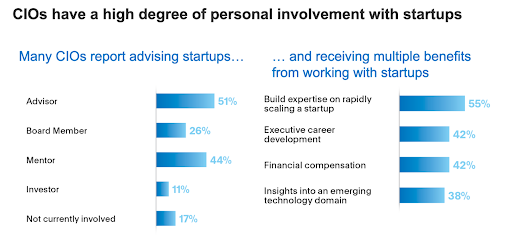
Based on the results from Sapphire’s CIO Innovation Index, we found that more than half of CIOs are currently advising startups, and they have taken on this role for a variety of reasons, including executive career development. Of the CIOs currently involved with startups, we found over 50% of them said they are advising in order to build expertise on rapid scaling a startup so they could learn about agile and innovative processes that could be used inside their organizations.

As Ralph Loura, CIO of Lumentum (and former CIO of Clorox), put it “I have found that serving as an advisor to startups can be a uniquely rewarding experience. The CIO benefits from the opportunity to help shape emerging technology and business model disruptors as they toil to bring early-stage work to the market; and startup leaders benefit from having a seasoned mentor on not only the market and product roadmaps, but on the people and culture aspects of defining a brand and building an organization as well.”
bar chart

In this post, we’ll discuss how CIOs are embracing the startup mentality in order to develop more efficient go-to-market strategies, and, at the same time, gain access to other leadership opportunities.

1. Startups can often innovate at greater speed

According to CB Insights, 84.9% of corporate strategists surveyed said that innovation is very important. However, 78% of respondents actually focus on incremental changes—and separately, 60% said it takes their company a year or longer to create new products.

Because of their install base, large incumbent companies can be perceived as lagging startups in tech innovation. Implementation of new technologies can be slow due to lengthy reviews and approval, a multitude of stakeholders, and the need to work with the existing tech infrastructure. On the other hand, startups are known to be starting with new technology, often resulting in a more agile, faster time to market for the latest solutions.

CIOs recognize that to stay ahead of the industry disruption, it’s important for large companies to simultaneously manage current operations and future opportunities for growth. In short, CIOs must keep their company’s innovation engine running.

According to Steve Coley, a director emeritus in McKinsey’s Chicago office, maturing companies face several horizons of growth, and they have to remain vigilant about emerging opportunities and pilot programs—all while maintaining day-to-day operations of the core business.

But it’s a difficult balancing act, and that’s one reason we believe we’re seeing more CIOs advising startups: they’re looking for ways to keep their large companies nimble.

Advising a startup allows the CIO to step away from their corner office for a change. They can see what it’s like to move ideas forward without the processes and bureaucracy they’re used to.

Lessons learned from the CIO’s advisory involvement can place them at the forefront of competitive strategy and leading edge technology.

2. Getting insight into new technological domains

Increasing internal efficiency in a large organization is easier said than done. Large budgets often come with lengthy timelines, operational duties, and oversight which can limit the time available for CIOs to discover and test new ideas.

For many CIOs, tapping the startup community can provide opportunities to expand their knowledge. They can partner with external teams and work on breakthrough ideas outside of the existing constraints of their organization.

In this way, startup advising is as much a win for the CIO and their company, as it is to the startup. Think of it as a fast track to innovation. CIOs who advise startups build hands-on experience with the latest technology and can often become their company’s point person for identifying and implementing emerging technologies.

CIOs already recognize the importance startups will play in the future of their enterprise with their spending. Sapphire’s CIO Innovation Index shows that startups today consume a median 10% of IT budgets—and are estimated to grow by 50% over the next 12 months.
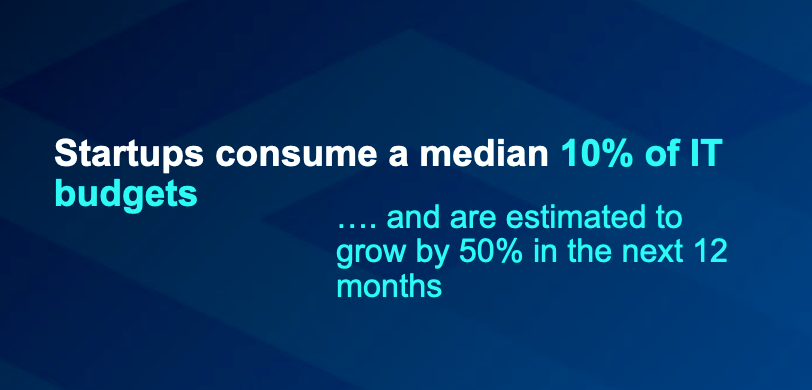
This means that large enterprises are seeking innovative solutions from the startup community. Becoming an advisor to one of these startups gives CIOs an inside look at the technology and how start-ups operate — potentially giving CIOs valuable insights on how to best engage startups.

Insights from your direct involvement with startups can help strengthen the CIO’s case for new technologies or partnerships when meeting with the internal CFO, COO, or CEO.

“When you can prove the tech is going to do something amazing for customers or in differentiating your [corporate] performance, you have to tell that story,” said Chris Laping, former CIO and senior vice president of business transformation at Red Robin Gourmet Burgers.

Laping explained in a CIO Magazine interview that he’s always pitching ideas on new technologies and partnerships with the company’s CEO.

3. Advising is a flexible, low-risk way to engage

CIOs are trusted for their deep technological and leadership experience. And given the fast pace of innovation, CIOs are in a unique position to advise startups, not only on the technology, but also how to effectively engage corporate IT decision makers in the sales process.

Advising can be a fulfilling experience—a chance to give back– but it doesn’t have to come with the high risk and time commitment of formally joining a startup.

CIOs can choose to engage with startups in a variety of ways—for example, by becoming an informal advisor or officially joining the board. Generally, advisors and board members both help companies stay ahead of the competition and ultimately grow shareholder value.

However, the main difference between the two roles is that an advisory role is usually informal—often selected by an executive team or board of directors, and CIOs may or may not be financially compensated for their participation.

Independent board directors at startups, on the other hand, are often selected and appointed by the CEO and existing board members (who are typically investors into the startup).

Executives discuss the expanding role of the CIO at Sapphire's 2019 CIO Summit.

Once elected by shareholders, board members have a fiduciary duty to act in the best interest of the organization. Joining a board brings both a legal and an ethical responsibility to oversee management decisions. And if board members fail to act in good judgment, they can be held liable for the actions of the corporation.

Here are some key distinctions between being an advisor and being a board member:

Advisors

  • Informally hand-picked by CEO and management team
  • Can serve for as long as needed and are easy to replace
  • May be compensated through equity interest in company, or not compensated at all
  • No voting rights in the organization, or power make management or product decisions
  • No legal duty to prioritize the needs of shareholders
  • Not held personally liable for the mistakes or misjudgments in connection to their advisory duties

Board of Directors

  • Formally nominated by a nominating committee, ballot, or petition
  • Most have term limits, and the removal process depends on company bylaws (impeachment, majority vote, etc.)
  • Usually compensated in cash and stock awards
  • Voting rights in the organization, with power to remove CEO or make changes in the executive team
  • Has a legal duty to place the needs of shareholders before employees, which includes the CEO and management team
  • Held personally liable for the mistakes or misjudgments in connection to their board duties

As technology becomes embedded in nearly every facet of a business, seasoned IT executives and CIOs are still missing at the highest levels of corporate leadership—the boardroom. We found that institutional investors are pushing for diversity in many forms, including functional expertise.

However, serving on a board can require a great time commitment (even in a startup). It also comes with legal and corporate governance standards. Conversely, advisory duties are generally more loose, allowing for greater risk-taking and creativity.

Speaking at our 2019 CIO Summit, Patty Morrison, former CIO of Cardinal Health, said, “Being on a board is not a minor commitment. Four directorships can equal a full-time job—and during major events, such as activist bid or merger (which often happens during a 10-year tenure), this can go up considerably.”

4. You can accelerate your career from CIO to innovation catalyst

Software is eating the world. Businesses are getting more and more complicated, and they’re adopting new technologies to meet the needs of savvy consumers.

In fact, more than 70% of the CIOs surveyed in Sapphire’s CIO Innovation Index are investing in emerging technologies, such as artificial intelligence, machine learning, cybersecurity, and data management. And more than 50% are choosing to work with startups over established vendors in those top emerging tech categories.

The CIO is well versed in technology, and they can be a valuable asset during strategic corporate shifts, or even when engaging with startups.

And, over time, CIOs who advise startups can learn skills and gain perspective that can make them great candidates for the top spot.

According to Bask Iyer, CIO and Chief Digital Transformation Officer at VMware, the CIO role has become one of the most complicated in the C-suite, but it also involves preparing IT executives to serve as presidents, general managers, and CEOs.

Becoming an advisor to a startup in a totally different industry is an opportunity to build a diverse resume. Advising startups, CIOs can be on the forefront of change and become technology leaders.

They can also become more exposed to the business decisions of startup companies. They can learn the ins and outs of finance, operations, and product management—all from the perspective of an IT guru.

As Iyer says, “CIOs know how to take a trend, change a culture, change a process, hire the right people, hit the numbers, and achieve delivery—what else could you want from your CEO?”

But accelerating your career takes time. As the CIO, you must be alert for new opportunities but know that building your story and credibility in the industry doesn’t happen overnight.

For example, Wendy M. Pfeiffer, CIO of Nutanix, found that her technological skills were relatable to both her CIO role and her board member role at Qualys, another cloud-computing startup. “Be open to everything,” she says. “Take time to develop and practice your narrative.”

Wendy Pfieffer

CIOS can also use their time as a startup advisor to remain active during career gaps. Life events, corporate restructuring, or industry shifts shouldn’t deter you from your career goals.

Becoming a startup advisor provides a flexible opportunity to stay ahead of innovation while you transition back to the corporate world—and perhaps open new doors in your leadership journey.

Ready to become a CIO startup advisor?

Startup advisory roles can be a perfect match for CIOs. It provides the opportunity to be directly engaged with more agile organizations that are constantly innovating.

And, in doing so, advisors don’t face the same legal constraints and governance standards that board members experience. They have more freedom to be creative with their startup counterparts, and, contrary to serving on a board, they have more time to balance advisory work with a full-time CIO job.

This is an opportunity to not only stay current with innovations but also exercise your leadership skills to make the industry better as a whole. We’ve seen that collaboration between startups and CIOs from large organizations end up delivering faster technological solutions.

Having startup experience can place the CIO at the center of this industry evolution.


Revenue roundtable dinner

Over 50% of Proof of Concepts Fail — Here’s How to Fix Yours

A request by a customer for a Proof of Concept (POC) can strike fear into the heart of even the most seasoned go-to-market team at an enterprise technology startup.  

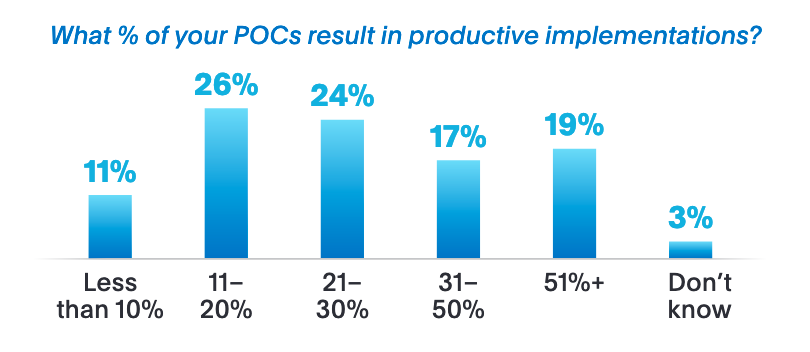
The truth is, a POC—a trial period of your product with a potential enterprise customer—elongates the sales cycle, can be expensive, and doesn’t always lead to a final sale. Over 78% of the IT executives from the Global 2,000 companies we surveyed in our recent CIO Innovation Index said that less than half of the POCs they participate in result in production deployments.

Source: Sapphire Ventures CIO Innovation Index 2019

To make matters worse, a poorly executed POC can be the bane of a sales team—placing deals in purgatory and leaving leads in a state of indecision. Yet, if deployed correctly, these experiments can squash concerns enterprise buyers have about adopting new technology and getting deals over the finish line.

But it’s no simple feat. We recently hosted a Revenue Roundtable for over 25 of our portfolio CROs that featured Trevor Schulze, SVP and CIO of RingCentral and Seann Gardiner, SVP of Business Development at ThoughtSpot to discuss strategies to executing a successful POC. This piece outlines insights from that dinner and five essential steps to successfully execute a POC and set your sales team up for long-term success with enterprise customers.

1. Proceed with Caution

Not every enterprise sales cycle should utilize POCs; they should be leveraged judiciously. POCs have a high opportunity cost, meaning they take up time and resources your company could use to pursue other deals. If a POC doesn’t add significant new information to the buyer’s journey , then it’s most likely not worth the time or trouble. In those cases you should utilize demos, customer references, and system documentation in lieu of conducting a POC.

You should clearly identify with your sales teams when it’s appropriate to use a POC. For example, POCs can be a valuable sales tool if you have a blended GTM motion that caters not only to technical users but also to executive buyers and/or serves particular enterprise categories (e.g., cybersecurity, data and analytics). In scenarios where you are leading with an enterprise sales motion focused on c-level executives and targeting multi-year contracts the threshold for proving your product’s efficacy and value goes up. For example, DocuSign—a company with a successful inbound GTM channel, also built an enterprise sales team that strategically leveraged POCs to win large enterprise-wide six-figure contracts.  POCs that have the right commitment and executive alignment are a valuable tool to validate your company’s point of view, elevate your product above the competitive noise, and position your solution from being labeled as a point solution to an enabler of digital transformation.

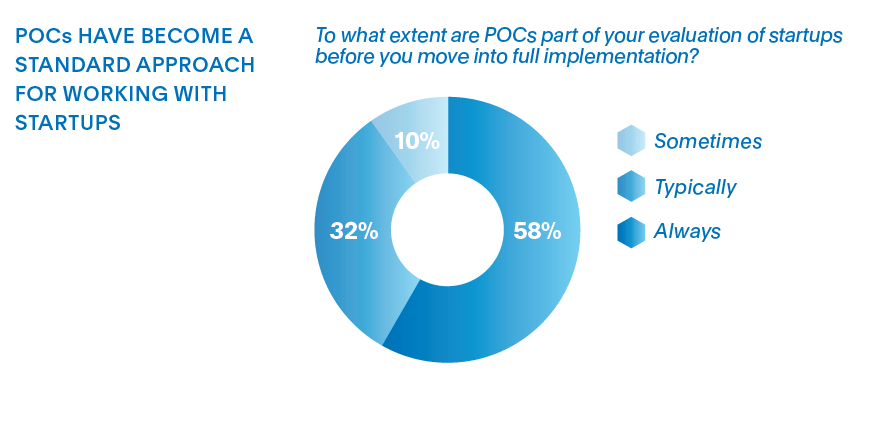
In this case, a POC can help sales teams achieve high-touch engagement with decision makers. Oftentimes enterprise buyers who are facing new technologies will be hesitant to take the plunge on a perceived unknown. In these situations, POCs can serve as a gateway for customer adoption and close this trust gap. In fact, 58% of IT executives that we surveyed said they always use POCs as a key evaluation tool for startups. By engaging in a POC, the customer can understand the nuances of your solution in order to make the right technical and business decision while instilling confidence in their buying journey.

POCs: a gateway for adoption

Finally, be sure to identify what your key performance indicators will be, such as the ratio of pipeline opportunities to active POCs, their average length, the conversion rate, and the annual contract value of POCs that you convert. These indicators will help track and refine your process over time.

2. Zero In On Your Value

A POC serves a very different purpose from a demo and should be structured around showing how your product addresses a specific problem.

A demo is open-ended and showcases your product’s features, capabilities, and performance, while a POC should demonstrate how you can tailor your solution to deliver value for that specific customer in their unique environment.

Emerging technology vendors should clearly outline upfront what value their customers should achieve upon completion of their POC. Focusing on value will align you with the customer’s business goals from the start and help rationalize their investment. You have to demonstrate the value of your product early on, but you don’t want to overpromise.

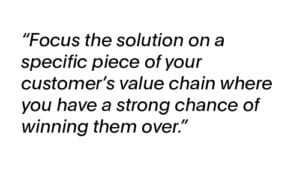
To avoid getting ahead of yourself, make sure you focus the solution on a specific piece of your customer’s value chain where you have a strong chance of winning them over. Trying to solve all of the customer’s problems will lead to POCs running over schedule and over budget and will most likely not result in a desirable outcome.

pull quote

As Eric Tan, VP of Business Services and IT at Coupa, eloquently said at our annual GTM Summit for emerging technology companies, “Aim small, miss small. Pick an area or a problem that you are trying to solve that is very, very specific. Don’t try to solve the large problem or critical areas . . . because chances are we’re not going to buy [that grander vision].”

For example, Eric said, if you are going to solve the entire single sign-on (SSO) authentication business, chances are he won’t buy-in because he already uses an identity and access management platform. So, you have to identify a very specific use case for your solution — perhaps one that aims to solve employee off-boarding because it’s something that complements what the customer may already have.

3. Keep It Short

As we mentioned earlier, POCs require significant time and resources. To create a more efficient POC process, agree to a clear deadline with your customer, and implement a system to make sure you stay on track to your commitments — on both sides.

After all, a POC that runs for a long time can undermine many of the perceived advantages that customers have of emerging technology vendors. Relative to larger, more established companies, startups are expected to provide customers with ease of use and fast time to value. 55% of startup customers cited a faster pace of product delivery as one of the greatest values to their organization when working with startups.

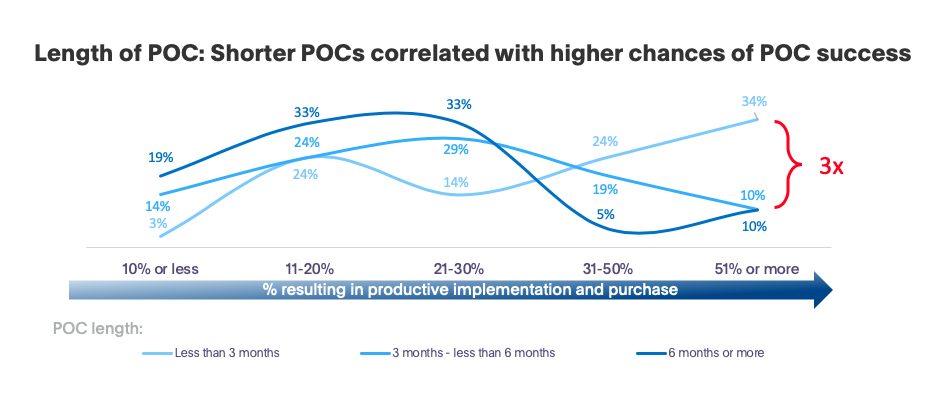
How long is too long? Most of our surveyed enterprises said 60% of their POCs run longer than three months. That number is concerning, because the CIO Innovation Index research also showed that POCs that last less than three months are 3 times more likely to result in successful commercial implementation. They don’t drain as many resources, and teams are able to quickly show how their product or service would drive business results for their customer. Shorter POCs helps to maintain sales momentum and results in better commercial conversion rates.

As Trevor Schulze, SVP and Global CIO of RingCentral said at Sapphire’s recent Revenue Roundtable, “Speed is everything we want to move fast. I need to show my business partners and board fast time to market on IT projects.”

4. Get Some Skin in the Game

Running a POC requires significant resources, so to get the most out of your POC, consider requesting a similar financial commitment from your prospective customer.

While it may seem bold to ask for a financial commitment before actually making a sale, if a customer agrees, the financial aspect can signify genuine intent and help focus your customer’s time and energy on the project for a greater chance of success.

You can also ask for other, non-financial investments from the customer during a POC, such as executive sponsorship who have the ability advocate internally on your behalf. This top-down buy-in can help move the POC to completion, and hopefully eventually into full production.

Source: Sapphire Ventures CIO Innovation Index 2019

“I actually like the idea of paying for a POC, as the buyer, because it will help me leverage my [team] to actually focus their time and energy on getting it done,” said Mark Settle, Okta’s former CIO at Sapphire’s 2018 GTM Summit. “If it’s just a free exercise, every other distraction in the world will come along, and people will just say, ‘Yeah, can we put that off for two more weeks?’”

On the flip side, be wary of innovation or digital teams within enterprises that have budgets to run POCs but have no authority or executive visibility to put your solution in production. This can be a red herring for your sales team.

If the customer is wavering, you can offer to take the POC cost off of the commercial agreement. Many IT departments within large enterprises even have budgets specifically set up for POCs. At Coupa, for example, the team sets up an experimentation budget every year so that they can run POCs to identify new technologies.

5. Set Clear Expectations, and Document Them

Once you have a financial commitment and sponsorship, it’s best to clearly document what a successful POC will look like with your customer.

Jointly identify the deliverables, the business objectives you will support, and the ways, exactly, you will add value and be measured. Taking the time to identify these expectations upfront will not only make sure everyone is on the same page, but it helps to make sure you have buy-in to the overall process.

Another benefit of outlining these expectations before you start deployment is that it provides a common reference metrics during the POC—they’ll be the basis for regular check-ins with your executive sponsors.

With a clearly documented POC at hand, your team can build a solid business case that executive sponsors can use to rationalize the move to a production environment.

Advantages of a Successful POC

A successfully executed POC can be your golden ticket to landing a large, complex enterprise customer.

You’ll create internal product advocates and loyalists—users who start using your product and will put up a fight if it isn’t put into production. They also are a path to executive buy-in, where leaders are confident that they know what to expect and exactly what business issues you’re going to help them solve.

With an affinity for your product among its technical users, and value alignment among your executive buyers, you set yourself up for long-term success.

We would love to hear your thoughts and feedback in the comments or on Twitter @RicoMallozzi.


Wendy Pfeiffer headshot

Nutanix CIO Wendy M. Pfeiffer’s Path to the Qualys Board

Serving on a corporate board means wearing many hats. You are a canary in a coal mine, as Homa Bahrami, senior lecturer & distinguished teaching fellow at UC Berkeley’s Haas School of Business, points out. You are someone who might bring a contrarian or otherwise unique perspective. You are a mentor, an educator, a coach.

For Wendy M. Pfeiffer, chief information officer (CIO) of Nutanix, serving on a board was about using her 25 years of industry experience to help other business leaders make more informed decisions about the future of their enterprise. As a fervent technologist, it was important to Wendy that other companies be prepared to meet the demands of the next generation of consumers. And she felt ready for a new challenge.

But making it to the board of cloud security company Qualys didn’t come easy for Wendy.

Just 22% of people on corporate boards in America are women. And according to a Deloitte study, just 5% of S&P 500 companies have technologists on their boards.

Wendy defied these odds, using her background as a tech and business leader, working her network and using Sapphire’s Board Readiness workshops to help her articulate her differentiating value as a leader.

In this Q&A, Wendy walks us through all of the work that went into landing her a spot on the board.

Wendy M. Pfeiffer, CIO of Nutanix, and new board member of Qualys, and Girls in Tech

Q: Why did you decide to look for a board seat?

After a 25-year career in technology, including roles at Cisco, Yahoo, and most recently as the CIO at Nutanix, I felt it was time to give back.

I wanted to bring my expertise into a boardroom to help business leaders make more informed decisions about the future of their enterprise.

At the same time, I was looking for a challenge.

While I have a strong foundation in business, with my B.S. in business administration, I was excited to become fluent in the language of corporate boards and learn from my peers in a new setting.

Finally, I believe it’s essential to get more technologists on boards. No company on earth today is not part of a tech ecosystem, and keen product-market discernment is how the best companies will thrive in the coming decades.

According to the U.S. Department of Labor, by 2020, Gen Z will comprise [more than] one-third of the global workforce, and we have to be ready to meet their demands or else risk falling behind. I knew I needed to walk the walk, not just talk the talk.

Q: Once you made the decision, what was your action plan to find the right fit?

First, I crafted my board bio to articulate my differentiated value.

A board bio should demonstrate your leadership experience, business competence, and industry knowledge.

For example, I’m an operator who has deep experience bringing technology products to market and then running them at scale. At Yahoo!, I was responsible for the world’s largest commercial private network, and at Cisco Systems, I delivered the company’s first ecommerce platform, CCO.

Next, I activated my network. I knew connecting broadly and personally would be critical to success. Sometimes, board appointments happen through personal networking, word of mouth, shareholder suggestions, and other informal channels.

I let different active board directors know I was looking for a board seat and asked for their advice and referrals.

I also attended seminars like Sapphire Ventures’ Board Readiness Workshop in order to build skills and further extend my network.

Finally, I reminded myself that this process, as with my career as a whole, was not a race. Every experience along the way was going to be valuable to the final outcome, and I should take as much time as I needed to focus and find the right fit.

Q: What, specifically, helped you find your role on the Qualys board?

I did a lot of preparation before I began actively searching. I made sure my board file was ready to go at a moment’s notice, did my homework to understand what, exactly, boards were looking for and how I could add value, and I identified and filled my own knowledge gaps so I’d be prepared to interview.

In addition, I was passionate about wanting to learn about a new arena, and I think that excitement was apparent in my conversations and interviews.

Lastly, understanding Qualys’ product was also helpful during the search process. Philippe Courtot, chairman of the board, was looking for a board member who truly understood how their product worked. Both Nutanix and Qualys provide cloud-based solutions, so the required technological skills were relatable to both the CIO role and the board member role.

My favorite memory of the search process is sitting at a tiny cafe in Hayward, California, getting a demo of Qualys’ product from Philippe and feeling a genuine connection with him as both a maker and a leader. I honestly didn’t expect to feel this way about a board director position, but I did, and I still do.

Q: What are you most excited about in your new role?

I’m most excited about the opportunity to apply both my technological background and my financial background as a member of the Qualys board.

In addition to this being my first board role, Philippe has asked me to serve on Qualys’ audit committee. At first, I couldn’t believe that my contribution, as a technologist, would be that valuable.

But in addition to giving me an opportunity to reconnect with my B.S. in business administration, serving on the committee has given me a view into how the company handles risk—including cyber risk.

Who knew that the indecision and stops and starts at the beginning of my career journey would result in this harmonious outcome 25 years later!

I’m also excited to define this position for myself and make it my own. The exciting thing about being one of the few female CIOs and board members in Silicon Valley is that I get to take advantage of a moment when no one knows exactly what to expect.

Qualys’ board is also an exception to the norm: we already have gender parity! Serving on a diverse and inclusive board in my first outing is an incredible opportunity to experience a level playing field from the beginning. I have to say, this is unique in my professional career.

Q: For other technologists seeking board positions at public or private companies, what other advice do you have?

For an experienced CIO, attaining a board of director role is 90% preparation and 10% luck.

Be ready to put yourself out there. Take time to develop and practice your narrative. Articulating your story in a way that’s authentic and meaningful is essential to finding the right fit.

Also, be open to everything, and say yes whenever you are asked to explore a potential board role. Entry and exit points to board service are not obvious, nor are they consistent. As my mom used to say, “You have to kiss a lot of frogs before you meet your handsome prince.” So, stay in the pond!

Expand your industry network

Networking played a key role in Wendy’s rise to becoming a board member. At Sapphire’s Board Readiness Workshop, she connected with Qualys’ CFO Melissa Fisher, who then introduced her to the chairman of the board later that day. The timing was perfect, Wendy says. While the connection happened quickly, Wendy’s acute preparation paid off. She had her bio ready and articulated how she could add value to a board.

Now it’s time to showcase your leadership skills. Sapphire Ventures leverages a diverse talent network to share expertise and help our companies scale. The next Board Readiness Workshop will help facilitate introductions to top industry talent.


2019 YIR

Sapphire Ventures: Looking Back on 2019

As we close out another year, we are proud to recognize the many successes and milestones the Sapphire Ventures community and team achieved.  During 2019, we celebrated:

Learn more about these moments, and other 2019 milestones, in this infographic.

Looking ahead to 2020 — and the close of our first decade as an independent venture firm — the Sapphire team is excited to continue to work with our entrepreneurs to build their companies into the Companies of Consequence we believe they are. 

We are grateful to be part of this global community and look forward to sharing more news with you throughout the year.


1 Includes all growth and sport investment platform activity from Jan. 1 – Dec. 31, 2019.

Future of work summit crowd shot

Four Things Employees Expect in the Workplace in 2020

After an incredible afternoon of learning from HR and Talent leaders in the tech ecosystem, the teams from Glynn Capital, IVP, Menlo Ventures, and Sapphire Ventures summarized the takeaways from our Future of Work Summit to help continue the conversation about how we can best support and empower employees now–and in the future.

Future of Work crowd shot
The way we work today looks very different from how we’ve worked in the past. We’re no longer working “9-to-5” or delineating between in or out of the office. Today’s workers are “always-on” and “available anywhere.” They work better, faster, more efficiently, and in a more distributed way. Advancements in technology have extended the boundaries of where we work and how work gets done. It’s up to HR leaders to help meet employees where they are and to support them in doing their best work.

The future of work will be all about people. That’s why Glynn Capital, IVP, Menlo Ventures, and Sapphire Ventures recently hosted a Future of Work Summit. We invited dozens of experts–including CEOs, HR, and People Leaders from technology startups and public companies–for a conversation about how we think about and engage in work across the startup ecosystem.

Here are some of the key themes explored at our second annual Future of Work Summit:

1. Benefits Need to Adapt to the Modern Workforce

Perhaps the most commonly cited challenge for HR leaders is building benefits packages that extend beyond standard benefits (health, dental, vision). With the line between work and personal life now increasingly blurry, companies who design new, nontraditional benefits can differentiate themselves.

Panelists emphasized that benefit leaders should consider including tuition and debt consolidation benefits, flexible work policies, and family and dependent care options to better serve the needs of their employees.  Each program should be evaluated within the context of usage and productivity, so that every dollar spent enables a more fulfilled and supported employee base.

Participants shared ideas on adding new benefits without blowing up the budget. These included mental health and therapy options provided by companies like Lyra Health and others. Some companies focused on physical fitness, providing stipends to cover gym memberships or massages through platforms like Gympass. Others mentioned solutions focused on financial health. SoFi can help employees consolidate student loan debt, while others specialize in investing. Additionally, some employers have expanded beyond the traditional “relocation bonus” to offer services to help employees find housing, which is particularly challenging in costly housing markets like San Francisco.

2. Creating Community Across a Distributed Workforce is Critical for Retention and Promotion

Our summit participants reported that 30% – 60% of their employees work from home or across distributed offices. It can be challenging to manage a diversity of working styles and needs outside of the traditional office walls.

In today’s global, connected workforce, companies must understand and support cultural differences across geographies. And sometimes, unique opportunities for connection will arise: one company realized that weekly code reviews provided an opportunity for international employees to practice their English and build relationships with peers across offices.

To create a culture of inclusion, employees must feel connected to an organization. This can be particularly challenging for organizations with remote workers in different countries. Summit attendees agreed that bringing remote employees to headquarters for an extended onboarding process or Quarterly Business Reviews can build lasting community and connections between remote and HQ-based colleagues. Another suggestion was to carry forward traditions that everyone can enjoy regardless of where their desks reside. Having shared traditions can make it easier to spark conversations and build connections. One company encouraged each employee to use a personal coffee/tea mug for work as a way to help break the ice, build culture, and also create a unique talking point.

3. Diversity and Inclusion Efforts Must Have a Dedicated Leader

Sapphire Ventures' Managing Director Kevin Diestel leads a conversation on how to build a diverse and enduring organization through inclusion efforts.

According to a report by Weber Shandwick, 27% of Chief Diversity Officers said they face a challenge making the business case for diversity and inclusion. The good news is that the majority of top leaders do understand how critical these efforts are –but many are still figuring out the best approach.

Participants agreed that leaving inclusion as a to-do item is not enough. What does work is having a dedicated team member that is focused on driving inclusion across the organization. Ideally, the CEO and Chief Diversity Officer are one in the same, or in larger organizations very closely aligned. Additionally, companies can improve the effectiveness of their efforts by engaging employees early to get buy-in and participation from day one.

Data can also inform decisions and help companies create conditions to attract talented workers and help them thrive in their new jobs. Platforms like Eightfold.ai leverage artificial intelligence and candidate masking to identify candidates that are most likely to be successful at an organization and then help employers define career paths for them once they are hired to drive motivation and retention.

4. Becoming a More Compassionate Company Takes Care

More than 1 in 5 Americans suffer annually from a mental health condition such as anxiety or depression, according to a 2016 study by SAMHSA. More companies are seeking to improve their mental health benefits for employees, but these resources can be underutilized if a company’s culture isn’t obviously aligned or if mental health is a taboo topic. Our panelists suggested that having a champion at the company creates better conversations around mental health. They also recommended implementing programs to reduce the friction in finding care providers and treatment.

Addressing mental health is a meaningful way to increase productivity and overall retention; however, discussing mental health can be seen by some as a difficult conversation due to stigma and cultural differences. NAMI has reported that 8 in 10 employees don’t seek treatment for mental health conditions because of fear and shame. Recognizing that leaders aren’t often equipped with the resources to effectively support employees facing mental health conditions, organizations like Mind Share Partners work with employers to help them normalize mental health challenges, debunk myths, and navigate conversations between managers and their employees to build stronger, more human, workplaces.

Looking Ahead

There is no doubt that business leaders feel a certain amount of unease as they grapple with new challenges in our digital era, especially as they marshal and mobilize their workforces. Chief among concerns is keeping pace with the evolutions and shifts across the global workplace while helping each employee navigate their own path. By continuing to partner with creative people, talent, and technology leaders who are committed to pushing the frontiers of how we engage with work, we hope that we will all benefit from a more empowered, fulfilled, and productive workforce.


FundIV announcement pop up

Sapphire Ventures Raises More than $1.4B to Support Entrepreneurs in Building Category Leaders

I’m proud to announce that Sapphire Ventures has raised more than $1.4 billion in new capital commitments, bringing our total assets under management (AUM) to almost $4 billion. You can read the full announcement here.

This larger capital commitment gives us the flexibility to support more entrepreneurs who are building what we call Companies of Consequence: visionary companies that seek to change the way we work and live. We believe the added capital enables Sapphire to: 

  • Differentiate even more effectively in an increasingly competitive market for high-quality investments such as those we’ve made most recently in Brightfield, Clari, Highspot, monday.com and Moveworks (1)
  • Create an optimal fund structure with a main investment vehicle that can invest as little as $5-10M in an initial check for expansion-stage companies, combined with a new opportunity fund that can co-invest at a combined level of up to $100M per company in later-stage businesses
  • Continue to scale our Portfolio Growth team to deliver critical, value-added services to help our portfolio companies grow their revenues, partners and talent base, and
  • Diversify our base of limited partners (LPs) who can help provide access for our portfolio companies to Global 2000 customers.

The Evolution of the Venture Capital Industry

This capital infusion is another step toward Sapphire’s goal of developing the highest-quality investment platform we can for both entrepreneurs and LPs. We continue to evolve what a venture capital firm can be as we adapt to a changing market and industry. Once a niche profession, venture investing today is rapidly institutionalizing as more capital flows into the VC asset class (with approximately $100B committed across 2018 and 2019)(a) and as start-ups stay private longer. To succeed in today’s later-stage market, we believe VC firms need to be able to move quickly, write larger checks and bring more value to the table than just capital.

Here at Sapphire, we’ve long known that venture investing is about more than showing up with a checkbook and generalized best practices – hence our creation of the Portfolio Growth team in 2014 and our deep focus on enterprise IT. As we enter our 10th year as an independent venture firm, this additional $1.4 billion in capital enables Sapphire to double down on our differentiation by giving us the scale to:

  • Staff up a larger, more global and more specialized value-added support team, including new talent leaders, a European business-development presence and additional go-to-market resources
  • Expand and continue to introduce diversity across our organization and investment team at all levels, with a particular focus on the senior-most levels. 
  • Focus on building processes and systems to ensure that we remain agile and operationally excellent at everything we do — from submitting term sheets and closing financings, to helping entrepreneurs and reporting results to our LPs.

We have been refining our platform to deliver value to entrepreneurs and LPs since our inception and the results speak for themselves. One of our stretch goals is to achieve 100% CEO referenceability, and to that end, in 2019 we:

  • Provided our portfolio with 300+ introductions to potential Global 2000 customers or partners
  • Made 250+ talent introductions to fill key executive roles 
  • Hosted and curated 75+ innovation events and executive briefings to showcase our portfolio companies to Global 2000 customers
  • Created and produced our first annual Cloud Go-to-Market Summit
  • Held our 5th annual highly successful CIO Summit, and
  • Launched an industry-first Women in Board Leadership workshop series to help identify and train the next generation of diverse board members.

We invest in these types of activities because we are committed to helping our entrepreneurs build Companies of Consequence. As part of our new capital raise, we will be further enhancing our Portfolio Growth services to help our companies with activities such as international expansion and sales optimization. Stay tuned for more information in the coming months.

Keeping the porridge just right

While we believe that expansion- and later-stage venture firms need greater scale to back the best companies, we also try to be thoughtful about keeping our organization at just the right size: big enough to expand the scope and depth of our services, but small enough to still be nimble and entrepreneurial ourselves. 

One of the benefits of having been in the venture business for 20 years – along with Sapphire’s President Jai Das and our other founding partners – is the experience to know how to right-size the platform so as not to overfund companies, or become paralyzed or risk averse by having too many decision-makers on the investment team. We’re certainly not perfect, but we strive every day to learn, grow and be better in providing entrepreneurs the right amount of capital and resources to succeed.

As a team, we’ve been through a couple of difficult economic cycles and learned a lot by backing Companies of Consequence through to exit such as Livongo that IPO’d earlier this year. Our history of 100+ total investments, 55+ exits(2), and $100B+ in enterprise value(3) we’ve helped create tells one story for sure.  But the team you see below, almost 50 Sapphires strong, is equally excited about the story we’ll be writing in the coming years as we put this new $1.4 billion in capital to work to build the next generation of Companies of Consequence.

Collage of Sapphire team

(a) Source:  https://nvca.org/wp-content/uploads/2019/10/3Q_2019_PitchBook_NVCA_Venture_Monitor-1.pdf


(1) Companies mentioned in this article are a representative sample of portfolio companies in which Sapphire Ventures has invested in which the author believes such companies fit the objective criteria stated in commentary, which do not reflect all investments made by Sapphire. A complete alphabetical list of Sapphire’s investments made by its direct growth investing funds is available here.

(2) Exit figures represent all Sapphire Venture direct investments that had an exit by IPO during the time period of January 2011 to November 2019.

(3) “Enterprise Value” represent the company’s total value, often called the takeover value. This calculation is based on the company’s value: either the value at the time of the company’s acquisition, or the calculated Enterprise Value of publicly traded companies as of January 1, 2019. Sapphire Ventures was not solely responsible for the economic value created and no inference shall be made otherwise.

Paul Levine

PropTech Summit 2019: Uncovering the Latest in Real Estate Tech

Last week Sapphire Ventures and NFX joined forces to co-host our 2nd annual PropTechCEO Summit.  It was a pleasure, as always, to team up with Pete Flint and host this special invite-only gathering of more than 175 entrepreneurs and investors.  It was great to see so many familiar faces, and welcome many new ones, into the expanding PropTech community.  

We had an amazing lineup of speakers again this year including:

  • Eric Wu, CEO/Co-Founder of OpenDoor;

    David Chiu, California, Assembly member
    David Chiu, California assembly member in a conversation with Paul Levine about affordable housing
  • Ivy Zelman, CEO of Zelman & Associates; 
  • David Chiu, California State Assembly member;
  • Adena Hefetz, CEO/co-founder of Divvy Homes
  • Court Cunningham, CEO of Perch

A lot has changed in a year.  The on-stage conversation focused on reading the macroeconomic tea leaves, discussing the impact and implications of WeWork’s failed IPO on the flex office market, and the growing recognition of the impact of income disparity and the need for affordable housing.  Rather than summarizing our great speakers, we’ll be posting the full-length session videos so you can see the content for yourself. 

Clelia Peters moderates a discussion with Nick LiVigne (left) and Ari Kantrowitz (middle) on the future of flex work.


Attendees at PropTech CEO Summit

It was great to wrap up the day with a wide-ranging discussion with Pete and Clelia Peters on what we see as the emerging trends for proptech in the coming year.

And the Survey Says?

Continuing a tradition we started last year, we conducted a pre-event survey to capture our attendees’ perspective and provide additional fodder for the day’s conversation.  The complete results of the survey can be found here but a few data points I think are most interesting:

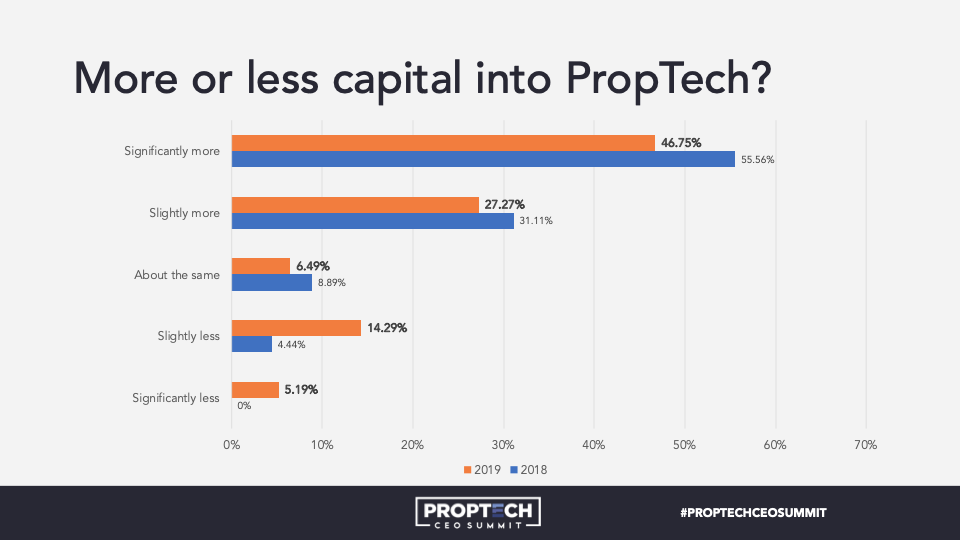
  • 47% of respondents felt that there would be significantly more venture capital going into PropTech this year, and only 19% expect less.  (Gotta love the optimistic inclination of founders/CEOs).

Graph of proptech capital expectations

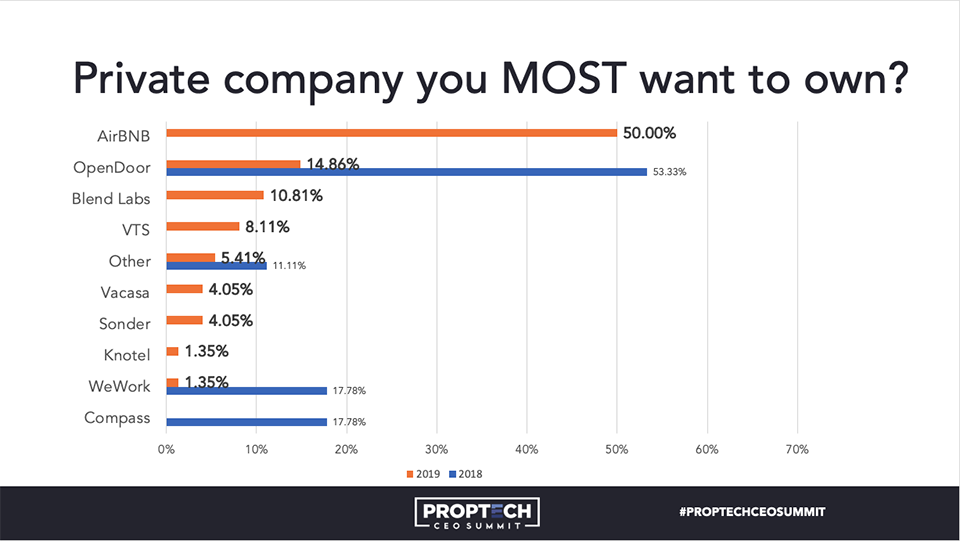
  • The landscape of Private companies attendees would most like to own have shifted significantly.  In 2018, the top three companies people wanted to own were OpenDoor, WeWork and Compass. This year, we expanded the list of nominated companies, and people said they most wanted to own AirBNB, OpenDoor, Blend Labs, and VTS.  More telling is that WeWork and Compass fell to the bottom of the list of private companies people want to own.


  • Finally, I think in an indication of how strong and diverse the innovation in the PropTech space is right now, the number of startups that attendees identified as “amazing, under-the-radar” companies to watch grew by almost 40% from last year.  

Innovative proptech startups

In all, it was a fantastic day spent with the best and brightest in PropTech.  We’re looking forward to continuing the conversation when we publish the videos, and we’ve already started planning for next year’s Summit!

Pete Flint, Paul Levine


CIO letters

Corporate Boards Need More Technologists — Here’s How CIOs Can Bridge the Divide

Technology is a powerful differentiator for enterprise companies today. Innovative tools can quickly set teams apart from their peers and sustain them in an increasingly complex and competitive environment. Cyber risk, digitization and innovation continually threaten to disrupt long established companies in favor of teams with more modern systems.

So it’s a surprise that as technology becomes embedded in nearly every facet of a business, seasoned IT executives and chief information officers (CIOs) are still missing at the highest levels of corporate leadership — the boardroom. According to a recent Deloitte study, just 5% of S&P 500 companies appointed a technologist to an open board seat (despite the fact that high-performing S&P 500 companies were 31% more likely to have a tech-savvy board director).

Why the gap? That was one of the topics we explored at Sapphire Ventures’ 2019 CIO Summit where we dug into the topic of CIOs on boards through presentations, panel discussions, and informal conversations. We discussed the perceptual barriers that CIOs often face when seeking public- or private-company director roles and brainstormed ways that CIOs can showcase their differentiated value as independent directors, nail the interview, and position a company at the front lines of innovation. Read on for five key takeaways.

1. Understand how boards have changed — and what they’re looking for today.

Corporate boards have the reputation of being homogenous and traditional with their business practices, yet that’s changing today. As Tuck Rickards, managing director at Russell Reynolds Associates and leader of the firm’s Digital Transformation Practice, described at the Summit:

Tuck Rickards, managing director, Russell Reynolds Associates

“Boards no longer seek members who look like them and are from similar backgrounds. Today, a board is looking more like an agile scrum.”

(For those unfamiliar with the term, Atlassian defines a scrum as a framework for “diverse teams learning through experiences, self-organizing while working on a problem, and reflecting on their wins and losses to continuously improve.”)

Boards today understand that bringing leaders together from different professional and personal backgrounds leads to a richer decision-making process, a stronger reputation among the company’s customers and employees, and even, according to recent data from McKinsey, better financial returns. In addition, institutional investors are pushing for diversity in many forms, including functional expertise.

As a transformational leader and CIO, it’s an excellent time to align with a find a board that is seeking fluency in emerging and innovative technology.

2. Identify and fill your knowledge gaps.

Despite demand, as a CIO looking for a board seat, it’s not enough to be an expert on business software. As Patty Morrison (former CIO, Cardinal Health, and five-time public-company director) noted at the CIO Summit, tech leaders must bring a lot more business savvy to the table — from understanding revenue recognition standards (if they serve on the audit committee) to managing risk to meeting shareholder demands and even acting swiftly and effectively during a major event (e.g., bankruptcy, merger, or IPO) — to secure their position.

While your tech experience will be a valuable asset in all of these discussions, it’s important to educate yourself broadly in areas of business where you’re less comfortable. At Sapphire Ventures we’ve started compiling a range of resources to help CIOs become board-ready. For example, our ongoing event series brings together career coaches and recruiters, current and former CIOs, and public- and private-company board members to help support, inform, and connect technology leaders as they take the next step into board service.

Attending events like this and seeking other forms of continuing education will help you understand the right questions to ask and will teach you how to speak the language of corporate boards. Being able to clearly describe issues like technical debt or a botched data migration and then suggest solutions through the lens of ROI, revenue and churn metrics, valuation multiples, and risk will showcase your strengths.

3. Let people know you’re looking for a board seat.

Half of board appointments go through global executive search firms, and another 50% happen through friends and family, so it is critical to communicate your interest. Are you answering calls from retained search firms? Are you activating your network?

To ensure that you’re top of mind as boards plan for succession, reach out to specialized retained search firms like Russell Reynolds Associates (public boards), as well as heads of talent at VC firms (for venture-backed, privately held company boards). If you work within a specific industry, such as health care, do your research to figure out which firms specialize in your field (e.g., Oxeon Partners). Affinity groups like Beyond Board, Him for Her, or the Athena Alliance (for women) can also support you and provide greater visibility. In addition, don’t be shy about connecting with CEOs, mentors, and with current directors in your network. “Boarded up” directors who don’t have room for another board commitment may be open to referring you when they are approached.

Finally, make sure your board bio represents your highest level of impact as a technically savvy, confident, and networked steward of your business. Candidates who reach the interview stage will have extensive management and industry experience; however, to make the final cut, you need to convey emotional intelligence, unshakeable ethics, and the ability to work effectively in a team. Tuck Rickards reminded the CIO Summit audience to “steer clear of signaling that you’re a single-issue director.” Instead, show how you can participate and debate at multiple levels to make the entire board stronger.

4. Tell your unique, authentic story.

As Juergen Mueller, CTO and executive board member, SAP, noted at the CIO Summit:

Juergen Mueller, CTO, SAP

CIOs must be change agents. While they should be proud of keeping the IT machine running, they also need to expand and pursue partnerships with other division heads, such as HR. Successful CIOs will ensure they’re relevant in the future.

For CIOs looking to level-up their career, being able to clearly articulate how they transform companies — instead of maintain the status quo — is essential. In a prior Sapphire Ventures event on board readiness, executive coach and multi-time CMO Ben Kiker shared how to:

  • Express your superpower (a talent that’s all your own). This might be, “I consistently reduce cyber risk in an increasingly dangerous environment by bringing in cost-effective and easy-to-implement threat detection tools.” Once you identify your superpower, lead with it.
  • Articulate your process (how you bring your superpower to life). For an IT leader, this could be through creating a balanced vendor portfolio to support your in-house team or identifying and working with startups that deliver greater ROI. Articulating your process in an action-focused way will help a board understand how you will close gaps at their company.
  • Name your active ingredient (your essence or core nature). Each of us has an active ingredient — but it will not be the same for everyone. For a CIO this might be explaining technical concepts to nontechnical teammates. When you find a company that values your active ingredient, you (and the entire company) will thrive.

Including specific anecdotes, success metrics, and professional references in your story will make it even more substantial — and actionable for those who interview you.

5. Know when to say no.

In the end, you won’t be a successful corporate director if you can’t devote the time to it. As Patty Morrison reminded us:

Patty Morrison, board director

Being on a board is not a minor commitment. Four directorships can equal a full-time job — and during major events, such as activist bid or merger (which often happens during a 10-year tenure), this can go up considerably.

Because of these requirements, it’s also important to be passionate about a company’s product before you dive in. You won’t be motivated to serve on subcommittees, dig in on strategic issues, and work closely with other board members and executives if your heart isn’t in it.

So be honest with yourself about your capacity and your compensation requirements (especially if you’re currently working full time), be wise about your offers, and don’t rush into service unless it’s a good fit.

Take the Next Step

Barriers remain — yet it’s an excellent time for CIOs to take their career (and company) to the next level. One of the key findings from Sapphire Ventures 2019 CIO Innovation Index — first released at Sapphire’s 2019 CIO Summit — is that CIOs and IT executives are already increasing their engagement with corporate boards, specifically with regard to emerging technologies. As new tools and ways of working become increasingly central to corporate strategy, boards will need more support in making decisions on complex issues like cybersecurity, data privacy, and digital transformation. Today nearly three-quarters of CIOs are engaging their company’s board on these issues on at least a quarterly basis. The next step is full representation — and Sapphire is here to support CIOs in making the move.