Punchh: Helping Retailers Understand Online and In-store Customers with their AI/ML Platform

Consumers are nowadays looking for experiences when they shop, go to restaurants or stay at a hotel. Psychological studies show that consumers are happier when they spend their money on experiences rather than purchasing things. Consumers, therefore, are demanding highly-tailored experiences and customer service from the brands they shop with.

To provide hyper-personalization in real-time, a brand, retailer or restaurant needs a deep understanding of its product/service usage and customer data. Most retailers, restaurants and brands have accumulated a lot of data but very few are leveraging it to their full potential. We are excited to be co-leading Punchh’s Series C financing since it’s one of the few companies that is using AI/ML on this data to not only provide very valuable customer insights but also enabling brands, restaurants and retailers to acquire and retain customers.

Punchh’s solutions enables a brand or a retailer to build a holistic view of who the customer is in real time, and based on that view, create a meaningful and  ongoing relationship with the customer. Once this connection is created, a brand or retailer can keep them as a loyal customer forever and build a very profitable business relationship.

Although a brand or retailer has all the customer data including purchasing behavior from the POS, online purchasing data, CRM data and loyalty/email engagement data; it often only exists in silos. Moreover, the marketing and customer acquisition departments in most brands/retailers are quite siloed as well since there are different teams for online vs. in-store and there is no sharing of information or customer data between them. Punchh is able to ingest data into its platform from all these silos including data from POS in physical locations, ecommerce platforms, email engagement data from SendGrid/MailChimp and CRM data from Salesforce/SAP Hybris/Microsoft Dynamics and provide retailers and brands an unparalleled understanding of how their customers engage with them online and in-store. The company is able to use its AI/ML-powered models to enable the different online and in-store teams at brands/retailers to work together to target and acquire these customers with pinpoint accuracy and create a unique and custom experience for the customer which keeps them coming back.

Since originally investing in Punchh in 2018, we at Sapphire Ventures have believed that Punchh is very strategic for brands and retailers to figure out which customers have the highest lifetime value, which customer personas they should be pursuing, how to acquire them and how to keep them engaged. We are very excited to back the Punchh team again because the company’s products will play a significant role in helping brands and retailers win in this hyper-competitive environment by using customer data effectively and providing then with both an immediate lift in revenue and, more importantly, sustained long-term growth.


Moveworks executive team photo

“Real” AI in Enterprise IT — Why Sapphire Ventures and Moveworks are Excited to Partner

Just about every pitch meeting, presentations include terms like “AI” or “machine learning” or “natural language understanding.”  Yes, this is likely driven by VCs’ appetite to invest in businesses leveraging these technologies, but in our experience it’s rare that companies are actually deploying them. That is why today I am thrilled to announce that Sapphire Ventures is partnering with Moveworks on their $75M Series B. Moveworks and their excellent  co-founding team proved every step of the way they were the real deal, and had actually built and deployed the latest and greatest in natural language understanding and machine learning to elegantly solve business and end-user pain points. More on why we invested:

Moveworks executive team photo

Why Sapphire Partnered with Moveworks?

Rajeev Dham, Managing Director, Sapphire Ventures

Moveworks is led by CEO Bhavin Shah, who inspires confidence with all those around him, and has experience building SaaS companies. More than just Bhavin, the uniqueness of the team is really driven by the individually brilliant, and complementary nature, of the four co-founders of Moveworks – Bhavin Shah, Jiang Chen (VP Machine Learning), Varun Singh (VP Product), and Vaibhav Nivargi (CTO).  Jiang, Varun and Vaibhav have proven technical chops from consumer-grade companies like Google and Facebook, but are also able to understand the business problem they are tackling and articulate why what they have built is necessary and special. Most of all, we enjoyed learning about them on a personal level over dinner and countless other meetings. We prefer to work with great people, in addition to talented professionals.

Moveworks provides automated support for employee questions and requests, beginning with IT tickets. They can fully resolve – truly autonomously – a significant percentage of tickets and consistently show improvement in their resolution rates across their customers over time. Importantly, unlike many other “conversational AI platforms”, there is no drag-and-drop toolkit needing weeks or months of implementation to set up every conversational flow possible. Instead, Moveworks leverages actual natural language understanding underpinned by a host of models to provide a truly automated solution. Sapphire has an extensive set of relationships with CIOs and IT leaders that we introduced to Moveworks and we received significant, positive feedback about time-to-value and the ultimate ROI from the solution. We think Moveworks is just scratching the surface in its potential to automate access to information and knowledge through the most natural interface, conversations and chat.


Bhavin Shah, CEO, Moveworks

Why Moveworks Partnered with Sapphire Ventures?

Bhavin Shah, CEO, Moveworks

Building Moveworks has been one blessing after the next. Over the past 6 months, dozens and dozens of investors reached out to us curious to learn more and to understand if we were considering a new round of capital. Some heard about us through the Silicon Valley grapevine; others spoke to our customers and were both impressed and intrigued about how we built a true AI solution solving real enterprise problems. But most reached out without having done their homework, and made little effort to understand our business and the nuances that make our approach and technology so powerful. 

Rajeev Dham and the Sapphire team were very different. It was immediately clear to us based on their portfolio and knowledge of AI and enterprise tech that they would be great partners. They researched our market, spoke to key customers, and deeply understood our differentiation. The very first meeting was like speaking to a member of our team. They shared our passion and clearly understood why our product works, and why other solutions have failed in the past.  

The Sapphire team has one of the most impressive CIO networks in Silicon Valley — and they were proactive in making customer intros. They were the only firm that made unsolicited introductions for us to prospective customers — many of which became Moveworks customers in record time — even before we discussed term sheets and fundraising. Their Portfolio Growth Team is one of the most engaged with deep relationships at 1000s of enterprises. Partnering with them was an easy choice.


Thanks, Bhavin, and cheers to the full Moveworks team!  Sapphire is very excited to work with you to build Moveworks into a company of consequence!


Stock exchange graph

Which Investments Generate the Greatest Value in Venture: Consumer or Enterprise?

This article is a fresh take on a topic we originally explored in December 2016.  Learn what changed when we went back and analyzed the returns data from the last couple of years.

A Dive into Enterprise vs Consumer Exit Activity

In today’s fast-paced market — where major funding or exit announcements seem to roll in daily — we at  Sapphire Partners like to take a step back, ask big picture questions, and then find concrete data to answer them. 

One of our favorite areas to explore is: as a venture investor, do your odds of making better returns improve if you only invest in either enterprise or consumer companies?  Or do you need a mix of both to maximize your returns? And how should recent investment and exit trends influence your investing strategy, if at all? 

To help answer questions like these, we’ve collected and analyzed exit data for years.  What we’ve found is pretty intriguing: portfolio value creation in enterprise tech is often driven by a cohort of exits, while value creation in consumer tech is generally driven by large, individual exits. 

In general, this trend has held for several years and has led to the general belief, that if you are a consumer investor, the clear goal is to not miss that “one deal” that has a huge spike in exit valuation creation (easier said than done of course). And if you’re an enterprise investor, you want to create a “basket of exits” in your portfolio.

What Creates More Portfolio Value: Consumer or Enterprise?

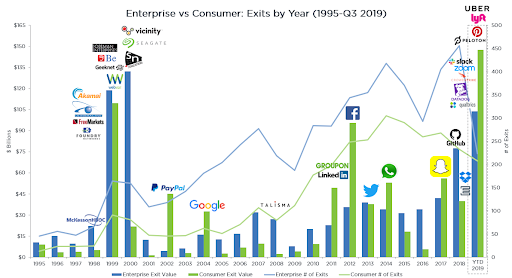
2019 has been a powerhouse year for consumer exit value, buoyed by Uber and Lyft’s IPOs (their recent declines in stock price notwithstanding). The first three quarters of 2019 alone surpassed every year since 1995 for consumer exit value – and we’re not done yet. If the consumer exit pace continues at this scale, we will be on track for the most value created at exit in 25 years, according to our analysis.

Source: S&P Capital IQ, Pitchbook

Since 1995, the number of enterprise exits has consistently outpaced consumer exits (blue line versus green line above), but 2019 is the closest to seeing those lines converge in over two decades (223 enterprise vs 208 consumer exits in the first three quarters of 2019). Notably, in five of the past nine years, the value generated by consumer exits has exceeded enterprise exits.[1]


At Sapphire, we observe the following:

  • Venture-backed enterprise tech companies have generated $884B in value since 1995; $349B from M&A and $535B from IPOs.
  • Venture-backed consumer tech companies have generated $773B in value since 1995; $153B from M&A and $620B from IPOs.
  • In total, there were 5,600+ venture-backed exits in enterprise tech and 3,300+ exits in consumer tech.

While the valuation at IPO serves as a proxy for an exit for venture investors, most investors face the lockup period. 2019 has generated a tremendous amount of value through IPOs, roughly $223 billion. However, after trading in the public markets, the aggregate value of those IPOs have decreased by $81 billion as of November 1, 2019.[3] This decrease is driven by Uber and Lyft from an absolute value basis, accounting for roughly 66% of this markdown over the same period, according to our figures. Over half of the IPO exits in 2019 have been consumer, and despite these stock price changes, consumer exits are still outperforming enterprise exits YTD given the enormous alpha they generated initially.

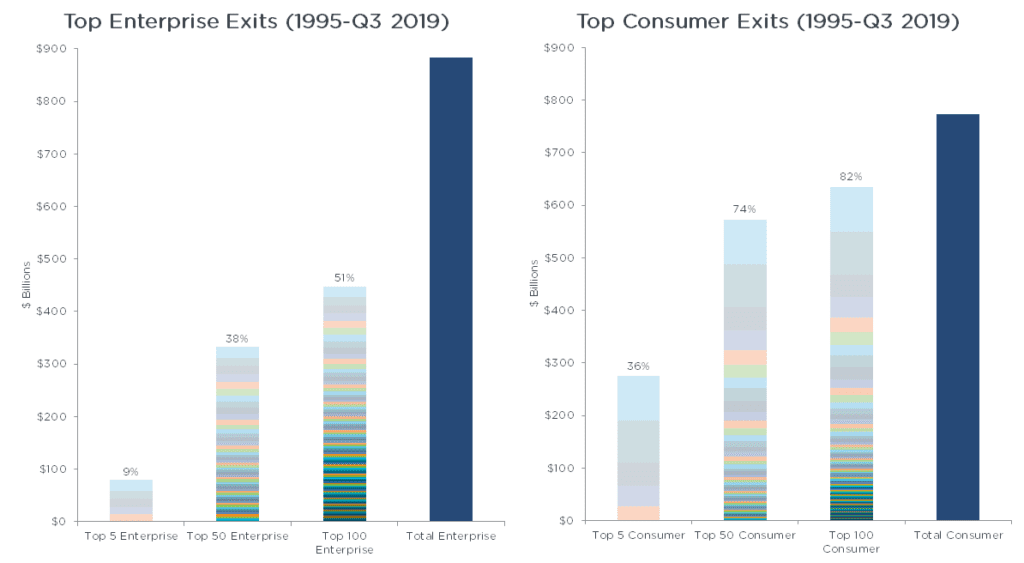
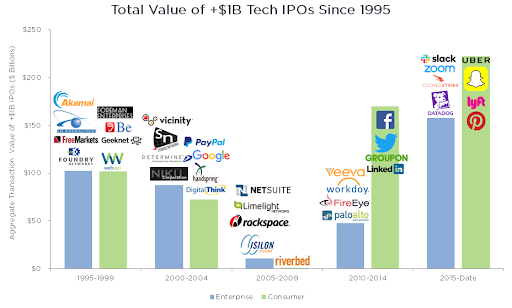
As we noted in the introduction, since 1995, historical data shows that years of high value creation from enterprise technology is often driven by a cohort of exits versus consumer value creation that is often driven by large, individual exits. The chart below illustrates this, showing a side-by-side comparison of exits and value creation.

Source: Pitchbook

At Sapphire, we observe the following:

  • The top five enterprise companies with the largest exits account for $79B in value creation, or 9% of the $884B generated in the enterprise category since 1995.
  • The top five consumer companies with largest exits account for $276B in value creation, or 36% of the $773B generated in the consumer category since 1995.

The value generated by the top five consumer companies is 3.5x greater than that of enterprise companies. 

Understanding the Consumer Comeback

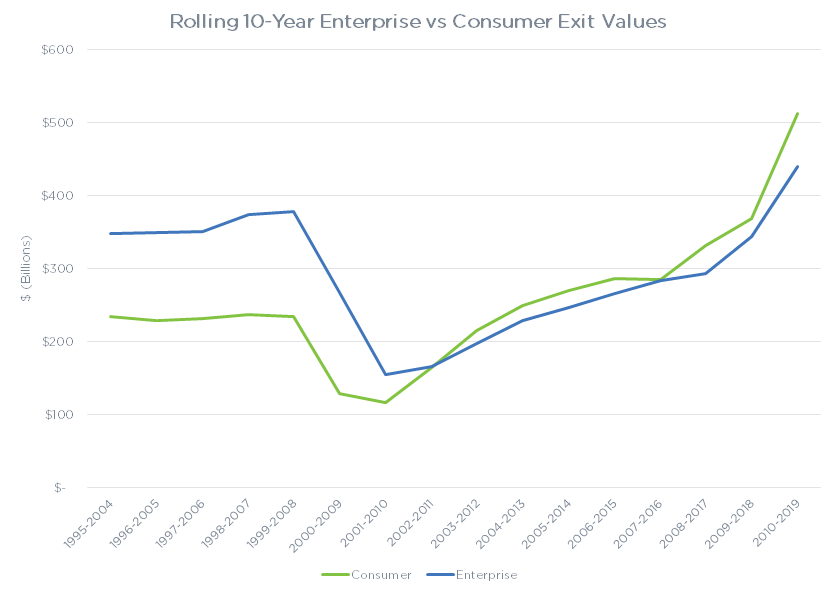
While total value of enterprise companies exited since 1995 ($884B) exceeds that of consumer exits ($773B), in the last 15 years, consumer returns have been making a comeback. Specifically, total consumer value exited ($538B) since 2004 exceeds that of enterprise exits ($536B).  This difference has become more stark in the past 10 years with total consumer value exited ($512B) surpassing that of enterprise ($440B). As seen in the chart below, the rolling 10-year total enterprise exit value exceeded that of consumer, until the decade between 2003-2012 where consumer exit value took the lead.

Note: Data from S&P Capital IQ and Pitchbook


Source: S&P Capital IQ, Pitchbook


We believe size and then the inevitable hype around consumer IPOs has the potential to cloud investor judgment since the volume of successful deals is not increasing.  The data clearly shows the surge in outsized returns comes from the outliers in consumer. 

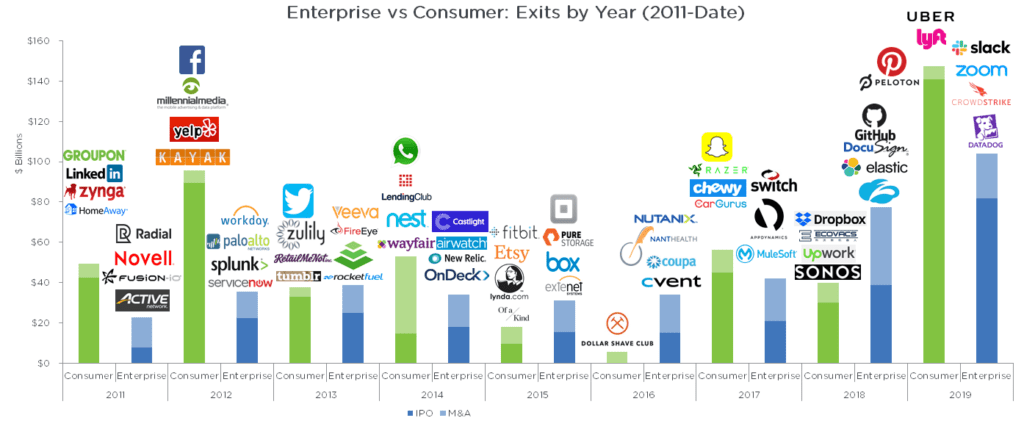
As exhibited below, large, consumer outliers since 2011 such as Facebook, Uber, and Snap often account for more than the sum of enterprise exits in any given year. For example, in the first three quarters of 2019, there have been 15 enterprise exits valued at over $1B for a total of $96B.  In the same time, there have been nine consumer exits valued at over $1B for a total of $139B. Anecdotally, this can be seen from four out of the past five years being headlined by a consumer exit. While 2016 showcased an enterprise exit, it was a particularly quiet exit year.

  • 2015 – Consumer: Fitbit ($6B)
  • 2016 – Enterprise: Nutanix ($5B)
  • 2017 – Consumer: Snap ($27B)
  • 2018 – Consumer: Dropbox ($11B)
  • First 3 quarters of 2019 – Consumer: Uber ($85B)

Source: S&P Capital IQ, Pitchbook

Enterprise Deals Still Rule in M&A

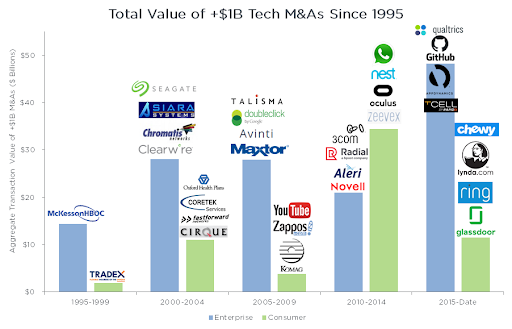
While consumer deals have taken the lead in IPO value in recent years, on the M&A front, enterprise still has the clear edge. Since 1995 there have been 76 exits of $1 billion or more in value, of which 49 are enterprise companies and 27 are consumer companies. The vast majority of value from M&A has come from enterprise companies since 1995 — more than 2x that of consumer. 

Similar to the IPO chart above, acquisition value of enterprise companies outpaced that of consumer companies until recently, with 2010-2014 being the exception.

Source: S&P Capital IQ, Pitchbook

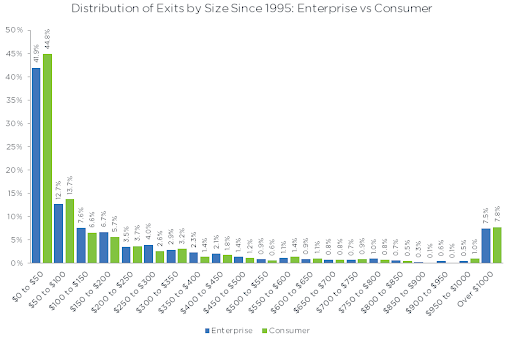
Of course, looking only at outcomes with $1 billion or more in value covers only a fraction of where most VC exits occur. Slightly less than half of all exits in both enterprise and consumer are $50 million or under in size, and more than 70 percent of all exits are under $200 million. Moreover, in the distribution chart below, we capture only the percentage of companies for which we have exit values. If we change the denominator to all exits captured in our database (i.e. measure the percentage of $1 billion-plus exits by using a higher denominator), the percentage of outcomes drops to around 3 percent of all outcomes for both enterprise and consumer.

Source: S&P Capital IQ, Pitchbook

What Does All of this Mean for Venture Investors?

There’s an enormous volume of information available on startup exits, and at Sapphire Partners, we ground our analyses and theses in the numbers. At the same time, once we’ve dug into the details, it’s equally important to zoom out and think about what our findings mean for our GPs and fellow LPs. Here are some clear takeaways from our perspective:

  • Consumer exits have surpassed enterprise over the past 15 years.
  • Consumer exits value is highly concentrated in the top deals.
  • There are more billion-dollar enterprise IPOs than billion-dollar consumer exits, so you may have more opportunities for a unicorn enterprise outcome than you do a consumer.
  • However, if you happen to invest in one of the outlier consumer exits, you could experience significant returns.  

In a nutshell, as LPs we like to see both consumer and enterprise deals in our underlying portfolio as they each provide different exposures and return profiles.  However, when these investments get rolled up as part of a venture fund’s portfolio, success is often then contingent on the fund’s overall portfolio construction… but that’s a question to explore in another post.


NOTE: Total Enterprise Value (“TEV”) presented throughout analysis considers information from CapIQ when available, and supplements information from Pitchbook last round valuation estimates when CapIQ TEV is not available. TEV (Market Capitalization + Total Debt + Total Preferred Equity + Minority Interest – Cash & Short Term Investments) is as of the close price for the initial date of trading. Classification of “Enterprise” and “Consumer” companies presented herein is internally assigned by Sapphire. Company logos shown in various charts presented herein reflect the top (4) companies of any particular time period that had a TEV of $1BN or greater at the time of IPO, with the exception of chart titled “Exits by Year, 1995- Q3 2019”, where logos shown in all charts presented herein reflect the top (4) companies of any particular year that had a TEV of $7.5BN or greater at the time of IPO. During a time period in which less than (4) companies had such exits, the absolute number of logos is shown that meet described parameters. Since 1995 refers to the time period of 1/1/1995 – 9/30/2019 throughout this article.

[1]  Includes the first three quarters of 2019. IPO exit values refer to the total enterprise value of a company at the end of the first day of trading according to S&P Capital IQ. Analysis considers a combination of Pitchbook and S&P Capital IQ to analyze US venture-backed companies that exited through acquisition or IPO between 1/1/1995 – 9/30/2019.[2] Lockup period is a predetermined amount of time following an initial public offering (“IPO”) where large shareholders, such as company executives and investors representing considerable ownership, are restricted from selling their shares. [3] Total enterprise value at the end of 10/15/2019 according to S&P Capital IQ.


Side Logo

Our Investment in Side: Empowering Agent Teams

I’m pleased to announce that Sapphire Ventures has led the Series C funding round for Side, a leading real estate technology platform that addresses a large and underserved portion of the $27 trillion residential real estate market.

Disruption in Real Estate

These are exciting and tumultuous times for the U.S. residential real estate industry.  Over the past 10 years, Zillow, Trulia, and others have empowered consumers to make informed decisions about the very important process of finding a place to live,  At the same time, they’ve helped entrepreneurial agents connect with transaction-ready consumers and grow their businesses.  

More recently, startups like OpenDoor, Offerpad, and Knock — joined by powerful incumbents like Zillow and Redfin — have innovated on the core real estate transaction, bringing IBuying and other alternative transaction models to home buyers and sellers in cities across the U.S.

Amid this upheaval, though, there’s an equally impactful, but far less discussed, trend: the rise of agent teams.  There are over 1.3 million real estate agents in the US of varying size and skill.  The top 10% of agents — those who generate $15m per year in home sales and up — are responsible for a substantial and growing portion of this massive market.  

These top-producing agents are often brilliant entrepreneurs that stand out from the pack — delivering excellent client service, building strong personal brands, utilizing online marketing and other technology to generate new clients, and largely running their own independent businesses inside brokerages across the country.  As the traditional brokerage model struggles to keep up with agents’ increasing demands in an ever-changing tech-driven landscape, top-producing agents and powerful agent teams have become dissatisfied with the value they receive from traditional real estate brokerages, and are looking for better alternatives. The real estate brokerage industry is massive, and is in desperate need of reinvention.

Side Logo

Enter Side: Growth Platform for Agent Teams

Side is a real estate brokerage technology platform that helps top-producing agent teams :

  • Own their own business and brand:  Side encourages and supports agents to launch their own brand, and exclusively own their client base.  There’s no misalignment between what’s good for the agent, and what’s good for their brokerage since it is one in the same.  Side’s model helps agents grow faster, attract associate agents to their team, and build enduring equity that they own.
  • Access market-leading technology:  Side offers a robust lead-to-close technology platform.  Side’s product development team has built new components where none exist, and in other cases they’ve integrated excellent technology that’s already available.  The result is a complete, easy-to-use suite that helps agents focus on serving clients, and not worry about the underlying tech that powers their business.
  • Receive comprehensive support:  Side’s experts help top agents develop business plans, create their own brand, find office space, execute marketing programs, and of course process transactions.

Side works with top-producing, growth-focused agents.  In fact, Side’s average partner agent executes 36 transactions per year, significantly more than any other brokerage.  With Side, the brand of the agent or team is front-and-center. In the background, Side is the broker of record and earns a percentage of customers’ commissions.  It’s a winning value proposition that is attracting top agents and teams at an accelerating pace.

Side CEO Guy Gal is one of the smartest and most driven founders I’ve met in the Proptech space, and he and co-founders CTO Ed Wu and Hilary Saunders have surrounded themselves with an extraordinary team.

Companies of Consequence

At Sapphire Ventures, we invest in companies of consequence: ambitious and talented teams, pursuing large market opportunities, with an innovative approach.  I’m very pleased to partner with Side’s exec team to build a company of consequence in this exciting space.


Three Ways CIOs Are Leveling Up Their Companies in 2019

Since 2014, Sapphire Ventures has been a passionate investor in the Chief Information Officer (CIO) ecosystem. It’s in our DNA to bring startups and enterprise IT leaders together for productive conversations and to generate new solutions for pressing (and often unprecedented) business challenges.

Title card

Since our inception, we’ve seen the role of the CIO evolve tremendously and become ever more central to corporate strategy. To support CIOs in this rapidly changing environment, and to guide the emerging startups and technology vendors that cater to them, we host an annual CIO Summit where business and IT leaders can share experiences, learn from one another, connect with the next generation of IT disruptors, and discover new ways forward.

This September, Sapphire Ventures and our co-host SAP held the firm’s 5th annual CIO Summit. Participants represented global enterprises with a combined $1.6T in market cap and $27B in IT budgets.(1) Featured speakers included:

  • Jason Pontin, Former Editor-in-Chief, MIT Technology Review
  • Greg Schott, Former CEO, MuleSoft
  • Lakshmi Hanspal, Global CISO, Box
  • JC Curleigh, CEO, Gibson Guitars and Former President, Levi’s
  • Jana Kanyadan, Global CIO, Mohawk Industries
  • Pedro Canahuati, VP Security & Privacy Engineering, Facebook
  • Tuck Rickards, Managing Director & Co-Lead for the Technology Officers Practice, CEO and Boards Practice, Russell Reynolds Associates
  • Amy Brooks, President, Team Marketing and Business Operations, and Chief Innovation Officer, National Basketball Association (NBA)

YouTube playlist for the CIO Sumit

While prior Summits focused on a singular theme — digital transformation (2015), improving the customer experience (2016), the shifting role of the CIO in driving top-line results (2017), and the future of work (2018), the recent convergence of many of these issues in 2019 inspired us to let Summit attendees steer the agenda by bringing together multiple topics CIOs are experiencing on the front lines of innovation.

Below are three actionable takeaways that developed in the conversations at this year’s event. CIOs can use and build upon this wisdom to ensure their organizations remain on the cutting edge in the year to come.

Takeaway 1: CIOs are re-designing their vendor portfolios — and making more room for startups

Today, executive teams aren’t looking for a CIO to simply keep the lights on. They want a transformational CIO who can level up their entire organization with technology that increases efficiency and productivity while sharpening their intelligence.  Today, many CIOs have designed vendor portfolios that help them improve upon the status quo and eliminate much of the heavy lifting. There is one key shift underway in the composition of the typical enterprise IT portfolio, however. In the past, the majority of IT vendors were well-known and well-established (e.g., SAP, Salesforce, Workday, PeopleSoft); however, new data from Sapphire Ventures’ CIO Innovation Index — released for the first time at the 2019 CIO Summit — shows that startups are beginning to capture a growing share of wallet. The study shows that startups today comprise a median of 10% of IT budgets — and are set to grow to a median 15% over the next 12 months.  The same study showed that 75% of CIOs expect that their IT portfolios will have more or the same number of vendors a year from now, indicating that dense and federated vendor landscapes are here to stay. 

Our CIO Innovation Index showed that CIOs report unique benefits to working with startups relative to engaging more established vendors, including:

  • More modern technology architecture
  • Faster pace of product delivery
  • Greater ability to influence the startup’s product roadmap

As Jana Kanyadan, Global CIO at Mohawk Industries, put it:  “Working with startups is core to the digital innovation agenda at Mohawk. As global CIO, I encourage my team to regularly assess emerging technologies and disruptive startups that can aid our company’s transformation and enable us to better serve customers.”

At the same time, the startup universe is evolving so rapidly that, as a CIO, it can be difficult to know where to begin. To solve this, Sapphire Ventures also launched SV Explorer in 2018, a curated and easily searchable startup platform for enterprise IT leaders. Today, over 300 IT and business executives from large enterprises leverage the platform to simply search for a term such as “sales” or “big data,” and then discover and engage with vetted startups through the portal. 

Takeaway 2: CIOs are zeroing in on the business value of cybersecurity solutions as threats escalate

Cybersecurity is one of the most pressing issues for CIOs today, and was a key topic of dialogue at the CIO Summit, with a panel featuring CXOs and executives from Box, AEG, Facebook and Sapphire portfolio company Netskope. For any CXO, however, it can be overwhelming to face the threat (or occurrence) of a cyber attack. In 2018 alone, over 6,500 data breaches and 5 billion compromised records were reported. According to IBM, the average cost of a data breach is up to $3.92 million — and recent data from McKinsey highlights that nearly 80% of technology executives don’t believe their cybersecurity programs can keep up with the criminals. There are serious financial and reputational costs to a cyber attack — and the pressure is on for CIOs and CISOs to protect their teams.

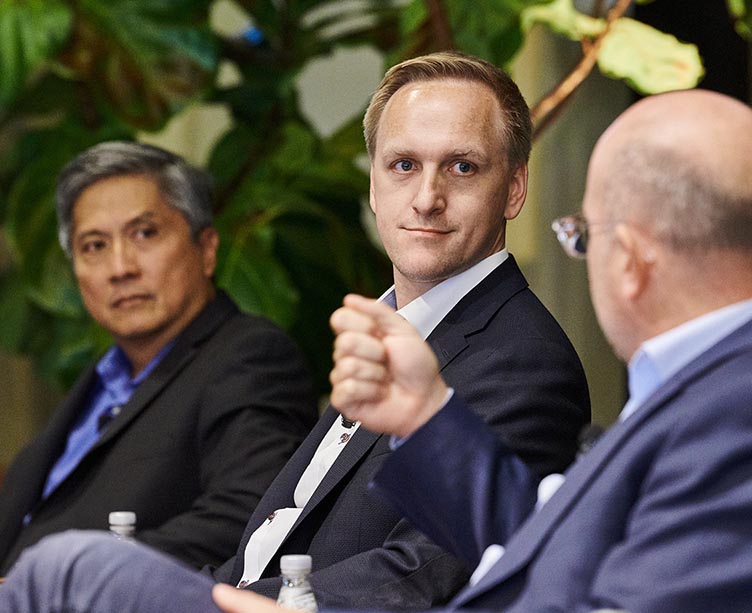
CIOs discuss the evolving cybersecurity environment during the CIO Summit.

Despite these high stakes, it can be an added challenge for CIOs to communicate priorities and needs to non-technical leadership, particularly during a crisis. One way that several teams, including Facebook, teach their C-suite and boards about cybersecurity is through preemptive tests and learning exercises. Creating and running scenarios for different types of web application attacks or detecting user anomalies, for example, can help business leaders understand what’s most important, what could be a false alarm, and even model out costs and recovery from specific incidents before they occur.   

In addition, articulating the cost of inaction can prompt decision makers invest in tools like Auth0 and Exabeam that can bear the burden of cyber risk and further mitigate losses from a breach. As a CIO, figuring out the best ways to collaborate and communicate about cybersecurity across the entire organization is key to staying afloat as the threat environment grows more complex.

Takeaway 3: CIOs are stepping up as innovation leaders

Traditionally, the role of the CIO was as a gatekeeper — the one who held the keys to the vendor portfolio, made the trains run on time, and manned the Help Desk. Today that has fundamentally changed. CIOs are stepping up as business and innovation leaders, serving as the eyes and ears of the organization as technology quickly evolves — and investing in the solutions they need to remain competitive.

The need for technical leadership at the highest levels is quickly increasing. Cyber threats, data analysis, cloud migrations — all of these critical topics require deep IT expertise. As President & CEO of Gibson Guitar Brands and former President of Levi’s James ‘JC’ Curleigh reminded us the CIO Summit, this isn’t restricted to young companies. The need for 100(+)-year old companies, like the ones he has helped lead, to remain innovative and have a startup mentality is stronger than ever.  And with technology being at the center of industry disruption, the environment has never been better for CIOs to elevate their roles and contributions.  

Board Service for CIOs, whether on public, private/startup, or not for profit Boards, was another key topic of conversation at the Summit, amid a growing trend of CIOs being tapped for corporate board positions .  To be a valuable board member, however, it’s not enough to understand technology trends. According to Patty Morrison, former CIO, Cardinal Health and Board Director at numerous enterprises including Baxter Health and Splunk, it is essential to understand and be able to articulate how technology fits into the overall corporate strategy, forecasting, financial modeling, and meeting shareholder demands.  Speaking on a panel titled “CIOs and Boards: A Match Made in Heaven?”, Morrison also stressed the importance for CIOs to take off their “operator” hats and assume a “governance” mindset, when thinking about the role of a Board Director. 

Patty Morrison, former CIO of Cardinal Health

The good news is that for CIOs angling for board positions, there are a growing number of resources. From learning to network with purpose to crafting and articulating your authentic, valuable story to nail the interview, Sapphire Ventures’ Elizabeth Patterson teamed up with Tuck Rickards (Managing Director & Co-Lead for the Technology Officers Practice, CEO and Boards Practice, Russell Reynolds Associates), and Patty Morrison to brainstorm and share best practices for making changes in the upper echelons of corporate leadership.

A family reunion

Now in its fifth year, the CIO Summit has begun to feel like a family reunion for many of us. For IT leaders, it’s a chance to connect and remember that many others are going through similar challenges in a constantly shifting tech environment — and inspire one another to take bold, innovative steps forward.  For the startups and VCs in our orbit, it is a unique moment to get inside the minds of Global 2000 CIOs while also influencing their thinking on emerging technology trends. Stay tuned for more insights and takeaways from this and other Sapphire Ventures CIO initiatives and events. Onwards!


(1) Source:  Pitchbook as of September 2019


Group of people walking, cheering

Clari: Transforming the Revenue Operations Process

The B2B revenue process has changed dramatically in recent years. Buyers are more informed, armed with information gathered from many sources before engaging vendors. New subscription and consumption-based business models require different management and measurement approaches, and ever-increasing competitive pressure and accelerating pace of change requires B2B teams to be much more agile than in the past. 

The rise of revenue operations 

All of these dynamics highlight the need for a different approach to managing the modern revenue process. To respond to these changes, innovative companies are combining their marketing, sales, and customer success teams into a single business function called revenue operations (or RevOps). The purpose of this new alignment is to create more transparency and accountability between team members as they work towards their shared goals of customer acquisition, retention, and account expansion- i.e. the levers that accelerate a company’s top-line growth.

Pendo, and Contentful. As business leaders eliminate inefficiencies and try to find new ways to create more relevant and satisfying experiences for their customers, they are focusing on how to make revenue operations teams work more cohesively and efficiently. Recent data shows that companies with formal revenue operations teams grew sales 3X faster in 2019 than those who didn’t — and public companies with revenue operations teams had 71% higher stock performance.

Although revenue operations has become one of the fastest growing roles in enterprise sales, the technology to support it has lagged behind.  It’s relatively easy to find tools that empower marketers, sales reps, and customer success teams to do their jobs faster and with greater attention to detail. But to bridge these teams and bring their different tech silos together, organizations typically have had to cobble together hand-coded spreadsheets, custom reporting and manual processes.  

A new way to revenue 

Clari logo

Clari, the latest addition to the Sapphire Ventures portfolio, anticipated this problem and has been working to solve it since its inception. The company’s powerful platform offers complete visibility into which leads in the pipeline will turn into customers and which customers at risk for churn or are primed for upsells. It even provides finance and operations teams insights to improve forecasting accuracy, and measure sales and marketing team productivity. In essence, Clari provides a single view and shared set of workflows for a company’s go-to-market operations — yet its ability to harness AI and machine learning to improve them truly sets the system apart.

Clari works alongside its customers’ existing marketing automation system, CRM, emails, calendars, and other repositories of revenue information and uses its AI/ML to automatically associate and bi-directionally sync each data point with its correct account and opportunity. From there, it generates valuable insights on active and potential deals and highlights how sales reps and marketing campaigns are engaging with these leads and prospects. Clari can help sales leaders coach reps on how to allocate their time and improve their communications to close more deals in less time. It also ensures that the team has a full picture of every contact, aggregating information from every customer touchpoint into a single, comprehensive, and easily accessible view.

Screenshot of Clari product dashboard

Since its inception, Clari has raised $75M from investors — including its last round of $35M (less than a year ago). It’s grown both customer count and employee count by 100% YOY — and shows no signs of slowing down.

We’ve been following Clari and its CEO Andy Byrne for the past four years as they’ve doubled down on product and launched an enormously successful GTM strategy while the revenue operations movement heated up. As a leader, Andy brings more than two decades of experience in sales, marketing, and management to Clari — and this is far from his first rodeo. Prior to Clari he was part of the founding team at Clearwell Systems, where he helped grow the company from pre-product & pre-revenue to $100 million run rate until its acquisition by Symantec (SYMC).

The success of a startup never hinges on any one person, however, and Andy has gathered a highly experienced, high-performing team around him. Clari’s CTO Venkat Rangan has more than 36 years of experience (22 years of executive experience) designing and architecting enterprise software products. VP of Product Kurt Leafstrand also has more than two decades of experience, previously serving as Senior Director of Product Management at Clearwell and Director of Product Management at IBM. Clari’s CRO Kevin Knieriem formerly led sales teams at Oracle and SAP (where he spent a decade and ran many of SAP’s US retail lines).

Simply put, we’re inspired by the brainpower and maturity of this team, who we believe are more than well equipped to bring Clari to the next level.

Revenue operations  may be new, but Sapphire has been investing in  this space for years. Through our investments in LeanData, Highspot, and Outreach, we support and collaborate with founders working at the front lines of automating and improving the revenue operations  business process every day. We’ve been privileged to see this sector develop and come into focus for other VCs and high-growth teams — and are thrilled to bring our expertise and network to support Clari as it continues to lead the pack in the years to come.


Sudheesh Nair, CEO of Thoughtspot, headshot

Sudheesh Nair on 3 Ways to Build a Team That Repeatedly Delivers Innovative, Valuable Products at Scale


This is a guest post from Sudheesh Nair, CEO of ThougthSpot

All industries go through cycles of creative disruption — when new products, companies and even ways of working emerge and replace the establishment. In IT, however, this isn’t a once-in-a-decade phenomenon — it’s become business as usual. Amid constant change, and a flood of new products coming to market every day, companies have to release early, iterate often, fail fast, and start over simply to stay in the game.

While this pattern has become familiar, most growth-stage tech teams struggle to maintain a creative and flexible core — the essence of what allows them to produce new and innovative products — while imposing the structure they need to successfully scale. Like an arrow, those organizations that go the farthest have both rigid and elastic parts working together.

There are many nuances on how to lead in this context; one of the most important being how you juggle the personalities, values, and skill sets of early-stage employees — many of whom thrive in a chaotic, experimental environment — with later hires, who often bring more operating experience and appreciate order. As the cycle of creative disruption tightens (now every 2-3 years), the challenge for us as organizational leaders becomes how you fit everyone you need — the creative “misfits,” operations-focused “builders,” and highly experienced “scalers” — under one tent.
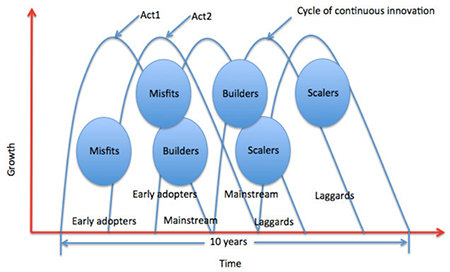
Overlapping waves of innovation on a graph

How do you create a compassionate, collaborative environment under these circumstances? How do you ensure everyone feels valued and productive in order to take the company to the next level? These are questions I’ve grappled with for years at growth-stage tech companies — first as President of Nutanix, where I grew the sales organization from 0 to $1 billion in revenue, and now as CEO at ThoughtSpot, a company with a visionary business analytics product in a competitive, $200B+ market.

I recently presented what I’ve learned (through both successes and failures) about building an  organization that can consistently deliver innovative, valuable products at scale at Sapphire Ventures’ Cloud Go-to-Market Summit. Below are three takeaways from that talk that I think are important for any leader in the industry today. If you’re interested in the full presentation, you can view it here.

1. Create a culture of safety

In times of evolution and uncertainty, it’s critical to provide your team a safety net for exploration. Their ability to experiment and take risks is what will ultimately differentiate your products and services for your customers — yet no one does their best work if they sense their job is in jeopardy. In a high-growth startup, you have to work to eliminate this fear. It’s not always an easy task amid shifting priorities, re-assigning roles and responsibilities, and sometimes even a lack of clarity around the company budget. This challenge can be compounded if you have a mix of employees who are comfortable with standard reviews and KPIs — and others who aren’t used to being so closely monitored.

Creating a culture of safety doesn’t mean doing away with employee oversight or coddling underperformers. Instead, it means creating an environment without surprises. To do this, you must begin by setting and communicating clear performance KPIs — even for those employees who aren’t accustomed to them. To build internal support for these changes, include early hires in the creation of new benchmarks. Their insights and institutional knowledge can go a long way towards crafting more relevant and valuable goals.

After you’ve set these goals, follow up with reviews, and maintain consistent, open communication throughout your team. If someone is outperforming, celebrate their wins. If another employee is struggling, begin a conversation with them as early as possible about ways to improve. Empower your front-line managers to have these sometimes difficult discussions with those who report to them. Mastering the ability to surface frustrations, resentments, questions, and fears that might be holding an employee back from progressing is a valuable (yet often overlooked) skill for building greater trust, loyalty, and retention.

If, after a deliberate, collaborative process, it’s clear that someone is not a good fit, don’t drag your feet about letting them go. Not everyone will be an asset — and your company won’t be the place where everyone thrives. Yet if everyone feels that the process for determining this is honest and thoughtful — it will go a long way towards empowering individuals to make bold, authentic decisions on a regular basis.

2. Build missionary (vs. mercenary) sales teams

To design, build, refine, and commercialize high-quality products, you need employees who execute above and beyond their job descriptions. In particular, you need a sales team that will evangelize your product, even when it’s still in progress; determine best-fit customers; and bring external feedback back to the team to help everyone improve.

Whether these extraordinary individuals already exist within your company or you’re looking to make outside hires — they’re not easy to attract and retain. In order to bring them into and keep them within your company, you have to spark them with an extremely ambitious goal.

It’s not enough to build new and slightly improved business analytics software, for example. To distinguish yourself, you need to bring the most complex and powerful AI and search-driven tools to every enterprise employee in seconds. You can’t simply create another CRM tool; you must invent a system of engagement that sets a new industry standard. Without this game-changing premise, you won’t catalyze other pioneers to join forces with you.

Bringing believers into the company can ease many leadership challenges. When the going gets tough, for example, you already have a team that’s aligned and motivated to move through it. At the same time, a leader can never afford to be lax in reinforcing the core mission as the company evolves. Keep the focus on your north star metrics vs. milestones, such as the next fundraise, IPO, or acquisition. This will help ensure your sales force continues to play the long game — and weed out those looking for quick rewards.

Finally, even the most visionary teams might find themselves with “mercenaries” — those who simply fulfill their job requirements, hit targets, but don’t have the guts to get creative when the going gets tough. In these cases, don’t give up. You can work to convert mercenaries to missionaries through an incentive structure that rewards more than closing a handful of deals. Entice them to build greater awareness of your product, create entirely new sales pipelines, forge partnerships, and even mentor other employees. In doing so, you will more clearly define how they can go above and beyond. Their growth = your growth.

3. When you’re at a fork, turn

If you’re a fast-growing tech team, you don’t have the luxury of resting on your laurels (during the good times) or standing still (when you don’t know what to do). You must constantly adapt to survive. If you’re faced with common challenges like a new competitor taking more market share than expected, funding drying up, or the departure of a key executive, don’t drag your feet.

Young companies face these obstacles and forks in the road constantly, often in ways that test the core of their business. Yelp!, for example, began as an automated system for requesting recommendations from friends. When this didn’t stick, they had a choice. They could keep pushing against an idea that wasn’t really working or try something new. They zeroed in on the part of their platform that was gaining traction — users posting reviews of local businesses — and redesigned the company around that. 100 million reviews later — the pivot proved successful.

Auth0, one of Sapphire Ventures’ portfolio companies, saw an enormous opportunity in a new market. Japanese companies were investing aggressively in digital transformation — an ideal context for pitching their authentication and authorization solutions. Instead of wavering about this expansion, they dove in. Due in part to their bold sales tactics, Auth0 hit unicorn status in 2019.

Not every new decision will lead to this level of success — yet if you’re serious about building an organization that consistently creates products and experiences that users love — you must develop a process for dealing with sudden, unexpected challenges and opportunities. Make a quick assessment, communicate your decision clearly and firmly to your team, and take action. The sum of each of these decisions will equal a company that keeps up with its customers, knows how to execute, and isn’t afraid of evolving.

Have the courage to lead in new ways

There’s no playbook for success in technology. In my experience, it’s both an art and a science to build a company that is a well-oiled machine yet flexible enough to make quick, effective changes.

As with most challenges, however, I also find answer lies in teamwork. To make ideas come to life — again and again — you need to surround yourself with experts (and curious, quick learners) in product, engineering, sales, marketing, customer success, operations, and strategy. Many of their backgrounds and skill sets will clash; however, as a leader, it’s up to you to make space for these differences and highlight everyone’s contributions. Clearly communicate and adhere to shared and individual goals; don’t be afraid of tough conversations; be bold with your vision to attract a passionate, hardworking salesforce; know how to motivate your company to transform when need be. If you can do this, you’ll continue to thrive.


CIO Innovation Index report cover

Announcing Sapphire Venture’s CIO Innovation Index: Benchmarking Disruption Within IT

Since launching the Sapphire Ventures Portfolio Growth team 5 years ago, we’ve developed a network of CIOs, CTOs and digital executives at Global 2000 companies that are motivated to engage with VC-backed startups and emerging technologies. In our interactions, we have consistently observed two challenges enterprises face in navigating  startups. First, CIOs face challenges in identifying promising and viable startups amid a noisy market that funds thousands of new enterprise startups every yearThis prompted us to launch the SV Explorer innovation portal, which over 300 corporate innovators now use to discover startups vetted by Sapphire and our VC network. 

CIO Innovation Index report cover

The second recurring challenge is that even though CIOs are working around the clock to instill innovation into their organizations (while keeping the lights on!) – they have no way to assess their innovation management practices and outcomes relative to other companies.  We’ve addressed questions on this anecdotally in the past, but lacked comprehensive data. Today, we’re proud to address this industry blindspot with the release of Sapphire Ventures’ CIO Innovation Index, a quantitative study that establishes the first-ever set of measures capturing the state of Global 2000 organizations’ interactions with the startup and innovation ecosystems.

CIO Innovation Index: What We Found

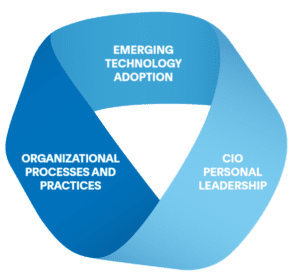
The Index study revealed some  compelling indicators of just how intertwined CIOs, IT and startups are, as well as the common processes and challenges that characterize this ecosystem.   In analyzing data provided by 70+ IT executives from Global 2000 organizations spread across 12 industries, we studied three interdependent areas that influence an organization’s overall approach to emerging technology and startups: 

  1. Organizational processes related to startup engagement and emerging technologies 
  2. CIOs’ individual participation in the innovation and startup ecosystem 
  3. Current adoption level of startup and emerging technologies

The Innovation Interaction Framework identifies three intertwined process areas that define how an organization approaches emerging technology and startup engagement.

Given how intertwined these areas are — and recognizing every company’s unique situation — we’re presenting the CIO Innovation Index results as a “conversation starter”, rather than a set of definitive conclusions. We hope that CIOs can use the Index to begin evaluating and benchmarking their current approach to startup engagement relative to some of the world’s largest corporations, and better understand the drivers for effective outcomes. For the startups, we believe the Innovation Index presents a series of observations that should influence how they think about influencing IT leaders, the role POCs play in their sales pipelines, and their relative advantages and weaknesses compared to established players. 

Since our goal for the CIO Innovation Index is to increase the transparency between large enterprises and startups, our initial report explores questions such as: 

  • What percent of IT budgets do startups currently account for, and how is that share of budget expected to trend?
  • Which emerging technologies do CIOs prefer to engage startups for, over more established vendors (and vice versa)?
  • What are the commonly reported benefits of working with startups, and the challenges?  
  • What role do startup Proofs of Concepts (POCs) play in the evaluation process CIOs and their teams? 

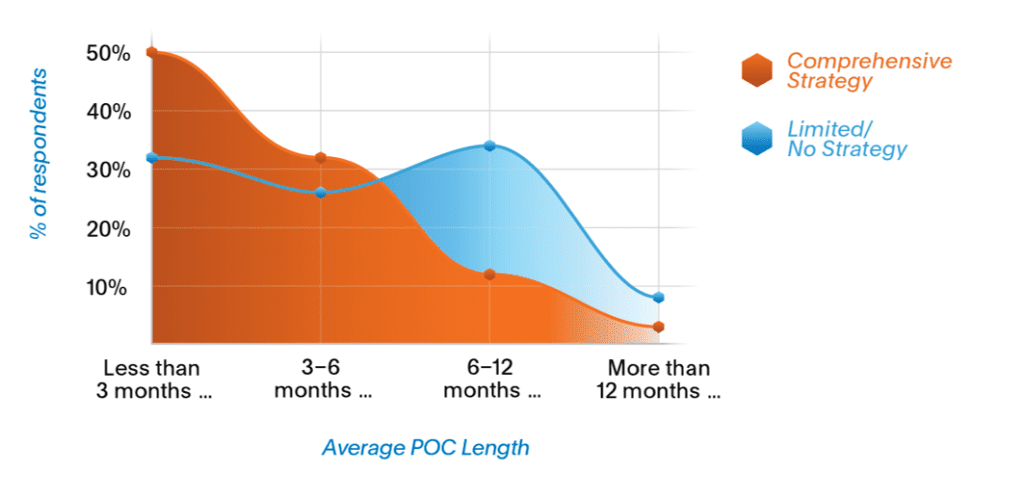
One of the most interesting findings in our initial report is that companies that say they have a comprehensive strategy for  adopting emerging technology tend to have significantly shorter durations for their Proof of Concepts (POCs) with startups — often less than 3 months — and tend to have a higher “graduation rate” for those POCs into production implementations relative to companies who say they have limited or no strategy for these new technologies.  This suggests how important having a clear, overarching strategy is in helping companies identify the right technology to trial, and defining what “success” should look like for any startup POC. It also implies that startups should assess whether their prospects have defined strategies for the emerging technology domains they represent, as this will impact their chances of being adopted. 

Read more about the role of POcs in adopting emerging technology — and all of the results of the CIO Innovation Index — by downloading the report here

Line graph showing the difference in POC timeframesWhat’s next for the CIO Innovation Index?

This release of this report is the first step for the CIO Innovation Index, with participation from more than 70 organizations across 30 data points.  Looking ahead, we want to drive CIO participation in the Index so we can keep growing the quality and breadth of the data set. And as we evolve the framework, we want to gather metrics in other areas, such as: 

  • Correlation between business KPIs and Innovation Index metrics. For example, we know CIOs are eager to see data on whether there is a correlation between the adoption level of emerging technologies and company profitability. 
  • Startup-driven metrics. With startups forming a key part of this equation, we want to invite startups to contribute data on their experiences engaging with CIOs and large enterprises, such as standard timelines and commercial models for POCs with enterprise customers.  

CIO Innovation Index report cover
Download the free CIO Innovation Index study

Our plan is to update the CIO Innovation Index annually, so we can monitor the trendline of how interactions with Global 2000 organizations and startups are faring.  Ultimately, we believe that CIOs are better off measuring their innovation playbooks against an aggregate index of peer activity, and we aimed to capture these playbooks with a broad canvas.  If you are a CIO or an IT executive from a large organization, and you would like to participate in the Innovation Index research study by contributing your company’s data, please reach out to us at ([email protected]).  We welcome your thoughts and feedback on this effort and the original findings in the Index report.


Brightfield logo

Brightfield: Lighting Up the Extended Workforce

The way we work has fundamentally changed. A company’s success used to rest on its full-time, in-house workforce — yet today, the most productive organizations are figuring out ways to balance salaried employees with an extended group of freelancers, consultants, and part-time workers. If done right, this approach provides greater access to talent, reduces costs, and creates a more supportive organization. If botched, it can bring chaos, new expenses, and leave non-traditional employees feeling siloed and ignored.

According to recent data from Upwork and the Freelancers Union, freelance, gig, and contract workers now make up more than one-third of the global workforce. Nearly 40 percent of workers below the age of 35 take on contract work in addition to full-time employment. Because of this, companies are scrambling to re-imagine their employees as fluid and adaptable — and struggling to create more flexible systems to hire, onboard, retain, and develop them.

Brightfield logo

Brightfield, the latest addition to the Sapphire Ventures portfolio, approaches this opportunity faster (and better) than nearly anyone. They saw massive inefficiencies with how many organizations were trying to manage their contingent workforce — including misaligned vendor relationships, a lack of visibility into procurement spend, misclassified SOWs, and broken integrations.

To fix this, the team developed a powerful analytics platform that sits on top of and optimizes a company’s existing HR and vendor management systems. Brightfield harnesses practical applications of AI and Natural Language Processing (NLP) to parse information — including job applications, service agreements, CRM data, and program KPIs — and unearth new insights to help their customers reduce risks, cut costs, and boost productivity across the board.

What’s more, Brightfield offers customers access to their Talent Data Exchange (TDX)—a platform with actual vendor management transaction data from more than 300 organizations, 15 verticals, 16 job functions, and 115 countries. This hub delivers unparalleled visibility into how other teams are designing their teams — and immediately gives new customers ways to benchmark their progress.

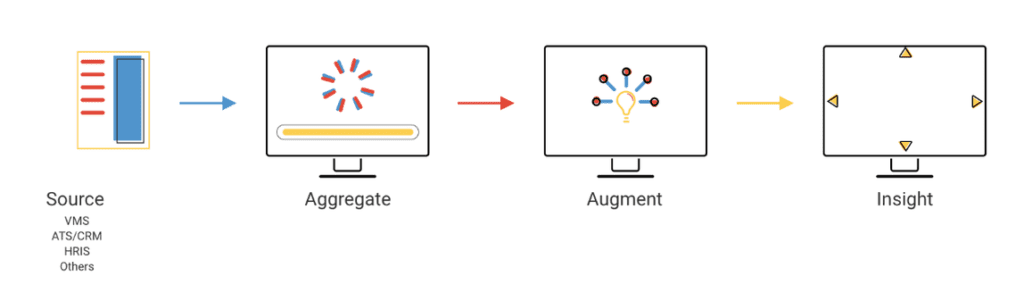
Brightfield Talent Data Exchange data flow

As Brightfield grows, so too does TDX, becoming a valuable differentiator that will make it difficult for competitors to catch up.

I first learned about Brightfield through their CEO, Jesse Levin. Jesse is an industry veteran, who most recently served as General Manager and Head of Strategy & Corporate Development at CEB. During his 18-year tenure, the public company grew to ~$1B in subscription revenue and $3.5B in market cap. 

During this time, Jesse wore a second hat as Head of CEB Ventures. In this role, he oversaw more than 30 acquisitions and investments (totaling nearly $1 billion in value). His broad and deep market experience — and comfort with both public and private companies — makes him an obvious fit for taking Brightfield to the next level. Some people even say companies that Jesse works for in the space have an “unfair advantage,” given his unique skill set.

What I most appreciate about Jesse, however, is that he is incredibly team-oriented. In 2011, Jesse and I co-invested in PayScale, one of Sapphire’s early investments in people-oriented technologies. I was struck by his dedication to the company, a leading database for salary data. It was clear from the start that he was passionate about bringing more transparency to the space and helping employers and employees reach fair compensation value. In 2014, PayScale was acquired by Warburg Pincus and today has more than 50 million individual salary profiles uploaded.

As an operator, Jesse naturally seeks out and partners with top talent. Brightfield’s co-founder Jason Ezratty is a leading data scientist with an excellent track record in the industry. Together, the two bring a powerful combination of intellect, industry experience, personal networks, and grit.

Jesse’s and Jason’s vision and expertise weren’t the only reasons Sapphire decided to invest. The company more than tripled their software business last year and expects to more than double it again this year. With freelance workers anticipated to comprise nearly half of the U.S. workforce by 2027 — and growth in freelancing currently outpacing employment growth in many parts of Europe, including the United Kingdom, France, and the Netherlands (according to recent data from MarketWatch) — this rare combination of such a booming company and market is a VC’s dream.

I’m thrilled to continue Sapphire’s history of investing in HR and people-oriented technologies with Brightfield. In addition to PayScale, our team has backed HR companies like LinkedIn, Jibe, AllyO, and Culture Amp. We’ve been curious about and committed to the industry for nearly a decade — and are excited to partner with Jesse, Jason, and the entire Brightfield team as they continue to shine.


Digital transformation

Thinking Twice About ThoughtSpot — a Visionary Product and Team at the Forefront of Business Intelligence

Every customer interaction I have as CEO of ThoughtSpot is an opportunity to learn about business transformation. In one meeting, I’m learning about how data is transforming a mom-and-pop restaurant businesses, while at the very next meeting I’m learning about the supply chain seasonality challenges of a global toy business. What we’re building at ThoughtSpot is at the center of all these, which is very exciting.

—Sudheesh Nair, CEO, ThoughtSpot

According to recent data from CBI Insights, 70% of tech startups fail — usually about 20 months after they’ve first raised their first million in financing.

That isn’t surprising. Getting to product/market fit by itself — not to mention building a successful marketing and sales engine, scaling a team, and navigating the numerous challenges of go-to-market — are formidable. At Sapphire Ventures, one of our core strategies is to uncover those rare companies that have overcome these early obstacles, and then help take them to the next level. When we find these teams, we commit for the long haul.

Today we’re excited to announce our follow-up investment in ThoughtSpot — a visionary search & AI-driven analytics platform transforming business intelligence by bringing data insights to everyone in the enterprise (not just analysts and data scientists). Recently named a Leader in the Gartner 2019 Magic Quadrant for Analytics and BI Platforms, ThoughtSpot empowers any business user to find insights in their company’s data through a simple search experience, which requires a deep architecture powering sub-second performance across billions of rows of data. In addition, the platform includes an AI-driven automated insights engine (SpotIQ) that lets users select simple terms, such as “product sales”, and the system automatically generates valuable insights to questions they might not have known to ask.

Two of the biggest names in the Business Intelligence and Analytics category — Looker (also a Sapphire Ventures investment) and Tableau — were recently acquired within days of each other for a combined total of $18.5 billion. Google (GCP) and Salesforce made these acquisitions because of the recognition that BI and Analytics are becoming the lifeblood of all enterprises as they transform themselves to be more agile and data driven.  However as we know companies that get acquired often have a short shelf life and they become slower to innovate. The void left in the market because of acquisitions have to be filled and that is where a company like ThoughtSpot with its unique search-based analytic capabilities and a truly incredible management team to fill it.

Instead of delivering this information in technical jargon, ThoughtSpot both receives and displays queries in natural language, so that everyone — from frontline employees to C-suite executives — can quickly interact with their data and take action.

Since its Series A in 2012, the company has taken off. It now counts more than half of the Fortune 10 as customers — along with major enterprises like Walmart, Hulu, Daimler, 7-Eleven, and Rolls-Royce. Sales grew by 195% in the first half of the year, allowing the team to expand into Singapore, Tokyo, Dusseldorf, and India. Internally, ThoughtSpot has grown employee count by more than 65%, to nearly 500 employees, and has been recognized as a Technology Pioneer by the World Economic Forum, one of the 100 most important cloud companies by Forbes, and one of the 50 best private cloud companies to work for by Glassdoor and Bessemer Ventures.

Many factors have contributed to this rise; however, the most important has been leadership. Co-founder and executive chairman Ajeet Singh’s product

expertise combined with CEO Sudheesh Nair’s leadership and customer empathy has lifted ThoughtSpot to a new level.

Ajeet and Sudheesh have known each other for years. The duo worked together at Nutanix, which Ajeet co-founded and where Sudheesh built and led the sales organization from zero to over $1 billion in revenue. We originally invested in Ajeet’s business because of his impressive track record, keen understanding of the market, and extraordinary technical talent. Yet as ThoughtSpot began to take off, Ajeet realized he needed a partner once more. Today, Ajeet drives the development of the ThoughtSpot platform, while Sudheesh spearheads operations and tackles building a diverse, high-performing team.

Sudheesh Nair, CEO, ThoughtSpot

In his new role, Sudheesh has not only proved himself to be enormously talented at hitting and exceeding goals for growth — he also has a rare empathy and understanding of organizational behavior. At a time when so many tech teams are balancing the pressures of scaling with the desire to remain creative and experimental at their core, Sudheesh has a unique ability to balance the personalities, values, and skill sets of early-stage employees — many of whom thrive in a chaotic, experimental environment — with later hires, who often bring more operating experience and appreciate order.

Yes, we think ThoughtSpot has an amazing product, but if you want to know the real drivers behind ThoughtSpot’s ascension, I would point to the culture of selfless excellence Sudheesh and Ajeet have created that includes:

  • employees with missionary-like zeal, who go above and beyond their job descriptions in pursuit of excellence – not for personal glory, but for the good of the company and customers;
  • a transparent and supportive work environment for all types of talent; and
  • flexibility to pivot when challenges and opportunities arise.

(If you want a deep dive into Sudheesh’s leadership style, he presented his approach and the lessons he’s learned in this video from Sapphire Ventures’ recent Cloud Go-to-Market Summit.)

It’s a privilege to continue the journey with Sudheesh, Ajeet, and the entire ThoughtSpot team. This is a rare opportunity — and we’re incredibly excited for what’s to come.


Disclaimer: Nothing presented within this article is intended to constitute investment advice, and under no circumstances should any information provided herein be used or considered as an offer to sell or a solicitation of an offer to buy an interest in any investment fund managed by Sapphire Ventures. Information provided reflects Sapphire Ventures’ views as of a time, whereby such views are subject to change at any point and Sapphire Ventures shall not be obligated to provide notice of any change. Companies mentioned in this article are a representative sample of portfolio companies in which Sapphire Ventures has invested in which the author believes such companies fit the objective criteria stated in commentary, which do not reflect all investments made by Sapphire. A complete alphabetical list of Sapphire’s investments made by its direct growth investing funds is available here. No assumptions should be made that investments listed above were or will be profitable. Due to various risks and uncertainties, actual events, results or the actual experience may differ materially from those reflected or contemplated in these statements. Nothing contained in this article may be relied upon as a guarantee or assurance as to the future success of any particular company. Past performance is not indicative of future results.