Hands on keyboard

Fundraising Tips – How to Build a Better Data Room

Since the inception of Sapphire Partners, our team has evaluated thousands of opportunities to invest in venture funds and have subsequently seen a variety of data room formats providing varying levels of information.

Because of our role in the venture ecosystem,  we often find emerging and established GPs asking us for best practices in putting together a data room. So, in the spirit of #OpenLP, this blog is our perspective on data room best practices. This will be the first in a series of posts on the subject of LP diligence processes where we’ll dive into what specific financial information we look for when assessing an early stage venture fund. 

Our goal with this post is to be as comprehensive as possible, and provide the community with a handy template to further illustrate our points. 

While we have tried to be as comprehensive as possible in our discussion of data rooms, it is important to note that not all LPs in early stage venture funds share a standard due diligence process.  As such, they may may require more, or less data, depending on their processes. Finally, although formatting data for a data room may take more upfront time for GPs, it allows LPs to run their processes more efficiently, and minimizes unnecessary back and forth throughout the fundraising process.

The first worksheet (“Portfolio Companies”) of the template looks at each portfolio company across all historical funds in a single view. We sometimes see data split up across worksheets by fund, but having all the company-level data on one worksheet is much more conducive for our quantitative analysis. Here’s a pro tip for GPs: provide your quantitative data in Excel format, not PDF format. LPs will use software to translate PDFs into Excel or worse – some poor soul will have to manually enter all your data into Excel. Receiving data directly from the fund manager in Excel format is ideal as both previously mentioned methods leave some room for error. 

At Sapphire Partners, we typically group data in six broad categories: 

  1. Financial Data – investment-level details for each portfolio company
  2. Entry Data – data pertinent to the initial investment made for each portfolio company
  3. Current/Exit Data – data pertinent to the latest activity (current or exit) for each portfolio company
  4. Attribution Data – partner attribution data for firms with multiple check writers
  5. Qualitative Data – provides categorical descriptors (i.e. geography, sector, etc.) which provides LPs an understanding of performance and investing dynamics across these groups
  6. Company Metrics – although not always relevant or available, LPs generally appreciate revenue metrics to understand the traction and scale of the underlying portfolio companies 

In our template, we break down each group by its data components and provided some accompanying details when necessary.

  1. Financial Data
    • Date of Initial Investment
    • Initial Invested Cost
    • Total Invested Cost
    • Realized Value
    • Unrealized Value (FMV)
    • Total Value (Realized + Unrealized Value)
    • Realized MOC
      • We view this metric as Realized Value/Total Invested Cost, but some LPs view this as the realized value and total invested cost of the fully realized companies.
    • Gross MOC
  2. Entry Data
    • Entry Series
    • Entry Ownership (%)
    • Entry Valuation (post-money)
  3. Current/Exit Data
    • Latest/Exit Series
      • For realized investments, this would indicate the last Series before the liquidity event
    • Current/Exit Ownership (%)
    • Current/Exit Valuation (post-money)
    • Exit Date (if applicable)
    • Exit Type (if applicable)
      • We typically see IPO, M&A, and written-off as options
  4. Attribution Data
    • Lead Partner
    • Board Seat (Y/N/O)
      • Yes, No, Observer
  5. Qualitative Data
    • Geography
      • Geography depends on strategy: For a global fund, country or region is best. For a US fund, region or state is typically most helpful.
    • Sector
    • Prior Investors
    • Co-investors
    • Follow-on Investors
  6. Company Metrics
    • 2017 Revenue
    • 2018 Revenue
    • 2019E Revenue

The second and third worksheets (“Fund Net Cash Flows”) provide a template for fund-level cash flows to calculate TVPI, DPI, and Net IRR metrics. 

Although not always shared by GPs, most LPs use fund-level cash flows to recalculate TVPI, DPI, and Net IRR metrics internally. In addition, this data it often used to look at the historical rate of capital calls and distributions. If GPs don’t want to provide cash flows, please make sure to provide net TVPI, DPI, and IRR metrics by fund. 


Ben Kiker and Jenna Fisher

From CXO to Board Director: 3 Lessons to Help You Forge Your Path

“[A corporate board member] is like a canary in a coal mine, ‘with your noses in and hands out’. You must think . . . I’m here to warn, to ask insightful questions, to bring a unique point of view. At the same time, I should be a mentor, a coach, a sounding board, an educator.”

— Homa Bahrami, Senior Lecturer & Distinguished Teaching Fellow at
UC Berkeley’s Haas School of Business; Board Director, Fabrinet and FEI

In early 2019, Sapphire Ventures hosted its first board-readiness workshop. The event focused on providing women business leaders (from CIOs of large enterprises to CEOs and CXOs at companies and startups) with new skills and networking opportunities to uniquely position themselves for board service.

Core topics included:

  • Networking with purpose
  • Telling a unique and valuable story for each board opportunity
  • Figuring out culture fit for long-term success
  • Understanding the demands of both public and private company board service and balancing these with current commitments

But we didn’t stop there. At Sapphire, we understand that when boards have a better gender balance, they tend to perform better financially. Recent studies further suggest diverse leadership correlates with greater creativity, better decision-making, and higher productivity. Despite the evidence, female representation on U.S. boards stands at just 22%. Among U.S. startups, which many view as progressive organizations, results are still below 40%. We are committed to helping improve these figures.

Building on the success of our first event, in July we hosted a second workshop, From CXO to Board Director — Forging Your Path (Part II). This time we dug into the dynamics of board service, as well as the mechanics of the board recruiting process (from the recruiters’ points of view).

Shruti Tournatory talks with 4 other speakers
Speakers from left to right: Shruti Tournatory, Homa Bahrami, Jai Das, Chris Kelly, Patrick Quinlan

Featured speakers for our second event included:

  • Ben Kiker – Founder, The Ben Kiker Group
  • Chris Kelly – Co-owner, Sacramento Kings; Former Chief Privacy and Head of Global Public Policy, Facebook
  • Christa Quarles – Board Director, Kimberly-Clark Corporation, Affirm
  • Homa Bahrami – Senior Lecturer & Distinguished Teaching Fellow at UC Berkeley’s Haas School of Business; Board Director, Fabrinet and FEI
  • Jai Das – President and Managing Director, Sapphire Ventures
  • Jenna Fisher – Managing Director, Global Corporate Officers Practices, Russell Reynolds Associates
  • Patrick Quinlan – CEO, Convercent

Below, we’ve consolidated their insights and provided additional takeaways from the day’s discussions. In addition, this article delivers useful data on current board operations; specific steps women can take to make themselves more valuable and visible to board recruiters; and concrete ways to craft and articulate a story that makes you stand out in a crowded field.

1. Boards have changed. Know what to expect today.

According to Homa Bahrami, senior lecturer at UC Berkeley’s Haas School of Business and board director at Fabrinet and FEI:

“[Board service] today is about delivering tangible value and demonstrating unique expertise. You must differentiate what you specifically add to a Board.”

Today, it’s evident that boards place greater emphasis on members’ skills and accomplishments. While boards may still have the reputation of being homogeneous, many companies are pushing for diversity throughout the hierarchy. They realize that this can lead to:

  • the ability to win and retain top talent;
  • improved employee satisfaction;
  • better reputation among customers; and
  • a richer decision-making process.

According to McKinsey, all of this can underpin a “virtuous cycle of increasing returns.”

Sapphire Ventures’ President and Managing Director Jai Das also shared: “Businesses are more competitive now. Boards must understand that there is more than governance.” In particular, the influences of technology increasingly require leaders who are familiar and nimble with new tools and ways of working. These are essential factors for remaining competitive. Growing cybersecurity risks also demand candidates with the expertise to navigate a company through a data breach (if it occurs) and implement systems to preempt these threats, which can derail progress.

As corporate boards become more meritocratic, board service has become more demanding. A typical journey lasts 7-10 years, and there is an increased expectation that you’ll be a driver of change (not simply a figurehead). Because of this, it’s imperative to find where you truly fit and can add value in the long term. The good news is that opportunities are emerging for leaders with a variety of skill sets.

2. Activate your network.

Board service may be more transparent today; however, the board search process is still largely traditional and network-driven. To secure your seat, you must leverage your connections in the smartest ways possible.

First, ensure that you’re connected with directors who are “boarded up,” heads of talent at VC firms (for venture-backed, privately held companies), and specialized retained search firms like Russell Reynolds Associates (public boards), DeWinter Group (venture-backed private boards), and Oxeon Partners (healthcare).

In addition, you might consider joining a nonprofit board for greater experience and exposure. While some participants opted to join advisory boards, Jenna Fisher (Managing Director, Global Corporate Officers Practices, Russell Reynolds Associates) advised a level of caution: “If it interests you and excites you, go for it. However, it will not be viewed as a checkbox for a future director role. It’s not a stepping stone.” While there are many roads that lead to greater visibility, it’s important to do your research, ask the right questions, and determine which is the right road for you.

Finally, several speakers emphasized the differences between a board search and the search for an executive or operating role. In both cases, candidates must showcase their background and unique talents; however, since close to 50% of board appointments happen through personal networking, word of mouth, shareholder suggestions, and other informal channels, figuring out how and with whom you connect in this case is critical to success.

3. Tell your authentic, differentiated story.

Ben Kiker and Jenna Fisher

According to cognitive psychologist Jerome Bruner, we are 22x more likely to remember a fact when it is part of a story. For executive coach and multi-time CMO Ben Kiker, this is fundamental to a successful board search. You have to take someone on a journey with you.

He drove home the point that women seeking board positions should wrap key professional and personal facts in larger narratives to help them stick in people’s minds. In a competitive field, these details are your aces for standing out from the crowd. Plus, you’ll feel grounded in a story that is authentically yours.

To this end, Ben shared three practical tips:

  • Express your superpower. Many experienced professionals share valuable skill sets; however, your superpower is a talent that’s all your own. Like a thumbprint, this unique capability is part of your personal brand that instantly differentiates you from your peers. Two participants described their superpowers as, “I bring financial liquidity and results to companies,” and “I make law relevant when you need to understand it.” Once you identify your superpower, lead with it.
  • Articulate your process. This is how you bring your superpower to life. Whether it’s sharp negotiation tactics, expert team-building capabilities, or a long track record of successful hiring, don’t hold back in describing how you do what you do. Walking someone through your process helps you connect in a way that’s interesting and helpful. It also helps you articulate in an action-focused way how you can help a board close their gaps.
  • Name your active ingredient. Think of your active ingredient as your essence or core nature. Each of us has an active ingredient—and it will not be the same for everyone. (Ben shared his active ingredient—energy for change—and reminded us that not everyone wants to change!) Landing your first board role is the hardest, but don’t settle. If your active ingredient isn’t “fitting,” don’t push. Look for a board where it will fit. When you find that one, you (and the entire company) will thrive.

Finally, Ben warned the group to be mindful of our “Insane Thought Generator” — the voice inside each of us saying, “It’s never going to happen.” This is common, often unspoken, and poisonous. Let go of this weight and you’ll fly.

Another of our speakers, Christa Quarles, did just that — and landed board seats at Kimberly-Clark (a $46.5B public company and Affirm ($2.9B private consumer-lending firm).

We’re Taking the Show on the Road!

The gender imbalance on corporate boards is a critical issue — and we’re just getting started. The interest in and success of our first two board-readiness workshops have catalyzed Sapphire’s Portfolio Growth team to host a third event in New York City in Q1 2020. There, we’ll deliver new results from a growing conversation and body of research — and offer more participants the chance to connect with and learn from others in the field in an intimate setting. In particular, the event will feature Betsy Atkins, 15x board member, 3x CEO, and successful author. The entire team at Sapphire Ventures is thrilled for what’s to come. If you’re interested in attending, please fill out this application to be considered for this exclusive event.


Roy Mann, Eran Zinman

Monday is our New Favorite Day: Why monday.com and Sapphire Chose to Partner

We’re excited to lead monday.com’s Series D financing round and work with Roy Mann, Eran Zinman and the rest of the very special team on building the next generational SaaS business.  We thought we’d take a moment to share why both Sapphire Ventures and monday.com are excited to be working together.

monday.com logo

Why is Sapphire Ventures partnering with monday.com?

We’ve known Roy and Eran for many years now and ultimately chose to partner with them on this journey for a few reasons:

  • First, execution.  Roy and Eran shared with us their ambitious financial plan and product roadmap two years ago and, given how much they wanted to do in such a short time, we had a hard time believing it!  Fast forward two years and they, together with the broader monday.com team, have executed to the precise goals set out during our first conversation. 
  • Second, product.  Even more remarkable than the ARR growth and the capital efficiency of the overall business has been the significant product advancements in what we think could be one of the largest software application markets today.  Even though we’re later stage investors, we moonlight as product managers and we marveled at how the monday.com team’s consumer DNA built a product that uniquely combines best-in-class design and ease-of-use with the flexibility and power of large-scale enterprise applications.  While monday.com may be considered a best-in-class team management application, we see it as more of a platform that – through automations and integrations enabled via a natural language interface – can power a multitude of business processes and applications to improve productivity across any organization.  And because a significant portion of these business processes are not standardized, they happen through email and spreadsheets – which indicates a simply gigantic market opportunity.
  • Three, the people.  Sapphire Ventures has made numerous investments in Israel including the likes of JFrog and Kaltura. We’ve visited Roy, Eran, Lior and the rest of the team multiple times and felt an unparalleled level of energy, commitment, and consistency across every individual in the organization that is unique to the most generational companies we’ve partnered with over the years.

Why is monday.com partnering with Sapphire Ventures?

Roy Mann and Erin Zinman

Roy Mann and Eran Zinman of monday.com

We are really excited to partner with Sapphire Ventures on our Series D round for a few reasons. Above all, the team truly understood our product and our vision. We had amazing conversations with them about the things we can achieve together and the different places we can expand our platform to. Although they carefully evaluated our metrics and performance, they cared most about the product, and maintained that the product lead to our continued success. 

Sapphire recognizes the huge opportunity we have to build a tech giant, as they have tremendous knowledge in our market. They have an amazing portfolio of other SaaS companies across a variety of dimensions with experience in being the best of the best. Sapphire offers us great support as we continue to target large enterprises and we are deeply aligned in our vision of growing monday.com into a central hub for work and the main operating system for any company. 

More than anything, and what we value most in an investment partner, is that we connected to the people – Nino Marakovic, Rajeev Dham, Rami Branitzky, and the rest of the team. Having them visit our office in Tel Aviv on two occasions made it possible to see that there is genuine chemistry between us. This extra special effort was truly appreciated and we’re so excited to continue this journey together. 

We’re thrilled to match their infectious enthusiasm to build a true Company of Consequence.


Livongo IPO

Congratulations Livongo, a True Company of Consequence

We’re thrilled about Livongo achieving their latest milestone of going public!  After such an accomplishment, it’s always fun and important to look back at the journey because after all, often it is the journey, not only the result, that is most fulfilling. 

Sapphire Ventures first invested in Livongo in 2016, and as our first true health-tech investment, it wasn’t easy. For one thing, we canvassed the digital health (and specifically the diabetes management space) for months, and while there were clearly lots of good intentions, there weren’t that many good businesses.  

Let’s face it: it’s tough to sell healthcare solutions. Where there are 1-2 critical decision-makers in an enterprise technology sale, there are at least twice as many in a health-tech sale and you have the added complexity of heightened regulations, patient confidentiality and more.

But it was clear Glen Tullman (then CEO, now executive chairman) and team were not only looking to do good, (Livongo, as the name suggests, keeps people “living and on the go”) but they were providing a solution that customers were willing to pay for.  

As growth-stage investors we always go deep on sales-motion repeatability/efficiency and retention/expansion metrics, and that’s where Livongo was really performing. Efficiency and existing customer retention/growth are extremely important to us because they are incredibly strong growth levers.  When we talk about working with “Companies of Consequence” we mean companies that not only do things which have an impact, but also have the ability to operate at very large scale – and the early data around true sales traction was like nothing else we’d seen in healthcare.

Our investment thesis was underpinned by their sales traction, but also by:

  • Glen and the team around him;
  • The disruptiveness of business model (not charging for strips, B2B2C, highly scalable recurring revenue, strong early traction with hugely influential partners);
  • he packaged software and service solution (driving real health outcomes, focus on consumer experience, personalized recommendations driven by data science) they provided;  
  • Glen’s vision of building a chronic-condition management platform that would encompass far more than diabetes – an ambitious enough challenge – and focus on best-in-class enterprise selling with an unparalleled consumer experience. 

Today, we find ourselves partnered with a Livongo team who is tackling not only diabetes, but also hypertension and mental health conditions, with a demonstrated skill set of developing solutions for other conditions. The opportunity ahead of Livongo is incredibly large, and more importantly, the impact the company is having – helping people with chronic conditions live their best / most full lives — is truly consequential. 

At Sapphire, our mantra is to partner with, and help build the companies we invest in.  We’re fortunate to have been involved with and helped Livongo.  

Cheers to the Livongo team and onwards and upwards!


Congratulations, Looker, on Your Acquisition

Congratulations to Looker on your acquisition!  All of us at Sapphire Ventures are incredibly proud and thankful to have been involved during an amazing part of the Looker journey.  

When we think of Looker we think of this Good Stuff:

  • Unparalleled talent
  • Customer-first culture and leadership
  • Amazing product
  • Relentless execution

For our part… well, we’re particularly proud of the talent and customer introductions we made along the way.  Some might characterize us as having been relentlessly supportive as a financial partner — getting involved in early March 2015, more than doubling down just a few weeks later, and supporting every subsequent financing — but that’s the least you can do as an investor when you find the combination of team and technology like Looker has.

We look forward to seeing what’s next as our friends continue to pursue the vision of bringing data to every business decision.  Congratulations, and thanks again to Looker!!


Highspot card

Riding High with Highspot: Why Sapphire and Highspot Are Excited to Partner

I couldn’t be more excited to announce our partnership with Highspot in their Series D.  Before I let Robert Wahbe, CEO and co-founder of Highspot, shed some light on our partnership, I’d like to outline why we are thrilled to join the extended Highspot team to build the next Company of Consequence.

Why Partner with Highspot?

Rajeev Dham, managing director

While there are always many reasons we ultimately team up with companies, two differentiators were prominent with Highspot.

First, their product leadership.  While some investors define category leadership as companies who have the most revenue, at Sapphire we fundamentally believe the business with a superior product can ultimately capture disproportionate share from incumbents.  From years spent studying the sales and marketing technology landscape, we built a thesis in the space and strong conviction that Highspot offers a best-in-class platform to enable sales and marketing teams drive more revenue;  Their platform innovates beyond what incumbents offer across multiple dimensions and is deeply rooted in sophisticated AI and search, coupled with a user experience that is uniquely engaging for sales and marketing professionals.  Moreover, Higspot’s product vision contemplates creating a new category beyond sales enablement.

But without a world-class team to execute on product and go-to-market, SaaS businesses often fall short of lofty expectations.  Fortunately, I’ve known Robert for several years and have watched him consistently perform ahead of his goals. More impressively, Robert’s command over every detail of his business and his focus on the “people engine” — not just ARR growth — is what drew us to invest in Highspot.  He is maniacally focused on how to preserve company culture through high-growth. In fact, we spent half of our partnership meeting listening to his framework for grading both interviewees, but also interviewers, [as well as his detailed outline for promotion paths]. This was further reinforced by our visit to their Seattle headquarters where had the opportunity to tour the office, feel the energy of the full team, and meet the broader, just as impressive management team – Oliver, Haley, David, Gwen, Jennifer, Jason, Jon and Chris.

Why Partner with Sapphire Ventures?

Highspot CEO Robert Wahbe

Robert Wahbe

The leadership team and I had been talking with Rajeev for many years as Sapphire had made early investments in our category over a decade ago. This led to what can be best described as a multi-year conversation about how the market was likely to evolve, why earlier attempts to solve the enablement problem had faltered, and what was different this time. Through this dialogue it was clear that Rajeev and the Sapphire team were thoughtful investors and partners.

Even as we built a shared view of the broader market, Rajeev was conducting dozens of interviews to understand how various players fit into the market. When we began to fundraise in earnest, he came prepared with insights at a level of depth and nuance that was impressive.   In my many reference calls, Rajeev’s incredible enthusiasm and persistence was a consistent theme. Bottom line, Rajeev was someone that could help our business grow and that we would want on our extended team.

The amazing thing about having Sapphire on your team is that you not only have people like Rajeev working to help your business, but you also get access to their entire Portfolio Growth team. Many firms talk about extended services, but through all of my reference calls and interactions, it was clear that Sapphire’s Portfolio Growth team delivers real value.

We are excited to partner with Rajeev and Sapphire.


Analog to digital brain

AllyO: Helping you win the Talent War with Boring AI (Artificial Intelligence)

According to Trading Economics, the US unemployment rate in April 2019 fell to 3.6% which is the lowest jobless rate since December 1969. For the first time, there are more jobs than there are job seekers. According to new research from SHRM, 83 percent of HR professionals said they had difficulty recruiting suitable candidates in the past 12 months. The costs for recruiting a new employee is also increasing. An enterprise can expect to pay anywhere between 16 and 20 percent of an employee’s salary in recruiting costs which is anywhere between $3000 in the low-end and $15-20K in the high end.

Along with low unemployment rates and increasing costs to hire, enterprises must completely makeover their mix of new hires because they require different skill sets to pursue their digital business transformation or build digitally-native companies. Enterprises also must increase diversity and inclusion in their hiring because not only are their customers getting more diverse, but it has been shown that enterprises with a diverse employee base does much better financially. Finally, the mode of interaction with candidates has changed dramatically with job applicants looking to interact with organizations in very different ways, thanks to social networks, greater access to organizational information and a greater awareness of other job opportunities.

Ankit Somani and Sahil Sahni, co-founders of AllyO

Sahil Sahni and Ankit Somani — two friends from their undergraduate years in India — started AllyO to solve this problem and make recruiting delightful and efficient for both the candidate/applicant and the recruiter by using “Boring AI”. They have created a solution that makes a candidate’s recruitment experience better while at the same time increasing the operational efficiency of a recruiting/hiring team by taking care of all the mundane tasks in a recruitment process with the use of automation and AI.

  • For a candidate, AllyO with its conversational AI, enables the application process to become a conversation (via text, email or web) rather than a form-filling process. It allows candidates to go through the process at their own pace and engage in the application conversation over whatever format that feels appropriate to them.
  • For a recruiting/hiring team, AllyO makes a recruiter’s workday less mundane by assisting them with all the boring tasks like coordination of candidates, scheduling of interviews and keeping all the fields in an ATS (Applicant Tracking System) up to date. AllyO, also through its boring AI, can route applicants to the appropriate job openings without the intervention of a recruiter based on the assessment of the applicant throughout the application conversation.
  • For enterprises, AllyO can be used to help onboard candidates transitioning to employees by being their helpdesk tool for answering all the questions that new employees frequently have in the first few months in a job.

For all of us at Sapphire Ventures, we believe AllyO is the perfect example of the real value of AI, which is replacing boring, repetitive tasks that a recruiter does not particular enjoy, and then mining the data to not only connect candidates to the most appropriate jobs, but also making sure that the candidates who become employees are productive and satisfied over time. We are excited to back AllyO not because of their “Boring AI” technology but because of Sahil and Ankit, the two co-founders. They not only perfectly complement each other with their business tenacity and product acumen, but have the vision and drive to completely change the HCM (Human Capital Management) industry. Sapphire Ventures’ mission is to help build and invest in “Companies of Consequence” and we believe that we have found the next one which initially starting with recruitment will eventually transform HCM with “Boring AI”.


The Do’s and Don’ts of Sustainable Consumer Startup Growth

If you’ve been following the world of consumer tech for the last ten years, you know it’s become increasingly difficult for consumer internet startups to find scalable and cost-effective growth channels. As an investor in consumer internet companies, I’ve found this question – does a company have a scalable growth engine? – to be one of the most significant determinants of success or failure.

This post illustrates several traps to avoid and highlights three core strategies to help consumer Internet companies grow sustainably and generate value that lasts.

The Big Four Conundrum

First, let’s talk about the root issue.  Over the past decade, Google and Facebook have grown their audience reach massively and collectively own a dozen different billion-user apps (Google: Search, Maps, Mail, Android, Chrome, YouTube, Google Play Store, Drive; Facebook: Facebook, Messenger, Instagram, WhatsApp). They’ve leveraged their dominant positions as aggregators of consumer attention to increase monetization, making it far more expensive (although still highly effective) for brands to reach consumer audiences on their platforms.

Facebook ARPU numbers- Source: Facebook 10-K, Q4 2018

For example, take a look at Facebook’s ARPU (average revenue per user) — an indicator of how much advertisers spend in aggregate to reach the average Facebook user. Facebook’s ARPU has grown dramatically in recent years, and there’s no sign of slowdown. As a result, it’s now more than twice as expensive for a consumer CEO to reach the average Facebook user than it was just years ago.

Not to be left out, Apple has built a $46.6 billion/year App Store business by taking a 30% first-year toll on any mobile apps or media that consumers purchase through the App Store. And Amazon, in addition to its roughly 15% take-rate in its marketplace, has also quietly built a $10 billion/year advertising business, taking advantage of its position as the de facto starting point for product search to build a lucrative business sending leads to consumer product companies.

In total, consumer marketers spent over $200 billion in 2018 to acquire consumers on these four big platforms alonec(i). To put that in context, that’s nearly $30 in marketing spend for each human on earth.  For many consumer startups, using these paid channels exclusively or without an informed strategy can make it extremely difficult to drive healthy growth.

Avoiding the Growth Paradox: Identifying Sustainable vs. Unsustainable Growth

At Sapphire Ventures, we meet a wide range of growth-stage consumer businesses and evaluate them across a full range of criteria. Team, market, and product are always essential factors for us. In addition, at growth-stage, one of the most important criteria is understanding growth efficiency. We try to answer questions like:

  • What are the costs and ROI of adding new consumer users?
  • Will the company grow more or less cost-effectively in the future than it did in the past?

All of which help us answer the more fundamental question: will this business become better or worse as it scales?

Below are two fully-anonymized examples of companies we’ve met recently. They illustrate two very different pictures of growth efficiency(ii).

Company A:

Sustainable consumer internet Startup Growth: Company A revenue

Company B:

Unsustainable consumer internet startup growth: Company B revenue

As you can see in the charts above, Company A on the top has been able to improve CAC (customer acquisition cost) from $30-40 to roughly $20 over several years.  This happens to be a business with strong network effects and increasing organic user acquisition. These CAC improvements show that the current growth engine is scaling nicely, and inspire confidence that the company will be increasingly profitable as it grows.

On the other hand, Company B’s CAC has rapidly increased from $30-60 initially to $80-100 over two years as they’ve ramped marketing spend.  We see this “growth paradox” with many consumer companies — it’s easy to skim the cream and find an initial pocket of profitable user acquisition, but as they ramp paid marketing to accelerate or maintain growth, it becomes more difficult and costly to acquire each new user.  Often user acquisition for these companies can turn upside-down, where an initially profitable paid growth channel becomes unprofitable over time, leaving the company to choose between two extremely challenging options: either grow unprofitably, or slow growth altogether.

Building a Sustainable Startup Growth Engine

Faced with this increasingly challenging landscape, what is a consumer tech startup to do? Below are three strategies for developing a profitable consumer growth engine that stands the test of time.

1. Invest in organic distribution

Many of this decade’s high-reach consumer companies – Zillow, Trulia, Yelp, and TripAdvisor, to name a few – were able to reach critical mass by focusing on organic distribution well before adding paid marketing to the mix.  More recently Airbnb, Pinterest, and Houzz have proven that, even when you grow up in a world dominated by Google and Facebook, it’s possible to reach massive scale without spending significantly on consumer acquisition. Organic channels like SEO, email, mobile, and social continue to be extremely fertile ground.  For marketplaces like Airbnb and Houzz, cross-side network effects can also be a significant driver of unpaid audience growth, as new supply brings new demand (and vice-versa).

The key is to focus maniacally and invest significantly in developing organic channels. Given they are less certain than paid channels, and usually take longer to develop, this requires commitment and discipline. At Trulia, for example, the team glorified and emphasized organic growth via SEO, email, and mobile notifications. As a result, at IPO, a significant majority of Trulia’s traffic was organic, and there was no meaningful investment in paid marketing until after we were a mature, public company.

2. Diversify your paid channels

One of the reasons why consumer marketers spend so willingly on Google and Facebook is that it’s easy! It’s much harder work to add other channels to the mix, as startup costs, time-to-market, and measurability can all be more challenging.  But since when is startup life supposed to be easy? Done well, new channels can bring down your CAC, make it easier to attain a sustainable growth rate, and liberate you from the shackles of dependence on toll-takers like Facebook, Google, Apple, and Amazon.

Many successful startups have leveraged TV, radio, direct mail, content marketing, and other paid strategies to acquire new customers. Here are just a few examples of how powerful consumer companies have found success with a diverse set of acquisition channels:

In addition, many DNVBs (digitally native vertical brands) have added retail distribution to their marketing mix. Warby Parker, Bonobos, Away, and Madison Reed are examples of companies that started as online-only and have pursued successful omni-channel strategies, growing their consumer reach and (perhaps counter intuitively) reducing CAC in the process.

3. Identify your LTV/CAC threshold and stick to it

It’s important to be highly analytical and intellectually honest when measuring the effectiveness of your spend. We’ve seen many companies get stuck in bad patterns.

One such pattern is attributing organic lift to paid marketing spend without validating it.  Companies use industry guidelines or other assumptions (many of which are – surprise! – theorized by ad agencies) that may or may not be true for your business.  We suggest you track each of your paid marketing channels individually, so you can isolate and understand CAC and customer lifetime value (LTV) for each channel. Hold each channel accountable for positive LTV/CAC; using blended CAC (summed across all channels) is lazy thinking and may cause you to overspend. Only attribute organic lift to your paid spend if you’ve used on/off testing to conclusively validate that there is an organic multiplier on your paid marketing. If you can’t prove it, don’t assume it’s true.

We see many examples where LTV/CAC looks good on a blended basis, but in reality the company has a healthy and profitable organic channel, paired with an unprofitable or less healthy paid channel.  
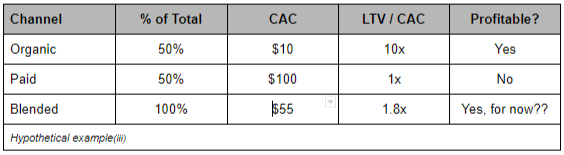
Company A, B comparison charts (Consumer internet Startups)

For example, imagine you’re the CEO of the hypothetical company represented above.  The company has a customer LTV of $100. Blended CAC is $55, and thus blended LTV/CAC is an acceptable 1.8x.  But when half of your users are acquired via paid marketing, with paid CAC of $100, then in reality your paid acquisition program is not profitable today, and the next user you acquire will likely cost you more than $100.  Pair a marginally profitable paid channel with the increasing CAC trends on Facebook and Google, and you’ll find it’s difficult to scale profitably in the future. Remember, you don’t want to fall into the same “growth paradox” as Company B that we highlighted above.

Remain Focused to Remain Competitive

It’s by no means an easy course for today’s high-growth consumer startups. It’s essential for consumer teams to create a differentiated product and build a strong, diverse set of growth channels from the very beginning; over-reliance on Facebook and Google is a dangerous strategy. Moreover, when funds are limited, it’s critical to make every marketing dollar count and prove your resourcefulness to attract capital.

While there’s never a one-size-fits-all solution, using the above guidelines to grow organic traffic, make intelligent investments across channels, and remain honest about your LTV/CAC ratio will help ensure that you build the foundation you need to stay in the game.

Thanks to Sapphire Ventures Associate Alex Lehman for her analytical support on this piece.


Up and to the right graph

Inbound to Outbound: Implementing the Blended Go-to-Market Model

We’ve seen it a number of times at Sapphire Ventures with growth-stage technology companies: you’ve nailed the transactional sales model — selling at a high velocity to a group of mid-level leaders (data analysts, developers, sales operation leaders) — but now you want to go hunting for enterprise-wide deals with c-level executives so you can land larger multi-year contracts.

Let’s be candid:  enterprise sales can be arduous, messy, and resource intensive. Before you even start to assess your readiness to sell to enterprises, you should ask yourself one basic question:  Why do you want to add an enterprise sales motion to your GTM engine?  

If you’re currently expanding your accounts at a high rate and your sales cycle is efficient and short, you need to think long and hard about the value of adding a new sales motion to your current go-to-market (GTM) function. Selling to technical users helps your company build important skills and habits. It leads to predictable revenues, helps create pattern recognition around successful sales tactics, and reduces the risk in having one or two deals make or break your quarter’s performance. That being said, for companies that have serendipitously landed a few enterprise deals and feel adding an enterprise sales motion can position your solution as a more strategic resource to your customers then courting enterprise buyers could be a valuable lever of growth. Ross Mason CTO and Founder of Mulesoft said his company started focusing on enterprise buyers because…, “We realized fairly early on that the problem we solve is pretty complicated and the sales cycle will be nine months, whether you’re spending 50K or five million with us. We just realized if that’s the way it’s going to be for the time being, what we should do is optimize for doing massive transformations first and then back into smaller ones as we got scale.”

Regardless of your reason, if your company does decide to pursue enterprise buyers then you should be prepared to answer four key questions to assess your readiness to sell to enterprise.

1. Do you have the right people and teams?

Enterprise sales require a high-touch engagement to navigate a jungle of corporate stakeholders. Your sales team will need to know how to cultivate a breadth of relationships across an organization and how to create a groundswell of corporate champions who you can guide to the right business decision – not necessarily a technology decision. Enterprise sales professionals are expected to bring something to the table. (How will your solution improve a situation? Improve their industry standing? Make a bigger name for the company?) These are big questions that require heavy research to answer correctly.

To achieve this, you’re going to need sales professionals who can not only conduct a sophisticated business conversation with a C-level executive, but can also be viewed as trusted advisors who bring a consultative approach to your customers. To do so, enterprise sales professionals need to develop a deep understanding of their customers’ business to understand their respective industry and specific business issue(s), which include reading customers annual reports to understand whether a prospect or customer’s business issue(s) is trying to increase revenue; bring down operating costs; mitigate risk; delight customers or delight employees.

Once you have the right people, aligning them on a “Strategic Account” team will free them to operate outside of your current GTM construct. For example, if you want to encourage your sales team to close long term contracts then you may want to offer a SPIFF (sales incentive) or pay an accelerated rate on those deals. When your company is selling lower ACV deals, you’ll pay your reps a lot more of the deal size, but the marketing costs are lower too. As you move to enterprise buyer sales, with higher ACV, you can expect the sales and marketing cost structure to inverse.

Lastly, is your marketing team equipped to support an enterprise sales motion? The relationship between marketing and sales will need to become much more aligned than it most likely is in a more self-service oriented sales model. Field marketing will become a core function of your marketing team to help your sales teams better understand and articulate how your solution can uniquely address your customers’ specific business issue(s)… On that note, your material will need to become much more targeted and focused on solving business issues within industry verticals.

InfluxData, a Sapphire portfolio company, has built a Strategic Sales Team that manages the company’s named accounts. This team is responsible for nurturing these accounts, being a trusted advisor to enterprise buyers, aligning their technology with customer’s strategic initiatives, and helping to build enterprise-wide use cases for their technology.

2. Does your messaging speak to a CXO audience?

Many high growth technology companies early on (and rightfully so) have relied on inbound sales and/or product-led growth to fuel their sales engine. In these cases, high growth companies have targeted corporate technical users not executive buyers. Many companies in this self-service GTM motion focus their messaging on the technical specifications, the simplicity of use, and the specific pain points they solve. As you move up the corporate ladder and add an enterprise GTM motion, you will need to align your messaging more with business outcomes and value than on how innovative your technology is. Put simply, enterprise buyers care about the things you solve while technical buyers care mostly about the things you do.

A good litmus test of your enterprise sales message is, could the CIO – after hearing your pitch – champion to their CEO how your solution fits into their larger business priorities? Your messaging needs to show how your solution impacts key business metrics for that executive buyer. For example, if you are a data technology company:

  • DO communicate how your solution drives top-line business outcomes, such as helping to drive X amount of revenue or driving down Y% in operating costs.
  • DON’T just message how your solution eloquently routes data and reduces data prep, since the business executives you’ll be pitching to don’t typically deal with these issues on a day to day basis.

This doesn’t mean not giving context about your product, but your messaging should clearly be tied to a business need that executives care about.

Aaron Levie from Box aptly said, that the questions that Box needed to answer when moving up to sell to CXOs was “How do we become a strategic part of the IT architecture? How do we actually build one of the key pillars of their enterprise?”

3. Are your product and process prepared for enterprise-wide sales opportunities?

What may have worked from a product portfolio mix for selling to individual users may not be ideal for selling to enterprise buyers. Make sure to evaluate your product offering to see if it will match expectations of targeted enterprise buyers and your modified messaging.

Additionally, be sure to revisit your current pricing model. Does your current solution pricing provide the correct incentives for large enterprise accounts? In some cases, companies will have pricing models that are based on consumption metrics and calibrated for smaller contracts, but will cause enterprise size contracts to reach their annual pricing threshold in a matter of months, which can cause for some tough discussions later on between you and your customer.

Finally, once you have received executive buy-in, you will most likely be handed off to procurement who will start the process of analyzing your product, evaluate you against other solutions, and negotiate pricing all over again. This final stage can derail a sales process so be prepared by having a strong business case — and executive champion — for your solution to push this through procurement.

4. Can you afford to be patient?

Executive corporate sales cycles tend to take considerably longer than when you sell to a technical user within the enterprise.  Are you and your board willing to invest the time and capital necessary to build an enterprise sales motion for executive buyers?

In addition to taking longer, you will need to create or increase the size of your field team and potentially hire a specialized overlay sales team for strategic enterprise accounts. This will need to coincide with amping up of your marketing capabilities to invest into different channels such as events, analyst relations, customer success programs, and solutions-selling oriented content for your sales teams.

Making the shift

The rewards of nailing an enterprise sales motion can be big, but it will also put stress on your organization. While technical users can be more forgiving and willing to ignore product shortcomings to enjoy your product’s primary benefit, executive buyers will be less lenient. They will be demanding and often require extra attention or customization that you will need to decide if you are prepared to offer or not.  Be sure to think through the answers to the four questions above BEFORE you start investing heavily into the new sales motion so you don’t waste your precious resources. Once you decide to seek enterprise deals and you start pursuing the office of the CIO or CTO, be sure to read Shruti Tournatory’s post on how to nail your executive meetings.

Good luck!


Sapphire board of director event

Closing the Gap: 5 Tips for Women Seeking Board of Director Positions

Meeting around a table

Decades of research have shown us that being around people who are different makes us more creative, more diligent, and harder working. There is also increasing evidence that company diversity leads to greater profits.

Yet, at the highest levels of corporate leadership, women still hold just 22% of board seats. What’s more, ascending the corporate ladder is becoming increasingly difficult for women—and particularly women of color. This disparity holds many leadership teams back from achieving their full potential.

Recent research shows women leaders often bring a valuable touch of humility to their work and can catalyze teams to achieve results over and above their male counterparts. In certain situations, women are even proven to be bolder than men in pivoting organizations and hitting KPIs. Results aren’t consistent in every situation; however, new data underscores how valuable it can be to have women in positions of power.

Sapphire Ventures is committed to helping female leaders navigate their way to company Board roles at both public and private enterprises, and further develop as corporate leaders. That’s because in our mission to help build Companies of Consequence, it’s essential to our firm to invest in “people of consequence” from all backgrounds. To this end, we recently hosted a workshop for emerging female board leaders, From CXO to Board Director – Forging Your Path.

Welcome sign

The goal of the day was to provide career-enhancing skills and networking opportunities to enable these women to uniquely position themselves for board service. Featured speakers included:

  • Coco Brown, Founder and CEO, The Athena Alliance
  • Kimberly Alexy, Independent Board Director at Alteryx, CalAmp, FireEye Inc, Five9, and Western Digital
  • Kirsten Wolberg, Chief Technology and Operations Officer at DocuSign, Board Director at Sallie Mae, Year Up, and JVS – San Francisco
  • Merline Saintil, COO, R&D and IT at Change Healthcare, and Independent Board Director at Banner Bank and Nav Inc.
  • Rob Bernshteyn, Chief Executive Officer and Chairman of the Board of Directors at Coupa Software
  • Yvonne Wassenaar, CEO at Puppet, Board Director at Forrester and Harvey Mudd College, and Sapphire Fellow

Below are five actionable takeaways gleaned from speakers’ personal journeys.

1. Network with Purpose

Many women have less effective professional networks relative to men. Since board opportunities are often privately circulated, a lack of connections or “gendered modesty” during the job search can be limiting factors in positioning yourself as a candidate.

Sapphire board of director event

Yet regardless of the size and scope of your professional circle, it can still be your biggest asset if you’re angling for a Directorship. To drive the best results, be specific about what you are offering and asking for. Instead of waiting to be discovered on a registry, let people know you are actively seeking a Director role. Amplify your voice through existing connections.

You can also join specific networking groups like Watermark or the Athena Alliance that support your mission. In addition, since many boards rely on search consultants to find new members, reach out to these firms to determine where you might be a good fit.

2. Articulate Your Unique Value Prop

When looking for a board member, companies are seeking more than operating experience. In addition to industry-specific, managerial, and financial skills, many boards look carefully for:

  • a high level of emotional intelligence
  • the ability to collaborate and work well on a team
  • a strong ethical foundation (particularly in the wake of some high-profile board breakdowns like Enron)

If a board is heavy on inside directors (employees, officers, or other direct stakeholders), they may be seeking new members with specific outside expertise and a more objective point of view.

In all cases, be sure to do your research when considering a board position. If it’s a public company, the proxy statement is a good place to begin; however, use as many available sources as you can to truly understand the nuances of the company’s current situation. From there, talk specifically about what you’ve done that will add value and bring balance to the group. To complement in-person discussions, also consider creating and circulating a crisp, one-page board bio that reflects your unique accomplishments.

3. Focus on Culture Fit

During the event, one seasoned director shared that she had 0 of the 5 qualifications to join a public company board during the interview process — yet she was hired.

If you’re in the running for a board position, your professional reputation and achievements already precede you. Given your existing track record of success in industry, public service, or academia, companies will often zero in on how well you align with and complement their group with your business skill set. For this reason, leave your doubts at the door and focus on connecting with existing team members on a personal level during the interview process.

Equally important is the passion that you have around the domain of the company you are considering. Many candidates are capable of joining their board; however, what distinguishes an adequate from an exceptional director is their enthusiasm and drive to create positive change.

4. Can You Commit?

If you’re doing your job right, expect to commit 200+ hours annually to a directorship. McKinsey research details how the most effective directors go above and beyond their basic role descriptions, making critical contributions to:

  • Company strategy
  • Investments
  • Mergers and acquisitions
  • Recruiting and talent management, and
  • Governance and compliance.

In addition, as many of our presenters noted, public company boards are often a 10+ year commitment. This is an extraordinary additional activity, particularly if you’re already engaged in full-time work.

Be sure to ask about the length and cadence of board meetings and how other board members are involved outside of regular events. Is this something you will be able to carve out time for?

A recent Harvard study found attendance and meaningful participation at meetings were important criteria for shareholders; however, many directors regularly missed meetings or weren’t well-informed on key issues. Being an active and committed board member can bring rewards — both to you as an individual and to the reputation of your company.

5. It’s OK to say “No”

Know your swim lane. Do your homework and be thoughtful about which director roles you assume.

Are you fired up about the vision of the company, and will you be able to make a meaningful contribution? In addition, is this a role in which you will also be able to learn and further develop your own skills? If the answer is no – do yourself (and the current board) a favor by bowing out. If you’ve received an offer, it likely won’t be your last.

Don’t forget that you assume financial liability as a director. Keep your own financial status in mind and understand how you will be compensated. Remember: compensation can differ greatly for public versus private companies. A venture-backed startup, for example, may offer a large portion of equity and no cash retainer — while a Fortune 500 company may pay handsomely in cash and a small portion of company stock.

If you have any doubts about the company’s funding and financial runway, it could be a sign to step away from the opportunity instead of putting yourself at personal. Being a board member is prestigious, but don’t let this cloud your decision.

An Effective Director is a Steward

Throughout the process, remember that your ultimate goal as a board member is to guide the executive team through the next operating phase — with all of the challenges and rewards this brings. The seat requires emotional intelligence and depth, should not be taken lightly, and can be an incredibly powerful experience for effecting change and advancing your career.

In 2018 former Governor Jerry Brown passed a law requiring more women on boards in the state of California. The Sapphire Ventures team, like Governor Brown, understands that more diversity will benefit individual companies and the economy as a whole.

We will be having a follow-up event to this on July 11. Stay tuned for more takeaways.