seminar

What Makes a Good Annual Meeting? An LP’s Point of View

Annual meetings are simple in concept but can be difficult to execute well. At Sapphire Partners, we are constantly asked what makes a good annual meeting, which makes sense given the typical GP attends one annual meeting (their own) while limited partners attend dozens.
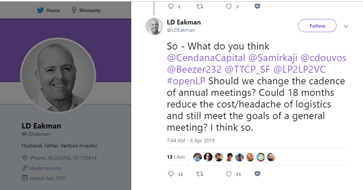
Eakman tweet about meetings

As such, we’re providing one perspective on what we think differentiates the best annual meeting from all the others.

Before going into details, I think it’s important to mention two things:

  • We believe all venture firms should have annual meetings, even if a firm is young. We consider annual meetings a best practice. That’s our preference, though it’s important to note that some LPs feel differently, especially if the fund is small, and there are other routes that work well, as Lindel Eakman mentions, such as GPs visiting individual LPs, or meeting every 18 months if there is less activity.
  • It’s important to keep your objective for the annual meeting in mind while planning the event. The point of an annual meeting is to share information with LPs about their investment in your firm. The true value for limited partners comes from spending time in person and sharing information that is not included in quarterly reports and financials (otherwise, should we all stay home and read them in sweatpants?) With that in mind, your goal should be to deliver that information about your firm and portfolio in a way that couldn’t be read in a spreadsheet and instead showcases your firm and engages your LPs.

There are three elements you need to focus on:  Content, Format, Logistics

1. Content

As Chris Douvous has mentioned, your annual meeting should be an open and honest dialogue. And, you should only include relevant information. What is relevant depends on the team, strategy, and age of the portfolio.  For example, if it’s a new or first fund, a discussion of liquidity is probably less applicable.

  • Portfolio: This is one of the most important topics for LPs (obviously) because the investments in the portfolio are what drive returns. Limited Partners are one step removed from the companies, so it’s helpful to provide a way for LPs to look at the portfolio. If it is a more developed portfolio, you can bucket investments into categories such as potential fund-returners, emerging value-drivers, too soon to tell, lagging, written-off, etc. That way you can show their evolution from year to year (also a point Chris brings up).

It’s also incredibly helpful to an LP to provide metrics for each company such as revenue, projected revenue, growth rates, and major milestones because it gives an indication of company maturity. Hard metrics are always better than qualitative statements such as “it has a lot of traction” or “it is moving along.”

Portfolio return expectations, even a broad range, are also something LPs really appreciate.

Another topic that should be included is anticipated or potential liquidity – we all love distributions. As mentioned, if it’s a newer portfolio, some of these suggestions are less relevant, but it’s great to hear about recent investments or those in the pipeline.

  • Team: An LP investment in a venture fund is an investment in the team, and that team’s ability to find, make and manage investments. Most LPs like to see a team summary and like to know if there will be any hires or departures that they don’t already know about.

If there aren’t changes, it can be as simple as flashing up a single team slide and saying there are no changes. If there are new hires, it’s nice to highlight them or have them give a quick hello so LPs can start to get to know them

  • Strategy: Many LPs don’t need (or want) a complete rehash of the fund strategy, but it is nice to have a (very) quick reminder. It’s also important to note if you are adjusting the strategy for any reason and why, such as adding new themes or incorporating lessons learned that are shaping current investment criteria.
  • Environment: LPs often appreciate a GP’s view into the environment, both generally and specifically how it impacts their platform. Often this overview ties into themes a GP is focusing on, or recent/upcoming deals in the pipeline. This section could also include a discussion of how a firm is competing and winning.
  • Operational Value-Add: LPs love to hear how GPs work with their portfolios. If you have already covered this you don’t need to repeat, but it’s nice to hear about any big developments, or what is providing the biggest impact or differentiation.
  • Next Fund: Fundraising is important for both GPs and LPs. Limited Partners like to know timing/fund size for the next fund for planning purposes and giving LPs a heads up about fundraising intentions can help you start conversations early.

2. Format

Various formats work for a successful annual meeting. Usually, it’s good to mix it up a bit and include some combo of the team/CEOs/special speakers/fireside chats/panels/videos. You should do what feels authentic for your firm. If you do have a panel, make sure the questions are interesting and challenging, not just layups used to repeat strategy basics.

  • GP Team: It’s nice to involve multiple members of the GP team during the day to hear different voices. There isn’t one way to do this – it could be partners trading off, involving junior people who helped with investments or having a CFO go over financials. Some GPs might not realize this, but LPs do read into who is presenting. If it’s supposed to be an equal partnership between three partners but one person does 95% of the talking, is it really equal?
  • Portfolio CEOs: I love hearing from portfolio CEOs. Nothing beats hearing the pitch directly from the CEO and learning why a GP is so excited about the investment. However, it’s best to pick CEOs who can tell the story in an accessible and concise way. LPs often cover numerous asset classes or geographies and may not know technology or industry as well as a GP (manipulating qubits using microwaves, what?).

Having a CEO speak for ~ 10-20 minutes with a couple of minutes reserved for questions works well.  And if there are multiple funds, it’s nice to have a mix of CEOs from value-drivers and newer investments.

Plan to have a couple of CEOs, not one, but not ten. It’s also often great to invite CEOs to stay for cocktails instead of them hightailing out so LPs have the opportunity to get to know them and your portfolio better.

  • Materials: Providing day-of materials generates a meaningfully better experience. This helps in multiple ways:
    1. LPs can focus on absorbing the content instead of madly scribbling notes.
    2. Typically, only part of an LP team attends any one meeting, so providing materials electronically (either before or after) makes it easier for LPs to share the update with the broader team.
    3. Prepared materials are also an easy place to include information you want to share but don’t necessarily want to take the time to cover. For example, I have seen firms only talk about value-drivers and new investments in funds, but provide nifty one-page summaries with ownership, cost, value, description, update, revenue and growth for every investment. Awesome!

3. Event Logistics

  • Scheduling/Attendance: Attendance is important. LPs like to see a full room which brings better energy and more networking possibilities. Plus, if a GP is going to all the work of hosting a meeting, it’s nice to have good attendance.

To ensure a full room, it’s helpful to schedule the meeting in advance. Way in advance. Some of the GPs we work with even share the time and location for the next year’s annual meeting at the end of the current annual meeting. Knowing this in advance helps LPs plan and make arrangements.

Another consideration is coordinating with other GPs you know your LPs are working with. We know it’s not feasible to check in with all other GPs, but if you know that your LPs are partnered with another group that has their meeting around the same time, it could make sense to coordinate timing to ensure LPs can attend both. We even have had GPs in the same geographies plan their meetings close together so LPs invested in both firms can combine their trips. That is super considerate and helpful.

  • Location: Location is another area where LPs have differing opinions. Some LPs prefer destination experiences and others optimize for easy access and logistics. I have had great experiences with both types though (sadly) often fall in the convenience-first camp. Above all, find a spot that is comfortable and has good lighting. Make sure there are plenty of bathrooms and power cords/outlets. Bonus points if there are tables to rest computers on vs. the circus act juggling of computers, coffee and waters on laps. Suggest hotels and negotiate rates if you have a big group coming. Some groups send shuttles if hotels are off-site or provide uber vouchers.
  • Time: Plan the duration of the meeting to match the amount of material you want to cover and leave time for networking. Do not feel like you have to do a full-day meeting, in fact, very few people have the attention span for 8-10 straight hours of presentations. Instead, do dinner the night before and a morning presentation or a lunch, afternoon presentation and cocktails. If you have a small LP base or have a newer fund, it can usually be a much shorter, more casual meeting.
  • Food: LPs like food. It’s nice to have a range of healthy/less healthy options so not all fried chicken and not all green juice. LPs will probably tell you they are excited about the juice but then eat the chicken. A quick lunch or coffee break is also a great time to build in a little networking time. I have heard mixed feedback on sit-down dinners. It can be a fun meal with the quality discussion but it’s also hard to talk to multiple people. If going the sit-down route, it often helps when GPs put thought into the seating chart so it’s a mix of the team, CEOs, and LPs.
  • Swag: Swag is funny. LPs know they are paying for swag but like to forget this once a year and almost expect a fun gift bag.

LPs are truly proud of their partnerships, and they like to wear a hoodie or other sporty items to support their groups.

It’s often neat when a GP can include a sample of a portfolio company product though this works better for consumer products and less well for things like enterprise software.

If you are thinking of giving something heavy or bulky and you have LPs traveling far, it’s a nice gesture to offer to send it back for them. I think others probably have stronger opinions, but I like most gifts I have received…except, long baggy tee shirts go in the back of the closet when you are a 5’3 woman 😊.


 

Sapphire Lock

Exabeam: Shedding Light on Security Data

At Sapphire Ventures, when we think of investing in “companies of consequence” we look for large market spaces, emerging and disruptive technologies, and companies with clear value propositions. Today we are excited to announce our co-lead investment with Lightspeed Venture Partners in Exabeam, a San Mateo, CA based company changing the Security Information and Event Management (SIEM) space with Smarts!

The SIEM market is mature and very competitive, so why should everyone being paying attention? The greatest challenge today is effective detection and response to targeted attacks and breaches. The effective use of data, behavior profiling and analytics (UEBA) can improve detection success, and Exabeam pioneered the usage of UEBA methods. Today, Exabeam is a widely-deployed UEBA solution with industry-leading behavioral modeling and machine learning capabilities. In the last few years the company has also become a leading SIEM vendor being named a leader in the 2018 Gartner Magic Quadrant for Security Information and Event Management.

Effective response is just as important as the detection of incidents. Exabeam’s Security Orchestration, Automation and Response (SOAR) solution allows teams to respond to security incidents rapidly and with less effort than ever before using playbooks and prebuilt APIs that integrate all the IT and security tools for an automatic response. The problem of effective response is so large that despite the legacy solutions in the market, the President has signed an Executive Order directing the creation of programs to grow and strengthen the cybersecurity workforce to help fill the estimated 300,000 cybersecurity job vacancies in the U.S. and 2,000,000 on a worldwide basis.

Great companies are built by great people, and we couldn’t be more excited to partner with Nir Polak, Domingo Mihovilovic and Sylvain Gil, who have a proven track record of building successful companies.

To close, I wanted to highlight how the founders came up with the company name. When they started the company, they knew they would have to process a lot of data, and they set out to find interesting patterns contained within that data. This is how the company got its name Exabeam, a combination of ‘exabyte’ and ‘light beam’. We are thrilled to partner with Exabeam on their journey to shed light on the next exabyte of security data.


Digital transformation

Transform!2019: How VC-led Innovation Fuels Digital Transformation

Emerging technology and high-growth, expansion-stage startups play an important role in creating value in the digital transformation to an intelligent enterprise. That was a key takeaway from the discussions at Transform!2019, an event hosted by the enterprise application leader SAP last month, for an audience of startup executives, enterprise IT leaders and other industry experts to explore how enterprises are managing their digital transformation.

With the recent expansion of Sapphire Ventures’ Portfolio Growth business development team in Europe and our access Silicon Valley innovation, Sapphire Ventures was asked to participate in Transform!2019 and bring some of our portfolio companies into the conversation to help IT executives better understand the startup ecosystem.  Executives from Sapphire portfolio companies JFrog, Contentful and Thoughtspot helped spark these two themes that developed throughout the event:

The Explosive Growth of Data Continues

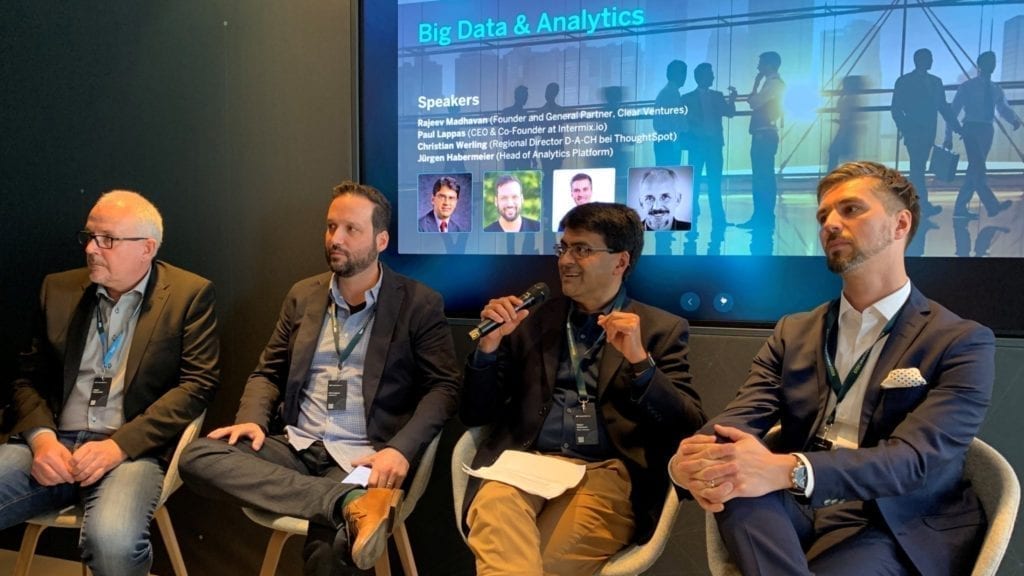
The 21st century has been called the Information Age, and compared to other global resources, we won’t be running out of information any time soon.  According to Christian Werling of ThoughtSpot, various experts estimate the size of the digital universe will double every 18 months, a 50-fold growth from 2010 to 2020. Human- and machine or IoT data is experiencing an 10x faster growth rate than traditional business data, and IoT generated data is increasing even more rapidly.

It’s no surprise that with this growth, modern enterprises can easily be overwhelmed by the sheer volume of data, making the ability to store, process, analyze, interpret, consume, and act a primary issue to future enterprise vale. The pivotal question in the analytics and business intelligence space remains: how to transform raw data into actionable insight?

Christian Werling, Regional Director DACH at ThoughtSpot, a business intelligence and big data analytics company, posed a thought-provoking question for the group:  “Why not integrate a next-generation analytics platform with your back-end, systems of records so that business people can use Google-like search to easily analyze complex, large-scale enterprise data and get trusted insights to questions they didn’t know to ask?”

Relational search and augmented analytics are two such new approaches designed for searching and analyzing company data – whether that be financial, marketing, sales, supply chain, and other business data sources. That’s because for most global enterprises, data usually exists in multiple silos and systems distributed around the world.  A relational search engine needs to crawl all these data sources, correctly identify the relationships, and enable everyone in the business to search and analyze the data relevant to them. But to be successful at the employee level, all this must be done without losing the instant gratification people have come to expect from a consumer search engine, like Google.

Transform!2019

Similarly, a true augmented analytics system helps business users to ask questions they never thought to ask because of the complexity of getting to the answer.  Practically, that means augmented analytics requires: no advance knowledge about the underlying data is needed, nor lengthy transactions to click. Thanks to sophisticated algorithms and a scalable architecture these augmented systems are helping enterprises find rare “golden nuggets” of information across an otherwise impossible ocean of data.

The Impact of DevOps and Continuous Innovation on Digital Transformation

DevOps is not necessarily a category you would immediately associate with enterprise digital transformation, but its focus on continuous planning, development, release of software is significantly impacting companies.

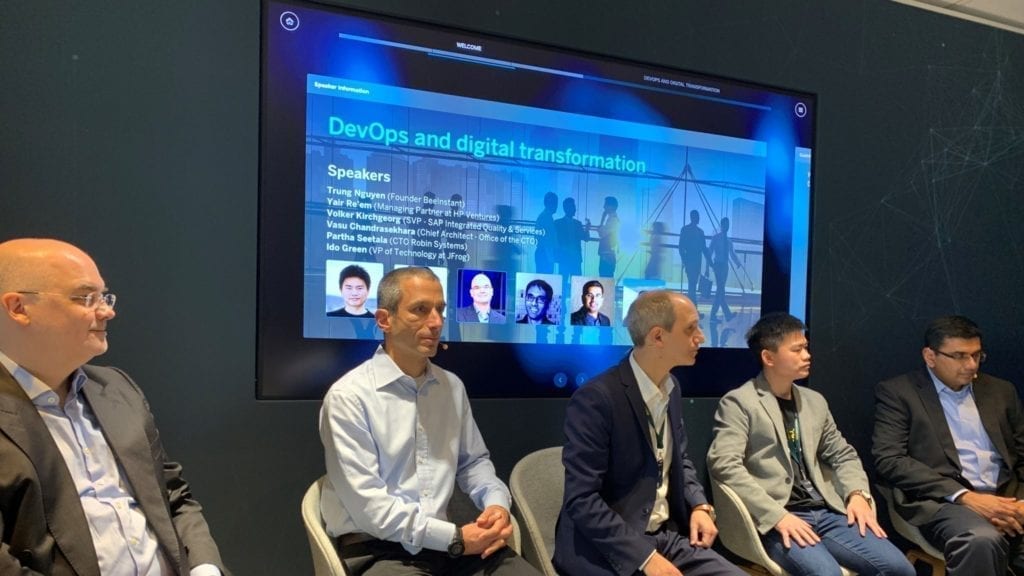
Transform!2019 featured a panel on DevOps and Digital Transformation hosted by Yair Re’em consisting of Ido Green, Partha Seetala, Vasu Chandrasekhara, Volker Kirchgeorg, and Trung Nguyen who talked about DevOps best practices and the past, the present and future of DevOps.

When it comes to creating a business that can thrive in the digital age, the benefits of DevOps are clear: faster deployment frequency and lower failure rates are proven advantages. Monthly, weekly and sometimes even daily release cycles in the Cloud, bring more velocity to software organization, enabling more value, faster to your users.

A good part of the discussion was on the adoption trends for DevOps, challenges it can create in the transformative journey, and best practices for implementing DevOps.

One of the central issues Ido Green from JFrog, a developer-centric software distribution platform provider, addressed was about security and how it can be an impediment for DevOps adoption. What should be the trade-off in DevOps Solutions between velocity and security?

DevOps and Digital Transformation

Ido believes that there should be no trade off sacrificing velocity. He believes enterprises need to bake security into your DevOps in a helpful, not hindering, way for developers. Companies can achieve this by using tools that implements guardrails, not gates which keeps developers on a paved road without having to spend time working through toll gates.

Ido provided the audience with these additional tips on DevOps tools:  

  1. Velocity: use an automated tool that suggests solutions and not just ‘FYI’ information. Moreover, the tool should secure the pipeline from the development phase all the way to deployment, and later, monitoring everything that is in production.  Look for tools that minimize false-positive alerts, so your developers gain trust in the tool.
  2. Security: your tools should have a wide coverage of vulnerabilities (think beyond NVD – National Vulnerability Database). They should have a way to integrate with IDEs (Integrated Development Environment) so your developers are aware of risks while building the software.  Last but not least, your developers need a tool that not only tells you what is wrong but also provides a clear path to remediation (i.e. precise matching between vulnerabilities and packages and offer the ones that are fixed).

The group agreed that there is likely no single solution that answers all of a company’s needs.  Each company will have different priorities and gaps that need to be addressed as they focus on: Innovation, security and cost reduction.

Here is what the group recommended looking at for each of these priorities:

  • Innovation: It’s a critical success factor for any company that wishes to boost progress and keep improving its product. The speed that you gain from DevOps best practices helps you increase the possibilities to build more innovative services.
  • Security: it is important to be able to find vulnerabilities as soon as possible in the development cycle and later mitigate them as fast as you can. A great DevSecOps ability is therefore critical.
  • Cost: DevOps helps reduce costs (finding bugs as early as possible and/or removing vulnerabilities from production). It is also a leverage point to your internal development team as they can reach users faster/better/cheaper.

The Future of the Intelligent Enterprise

All industries have a lot to think about on their path to becoming an intelligent enterprise.  Emerging technologies, whether in the form of a new solutions like augmented analytics, or a fundamental rethinking of their software development process through DevOps, can play an important role in their continued growth.  Sapphire Ventures looks forward to helping IT leaders navigate the shifting landscape through events like Transform!2019 or our online SV Explorer platform to keep CIOs connected with new technologies and vendors.

Many thanks to Ido Green (JFrog) and Christian Werling (ThoughtSpot) for contributing to this article, and the conversation at Transform!2019.


How Does Data Influence LP and GP Decisions?

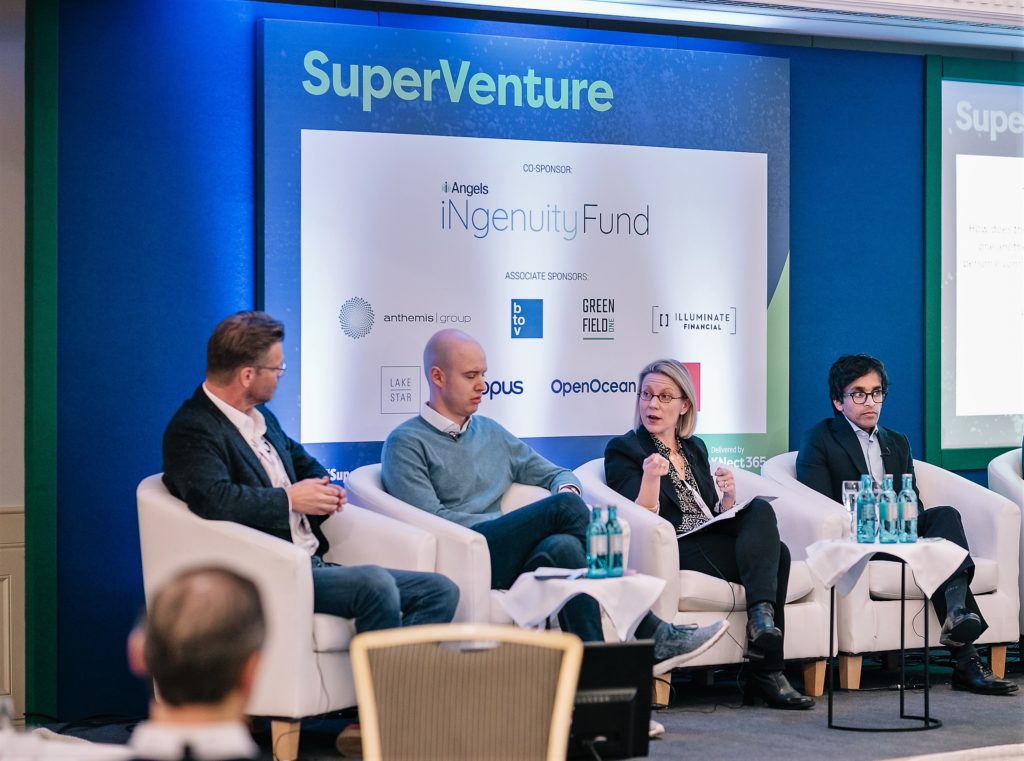
Last month I had the opportunity to speak at SuperReturn365 on a panel focused on how LPs and GPs use data in our respective business.  Some of the questions Tom Henriksson, Suranga Chandratillake, Mish Mashkautsan, Kart Siilats and I explored included:

  • How and where GPs and LPs leverage data – Sourcing? Diligence? Post investment? As well as other creative ways.
  • How we believe data adds competitive advantage to our work
  • What tools we use for managing data, and
  • What limitations we have found of using data

    LP & GP SuperReturn
    “How is data used in venture capital? Hear from the LPs and GPs” panel at SuperReturn365

Watch the full video to hear our answers to these questions — and you can form your own opinion on whether venture jobs will eventually be replaced by machine learning.

Why Sapphire Ventures and Segment Are Excited to Partner

Today, we’re excited to announce our investment in Segment, a leading provider of customer data infrastructure.  We’re thrilled to partner with CEO Peter Reinhardt and the rest of his team on their journey to building a Company of Consequence.  

Segment provides technology to help companies ensure their customers have highly relevant, personalized experiences no matter where they interact.  They do this by giving companies the ability to collect, unify, and connect their first-party data to hundreds of marketing, analytics, and data warehousing business tools.

Segment has built an elegant, yet powerful solution for one of the most acute problems businesses are facing: how to leverage siloed, first-party customer data to power a wide variety of use cases.

Peter was nice enough to discuss below why he chose to partner with Sapphire, but first, more on why we’re excited to help Segment scale.

Why Partner with Segment?

Rajeev Dham:  VCs love referring to “pattern recognition.” Well, there’s no difference in this situation. At Sapphire, we feel we have been fortunate to partner with data & analytics businesses such as Alteryx, Looker, Reltio, ThoughtSpot, Alation, as well as business & marketing applications like ExactTarget, Outreach, and Pendo. As a result, we’ve gained a deep appreciation for the solutions that Segment delivers. There is a clear need for a single data infrastructure that enables better analytics, execution of customer intelligence applications, and consequently, a better customer experience.  

In addition, given our experience with MuleSoft, we’ve seen how “middleware” — traditionally relegated as a second-class citizen to business applications — is actually crucially important within the stack. Segment has strategic real-estate that is oftentimes stickier than the applications they empower.

Big markets drive big businesses. Unlike very specific point solutions or software targeted at slices of the market (SMBs, vertical SaaS, B2B-only, etc.), we believe Segment addresses all businesses. Our customer diligence revealed that everyone ranging from Fortune 50 B2B enterprises to direct-to-consumer start-ups are leveraging Segment for their core data infrastructure. We believe Segment can be the next horizontal platform to power digital transformation initiatives for all companies.

Finally, one of our key learnings about successful software businesses is the ability for CEOs to tell the story in a way that inspires confidence from investors, employees and of course customers. This ability is oftentimes exhibited by charismatic, sales-driven CEOs, but we’ve found that charisma comes in all forms. Over the last several years, Peter inspired our confidence by showing he has a keen sense for the challenges his customers encounter with their customer data.  Moreover, he can articulate the vision of what Segment is providing in an elegant manner, actually quite similar to the product itself. We believe his clarity of thought and conviction about his product positioning and vision, despite having the potential to be pulled in many directions, will propel Segment to further cement their industry leadership.

Why Partner with Sapphire Ventures?

Peter Reinhardt: We wanted to partner with Sapphire because we know how deeply engaged and committed they are to the success of their portfolio companies. They have an incredible track record helping some of the industry’s most important companies build and scale their businesses. Rajeev and team really took the time to understand our business and needs, well before any financing discussions took place. It was very clear to us that they always go the extra mile.

Building a Company of Consequence

We are thrilled to welcome Peter and Segment to the Sapphire family and can’t wait for the journey ahead!


CIO mistakes

3 Cardinal Mistakes Startups Make During CIO Pitches

Since it was started in 2014, Sapphire’s Portfolio Growth arm has generated thousands of introductions between startups and enterprise customers. Perhaps, the most rewarding outcomes of these connections is new revenue or logo acquisitions for our portfolio companies.  We feel an equally valuable takeaway for us, however, is the insights this has given us into the ingredients for truly successful pitches to CIOs.

Many factors shape a successful first pitch to a CIO and securing that follow-on meeting.  Many stars have to align, many boxes must be checked, and the technology must actually solve a business need.  But there are certain mistakes we see startups repeatedly make early in their first exposure to C-level technology buyers, that we feel hamper their chances of any ongoing engagement.   

Below are three recurring mistakes — and our advice on how to steer clear of them:

1.  Asking zero questions  

Getting face-to-face with a Global 2000 CXO is a truly rare opportunity to not only market your company – but also to understand how they think.

Having personally attended hundreds of CIO pitches by startups, I’m amazed time and again that even the most seasoned startup CEOs don’t ask the CIO a single question during their meetings.  Instead, they launch immediately into a description of what they do and how they’re different from all the other vendors. This is truly a missed opportunity on multiple levels.

Asking questions early on in a pitch gives you several advantages:

  • It reveals the customer’s inclinations (or biases) around your specific technology so you know what you’re dealing with.  
  • It gives you context on their IT stack so you can highlight those aspects of your solution that most address their unique landscape.  
  • And ultimately, it engages the CXO in a dialogue that positions you as a thought partner and not merely as someone delivering a sales pitch.   

In our experience, the average pitch CXO is 30-40 minutes.  We think that at least 5 minutes in any such meeting should be dedicated to the startup asking the customer questions like:   

  • How familiar are you with [XYZ technology domain – CASB, Blockchain, DevOps, ML platforms etc]? If the CIO is already familiar, cut the “101” opening credits and focus on what differentiates you.  Nothing annoys IT execs more than being lectured on “disruptive” technology they already know.
  • Can you tell me about your IT landscape or stack? If you’re providing cloud management tools for example, get a quick grasp on their current and planned cloud footprint.  If nothing else, find out if they’re using or have talked to your competitors!
  • What have been your biggest challenges in [given domain]? Open-ended queries can help tease out what is most pressing to the CIO –  cost reduction, security, upgrading their architecture and beyond?
  • What benefits would you derive if you had [the end state that your solution produces]? Prompt the CIO to imagine a world where your solution is implemented to quickly give you a sense where (if at all) the potential business value of your startup might lie.

The idea of consultative solution selling is now decades-old and giving way to newer avatars,  such as the idea of “Insight Selling”. Whatever the reigning wisdom, the timeless principle of engaging your target in a conversation (vs. a monologue) still holds very true for CIO-to-startup discussions.

2. Shy away from discussing obstacles to success

When startups proudly present their glossy “NASCAR” slides – impressive logos of global corporations that have bought and implemented their technology – they have the CIO’s attention for a few seconds.

They can hold that attention for a LOT longer if they are also realistic and talk about the most common challenges customers have encountered in implementing  the solution and how they overcame them. The challenges you bring up can include cultural change, dealing with legacy architecture, messy integrations or the pains of replacing an existing solution.  By talking openly about customer challenges you build credibility and persuade the CIO that you truly understand the obstacles to working at enterprise scale – and that you are equipped to partner with them for a potentially difficult but rewarding journey.

At the growth stage that we invest in, startup CEOs have solid experience with Global 2000 companies deploying their technology, and can share that knowledge and secrets to success employed by others with the CIO.  Often this type of discussion adds immediate and real value to the interaction with the CIO.

This situation is not dissimilar from startups making funding pitches to VCs for funding:   showing growth charts that always and inevitably trend “up and to the right”. Just as those funding pitches are often less convincing for seasoned VCs, CIOs appreciate pitches grounded in the reality of expected implementation or adoption bumps and how you’ll deal with them, as you paint the picture of longer-term success. 

3. Forget that CIOs are business executives and portfolio managers

It is important to remember that most CIOs aren’t geeks – they’re actually P&L managers and chief executives of their own IT organizations.   CIOs routinely tell Sapphire Ventures that reducing cost of IT delivery, increasing IT efficiencies and consolidating their vendor landscapes are among their top priorities. This literally translates into spending less dollars on IT and working with FEWER vendors.  Meanwhile, startups are pitching them on adding yet another vendor and MORE expense to the mix – often the opposite of the CIOs “lean” imperatives.

So, no matter how compelling your technology is – most IT executives are thinking during your pitch: “How am I going to pay for this?” or “If I implement this technology, can I displace another vendor’s technology (and another expense item on my P&L)?”  This thinking is especially true of categories that are densely populated with startups and vendors – such as cybersecurity or marketing tech – where there are likely already a lot of in-house solutions implemented at the customer.  

When you’re pitching, make sure to clarify if you’ll enable the client to replace a substitute solution.  If the CIO can work with one less vendor, and keep the costs stable with just a more innovation solution – that is a winning proposition.  If you’re NOT allowing short-term replacement, will you be able to avoid future spending on additional solutions? Helping improve cost structures within an existing expense category makes it a lot easier for a CIO to justify new spending in many cases.   That said – if you’re creating a whole new category of technology, or unlocking new business value – there can often be budget in the CIO’s portfolio for greenfield, emerging technologies.  If you do go after the “greenfield” budget with new category creation, leading with a message of “disruptive” innovation vs. incremental (or “sustaining” innovation) is often the more effective path.   

Finally, a typical CIO will have a series of direct reports who are making these kinds of portfolio decisions at a modular level.  Work to identify these other decision-makers within the CIO’s organization and then understand their trade-offs is also a sophisticated way of paving your way into that customer’s portfolio. 

Set yourself up for success

Landing meetings with CIOs is hard, and will continue to be that way – especially with the burgeoning crop of new IT startups being funded.  When you finally get that meeting, maximize your chances of success in translating CXO meetings into opportunities by shifting the orientation of your pitches to gather more insights from the customer, authentically engage in a discussion about obstacles to success, and place your solution in the context of the business leadership role the CIO plays in a large enterprise.   Do anything else, and you risk wasting the CIO’s time — and your’s.


globe

The Internationalization of Venture Capital: Will this Affect LP Allocations?

This article originally appeared on SuperReturn365 in March 2019.

Venture capital is becoming increasingly globalised. The VC stronghold is said to be shifting to regions outside the US, and VCs are moving to make investments across multiple geographies. Is this really the case? And how does this affect investor allocations? Beezer Clarkson, managing director at Sapphire Ventures, shares her thoughts with us.

1. Leading the international fund investment programme at Sapphire Partners, which regions do you see the most opportunity? What strategies and geographies are you actively investing in?

At Sapphire Partners (the investment platform within Sapphire Ventures that invests in early stage venture funds) we currently focus on a handful of regions. We invest in the U.S., focusing on the Bay Area while also mindful of the strong technology ecosystems in New York and Boston as well as growing technology ecosystem in the greater LA area. For our investments outside of the US, we have focused our investing in early stage venture funds in Europe and Israel.

We believe innovation knows no boundaries. Great ideas can, and do, start anywhere. Further in our experience, the entrepreneurial ecosystem has become increasingly porous over time with companies starting in one location, say Israel or a European country and then moving to the U.S. or expanding into multiple European countries.

SuperReturn panel
Click to watch video from KNect365 “How is data used in venture capital? Hear from the LPs and GPs

We also see U.S. tech companies moving to Europe to pursue European customers — both private tech companies as well as massive public ones like Google, Facebook, Cisco, eBay, etc. There are three European ecosystems we watch, in particular, and have focused our fund investment activity: the U.K. (London), Germany (Berlin) and the Nordics (Stockholm). We track them because of their high levels of new company formation, value creation and exits.

By investing in multiple geographies, we get a front row seat simultaneously to numerous high-tech markets. If we pay attention, we can see patterns emerging, trends in company formation, customer traction, valuations and the corresponding responses by venture capitalists. With this perspective, we believe we can be a more informed investor, and that much more valuable as advisors to our GPs as they compete on an ever-globalizing stage.

2. Venture capital is becoming increasingly globalised – is this a trend that you’ve observed or have experience in? Is it true that VC opportunities are moving out of the U.S. into other regions?

2018 was a strong year globally for venture with over $200BN being invested in over 14,000 venture deals. This was not just a US phenomenon. Of the 14k+ deals, just less than half were in the U.S. (almost six thousand), with another five thousand in China and almost 3 thousand in Europe. [1] And three of the top ten biggest venture-backed listings were European.[2] The case can, therefore, be made that venture is by no means limited to the U.S.

3. How can LPs factor this movement into their portfolios? How do LPs consider their allocations when VCs are making investments across multiple geographies, or moving into different markets?

A fellow institutional investor once said to me “LPs are like snowflakes, each one is different”. It is therefore hard to generalize about what all limited partners do. Some LPs might prefer to invest in a firm that has multiple funds on its platform that cover various geographies – China, India and the U.S. for example run through separate local offices with their own pools of capital. Other LPs might prefer one fund that invests in a range of geographies out of one fund and yet other limited partners might prefer to pick ‘local champions’ in each market.

The range of LP interests and subsequent investment decisions reflects both the range of types of entities that are institutional investors (very large institutions who have tens of billions if not hundreds of billions under management all the way down to much smaller ones and everything in between) as well as the range of perspectives on what makes for a compelling investment. Different LPs also have different return targets for their investments. For example, some might be looking to underwrite their investment looking for a 10x fund return, others are happy with a 2x. And LPs might have their own internal perspectives on what geographies or markets might make for good investments as well as ones they do not want to allocate money to. All of these factors come into play when an LP is considering an allocation into a possible VC.

4. How do LPs conduct due diligence on global teams to ensure they have the right local connections when moving to new geographies?

 What geographies or market a fund will be investing in is clearly a relevant conversation for a GP and LP to have and one typically covered during fundraising. If there are also changes mid-fund cycle this is also typically a conversation at GP will bring to the attention of their limited partners.

For us at Sapphire Partners diligencing a fund that is expanding its geographical or market focus can be covered as part of our typical diligence process. We always look to understand why a particular GP is focusing on a particular market (or geography), what makes them compelling to their target entrepreneurs as well as how they are perceived by their target entrepreneurs and co-investors. This is no different if a fund is expanding its scope or staying with what it has done before.


Disclaimer: Nothing presented within this article is intended to constitute investment advice, and under no circumstances should any information provided herein be used or considered as an offer to sell or a solicitation of an offer to buy an interest in any investment fund managed by Sapphire Ventures. Readers should not treat any opinion expressed on this blog as a recommendations to make a particular investment or follow a particular strategy, but only as an expression of an opinion. Information provided reflects Sapphire Ventures’ views as of a particular time. Such views are subject to change at any point and Sapphire Ventures shall not be obligated to provide notice of any change. No guarantee of investment performance is being provided and no inference to the contrary should be made. Investments referred to above do not necessarily represent investments made by, or all of the investments made or recommended by Sapphire Ventures and were not selected based on the performance of Sapphire Ventures’ investments have experienced, and are presented to describe investment strategy, or approach only. It should not be assumed that any investments mentioned within the article were or will be profitable or that any investments made in the future will equal the performance of investments identified herein. While Sapphire Ventures has used reasonable efforts to obtain information from reliable sources, we make no representations or warranties as to the accuracy, reliability, or completeness of third-party information presented herein. Past performance is not indicative of future results.

 
[1] CB Insights – Venture Capital Funding Report Q4 2018

[2]  Atomico –2018 State of European Tech Report

These are the Good Old Days for SaaS

Just a month ago I wrote about why we are Embracing the Cloud here at Sapphire Ventures.  The basic thesis is that cloud adoption has inflected and as a result, SaaS stocks are likely to outperform the market for years to come due to the growth tailwinds.  So far this thesis is playing out in 2019, with SaaS stocks up almost 30% year-to-date, just two and a half months into the year(i).

But I received some feedback on the blog along the lines of: “Yeah, SaaS stocks may be up, but what about new company creation?  And what about exit alternatives for software entrepreneurs, given that the tech IPO market appears to be stuck in the mud, with fewer than 10 software IPOs on average annually over the past 10 years?(ii)”  Put another way, “can’t we just go back to the good old days with a lower IPO bar and more truly emerging-growth IPOs?”

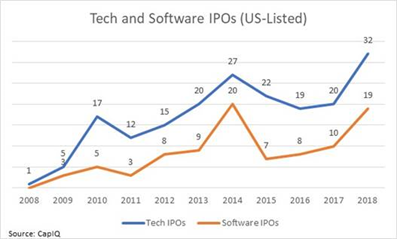
Here at Sapphire Ventures we don’t see it that way; we like the capital markets set up for software entrepreneurs in the “here and now” of 2019.  We believe the glass is way more than half full. Let’s go through the good news – and there’s plenty of it. Here’s a graph of tech and software IPOs over the past decade since the financial crisis of 2008:

Tech and Software IPO trend chart

IPO activity is on the rise, with more than 30 tech IPOs in 2018.  More importantly from a software perspective, 2018 saw nearly five new software IPOs each quarter.  With software IPOs now comprising ~60% of all tech IPOs, we see that as a bullish sign for software investment.  In the decade prior, software IPOs averaged just 46% of all tech IPOs(ii).

Yes, the IPO bar is higher, with the average LTM revenues for the 32 tech IPOs in the class of 2018 coming in at $284M and median LTM revenues at $192M. This squares with what I’m hearing bankers routinely say for software companies these days that the minimum IPO bar is $100M in the rear-view mirror and approaching $200M in the calendar year of the IPO(ii).

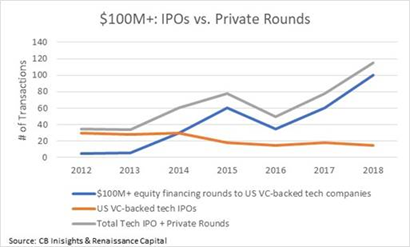
But funding for late-stage tech innovation is on the rise.  The IPO is just one step on a company’s capital markets journey.  Take a look at the following chart:

IPOs vs Private rounds

VC-backed tech IPO activity may have stagnated, but this belies the underlying story that mega-round funding for technology companies is on a steady rise.  In today’s world, we define mega-rounds as IPOs combined with $100M+ late-stage private equity rounds (the up-and-to-the-right gray line in the chart above). Back in the so-called good old days, typical tech IPO deal size was $100M or less. At current levels, this would equate to 10 such financings every month between the public and private markets. I believe today’s private markets are far more entrepreneur-friendly in accepting founder liquidity as part and parcel of the round than yesterday’s IPO markets ever were(iii).

I feel another strong indicator of health in today’s markets is the amount of capital raised prior to IPO.  The typical tech company raises more than $200M prior to going public today (in fact, $239M at the median in the IPO class of 2018), versus just $64M at the median in 2012.  To me, this means that funding for tech innovation is plentiful – and better yet, when companies do go public, they are on steadier footing with a stronger balance sheet, higher revenue levels and more mature systems to ensure they can weather the storm of quarterly earnings reports(ii).

Back in the so-called good old days, we used to talk about the “valley of death” where newly public tech companies went to die as they tried to march through $500M market cap and come out the other side at $2B.  This death valley existed because software companies that hadn’t proven they could scale went public too soon at $500M market caps. Many of these companies had false “exits” – the company didn’t scale, missed growth estimates, and entrepreneurs and VCs alike didn’t achieve the liquidity they were looking for.  In the 2010 class of tech IPOs, the median market cap at IPO was $535M, and the median market cap for these same 17 companies two years later (on the last trading day of January 2013) was just $390M. (And by the way, the markets weren’t too shabby overall in 2011 and 2012.) Contrast that to the tech IPO class of 2016.  19 tech companies went public in 2016 at a median market cap of $718M and traded up to $1.2B two years later (at the end of January 2019). The average statistics are even more compelling: IPO market cap of $1.0B, trading to $2.4B on average as of January 2019. The higher IPO bar has all but eliminated the valley of death(ii).

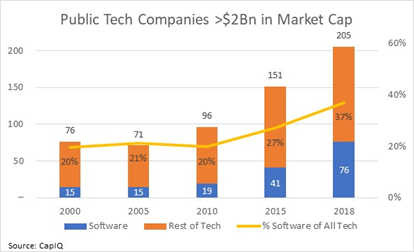
And here’s some more good news for software entrepreneurs.  The number of $2B+ market cap software companies (just the public ones, not even counting private unicorns) is up from just 15 in 2000 to 76 today.  Plus, as the chart below shows, software companies are becoming that much more important to the tech ecosystem, making up ~20% of all tech companies with $2B+ market caps back in 2000 (and even as recently as 2010), but close to 40% of all $2B+ tech companies today(ii).

Chart of public tech companies with >$Bn market cap

With 76 $2B+ public software companies and more than 200 total $2B+ tech companies, there are plenty of companies with the scale and the firepower to acquire today’s VC-backed software companies.  Not only that but let’s take a quick look at the trading multiples. Back in 2010, the 19 $2B+ public software companies traded at median multiples on next year’s statistics of 5.5x revenues, 17.5x EBITDA and 28.7x price/earnings ratio.  Today, the 76 $2B+ public software companies trade roughly 30-40% higher at 7.0x NTM revenues, 25.4x EBITDA and 39.3x P/E(ii).

With so many potential acquirors trading at attractive multiples, it’s not surprising that the number of $500M+ software M&A exits annually has nearly doubled from 21 back in 2010 to 38 in 2018.  And remember, the average IPO back in the so-called “good old days” used to clock in at around $500M as well – yet there were only 5 of those annually in the 2010 timeframe(ii).

With IPOs no longer stuck in the mud, with mega-round fundings skyrocketing and with the number of solid M&A outcomes nearly doubling year-over-year, I think it is safe to say that these are the good old days for software entrepreneurs.

Thanks to Sapphire Ventures Associate Jane Lee for pulling all this great data for me.


Portworx

Portworx: Providing Data Management for Container-based Applications

We are thrilled to be co-leading Portworx’s Series C financing along with the Mubadala Investment Company and helping bring in new strategic investors like HPE, Cisco and NetApp. We led Portworx’s Series B financing about two years ago and decided to increase our investment and commitment by co-leading this current financing given Portworx’s leadership position in helping enterprises deploy stateful applications in containers on public and hybrid clouds.

According to polling results of Gartner’s IT Infrastructure, Operations & Cloud Strategies (IOCS) Conference 2018, 22% of enterprises will use containers as their primary computing abstraction by the end of 2022, and 27% already deploy containers in production. However, until quite recently containers were optimized for deploying stateless applications. Due to the increased ease-of-use for deploying applications in containers with Kubernetes, enterprises have started deploying stateful applications like MongoDB, MySQL and Cassandra in containers on public clouds or on hybrid clouds.

Stateful applications deployed in containers need to share application data while having access to persistent data storage systems and advanced data services (e.g., encryption, data reduction and data protection). Enterprise customers are increasingly using Portworx to provide data persistence and data management services when they deploy stateful applications in containers, validating Portworx’s unique value proposition as the only cloud-native storage solution solving non-negotiable business requirements like High Availability, Data Security, Multi-Cloud Data Management and Disaster Recovery in a fully-automated manner using Kubernetes. This product leadership has led to a nearly 400% year-over-year bookings increase for Portworx in 2018 and has helped expand its customer base by over 100%. Portworx now works with dozens of the Fortune Global 2000 and government agencies including HPE, GE Digital and Lufthansa Systems.  The company has also expanded partnerships and reseller agreements with leading companies including IBM, Intel, HPE, Toshiba, Red Hat and Mesosphere.

It has been quite a pleasure to have worked with Murli Thirumale, Gou Rao, Eric Han, Vinod Jayaraman and Venkat Ramakrishnan to help them build the company, fine-tune the product and hire the talent to help them scale the company. Sarvesh Jagannivas, Steve Ackley and Michael Ferranti have joined the management team over the last 12-18 months and have each contributed to a dramatic improvement in the way Portworx goes to market and closes deals. The Sapphire Ventures Portfolio Growth team will continue to work with the entire Portworx management team to help them scale and penetrate more Global 2000 enterprises as these enterprises adopt containers and Kubernetes for deploying applications.  

The market for data management of stateful applications deployed in containers is still evolving and maturing. Some of the largest storage vendors like HPE, Cisco and NetApp saw that this burgeoning space is growing fast and decided to invest in Portworx as part of this financing. We are excited by their participation and the help they will provide in building the Data Management platform for this new DevOps focused container ecosystem.

All of us at Sapphire look forward to working with the existing and new investors, as well as the Portworx team, to help them build a Company of Consequence in the container-based data management market segment.

Value add

They Talk the Talk, But Can They Walk the Walk? 7 Ways To Assess the Value-Add of VC Firms

In recent decades, many venture capital firms are working to differentiate themselves beyond their ability to write a check. They understand that entrepreneurs’ success isn’t strictly correlated to the size of a funding round; rather, start-ups often need the intelligence, mentorship, and network an experienced VC is able to provide in addition to cash.

Today, value-add teams at VC firms exist in many flavors. Some specialize in engineering support, others center on customer success; still more offer geographical expertise. Sapphire Ventures created its own Portfolio Growth team, which works closely with our entrepreneurs and GPs to help solve their business development, talent, and marketing challenges.

If you’re an entrepreneur with options during fundraising, it can be a challenge to determine which firm is right for you. Any investor can provide financing — and that coveted pattern recognition and broad understanding of your industry matter — but how do you make sure you find a VC with the right operational team to help unlock your company’s real potential? Below are 7 questions every founder should ask about a prospective VC’s value add team to ensure she or he finds the best match.

1. How senior is the team?

Some firms stack their growth teams with junior colleagues and inflated titles. It’s great experience for pre- or post-MBA associates to sit on your board and gain exposure to the start-up process — but this isn’t usually in your best interest. Make sure the value-add team you work with is staffed with senior team members with track records of success.

One particular benefit to working with senior growth partners is access to their Rolodex. When you’re in the middle of rapid growth, the ability to quickly expand your network can be invaluable. For example, if you need to boost sales in a given quarter, you should feel comfortable asking them to introduce you to decision makers at your target accounts. Or, when you’re ready to hire a CXO to augment your team, this is where you should be able to lean on members of your growth team for reputable connections.

Above all, your partners should be experienced startup operators themselves and know what it’s like day to day in the trenches. Otherwise, you’ll be taking advice from people who don’t truly understand the types of problems you’re working through — and who can’t offer the best direction.

2. What is the relationship between the investment team and value-add team?

You want your portfolio growth team to have a direct line of access — and excellent working relationship — with their investment team. Do the two groups show up together to meetings? If they do, are they on the same page, or do they have different agendas? Before the investment closes, does the investment team make an effort to connect you with the growth team for their ideas and advice?

The dynamic between these teams will have a strong impact on your progress. If they’re not aligned, it’s likely you’ll receive mixed messages—which will only make it more confusing and cumbersome to move forward. When speed is imperative, poor teamwork could derail you.

3. What is the structure of the team?

Within the growth team itself, look carefully for cohesion and synergy. Are they simply a bunch of individuals pitching in where they see fit, or do they have set roles and responsibilities that play to their backgrounds and specific strengths? Are they situated under a cohesive leadership structure within the firm and focused on portfolio success, or are they reporting into different investment partners, who may have different agendas, and reduced synergies?

Do the team members complement each other? High-performing teams, even small ones, have a healthy balance of technical and social capabilities—which should play into the range of skills needed to build your company. In addition, understanding your team’s own strengths and weaknesses will help you better select a partner that complements you.

4. How – exactly – will they add value?

You want to be sure that your VC’s growth team takes your company seriously. Indications of their dedication include:

  • Delivering specific ideas to you pre-investment
  • Symmetry between what you’re looking for and what they offer (e.g., if they pitch their strength in helping with expansion into Asia, but your market is firmly domestic, that’s clearly a mismatch)
  • Their availability to meet when you need them — and their ability to follow through on a timely basis

Sapphire’s Portfolio Growth team, for example, is able to provide consistent, extraordinary support to growth stage startups that cater largely to enterprises. We have a global network and deep industry expertise that helps corporate and IT executives keep pace with new trends and find tools that fit their unique needs.

With regards to talent, Sapphire goes well beyond the job board. We’re able to find executives that come in and move the needle. Finally, our team’s European network can help founders looking to access the next frontier in tech.

5. Do they have carried interest?

VCs with carried interest receive a share of the firm’s profits. They are retained by the firm for a longer period of time and have a direct stake in the success of your start-up. If your value-add team partners have carried interest, it is an indicator that will be committed — over and above other members of the firm — to navigating many of the more frustrating aspects of growing a company.

Carried interest can also help you avoid a revolving door of people coming and going from your case. Because the benefit of carried interest is usually reserved for senior partners, it can whittle down your list of potential collaborators to those who are already proven in the start-up ecosystem — eliminating those who are less experienced. We realize it is a sensitive question, but it’s important for you to know they are in it for the long-haul with you.

6. How is their success measured?

Ask your prospective growth team what OKRs/KPIs they rely on — then cross-reference them with your own to ensure they match your success.

At Sapphire, one of our KPIs is 90% referencability from our CEOs. Your success is our success — full stop. If our CEO wouldn’t recommend Sapphire to another entrepreneur, we haven’t been successful.

It’s important to be wary of vanity/effort KPIs, such as the number of introductions made in given month or attendees at meetings — these are not outcome oriented and can confuse activity with effectiveness.

In the end, be sure the investment team and value-add professionals share KPIs. Again, you want to be sure these teams are as aligned as possible to amplify your success.

7. What do references say?

Metrics are essential; however, selecting a value-add team is ultimately personal. When you’re in the midst of rapid expansion, it’s easy to veer off course if you don’t have a solid foundation with your colleagues. Being able to align on values, set expectations, and delegate work streams are the bedrock of hitting any benchmark as a group.

To this end, do your research to determine what CEOs say about a VC’s growth team. Do they — and you — personally know of value-add team members? Do you know them by name? Can you call them? On speed dial? This is the level of access and reputation you should demand if you’re serious about scaling.

Start Your Due Diligence Early

Smart founders know that selecting venture partners begins long before a fundraising deadline. A main reason for this is to be able to test and vet a firm’s value-add capabilities.

CEOs should plan to have a “portfolio” approach to these platforms. As your company ages, your needs will invariably change. At the early phase you may need help with core engineering, UX, or even SDR support. As your business matures, you may find that you need help with other areas, e.g. channel entry, pricing and packaging, or perhaps hiring your COO.

Get to know VCs months or even years in advance of taking their capital. Get a feel for and leverage their platform to be sure it fits your specific needs and phase of growth. As the proverb says, it takes a village! (To raise a child or a successful business.)

Once you’ve done your homework, narrowed your list, and are happy with the valuation and ownership — don’t wait. Solidify the partnership and move forward.

To learn more about how Sapphire Ventures approaches value-add services, visit our Portfolio Growth team page.