2018 Year In Review

With 2019 underway, we wanted to look back and share some of the moments that made 2018 another banner year for Sapphire Ventures.

In 2018, we:

• worked with a record number of new entrepreneurs
• expanded our team and Portfolio Growth capabilities
• launched a new brand and website, and
• just last week, announced our newest investment vehicle, Sapphire Sport

Sapphire Sport is a $115M+ vehicle focused on investing in early-stage technology companies at the intersection of sport, media and entertainment. Learn more about Sapphire Sport here.

Led by Doug Higgins, and Michael Spirito, Sapphire Sport is another example of Sapphire’s continued evolution of what it means to be a venture fund. This trend started with Sapphire becoming an independent firm in 2011, and has continued with the:

• launch of Sapphire Partners — our fund investing business — in 2013, and
• creation of Portfolio Growth — our value add platform — in 2015

In our mission to add value to our entrepreneurs, investors and funds, we strive for 90% of our portfolio executives to be referencable. Please see the below infographic to see the ways Sapphire worked hard in 2018 to achieve this goal.

We are excited for what will come in 2019 and look forward to working with each of you to help our portfolio grow into companies of consequence. Without your support, Sapphire wouldn’t exist, and for that, we’re eternally grateful and excited for what is to come!


2018 Infographic

Sports team

Why Sport?

In 2004, I spent several weeks traveling Brazil and Argentina. Toward the end of my trip there was a soccer match, contested by two of the top clubs in the Brazilian Series A, in the Maracana in Rio — the iconic stadium that hosted 199,000 fans for the 1950 World Cup Final, and would eventually host the 2014 World Cup Final and 2016 Olympic Final.

At that point, I had never been to a professional soccer match, so, my friend and I secured cheap tickets and decided to enjoy. The scene that unfolded was unlike anything I had ever witnessed:

  • Several hundred thousand people gathered outside a stadium
  • Riot police on horseback patrolling the perimeter keeping the crowds at bay
  • Singing and yelling echoing around the exterior of the stadium an hour before kickoff
  • And inside, a cacophony of spirited chants back and forth throughout the match.

All this for a regular season match in one of the dozen or so biggest soccer leagues in the world — all of which existed outside the United States. At that moment it crystallized for me … sport is much bigger than I ever thought it was.

We announced Sapphire Sport last week, and we did so with the resolute belief that sport is not only an extraordinarily interesting space from an investment perspective, but that it is bigger economically and culturally than we, or anyone, was even giving it credit for.

Let’s call it what it is: Sport is truly global. Sport is a unifying mechanism in our society with  80+% of the world’s population identifying as a sport fan in some manner. In an ever-evolving and, at times, frustrating world, sport is increasingly the one thing people can all agree on, even as we may disagree on our loyalties and rooting interests.

Sport is also massive as an economic driver. Reports on market size have been published, ranging from several hundred billion dollars to over a trillion (and growing faster than GDP) depending on what sectors and geographies are included. The size and scope of the opportunity are more than significant enough for venture capitalists to consider the grounds fertile. At Sapphire, when we talk about “sport,” we are not only considering the hundreds of billions worth of global sports media rights but their underlying distribution mechanisms, and other related areas such as:

  1. Next Gen Media
  2. Digital Health and Fitness
  3. eSports and Gaming
  4. Betting and Fantasy
  5. Fan Engagement & Data Management
  6. Performance Analytics
  7. Digital Commerce
  8. … and everything in between

All of this is sport. And as technology disrupts the global sport ecosystem, Sapphire Sport is in position to match best-in-class technologies to a sport and media customer base working to future-proof their business.

Global sport is getting disrupted by technology in a manner which extends throughout the ecosystem. The scorecard is reflected in team valuations, league and governing-body financial health, media rights deals and global sport sponsorship dollars. These changes are creating new business models and technology platforms that fundamentally change consumers’ experience with sport. From a constituency basis, “sport” means team owners, leagues, governing bodies, brands, financial partners, agency, apparel, media entities and other investors.

Sapphire Sport is fortunate to draw from a limited partner (LP) base that covers these different aspects of the sports ecosystem. Many of our LPs are entertainment brands unto themselves, competing for consumer attention in an increasingly digital world where options abound, and mindshare is increasingly fragmented. Remember, sport at its core is entertainment, and as entertainment brands our partners are looking to create and nurture direct relationships with their fans through technology. Each of our partners is interested in one thing: to build globally relevant and leading businesses that stand the test of time.

Perhaps the best way to encapsulate all of this is through a couple of examples. One of our portfolio companies, Fevo, is a technology business which began in a horizontal space (events and ‘space filling’) yet solves a very real problem for many stakeholders across the sport landscape. Simply put, Fevo is an unconventional payments method, a new category which can be defined as an alternative payment experience for different asset classes, be they live events, attractions, travel, registries, high ticket items, or merchandise that has strong community association like health and beauty brands. In sport, the business is able to partner with both ticketing providers (Ticketmaster) and stakeholders (Team owners and arenas/stadiums) to provide a socially-enabled payments solution. In this way, Fevo’s mission is not only to build a great product that serves a number of different constituents in our world, but also to truly become a category maker.

Another example I like to use is my belief that Instagram is arguably the most important sports media company around. No platform better empowers all parts of the value chain to:

  1. Tell their story with their own media and in their own words
  2. Connect with the exact demographics who are driving disruption in consumer-driven business models, and
  3. Provide a meaningful conduit for both brands and media rights holders to forge connections with fans and customers.

When Instagram came into existence, the idea of it as a sport (or even media) entity was far fetched at best. But it is exactly the type of horizontal technological platform where migration to sport and media is not only possible, but potentially category defining.

I will close with this. I’ve always been a sports fan. As a kid in Rhode Island, when my brother and I weren’t playing sports (often coached by our dad), we were watching them, living our lives through the sports we loved. I sit here typing this in the shadow of the New England Patriots winning their sixth Super Bowl in 18 years. That the hapless Patriots of my youth have become one of the most dominant sports franchises of all time (and almost universally reviled) is still such a foreign, almost illogical thought. But in watching the celebration unfold in Atlanta that evening, I must admit I was more emotional than I expected. Whether that was fostered by the connection to my youth and my family, or just a brief respite from some of the unplanned ups and downs that life can throw at you is irrelevant. Sports are there when we need them most. We are all sports fans in our own way.


slush

When Money Isn’t Enough: How to Distinguish Yourself as a VC in a Crowded Market

In 2018, U.S. venture funds invested over $130 billion in startups — crossing the $100 billion mark for the first time since the dot-com boom in 2000. In addition, U.S. venture funds themselves also raised record amounts not seen since 2000, raking in over $50 billion across 220+ vehicles. Across the board, deal sizes surged.
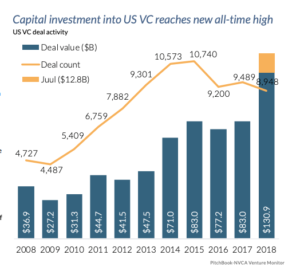
Capital investment into US VC reaches all time highAt the same time as multiple folks have noted, the number of absolute financings has not kept pace, rather more money continues to go into fewer but larger rounds starting as early as at the series seed.

To succeed as an investor in an ecosystem such as this — flush with venture capital and venture capitalists, is it enough to differentiate yourself just by having capital? To attract entrepreneurs and limited partners (the people or firms that invest in a venture fund) to your fund we believe it is not. We would argue that you have to distinguish yourself with an authentic and valuable model.

What do you stand for? How can you deliver for your portfolio companies over and above the competition? There’s more than one way to skin a cat — but it’s essential that you figure out what makes your firm original and lead with it.

I recently dug into this topic on a panel on The Shifting Funding Landscape I hosted at Slush along with Rebecca Kaden from Union Square Ventures, Rebecca Lynn from Canvas Ventures, and Alice Bentinck from Entrepreneur First. Below are seven ways I’ve identified where VCs have differentiated themselves and found success.

The Shifting Funding Landscape panel @ Slush 2018

1. Stick to a thesis

Thesis-based investing takes the long view on how a specific industry or trend will evolve over time. Investors come to a consensus on their vision for the future (generally a 5-10 year horizon) and run each potential investment through the model to ensure it aligns with and helps drive the change.

According to Fred Wilson, thesis-based investing is an excellent strategy for smaller venture funds that can maintain and execute a singular vision. His firm, Union Square Ventures, is a pioneer of this approach. Leveraging their thesis around the power of networks led them to invest in companies like Twitter, Tumblr, Twilio, and MongoDB (to name a few). And thesis based investing does not have to be rigid. Today Rebecca Kaden at Union Square Ventures articulated the third iteration of their thesis – now about backing trusted brands that broaden access to knowledge, capital, and well-being by leveraging networks, platforms, and protocols.

Other venture firms also use thesis-based investing and continue to iterate on the model. For example, Forerunner Ventures zeroes in on entrepreneurs defining a new generation of commerce by tracking major cultural shifts from a consumer perspective. From there, they select companies to invest in based on how they dovetail with these shifts. These include investments in companies like Glossier and Warby Parker and exits in companies like Dollar Shave Club and Jet.

2. Platform as VC

When Josh Kopelman and Howard Morgan launched First Round Capital in 2008, they championed the concept of transforming their portfolio of companies into a community of entrepreneurs who supported one other.
First Round Capital

To this end, they built the First Round Network, a platform where entrepreneurs can ask for help and share successes on every aspect of startup life — from fine-tuning pitch decks to accessing the latest software to hiring. From the data they collect on interactions, First Round publishes an annual State of Startups report, unveiling trends in everything from productivity tools to the benefits and challenges of parenting while working in tech.

Access to the First Round Network isn’t limited to First Round’s founders and C-Suite executives. All startup employees at First Round Capital’s portfolio companies can request and share insights — engineers, marketing teams, and customer success — alongside leadership. Well-known companies that have relied on the platform to scale include Square, Flatiron Health, and Ring.

3. Form your own agency

Andreessen Horowitz (A16Z) launched in 2009 with a novel structure modeled after the Hollywood talent agency Creative Artists Agency in which they hired partners not to invest but to provide their functional expertise — be it marketing, business development, or recruiting to help their entrepreneurs. A16Z might not have been the first to offer “value-add” services, but they did it in a big, public way — and the industry took notice.

Y Combinator emerged in tandem as a prominent seed stage accelerator, admitting scores of companies into ‘batches’ a couple times per year. Each company gets a focused three-month experience to work on their ideas, getting advice, pitch training, funding and connections to participating companies leading up to ‘demo day’ and then access to the YC alumni network. With investments like Dropbox, Airbnb, Stripe, and DoorDash, the model inspired many others to consider new ways of helping entrepreneurs and companies at the earliest stages.

Enter Entrepreneur First (EF). EF decided to partner with talented founders even earlier — at the pre-company stage and help them with critical early decisions like selecting a co-founder and refining their business model. Comprehensive and personalized commitment is why ambitious individuals like Zehan Wang and Rob Bishop of the neural network technology Magic Pony which was acquired by Twitter were attracted to EF.

(Of course, I’d be remiss not to mention Sapphire’s own Portfolio Growth team who help our GPs and portfolio companies — direct and indirect — with a variety of business development, talent and marketing activities.)

4. Send out the scouts

Who makes the best venture capitalists? Ex-bankers? Ex-operators? Current operators? Ex-journalists? College students? Recent graduates? The jury is out according to CB Insights data, but as an industry, we continue to think about this and experiment with new approaches.

Cue the scouts. Sequoia started using scouts in 2009 and in 2017 raised $180 million for a seed stage fund based on the model. The program involves distributing money to a network of well-connected entrepreneurs, academics, and industry leaders who invest in promising startups and keep their ears open for new opportunities for Sequoia. (In 2015, The Wall Street Journal published a list of more than 100 Sequoia Scouts, including Airbnb CEO Brian Chesky and Stanford Cryptography Professor Dan Boneh.)

Other teams have made this model their own, and today successful scout programs come in various forms, ranging from working exclusively with one fund to funds raised just to fund other scouts. Data Collective has innovated on the scout program and taken a whole new angle on it. Data Collective gives 40+ technology executives, engineers, data researchers, and scientists equity stakes in the fund to help source and work with DCVC portfolio companies — a great added incentive to uncover the next unicorn.

5. Community as deal flow

For the most part, there is no proprietary deal flow anymore. But there is proprietary access. One way to generate it is by building your own community from which to invest. A prime example of this is Jason Lemkin – the founder of the SaaStr community, the SaaStr podcast, the enormous SaaStr Annual conference (along with its European counterpart, SaaStr Europa), and his eponymously named SaaStr Fund.

It took Jason a mere five years to grew his presence 20X on Quora to 45 million views, publish more than 200 podcasts, and hosted some 12,500+ SaaS execs, founders and VCs, and execs at this year’s 2019 SaaStr Annual. In 2016, he raised a $70 million venture fund focusing on inbound investments from the community he created.

6. Harness data to your advantage

Just as companies are using data smarter and better to understand their customers, outmaneuver their competitors, and map their ecosystem — so too are venture firms. VCs are leaning on data to be smarter about everything from sourcing investments to benchmarking to helping a portfolio company make its next hire.

Scale Venture Partners, for example, launched the Scale Studio in 2018 to give entrepreneurs a window into industry metrics like the Mendoza Line.

Mendoza Line - Source: TechCrunch

The Mendoza Line is an acceptable growth rate for a SaaS company looking for venture funding. SVP also offers insight into the Magic Number, a calculation to predict which subscription models will become profitable.

Another data driven VC is SignalFire which has built their firm from the ground up with a heavily data-centric approach. Signalfire says it tracks more than half a trillion data points that it collects from millions of data sources, from patents, academic publications, open source contributions and financial filings.  It does so as part of its deal sourcing work but also as part of the value add it delivers to its portfolio companies and last but very much not least in order to track millions of engineers around the globe.

Proprietary data can be an enormous asset. If you can collect and organize it in an effective way — it can be your best weapon.

7. Take a chance as a first-time fund

Old is new again. Instead of joining existing high-profile firms, more and more individuals are striking out on their own and starting new venture funds. 2018 saw some 70+ new funds raised representing almost $7BN. This new fund creation activity was also not an isolated event in 2018, but part of a larger pattern. According to Pitchbook, with the exception of slight dip in new fund creation in 2014, approximately 30%+ of funds raised every year since 2010 have been new first-time funds.

This is not an easy path. New funds can be laborious to raise. Many Limited Partners don’t invest in a first-time fund. And of those that do, many will only commit to experienced venture investors spinning out of existing funds. It is also a challenge to gain visibility among entrepreneurs. Rising above the noise and building your brand as an existing venture fund is tough enough; for those just starting out, it can be a much longer road to recognition and trust.

The upside, of course, is that first-time funds give investors an opportunity to start fresh. First time funds can offer greater independence, flexibility, speed, and creativity with investments since you’re not balancing your vision and priorities with your partners’.

Most first-time funds raise less than $100m — and while this may bring some disadvantages when it comes to competing with bigger funds, it can also give the new fund a chance to carve out a focused niche. We’ve seen new funds zero in by theme, by vertical, and by geography to take advantage of their particular expertise. In the past few years, we’ve seen new managers like Notation Capital, focused on technical founders in the general tri-state area; Backstage Capital, with a commitment to women, people of color, and LGBT founders; Basis Set Ventures, centered on AI; and Third Kind Ventures, which aims to invest in contrarian founders at the very early stages, targeting large outcomes in transformative spaces.

Whatever your tactic, make sure it’s authentic. You need to stand out even more if you’re starting your own brand.

Put Your Best Foot Forward

Founders and limited partners will quickly see through inauthentic copies. The startup ecosystem is well-networked, and the smart, ambitious people you’re trying to attract to your fund will know if you’re not being real. You don’t necessarily have to re-invent the wheel. There are many ways to support your portfolio companies and develop your approach to sourcing and making investments, but play to your strengths. Whether it’s an edge in data, access to industry leaders, a knack for fundraising, or your personal brand — lead with it. If you’re authentic, you’ll be a magnet for like-minded talent.


Trees

3 Things that Make a Great Limited Partner For A Venture Fund

I recently met with a new fund being formed by a group of talented operators. After an hour discussing their strategy, the team mentioned that I had asked insightful questions that they previously hadn’t been asked, particularly around the team and fund construction, which they found helpful as they made final decisions about their fund.

This interaction (while flattering) was not actually a statement about me, but rather a reflection that I happened to be part of their first meeting with an institutional investor. Their comments got me thinking about what makes a truly good limited partner (LP), a topic we take seriously at Sapphire Partners, the investment platform within Sapphire Ventures that invests in global early-stage venture funds as LPs. Venture funds typically have a choice when putting together their syndicate, and this choice can have a large impact on the firm and its future. I thought I’d share Sapphire’s philosophy on what it means to be a good LP for venture funds.

1. Be a long-term partner

A long-term view is essential to being a good LP. There are two primary parts to having a long-term view:

  • The LP mentality: In our experience, venture funds typically have a 10 year life, although the majority can take much longer than 12 years to liquidate. When an LP makes a commitment, they should invest with the intention of partnering for numerous funds, potentially during various cycles (ps. venture is cyclical!) That doesn’t mean that LPs shouldn’t do their full work for every re-up (they should), but the default should be to reinvest unless there is underperformance or a major change in what a GP is doing.
  • Availability of capital: To fulfill an LP’s part of the bargain, they should appropriately manage their own capital so they have the capability to make subsequent commitments to GPs. GPs should have confidence that LPs will be with them for more than a few years assuming GPs do their part and perform well.

2. Provide value beyond capital

LPs should provide value past capital, though what each GP considers valuable can be different. I can’t speak for all LPs of course so I will instead speak from our own experience. Some of the ways we deliver value to the GPs we partner with include:

  • Ask questions: Limited partners should be cheerleaders but also ask thought-provoking questions. LPs are uniquely positioned because of what they know – the team, the strategy, the portfolio AND what other GPs are doing or have done in regards to both investing and firm management. LPs can and should use this knowledge to ask informed questions. Why? Because ultimately, we invest in GPs because we believe in them and trust their decisions. But if we can get GPs thinking, even if it’s just to reaffirm their decisions, it helps everyone: GPs, LPs and often the underlying portfolio companies.(For more about the value of GPs asking good questions, check out my colleague Beezer Clarkson’s post.)
  • Market insights / analytics: LPs can leverage the knowledge, insights and data they gather across their portfolio to provide benchmarking and discuss valuations or investment trends beyond what a single GP is seeing. Sometimes LPs can provide knowledge specific to a sector. For example, the new Sapphire Sport investment vehicle has deliberately assembled an LP syndicate of key players in the sporting world such as City Football Group and adidas, who can weigh in on trends or markets.
  • Fund management: LPs can also help with fund formation or fund management questions. A typical LP sees a lot of models of what works and what doesn’t and can help answer questions around topics like reserves and recycling.
  • Introductions: LPs can help with intros, whether it’s to other LPs, GPs, customers or even key talent. At Sapphire, we tend to make three types of introductions for our GPs and their portfolio:
    1. Other investors – we make intros to other investors including other LPs and follow-on investors, such as GPs in our ecosystem or our ventures team, which is a natural fit for most of our early portfolio as they start investing later, typically in the Series C round.
    2. Business development – through our Portfolio Growth team we have made hundreds of introductions over the years to new customers and partners. For example, our business development team hosts about 40 executive innovation days annually for Global 2000 companies. All of the innovation days in 2018 included a company or GP in the Sapphire Partners portfolio.
    3. Talent – we try to help add talent in several ways. Our firm has an internal head of talent, who can help our GPs develop a pipeline of candidates for their portfolio. We also engage with a large ecosystem of GPs and entrepreneurs, and we can refer experienced talent whether it’s to join a portfolio company or GP.  

3. Contribute to the broader ecosystem

One element that I think gets overlooked is the notion of contributing to the venture ecosystem. We work in a pretty amazing, constantly evolving ecosystem, and while I feel very lucky to be part of it, I think we have a responsibility to make it better.

There are tons of ways to contribute beyond giving capital, from advising newly forming funds, to speaking, to making connections. For example, I hosted a dinner last fall with Hana Yang connecting LPs and emerging female GPs; a topic that Beezer and I both plan to spend more time on this year amongst other areas.   

This is some of the philosophy we have at Sapphire Partners, and I’m sure there are other perspectives or guidelines for LPs that I’ve missed. Help add to the conversation so that we can collectively make this ecosystem stronger and more valuable and please check out additional LP views at OpenLP.com or by using the #openLP hashtag on Twitter.


Embrace the Cloud

2018 was a strange year.  The Red Sox won the World Series again, Kanye West and Donald Trump held a policy summit at the White House, and global stock markets rallied and fell multiple times without clear catalysts.  But perhaps the oddest thing that happened in the markets was something that hasn’t happened in nearly 50 years: investments in S&P 500 stocks and bonds both lost money. (i)

Stocks and bonds haven’t declined in the same calendar year since 1969 when the S&P 500 fell 8.5% and 10 Yr. Treasury fell 5.0%. (i) In 2018, the S&P 500 finished the year off 5.2% and S&P 500 bonds fell 3.3%, upending traditional diversification strategies designed to hedge losses in the market. (ii)

Conventional wisdom is that stocks and bonds are supposed to move in opposite directions. Interest rates generally rise when the economy heats up, and when rates go up, bond prices go down. Thus, rising interest rates are usually a sign that the economy is in good shape and getting better.  Not so in today’s market. The Fed has been playing catch-up after years of near-zero interest rates and savvy equity investors see an earnings plateau in 2019, with a nearly decade long bull run losing steam and a trade war brewing.

So, what’s an investor to do?  Well, it’s a global economy so it makes sense to look outside the U.S., right?  No, the MSCI developed country index was off 13.4% in 2018 and the emerging markets index finished the year down 14.5%.  Surely commodities were a safe bet.  Think again.  Oil was off 24.3% and even old faithful gold was down 1.9% in 2018.  It’s Silicon Valley, so why not stash your cash in crypto?  Nope, Bitcoin finished the year down 72.2%. (ii)

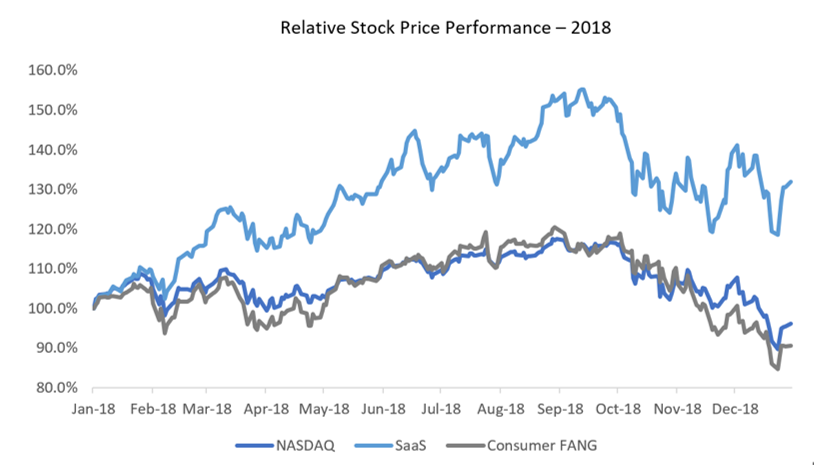
Here at Sapphire Ventures, where we’ve spent over a decade investing in what Gartner calls the Great Cloud Migration, we were not surprised to see one uncorrelated asset in 2018 turned out to be SaaS stocks, which were up 32% on the year, according to our internal estimates. (iii) Not tech stocks, but SaaS stocks.  The tech-heavy Nasdaq index was down 3.8% in 2018, and the Consumer FANG group (Facebook, Apple, Netflix, Google) was down even more.  A dollar invested in the Consumer FANG index left you with just 91 cents by year-end. (ii)

Global Asset Class Returns 2018


Relative Stock Price Performance cloud
Source: (ii) CapIQ, WSJ.
All composite indices are indexed to 100% on the first trading day of 2018.
(1) SaaS index based on KeyBanc SaaS comps.
(2) Consumer FANG = Facebook, Apple, Netflix, Google

So why were SaaS stocks sparred the rout that overtook the markets in 2018?  It is our opinion, despite the global macro uncertainty and the supposed end to the secular bull run, mainstream cloud adoption continued unabated, and in fact, even picked up momentum.  Put simply, SaaS stocks just grew right through all the volatility in 2018.  The potential slowdown in consumer spending which seemingly impacted the Consumer FANG stocks couldn’t slow the growth in cloud computing, as the cost benefits and potential revenue enhancements to enterprises from a move to the cloud have become too clear: more flexibility, scalability, innovation, and cost-effectiveness, all at the same time.

In fact, we believe that we have reached a tipping point, where the inevitability of a dominant cloud computing paradigm has reached the mainstream enterprise.  According to Gartner, most organizations (~70%) now use cloud services in a meaningful way, and of the enterprises that use cloud services, >75% now adopt a cloud-first strategy.  More than 20% of total IT budgets are now focused on the cloud, with that number expected to grow at more than 20% annually through 2022.  Gartner projects the growth of the cloud services industry at nearly three times the growth of the overall IT services industry through 2022, with SaaS software growing at over 17+% annually (versus non-cloud software at just 3%). (iv)

So, after the estimated 32% appreciation in 2018, are SaaS companies still a good investment?  Here at Sapphire Ventures, we think the snowball is just beginning to roll downhill.  In 2019, over 30% of new enterprise software investments will shift from cloud-first to cloud-only, also according to Gartner. (iv)  Over the next few years, as enterprises face spending triggers based on legacy IT asset obsolescence, we believe it’s clear that the shift to a cloud computing paradigm will continue its steady march forward.

After peaking at ~9x 2019 revenue multiples in late summer 2018, a basket of public SaaS stocks today trades at a median multiple of just ~6.5-7.0x 2019 projected revenues.  Certainly not cheap by broad market standards, but SaaS stocks haven’t been cheaper since 2016 when they traded at ~5.5x forward revenues on average.  Every other year since 2012 SaaS stocks have traded on par or higher, most typically in the 7x to 8.5x range. (iii)

With the group growing at a median of >20% and some of the best companies growing at >30% annually (iii), we feel SaaS stocks have a lot going for them.  Salesforce (CRM) has grown to become a $100+ billion market cap company and we think plenty of other enterprise application software segments will continue to follow, including collaboration, business analytics, and office suites.  We’ve been able to invest in a number of these SaaS companies who have already gone public, including Alteryx (AYX), Box (BOX), DocuSign (DOCU), and Five9 (FIVN).

And with over $100 billion invested by venture capital firms in 2018 and over $50 billion raised by VC funds last year, according to PitchBook/NVCA(v), there’s plenty of support for the Great Cloud Migration in the private markets as well.  That’s why Sapphire Ventures continued to invest heavily in the cloud economy in 2018 – in horizontal SaaS companies such as Alation, DataRobot, Outreach, Pendo, and ThoughtSpot, in vertical SaaS companies such as project44 and Reonomy, and in DevOps and cloud infrastructure companies such as Auth0, Contentful, InfluxData, and Matillion.  For a list of all of Sapphire Ventures venture investments, click here

So as John Neff, the legendary Vanguard Funds investor said, “Obsession with broad diversification is the sure road to mediocrity.”  We agree.  In 2019, we intend to invest in the next generation of SaaS leaders and cloud innovators.


adobe stock

Tools Every Startup CFO Needs to Succeed

This is a guest post from Rob Krolik, General Partner and CFO at Burst Capital.

There are currently more than 60 active CFO searches for startups in Silicon Valley. Despite the importance of the role — particularly for later stage startups eyeing IPOs — it’s a notoriously tough one to fill.

AdobeStock_177641645-1024x683

Why? Because there’s a lack of experienced financial talent in the Valley. There are many people out there who are excellent at financial modeling, but being a successful CFO — especially one getting ready to go public — requires a much broader skill set. You need to understand the nuances of business taxes, cash management, how to speak to a board and investors, etc. The challenge is that professionals of this caliber and breadth of experience typically opt for jobs at established companies rather than risking it with a startup.

To help solve this talent gap, I recently hosted a workshop at Sapphire Ventures to expand and sharpen the skills of promising finance professionals who some day could take on the CFO role at a Sapphire portfolio company.

Below are a few of my tools and tips I shared to get up to speed as a CFO before you’re in the hot seat.

What do startup CFOs need to know today?

After serving as Yelp’s CFO and leading the company through its IPO, and holding CFO positions at Move, eBay, Shopping.com, and DigitalThink, I took time to consolidate what I had learned. I broke down what I believe the core skills of a CFO to be into fifteen disciplines:

  • Accounting
  • Financial Planning and Analysis (FP&A)
  • Taxes
  • Treasury Management
  • M&A
  • Investor Relations
  • Internal Auditing
  • Security
  • Business Systems
  • Facilities
  • Insurance
  • Working with a Board of Directors
  • Stock Administration
  • The IPO Process
  • Scaling the Organization

From there, I developed a curriculum to give technology finance professionals more practical, hands-on exposure to these topics than what they’ve experienced in their current roles. Although many people want to jump straight to the IPO module, I’ve found they get far more value from the other topics. That’s because since so few companies actually go public, it’s essential for finance leaders to have the tools to steer an organization through day-to-day events like presenting to the board, developing a framework for FP&A, and imposing revenue and expense discipline for greater scale. Foundational topics like this are where the real value lies. That includes things like:

Working with the Board

It’s not always easy to collaborate with board members — particularly venture-capital board-members, who may be pressuring for an exit. As CFO, you have to balance their expectations with an accurate portrayal of your company’s progress. This includes being able to clearly identify revenue growth (or stagnation), illustrate the strength (or weakness) of cash flows, and highlight when and how fundraising would be most helpful.

With many new CFOs being sharp on the math but less experienced in management situations, brushing up on the best presentation methods and modes of communication are absolutely key.

A framework for financial planning & analysis
CFOs must be the masterminds behind a company’s financial architecture. They have to forecast the next year or two, create a budget, and monitor working capital, with a particular focus on cash. No amount of fundraising will help in the long-term if these day-to-day tasks aren’t smooth. As the workplace evolves — with more employees working remotely and operations becoming more distributed — financial planning is an increasingly complicated endeavor. The tools and systems of the past are giving way to new methods like cloud-based services, shared documents, and virtual cards for reimbursement. Staying up-to-date is more important than ever for CFOs to add value.

Scaling the organization
Finance doesn’t exist in a silo. For a company to be successful, everything from hiring and employee development, to new product rollouts should be grounded in financial analysis. A CFO needs to know the nuts and bolts of the other departments to help with that analysis. This understanding of the core business functions is key to developing a more integrated strategy with the right tools and processes needed for rapid growth.

Many CFOs start with expertise in one or two areas — such as accounting or FP&A; however, it’s important for the successful CFO to have a breadth of tools at your disposal. To transition a young company to a more mature place, you must have a strong foundation in a range of disciplines. From there, you can always continue adding to your toolkit when situations require it. Have you ever needed to build out offices space, sign tax returns, evaluate whether the current team in place for a $20 million business will be right for the organization when it is $200 million, implement systems such as accounting, stock administration, or expense reimbursement? Focus on People, Process and Systems is critical to scaling the organization.

Build your CFO network

Unlike founders, CEOs, and even COOs, up-and-coming CFOs don’t always have good sounding boards or mentors to turn to. I know firsthand how hard it can be to find peers to discuss particularly sensitive topics.

Through my seminars, I’ve built up a network of up-and-coming startup CFOs. Attendees leave with a consistent crew they can freely turn to with questions — ranging from the best insurance brokers to managing a finance team, to thornier topics like balancing a CEO’s financial optimism with reality.

This group has been invaluable for many participants. No one is able to succeed in isolation, and the network affords them a community for working through challenges together. I believe that connecting with other CFOs (or potential CFOs) at young companies is essential for success. Knowing when and how to ask for help and perspective from other finance professionals can make the difference between a unsuccessful or successful organization.

Never stop learning

All financial professionals need to brush up from time to time. Our field is continuously evolving — with SaaS metrics now required alongside revenue and profits, companies exploring new calculations for employee equity, and private companies like Uber opting to disclose financial statements like public companies — it’s critical to stay on top of new developments.

That’s one reason I developed my core learning curriculum, and why Sapphire Ventures invited me to share these lessons with others who aspire to hold the CFO title.

Are you a Finance professional interested in future educational opportunities hosted by Sapphire Ventures? Provide us with your contact information here and we’ll let you know about upcoming events and opportunities.

database concept. vintage cabinet. library card or file catalog.

Alation: Finding Truth in Data

Despite promises to the contrary, businesses today must spend a great deal of time and effort collecting data. Even in 2019, many organizations still have a hard time with the basics of locating relevant business data and the context necessary to make it accessible to business-intelligence users. This disconnect puts BI investments at risk and degrades the experienced value of business intelligence for millions of companies.

database concept. vintage cabinet. library card or file catalog.

This data issue is not going to get easier. According to Forrester’s Machine Learning Data Catalog, Q2 2018 Wave report, between 36 and 38 percent of global data and analytics decision-makers reported that their data totaled 1,000 TB or more in 2017. In 2016, that number was only 10 to 14 percent of decision makers. A slowdown in data growth isn’t anywhere in sight. With the growth in data volume, there has been an equally dizzying growth in data interpretation and analysis tools available to businesses to extract value from the data they are sitting on.

At Sapphire, we are firm believers that the greatest leverage for understanding data comes from a single, but very real, source of reference that serves as the basis for creating a business culture defined by trust in data.

Today, we are excited to announce our lead in the $50 million Series C investment in Alation, a company we believe is helping companies build that single source of reference for data. Alation was the first to bring a data catalog to market with an approach based on the founders’ deep technical understanding, and keen desire to unlock the value of billions of dollars invested in self-service analytics initiatives.

Sapphire has a long history of investing in the business intelligence market and have been on the quest to support enterprises with the best tools in the data and business intelligence market. Alation has become a leader in the data catalog space, scaling to help people find, understand and use the underlying data of their business.

So, why is a data catalog like Alation’s important in this world of ever increasing data investments?

The Role of the Data Catalog

If the underlying challenge businesses face is having too many data sources across too many locations, generating conflicting data, they need a way to rationalize that data into a singular source of reference.

This is where a data catalog comes in — a place to centralize data knowledge in a single location, allowing users to self-serve, while providing accuracy and consistency across data silos.

The Alation Data Catalog was a solution that helped start this machine-learning data catalog trend. Alation created a premier data cataloging solution that has revolutionized the old approach of metadata management. Today’s data catalogs create that critical single source of reference for distributed data knowledge by doing something innovative:

  • indexing the metadata in enterprise databases like Teradata and RedShift,
  • parsing the queries for metadata created in business intelligence tools like Tableau, and
  • creating new metadata from observing processing behaviors in analyst work done on file systems like Cloudera.

Similar to how Google crawls the public Internet, the Alation Data Catalog automatically sifts through, parses and indexes all data and metadata. To make the user experience seamless, Alation also applies machine learning to look for patterns and continually make recommendations to improve the human understanding of the data it parses. This simplifies human data discovery by simplifying search processes, improves analyst productivity through data recommendations and provides a foundation for driving improvements for many other use cases and user profiles.

We met Satyen Sangani in 2013, well before Alation raised its Series A. Immediately, we were impressed by his passion and the vision for defining a new software solution. Since then, he and his team have not only built a scalable technical solution, but helped create the category of data catalog by helping companies understand the need for this important data layer. We are thrilled to partner with Alation to bring Sapphire’s experience and resources to their journey to become a company of consequence by returning corporate data to a single and irrefutable source of truth.


Adaire Fox Martin

The New Science and Art of Customer Engagement

It’s a herculean effort to win over customers today. With an explosion of products and services and with information about new technologies just a click or two away, teams have to deliver something that feels new, differentiated, and truly personal for customers to take notice. To capture their attention over time, a company must deliver something their users love and depend on.

At Sapphire’s 2018 CIO Summit, speakers such as Todd Olson, founder and CEO of the product-analytics platform Pendo, and Manny Medina, founder and CEO of the sales-engagement platform Outreach, brought to light new tools and tactics that chief information officers are using to improve the quality of customer engagement with their organizations — and at all touch points along the customer journey.

CIOs today have a responsibility to constantly push for better customer engagement within their organizations. In the race to acquire and retain customers, tools for sharper research and personalization at scale will make the difference between delivering something that users want to incorporate into their daily routines and something that misses the mark.

As the workplace fundamentally changes and “the very DNA of customer-facing organizations evolves,” according to Sapphire’s vice president of market development Shruti Tournatory, CIOs will be the ones other managers turn to for insights and access to the best customer-engagement strategies. Drawing on presentations discussions from the summit, this piece presents ways CIOs can add value in a challenging new environment.

Better Tactics for Customer Research and Connection

In an ideal world, teams should be able to catch technical issues before customers complain, but CIOs trying to achieve this face an uphill battle. Success requires gathering an enormous volume of data and then analyzing it at an extreme level of detail to understand who the customer is; how they behave; and what they’re looking for next. Organizations have to nail this starting point in order to develop a strategy that attracts and holds customers over the long term.

At the summit, discussions revolved around three opportunities for CIOs to help their teams get to the heart of this:

  1. Create a single view of your customers across the organization.
  2. Use data to help reps connect more efficiently and personally with customers.
  3. Push for customer engagement metrics that support retention.

Leaning into these can help a company deliver at the pace and quality needed to stay in the game.

The Power of Single View

As SAP’s Executive Board Member Adaire Fox-Martin noted at the summit, it’s critical to have one comprehensive view of your customers.

“One of the elements of the transformation that [SAP] is undergoing is creating a single view of the customer, regardless of their touch point.”Adaire Fox-Martin, SAP

In the past, particularly for large companies, an understanding of a customer was fragmented across the organization. Customer support would have one perspective, the CRM would tell a different story, and a member of the executive team might have an entirely different vantage point. In order for reps to have the information they need to build meaningful relationships, companies need to combine disparate views into one.

New tools like Auth0 are allowing companies to consolidate customer identities across the stack, laying the foundation for more-robust profiles down the line.

Image Source: Auth0

Starting with basic log-in data, including an email address, teams can take things a step further using integrations like Clearbit that aggregate publicly available customer information. Combined with a company’s internal data, these profiles can grow over time into comprehensive pictures of the people and organizations that you’re connecting with.

This full understanding affords reps to be able to predict what a customer might need, which in turn leads to a more empathetic approach in helping customers achieve an outcome.

Harnessing Data to Support Customer Success and Sales Reps

It’s one thing to collect data, but you have to deploy it in a way that’s useful to see returns. At the summit, speakers highlighted platforms like Pendo and Outreach, which take large amounts of customer information and turn them into more tailored communications and more efficient sales workflows.

autho-300x215

A customer’s first experience in a product or feature is the most important. If it’s confusing or seems to lack value, they’ll quickly lose interest or switch to something else. Pendo allows teams to take specific segments of user data, such as industries or geographies, and craft introductory screens, text, and visual content that speak to them. If a new feature doesn’t immediately resonate or appears clunky and boring, the customer won’t keep exploring.

Outreach offers a window into sales reps’ daily conversations and helps managers improve their quality and speed. In large enterprises, with salesforces of hundreds of employees, it’s too much to monitor the details of each customer and prospect interaction. This view into all daily meeting activity helps managers figure out where to intervene.

Outreach has bidirectional integration with Salesforce — all activity in Salesforce transfers to Outreach, and all activity that reps and managers conduct in Outreach is copied to Salesforce to ensure no details are lost. Outreach also takes Salesforce a step further, automatically creating communications sequences via email and phone-call text to ensure reps don’t forget to follow up — and, when they do, ensures that what they say is valuable.

Outreach UI

New Metrics for Customer Engagement

Beyond the outreach, sale, and initial onboarding, it’s critical to constantly take a pulse to make sure customers are successful. CIOs can help ensure this by pushing for the incorporation of specific customer-engagement milestones. This can help an entire team stay focused on end users’ long-term potential over short-term revenue growth and margins. Ultimately, creating a customer-first culture drives positive financial results.

Specific metrics that teams can incorporate to ensure that their offerings remain popular and on-point include the following:

  • Product breadth, depth, and frequency. These measure how many users per corporate account there are, how many of a product’s core features are being utilized, and how often users are logging in over a given time frame. Together, these paint a more accurate picture of customer health than simply new or active users.
  • Net promoter score (NPS). Teams use NPS as an indication of customer loyalty. NPS involves sentiment analysis, gauging customer happiness with survey questions such as “How likely are you to recommend the product?”

Alongside research and investments into new customer engagement tools, encouraging the adoption of these metrics will amplify their results.

CIOs Can Make the Difference

The organizations that succeed in the long term will be those that deliver products and services that customers love and come back to time and again. The only way to do this is to create a culture that is obsessed with customer satisfaction. CIOs can be key to making this happen by staying on the frontlines of customer engagement trends and tools that help their companies become better informed about customer behaviors and preferences, engage with users in a more thorough and holistic manner, and support metrics that measure customer loyalty in order to keep teams focused on long-term success.

square

The Big Opportunity in Small Business

square

Startups that serve small businesses can become massive successes. Shopify, MINDBODY, GoDaddy, Trulia, Zillow, and Yelp are just a few now-public companies that discovered and built multi-year relationships with hundreds of thousands or even millions of small business customers, which were the foundation on which they scaled. And at Sapphire Ventures, we’ve backed some extremely successful SMB-facing companies such as Square and DocuSign.

Yet despite these success stories, many VCs still shy away from companies that serve small businesses. Instead, investors gravitate towards teams that sell top-down into large enterprises at big-ticket prices — and fear that working with SMBs automatically means high customer acquisition costs, lower contract values, high churn, and lower profits.

While selling small business buyers comes with unique risks, with the right tactics, you can quickly gain momentum. I am a firm believer that there is big opportunity in small business. This post outlines the three keys to success for companies that serve SMBs.

#1 — Adopt a clever go-to-market strategy to keep acquisition costs down

When most of your customers pay only hundreds of dollars monthly or annually, you need to build a large base of customers to have a meaningful business. And to make sure your growth engine is sustainable, you have to keep your acquisition costs to a minimum.

You can do this in three ways:

  1. Use a freemium model to attract a large volume of early users at minimal cost,
  2. Create a simple, user-friendly sign-up that shows value immediately and has a high conversion rate, or
  3. Leverage channel partnerships to extend your marketing reach and dollars.

While these aren’t the only tactics, many of the biggest SMB success stories relied on them to launch and scale.

Start with freemium

The Freemium Funnel [SOURCE: https://www.slideshare.net/sohinshah/valuation-app]

The freemium funnel works best when your product has a large addressable market and low marginal cost. You need to create something of exceptional quality but also be able to deliver it to thousands, even millions, of new users without draining your resources.

The freemium funnel often attracts 10x more SMBs than a traditional paid-only customer funnel since customers notice and adopt free products quickly and without friction. With some basic free distribution via SEO, mobile, and social media marketing, the number of people curious and willing to test what you’re offering can snowball.

Trulia started with a free platform where real estate agents could build agent profiles and feature listings at no cost. These free tools attracted agents, built our brand, and brought valuable content to the platform. Over time, as more home buyers flocked to the site and participating agents’ deal flows increased, Trulia added paid subscription products and was able to charge more for branding, leads, customized profiles, and featured listings. By the time Zillow announced its acquisition of Trulia in 2014, Trulia had grown to more than 79,000 agent customers, each paying over $200 per month, netting us nearly $200 million in annualized revenue.

Make sure sign-ups are painless

Freemium isn’t the only inexpensive tactic for attracting customers. A user-friendly interface with low-friction sign-ups will help ensure that potential customers create accounts. From there, it’s more likely they will convert.

GoDaddy excelled at this by putting its sign-up form front and center on the homepage.

Go Daddy Homepage with "No credit card required" highlighted


They also eliminated the need for users to input credit card info before registering a domain name and clearly defined the value of clicking through: “All the help and tools you need to succeed online.” Since users churn if they don’t quickly see the reason for testing a new product or service, spelling out a simple benefit is essential.

GoDaddy’s process was fast and low-risk. When it filed for an IPO in 2014, the platform had already hooked 11.9 million customers.

Find channel partners

Using channel partners can significantly accelerate your growth while cutting down your cost of sales. Beware: building a successful partner channel is notoriously difficult as it can be hard to motivate a channel partner to sell your product as effectively as they sell their own. But if you choose your channel partner carefully and execute well, it can be highly lucrative.

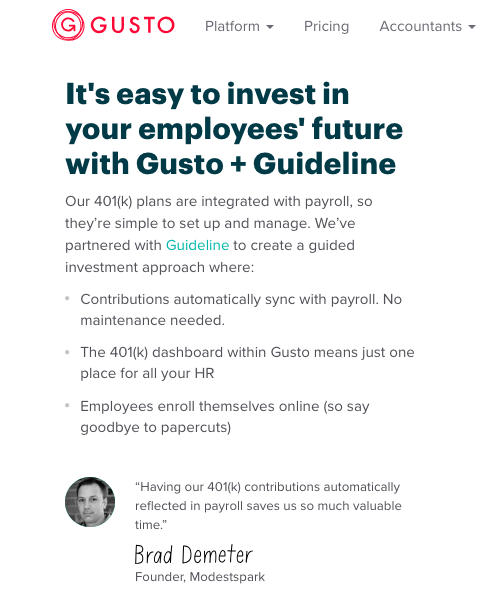
Guideline, which offers a simple 401(k) plan to small businesses, is an excellent example of an SMB-facing company that has successfully used channel partnerships to accelerate customer acquisition. Guideline teamed with several channel partners — including well-known cloud HR/payroll platform Gusto — to gain accelerate customer adoption.

SOURCE: Gusto homepage

The key to success: Guideline’s 401(k) naturally aligned with Gusto’s core payroll product. Once SMBs sign up for a payroll service — especially progressive SMBs that use cloud-based payroll — 401(k) is a natural next product to set up. With channel partnerships, complementary products and a motivated partner are critical. Be smart and creative about how you reach your target audience. Once you figure out what works, then you can double down.


#2 — Increase your ACV by adding more products

Another common challenge with SMB-facing businesses is low ACV (average contract value). However, just like with any business, successful upsell and cross-sell are critical. Adding a second and third product that is complementary to your core product can increase customer value and reduce churn.

Square — a Sapphire Ventures portfolio company — is a prime example of a company that started small (with its simple white card reader) and consistently rolled out new products like reporting and analytics tools, next-day settlements for customer accounts, and more advanced point-of-sale hardware that have attracted higher-paying customers over time.

In 2017, for example, Square launched the Register, a new PoS system aimed at larger enterprises.

square

The Register combined the company’s hardware and software solutions in a single unit, which not only made things less confusing for growing companies but also offered better security, cloud backup, and touch display to improve the speed and quality of transactions.

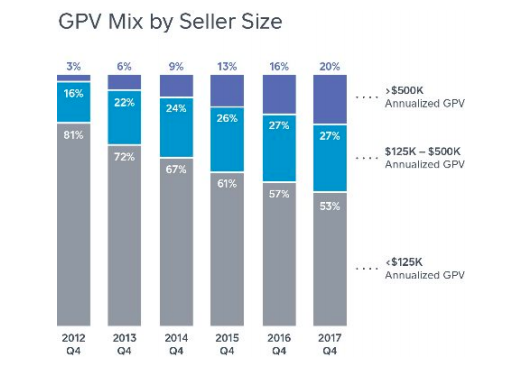
Large companies quickly adopted this solution. In Q2 2018, Square announced that 50% of the sellers on its platform had annual gross merchandise volume of more than $ 125,000.

Square 2017 10-K

Similar product releases have helped Square increase GPV of existing customers, and steadily attract new customers with greater GPV for several years. Since Square calculates transaction-based revenue as a % of GPV, customers with higher payment volumes push overall account values to new levels.

Another SMB-facing rocket ship, Shopify was able to increase its ACV by offering additional “merchant solutions” for larger retailers, including shipping services, support accessing working capital and even a dedicated success manager for its largest accounts. Shopify Plus, its most robust plan, caters to companies as big as Nestle and Kylie Cosmetics. In 2017, Shopify had 3,600 merchants in its Plus program. While most of its customers pay just $50 per month, the customized offerings in Shopify Plus helped drive overall ACV in 2017 to $92.


#3 — Add workflow tools to reduce churn

Perhaps the most angst-inducing dragon that SMB-facing businesses must slay is customer churn. In an environment with low barriers to switching, your customers can’t just enjoy what you’re offering; they must depend on you. To increase retention and reduce churn, many successful companies have become essential by providing tools that integrate with their customers’ workflows, allowing them to gain a competitive edge and grow into larger, more established companies.

MINDBODY is a great case to learn from. The company started as an appointment booking tool for wellness providers. As space became more crowded, MINDBODY added marketing, staff management, and client relationship services to increase stickiness and avoid customers switching to competing software.

Mindbody Milestones 2016 10-K


Today, many customers rely on MINDBODY as a one-stop shop for scheduling, payments, marketing, and even product sales. One longstanding fitness customer remarked that though they mainly use MINDBODY software for class bookings, knowing the retail functionality exists spurred them to expand their store.

Once a company is familiar with MINDBODY’s initial services, it’s easy to continue to depend on them for years as they scale. Adoption of multiple products increases customer engagement and reduces churn.

A final ace that many SMB-serving teams have up their sleeve is the ability to create network effects. DocuSign, another Sapphire portfolio company, is a prime example. At first, the tool was unfamiliar and cumbersome. A way to sign and deliver sensitive documents with electronic signatures — many SMB customers were dubious. Yet the more people used it, and the more other people used it, the more comfortable they became. If one party relied on it for a deal, the other would have to come up to speed to complete the transaction. In 2018, DocuSign had over 285,000 customers. The tool has become commonplace in deals, NDAs, legal transactions, and more. It’s a go-to solution that speaks for itself, with low churn based on its broad adoption across a network of users.

In summary

It’s no easy feat to build a large-scale SMB-facing business like Shopify, Square, DocuSign, or Trulia. The complexities of customer acquisition and retention are enormous (one study shows that SMBs churn at three times the rate of mid-market companies and nearly six times that of enterprise teams.)

While SMBs may be more volatile to work with, the opportunity is massive, and SMBs can be more flexible and eager to try new tools and strategies. If you are patient and inventive with your go-to-market, thoughtfully and regularly roll out new products to solve your customers’ latest problems, and deliver services that genuinely help them succeed in the long run — you’ll reap the rewards equal to or greater than any enterprise-facing team.

Head Over Heels for Headless

Contentful logo

Today we are excited to announce our lead investment in Contentful, a Berlin-based company transforming the content management space by going headless, who is today closing their series D funding at $33.5 million.

We first met Sascha Konietzke, CEO and co-founder, not long after the company was formed and learned about Contentful’s headless content management solution. We were intrigued by their differentiated solution, potential market opportunity and approach even back then. Furthermore, we were impressed by their passion and vision. Also, we knew Sascha and his team were onto something special to redefine an entire technology category. As a later stage investor, we agreed to stay in touch and look at becoming more engaged when Sapphire could be of most help to Contentful.

Content management systems (CMS) have been around for a while and have created a large and growing market. Incumbent enterprise solutions are mostly on-premise and have focused on a page-centric model by coupling content management with content presentation (WYSIWYG). But these large enterprise suites, with their long list of features, increasingly fail to address the changing nature of how content is consumed.

Today, the devices through which we interact with content have proliferated from our desks into our pockets, wrists and cars. Content is not just page-centric any longer, but has taken different forms, coalescing, becoming richer and changing at an increased pace. Applications for content consumption have become more varied, making content consumption more interactive, immersive and seamless.

Delivering content across these new and complex digital applications represents a challenge for organizations using their existing monolithic CMS platforms, which were built for a single purpose, are hard to scale, create content silos and hamper reuse.

Contentful addresses these demands by enabling enterprises to deliver content under a new, headless paradigm. By decoupling content from the presentation layer, Contentful’s content infrastructure frees up the use and reuse of content. Its context agnostic, API-first approach and flexible data model enable content to be used like building blocks within many applications. With a multi-tenant cloud architecture at its core, Contentful offers high availability, scalability, extensibility and improved security management. Customers see a faster time-to-value, lower risk of launch as well as improved efficiency and flexibility.

Contentful initially went to market by addressing developers as enterprises started to renew their digital stacks — replacing on-premise legacy systems with modern, cloud-based, modular architectures. By focusing on enterprise development teams and their requirements first, Contentful created a groundswell of adoption and momentum. Smaller scale trials and project-based usage led to broader adoption and eventually consolidation of the Contentful platform within organizations. The company’s developer focused go-to-market approach created a pull for their solution into enterprises. That pull is now being leveraged and amplified by an enterprise sales motion as Contentful is emerging as the leader in the headless content management space.

Contentful’s progress was recently recognized in the 2018 Forrester Wave report for Web Content Management Systems where they were identified as a Contender solution. In their first appearance in this report, Contentful achieved the highest possible scores in the Cloud Strategy, API Management, Deployment and Configuration, and Developer Program categories.

We are very excited to join Contentful at this point of its journey as an investor and partner. We look forward supporting Sascha and his team with our network and experience on topics such as enterprise sales, efficient scaling and internationalization.