AI blur

How AI Is (and Is Not) Transforming the Workplace

At Sapphire’s 2018 CIO Summit, Databricks’ CEO Ali Ghodsi pointed out that the biggest gains in AI are quite boring. Shiny solutions like self-driving cars, Google Home, and Alexa may dominate headlines, but the real opportunities for the enterprise lie in automating mundane, lower-value tasks. Being able to save time and money on data entry, bookkeeping and tax preparation, and even surveillance in construction projects can free employees to focus on more creative, higher-value work.
how AI


For chief information officers, who increasingly find themselves on the front lines of investment in enterprise technologies, knowing where AI makes a difference can be an enormous asset as the pressure to work in more creative and efficient ways intensifies.

howai


Public interest in AI has surged in recent years, with images like self-driving cars entering the public consciousness. Looking at Google Trends, the average search popularity index for “artificial intelligence” has grown more than 30% since 2014.

Far from entering an “era of replacement” with AI, where humanoid machines succeed people sitting at desks, manning assembly lines, or serving food, we’re facing a time of “enhancement,” as Chris Anderson, former editor of Wired and current CEO of 3DR, noted at the Summit’s opening keynote.

It’s clear that many people still have questions. This pieces provides answers for CIOs and others looking to stay on the cutting edge of AI in the workplace. Drawing in large part from discussions at the 2018 CIO Summit, we zero in on how some of the most innovative companies are incorporating AI into their workplaces — and realizing enormous gains.

The rise of data factories

There’s a lot of hype about how applying machine-learning techniques to data sets can unearth valuable insights. Companies that do this successfully are finding new links between how customers behave in their apps and when they make purchases, between specific onboarding practices and employee retention, and even between variables like the weather and the outcomes of new building projects.

The challenge for most companies, however, is that their data is siloed. Most of the Forbes Global 2000 are sitting atop troves of information, such as purchase histories, product analytics, and employee credentials, but most of the time it’s stored separately and in incompatible formats. Small samples make it hard to unlock meaningful results. In addition, if a company is trying to train machines on limited information, it’s often not enough to deliver accurate predictions.

At the CIO Summit, Ali Ghodsi pointed out that just 1% of companies — primarily Facebook, Twitter, and Google — have the architecture in place to derive significant value from their data sets. For CIOs, this highlights a massive opportunity to follow suit.

The good news is that even for organizations without Facebook’s, Twitter’s, and Google’s resources, new solutions are emerging to help them integrate, clean, and optimize their data sets and run tests at competitive speeds. Databricks, for example, can provide this infrastructure in lieu of organizations having to rebuild their existing systems. Instead of simply storing information, companies that use Databricks software can spend more time analyzing their information and turning it into more relevant products and experiences for their customers.

Using automation to get closer to customers

Interacting with a diverse set of customers on a personal level requires enormous attention to detail. In industries like retail and enterprise software, more and more sales reps rely on nuanced pieces of information, such as past app behavior, purchase histories, interests, and geography, to prospect new leads and pitch products in more meaningful ways.

AI offers ways to complement this data-driven process. At the Summit, Frerk-Malte Feller, director of Facebook’s Workplace collaboration platform, highlighted how teams are starting to lean on sentiment analysis — the process of automatically deriving opinions and other qualitative information from large blocks of text or long voice recordings — to get real-time feedback on customer calls and improve the speed and quality of complex translations. Making these small tasks more efficient helps customer support and sales teams reach more-diverse audiences and ensure that their interactions are more valuable.

The opportunity for improvement is vast. In many call centers, agents still manually enter customer contact information. After calls, the information that agents collect on the quality of customer interactions, including pain points, tone, and the resolution (or not) is rarely complete. When agents are pressed for time, details can fall through the cracks. Sentiment analysis (or emotion AI) helps monitor the quality of customer interactions in real time. The process is advanced enough to measure tones like frustration or satisfaction, based on the prevalence of certain words. While representatives previously routed customers to after-call “How was your experience?” surveys, they can now get results immediately. A quicker and richer data set helps managers support agents’ growth.

In addition, translation rates run about 10 cents a word. With many teams trying to tap into emerging markets, costs can quickly add up. Neural machine translation (NMT) is an advanced AI technique that allows teams to translate Skype calls, marketing materials, and even social media posts faster, with better quality, from English into more complex languages like Urdu and Romanian. In 2018, Facebook was able to increase its translation speed to 4.5B post impressions per day with NMT.

Improving project sequences with AI and machine learning

During the Summit’s opening keynote, Chris Anderson drew connections between AI and more traditional, physical industries. Even in construction — one of the least digitized sectors — AI is helping companies automate project sequences to be safer and more efficient.

Engineering giant Bechtel, for example, is saving millions on new projects, such as airports and power plants, by running data from past projects into an AI algorithm, which helps them better predict how new contracts will turn out, based on risks like inclement weather, as well as material and labor shortages.

“AI — which performs decision-making tasks traditionally reserved for humans — won’t render our knowledge workers irrelevant. AI will allow us to better predict outcomes, design complex projects, and automate day-to-day decision-making tasks.” — David Wilson, Chief Innovation Officer, Bechtel (Source: Bechtel Blog)

Training on a decade of project data, Bechtel has been able to speed up the process of finding correlations among past projects and selecting sequences of operations going forward that are lower risk.

WeWork has also developed a more efficient formula for office renovations that uses machine learning. They start by using reality capture to create high-res 3D models of empty spaces.
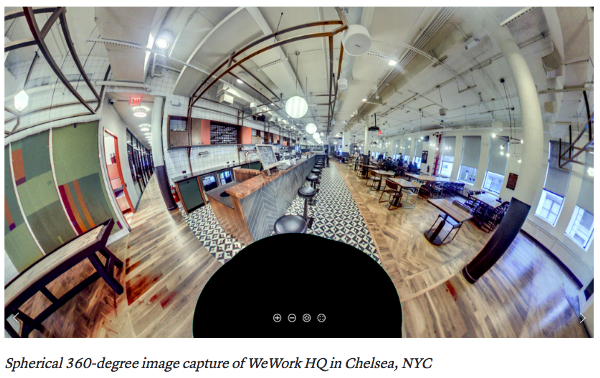
Fisheye

From there, they feed this and other architectural data through artificial neurons that understand the nuances of the building’s layout and how employees move in the spaces, based on prior designs. The software relies on past layouts to predict what changes the new space requires to become a functional and productive workplace.

As WeWork expands from constructing just their own offices to those of other companies, like like UBS and Pinterest, it’s able to create designs with intelligent software that learns the “experience” their client is going for, based on details like the ratio of conference rooms to offices or number of telephone rooms; the layout of public spaces; and even acoustics. The software also optimizes for materials, limiting more expensive glass and metals, given budget constraints. Finally, WeWork prefabs the office, trucks the pieces to the building site, and assembles them like Legos, at low cost.

Construction, manufacturing, trucking, and warehousing — specifically because these sectors are less digitized, there is an outsized opportunity to integrate AI for a competitive advantage.

AI Unlocks Value in Subtle Ways

The most successful AI applications in the workplace today are those that are invisible. Like sprinklers or light switches, they simply do their job, are nonintrusive, and make life easier. CIOs recognize this, even as they face organizational and FOMO pressure to focus on the “shiny” but more experimental uses of AI.

AI is far from replacing entire professions, but it is automating and improving low-value details in day-to-day operations that can be costly, time-consuming, and even hazardous, allowing human employees to take on work that is more meaningful and directly contributes to the bottom line.


Sapphire Fellows

Introducing Sapphire Fellows: Proven leaders to help founders scale

Building a company is hard. With every success and burst of growth, comes a new set of challenges that founders may not have experienced — or even thought about — before.

To help founders navigate these developments and accelerate their growth, Sapphire is proud to announce the Sapphire Fellows program. Sapphire Fellows matches experienced business and tech leaders with Sapphire portfolio companies looking for perspective and ongoing mentorship as they grow.

In addition to access to a skilled mentor, Fellows can help portfolio companies by:

  • Making introductions between founders and potential investors, customers or partners
  • Assisting in fundraising or recruiting efforts
  • Participating in strategic meetings to support the portfolio company
  • The value exchange from the Fellow program is two-way, with participating companies benefiting from an experienced, guiding hand, and Fellows getting exposure to the next generation of innovation.

“Tomorrow’s most successful companies are combining the wisdom of the past with the digital possibilities of the future,” says Yvonne Wassenaar, former CEO of Airware and Sapphire Fellow.

“The Sapphire Fellows program accelerates this powerful exchange and it is an honor to be a member; working with and learning from such a diverse and powerful set of leaders.”

The first cohort of Sapphire Fellows who will be matched with portfolio companies include:

  • John Baird, Executive coach to CEOs and Founders, Velocity.
  • Kiran Bondalapati, Infra, Uber; Former Co-Founder, CTO and VP Engineering, ZeroStack.
  • Richard Campione, Former Senior Executive and GM at Splunk, SAP, Siebel, ServiceSource. Board Director: Winshuttle, Biome Analytics, Mavenlink, and Innovyze.
  • Cheryl Chavez, Chief Product Officer, Engagio; Former Group Vice President, Product Management and UX, Marketo.
  • Ray Elias, Chief Marketing Officer, Hotel Tonight. Former Chief Marketing Officer, NatureBox and StubHub.
  • Justin Fitzhugh, Vice President, Technical Operations, Instart; Former CIO and VP of TechOps, Jive Software; Former VP, Engineering Operations, Mozilla Corporation; Advisor: Portworx and The Fabric.
  • Arnnon Geshuri, Chief People Officer, Livongo; Former VP of Human Resources, Tesla Motors; Former Senior Director, Recruiting and HR, Google, Inc.
  • Vijaya Kaza, Chief Development Officer, Lookout; Former Senior Vice President, Cloud Products and Engineering, FireEye, Inc.; Former Engineering Executive, Security Business Group, Cisco.
  • Leslie Kurkjian, Vice President Talent, MuleSoft; Former Head of Dropbox Rotation Program, Global Talent Development, Dropbox; Former Program Manager, Emerging Businesses, Google.
  • Doug Knopper, Former Co-founder / Co-CEO FreeWheel Media; Former CEO, BitPass, Inc; Former SVP/General Manager, DoubleClick.
  • Ursula Llabres, Head of Customer Growth, Workplace by Facebook, North America, Facebook. Former VP of Customer Success, InsideSales.com; Former Senior Manager, Customer Success, Box.
  • Dan Maloney, CEO of ZEPL; Former CEO of Perspica; Former Vice President, Sales and Marketing, AccelOps.
  • Tatyana Mamut, Founder, Strategic Advisor, TMamut Inc and CultureRisk.com; Former GM and Director of Product Management, Design and Engineering at AWS; Former Vice President / Head of Product Experience & Design, IoT Cloud, Salesforce; Former Founder & Senior Designer, Organization Design, IDEO.
  • Chris McClain, Principal, Growth Accelerators; Former SVP, Global Sales, DocuSign; Former EVP and GM, Americas Strategic Industries, SAP.
  • Avanish Sahai, Global VP, ISV and Technology Alliances, ServiceNow; Board Director, HubSpot; Former SVP Channels and Alliances, InsideSales.com.
  • Eric Schrader, Chief Customer Officer, BetterWorks; Former Global VP, Professional Services at Coupa.
  • Eyal Shavit, VP, Global Head of Technology, Samsung NEXT; Former Chief Technology Officer, Sports Illustrated Play (Acquired by NBC), Former Chief Product Officer, Innovation, Deluxe Entertainment Services Group.
  • Adam Spiegel, Former Senior Vice President, Chief Financial Officer and Treasurer, Glassdoor and RPX Corporation; Former Chief Financial Officer, Vectrant Technologies Inc.
  • Yvonne Wassenaar, Former CEO of Airware; CIO and SVP of Operations New Relic; CXO Vice President VMware; Strategy Partner Accenture. Board Member of Forrester and Harvey Mudd College; Former Board Member, Mulesoft, Bitium and the Athena Alliance.
  • Courtnee Westendorf, Former CMO and marketing executive at The Oakland Raiders, Intel, Disney, and Apple.
CIO Summit 2018

3 Ways CIOs Stay on the Front Lines of Innovation: Takeaways From the 2018 CIO Summit

Sapphire Ventures recently brought together business and IT leaders representing more than $63B in annual IT spend for our CIO Summit 2018 — a 2-day exploration of emerging trends and tools driving today’s successful companies. Featured speakers included:

· Chris Anderson, former editor of Wired and the current CEO of 3DR;

· Aaron Levie, CEO of Box

· Bruce MacGregor, an IDEO partner;

· and Norm Fjeldheim, CIO and Head of Global Facilities for Illumina

2018 CIO Summit

Aaron Levie and Norm Fjeldheim share the stage at CIO Summit 2018

For attendees, the annual CIO Summit provides a forum for exchanging best practices and swapping stories from the trenches. Presentations, breakout sessions, and networking enables CIOs to connect with peers addressing similar business challenges — and often, to be connected with, tech startups in attendance with solutions that address those issues.

This year’s conversations revolved around:

• How AI is (and is NOT) transforming the workplace
• How CIOs can enable new paradigms for employee collaboration
• The role CIOs can play in engaging non-traditional stakeholders such as customers, external vendors, and the developer community.

This last topic highlights a trend we’ve identified in prior years: the role of the chief information officer is fundamentally changing. CIOs continue to call out that their role is evolving from internally-facing, “keep-the-lights-on” activities to a role that is more externally, and focused on value-add activities. One way CIOs are making this transition is by proactively finding and adopting emerging technologies to improve their organization’s infrastructure and operations.

This year’s Summit focused on the Future of Work, and the unique role CIOs play in future-proofing their organization.

There were three common calls-to-action CIOs highlighted at this year’s Summit:

1) Enhance existing jobs with intelligent systems

When many people think of AI in the workplace, they envision human-like robots taking over and leaving large segments of the population unemployed. This dystopian future couldn’t be further from current practice. While robots and AI are set to take over millions of existing jobs in the next several years, they will be focused far more on “boring” tasks (in the words of Databricks CEO Ali Ghodsi) than general-purpose human replacements.

While many acknowledged that AI has been over hyped, attendees agreed that AI’s increasing ability to take over mundane tasks can increase productivity and add tremendous organizational value.

Far from leaving millions unemployed, intelligent systems will create even more opportunities, freeing up humans for complex and creative work. Today’s AI hype tends to focus on more exotic applications such as self-driving cars, but there are literally thousands of uses for “boring AI” to sort through the repositories of data enterprises have access to.

Chris Anderson highlighted this trend in his opening keynote, focusing on how even such a physical world industry such as construction, can leverage AI to address repetitive and dispassionate work like performing site scans.

Ali Ghodsi urged CIOs to shift their thinking on AI from an “era of replacement” to one of “enhancement” — where integrating intelligent systems into daily workflows make teams faster, smarter and help them deliver higher-quality products overall.

2) Improve financial results through stronger customer engagement.

Measuring customer engagement alongside top- and bottom-line growth isn’t new. Companies like Amazon have been doing it (with enormous success) for decades. What’s changing today is the level of detail teams get into when studying their end users, and the impact it can have on the business.

Tracking monthly active users used to be enough, but today’s tools allow companies to measure data like product breadth (users per account), depth (how many of a product’s core features customers engage with), and even frequency (how often users log in to a product in a certain time frame) on a near real-time basis.

Customers are smarter than ever and their expectations are rapidly evolving. With easy access to information and low switching costs, consumers are continually optimizing for quality and price. It’s up to companies to stay up to date with consumer needs and expectations, and rapidly respond — and this is where CIOs can directly impact business performance.

CIOs have a strong role to play in helping their organizations better understand customers on a granular level. Tools are emerging to help teams track the movements of customers on company platforms and make communication more personal and relevant. Pendo cofounder and CEO Todd Olson and LeanData cofounder and CEO Evan Liang discussed how companies zeroing in on these metrics are better able to update existing products, develop new ones, and delight customers.

While top-line growth is important, teams that lean into customer engagement often realize greater revenue over time, due to higher retention rates and cross-sell and upsell opportunities.

SAP’s Adaire Fox-Martin and Pendo’s Todd Olson discuss the opportunity to engage customers in the New Economy.

3) Adapt to a changing workplace with new tools and emerging technologies.

As technology evolves, so does the way we work. CIOs can help drive this organizational shift by leveraging recent developments in tech — from investing in new collaboration tools like Workplace by Facebook, to utilizing tools to increase developer speed and agility.

2018 CIO Summit

The most successful engineering teams — and, by extension, the most nimble and productive companies — execute quickly yet remain open to new ways of working. Microsoft’s Julia Liuson pointed out that it’s time to throw out the old rule book for measuring the productivity of a developer. Today, the best tools can win at the grass roots level with developers before a CIO is even aware they are being used in the organization. Companies like JFrog, which automates and secures developer processes, can free up teams to be more creative and ultimately deliver higher-quality products and services.

Staying on the front lines of innovation is essential to being a successful CIO, and yet staying on top of emerging technologies can be like drinking from a fire hose. To help CIOs and their colleagues, Sapphire Ventures revealed SV Explorer, a soon to be launched innovation discovery tool that will help CIOs identify, evaluate, and share profiles of start-ups that have built emerging technologies of potential value. SV Explorer taps into Sapphire’s portfolio of disruptive technologies, as well as over 40 top-tier venture partners across the globe. SV Explorer launches publicly in later in 2018 to help innovative Global 2000 companies drive digital transformation in their organizations.

CIOs: Adapting Your Organization to Survive

Organizations that can adapt to new consumer expectations and the changing business environment will survive, while others will become irrelevant. We’ve seen this trend play out in real time with decreasing life spans of companies on the Fortune 500 — down to just 20 years from 60 in the 1950s. In 2017, 15 companies dropped off the list, including heavyweights like KKR, Hess, and Barnes & Noble.

With the pace and volume of work increasing, CIOs are juggling many moving parts as they try to steer their organizations in the future. For CIOs to be successful in this, it’s critical to stay informed on emerging technologies to predict and adapt to the disruptions their industries and organizations will face. Events like Sapphire’s CIO Summit enable CIOs to stay on top of emerging trends, and network with their peers.

Stay tuned for deeper dives into content from the CIO Summit 2018 in the coming weeks.

project 44

project44: Democratizing the Amazonification of Shipping

At Sapphire Ventures, when we think of investing in “companies of consequence” we think of monster spaces, emerging and disruptive technologies, and companies with clear value propositions. It’s hard to think of a better fit for those characteristics than a company that’s creating the connective tissue layer between the various elements of the transportation and logistics space. And who better to lead a company to disrupt a trillion-dollar industry than a team who has done it before. That is why we are so excited to join Jett McCandless (CEO) and team with our newest Series C investment in project44.

A White Lie

This is a bit embarrassing to admit, but I first came across Jett and project44 more than two years ago when I emailed Jett multiple times asking if he would be able to meet while I was in Chicago for meetings or a conference here or there. What Jett found out while co-writing this blog was that I had fabricated those trips so that in the case he agreed to a meeting I could quickly book a flight. True story. But, that’s how taken I was with the concept of bringing a fully automated, real-time API visibility layer to the shipping space.

I won’t confess to how many trips I faked to Chicago before our first meeting, but I will admit that our excitement in what project44 was building only grew as we spoke with shippers, carriers and third-party logistics players who were tired of using phones, faxes and outdated EDI solutions to track shipments. project44 provides a digital API solution that connects all the elements of this supply chain with trusted, normalized data in real-time that can easily be shared and analyzed to ensure optimization of shipments. Think Stripe, Twilio and Mulesoft*, but for shipping. This is one of those huge spaces with a no-brainer value proposition — to replace an asynchronous, human-intensive process of connecting dots in the air with an automated, digital solution that takes only 15 seconds, not the traditional 15 minutes, to complete. And it’s able to do this thousands of times every day.

The Sound of Inevitability

The logistics industry is rapidly changing. Traditionally, it has lagged behind other industries in the adoption of nextgen technologies, which is somewhat surprising given the size of the space and the fragmentation between when a shipper looks to ship something and when a carrier ultimately delivers it. Call it an emerging wave, an inevitable modernization, or the Amazonification of an industry, but players in the space are realizing that as customer expectations become increasingly important, it’s not just about operational efficiencies anymore. Customers want and expect visibility into where shipments are and confidence in on-time delivery of those shipments. As we move toward an era of “liquid inventory,” limited human interaction and cobbling together vast amounts of siloed and ununified data just isn’t going to cut it anymore.

The Man to Do It

This is where Jett comes in. He started his career in the call center of a freight forwarder, taking call after call to tell the other person on the line that their shipment was on the way regardless of where it was at the time. He quickly realized there must be a better way to manage and track freight. Jett assembled a top-notch team of professionals with experience across the space to build what would quickly become the preeminent connective tissue that provides not only visibility, but also unifies every part of the process, from pricing to payment, across all modes and geographies.

We couldn’t be more elated to add project44 to the Sapphire family, and join Jett and his team as they revolutionize the shipping industry and help all players in the supply chain make better, faster and cheaper decisions to ultimately get customers what they need when they need it.

A First Impression and Lasting Partnership

My first thought about Kevin Diestel was, “Wow, this guy must really love visiting Chicago, he’s here all the time!” In retrospect, even though Chicago is a world-class city with many cultural and culinary attractions, I soon realized that Kevin was very serious about project44 and he was “leaning in” to learn more about our company. In hindsight and unknowingly, I was playing hard to get. It was clear after our first meeting that we were “kindred spirits”. It takes a unique perspective, which Kevin and I share, to get as excited as we are, about bringing advanced visibility solutions to the transportation and logistics markets. Finding somebody with that passion matched with the focus, drive and operational acumen to make it happen is rare, and once we were finally able to sit down and talk, it quickly became clear to me that Kevin saw the same potential here that I do.

In truth, it was his persistence that spoke volumes. Seeing how committed Kevin and Sapphire were to understanding our vision and market, I knew that they saw as much value in the work we’re doing as my team and I see. That’s a large part of what ultimately led us to partner with Sapphire — they understand the massive potential behind connecting the freight industry, they see the incredible benefit this can bring to everyone and everything that touches the supply chain, and they recognize that we have the team and the resources to get the job done.

Having a team like Sapphire behind us is a tremendous strength and competitive advantage. They don’t just make financial investments, they invest in the growth and success of their portfolio companies. I’m as committed to the success of my team members as I am to the success of the company, and I only partner with people and organizations who share that view and passion. That’s what I see in Sapphire, and that’s what makes me so excited about collaborating and scaling with them. With investors like Sapphire Ventures helping us on our journey, we are extremely confident that we will succeed in connecting the world’s transportation ecosystem and increase trust and predictability in the industry.

Paule Pete

The Right COO Will Take Your Company to the Next Level — Here’s How to Find Your Match

Over the years — as an operating executive, angel investor, board member, and now a VC at Sapphire Ventures — I’ve enjoyed being a sounding board and advisor to dozens of amazing startup CEOs. A common topic that CEOs want to discuss is how to level up their organizations when they’re experiencing hyper growth. Often, that means figuring out whether they should hire a COO, and if so, making sure they find the right fit.

As a former COO who joined Trulia as an outside hire, I know first-hand that this is an important and nuanced topic. In the right situation, adding a COO can give a CEO a powerful partner in transforming and scaling her company. But hiring a COO at the wrong time, or hiring the wrong person, can be a costly — or even fatal — mistake.

In this post, I’ll help CEOs think through five critical parts to hiring an outstanding COO to level up their organizations.

1) Hire a COO when things are going well, not as a fix

If your startup is struggling to gain traction or growth has slowed, adding a COO likely won’t solve the problem. Establishing product-market fit and starting to scale are your first priorities, and if you haven’t achieved these and are failing to lead your team through a stagnant time, your company needs stronger medicine than an outside COO.

As an early-stage founder/CEO, you need to fix what’s wrong yourself. If you’re not up for the grind of execution, you should take time to consider whether being CEO is right for you and your company in the first place. Startup CEOs need to be hands-on for many years — if not forever — and a culture of strong execution and attention to detail must be established from the top of the company down.

Hire an outside COO to fan the flames — not start the fire itself. A good time to add a COO is when your company is exploding with growth, and you need a partner to capitalize on a ballooning list of opportunities. This happens as you add more product lines, address new customer segments, and push into new geographies. At this point, a COO can bring real leverage and accelerate what’s working.

Paul Levine, Pete Flint

Paul Levine, Pete Flint

As COO at Trulia, I joined a company that had a large consumer audience and recently hit $20m in revenue. The company’s employee base was doubling year-over-year, and growing revenue was becoming a primary focus. Pete Flint, Trulia’s co-founder and CEO, was sharp on vision, product strategy, audience, and company culture but was searching for support growing revenue and scaling the organization. These were two of my core skill areas, and I was able to complement Pete and partner with him for the next leg of the journey — from private company to IPO to eventual multi-billion dollar acquisition by Zillow.

2) Seek out complementary skills

Typically, a COO will bring skills and experiences that complement those of the CEO. In places where the CEO is weaker or less interested a COO can add fluency and dedication. Maybe the COO is an industry veteran who knows the market well or has made a name for herself in hiring and retaining talent and managing large organizations. Figure out your gaps and look for someone to help fill them.

Sheryl Sandberg, Mark Zuckerberg

Sheryl Sandberg, Mark Zuckerberg (Mark Zuckerberg’s Official Facebook)

Sheryl Sandberg’s partnership with Mark Zuckerberg is perhaps the canonical example of a complementary COO. Sheryl joined Facebook in 2008 when it was just four years old and experiencing exponential growth. The company was beginning to focus on revenue to realize the stratospheric $15 billion valuation Microsoft had bestowed on them the prior year. Sheryl’s track record driving Google’s sales and ops and her 15 years’ experience were a perfect balance to Mark’s product vision and youth. At Facebook, Sheryl built the sales and revenue ops team and steered 260 employees from a young, relatively immature organization to a public company, deep with talent.

Hiring Sheryl allowed Mark to channel his efforts into Facebook’s product, with resulting breakthroughs such as the News Feed, Facebook platform, mobile, and Messenger. Facebook’s results — 2 billion users, $40.7 billion in revenue, and its current $400+ billion market cap — speak for themselves.

3) Remember: this is different than a VP hire

While CEOs often lean heavily on and entrust VPs with significant portions of the business, in most cases CEOs hire a COO to take on broader leadership responsibilities and be a true partner in building the company. Because of this, hiring a COO is higher-stakes than hiring a VP. Mutual trust, alignment on vision, and personal chemistry are just as important in hiring a COO as they are in selecting a co-founder. You and your COO will spend late nights and weekends working through the thorniest issues facing the company. In challenging times, you’ll have to get creative and project confidence to the rest of the team. And when things are going well, it’s helpful to have a foil, so you don’t rest on your laurels.

Aaron Levie, Dan Levin

Aaron Levie, Dan Levin (Box)

At Box — a Sapphire Ventures portfolio company — founder/CEO Aaron Levie hired Dan Levin into a very senior, expansive COO role early in the company’s history. Dan became the de facto general manager of the Box business, leading go-to-market, operations, and many functional areas. This freed Aaron up to focus on Box’s product and culture, the things he cared most about and felt uniquely qualified to lead. A large portion of Box’s executive team, including several VPs, reported to Dan, and the two worked side-by-side to drive many of the company’s major initiatives.

When hiring a COO into an expansive role as Aaron did, it’s important to seek out experience, but you don’t want someone who’s so entrenched in their ways that they aren’t flexible enough to adapt to a new situation. Every startup is unique. The best COO will be able to draw on their prior successes yet be creative and flexible enough to try new things where solutions don’t yet exist.

4) Know your potential COO’s goals

A final important fit factor is to assess a COO’s aspirations. Unless you’re looking to replace yourself as CEO, your COO should be happy to stay in his or her role — and not see it as a stepping stone to replace you as CEO. All of the examples discussed so far — Pete and I, Mark and Sheryl, and Aaron and Dan — were stable multi-year relationships, built on common expectations, mutual trust, and respect.

Two other exceptional duos to learn from are Yelp’s Jeremy Stoppelman and Geoff Donaker, and Intercom’s Eoghan McCabe and Karen Peacock.

Geoff Donaker, Jeremy Stoppelman (Getty Images)
At Yelp, Geoff Donaker joined very early in the company’s evolution, and became COO the next year. As Yelp’s tenth employee, Geoff played a crucial role in keeping the company focused and on-task in its exciting yet fragile state and built a powerful local advertising business that multiplied growth exponentially. Geoff oversaw Yelp’s revenue strategy from inception to generating $700 million. Geoff remained Jeremy’s powerful #2 for over ten years and played a massive role in the company’s success. By 2016, employees numbered 5,000, and Yelp was a public company.

Karen Peacock, Eoghan McCabe (Intercom)
At Intercom, Eoghan McCabe brought on Intuit veteran Karen Peacock last year, after their Series C. Eoghan and Karen spent five months getting to know one another before starting to work together professionally. This was largely due to Karen’s firm belief that it was important to align on values, figure out one another’s skill sets, divvy up tasks, and set clear expectations for handling disagreements. If you’re “oil and water,” in Karen’s words, “you’ll start pulling the company in different directions.” Defining and settling on roles that work for both parties early on has allowed this formidable CEO/COO pair to stay on track when things took off.

5) Use your network to find the best match

Given the above, hiring a COO should be network-driven. Chemistry and alignment are indispensable, and it may take you many months or even years to find the right person. Once you do find your “other half,” the benefits are well worth it. Because finding a true partner, who supports your vision and balances your personality and working style, is far more important than hiring someone with the right resume, CEOs should leverage people who know them best in the workplace for advice and introductions. These might be investors they have closely collaborated with, or peer founders.

In an extreme case of network-driven, long-term CEO-COO dating, Pete Flint and I met 4 years before I joined Trulia as COO. A mutual colleague at Accel introduced us, and initially I was a reference for one of Pete’s early hires. We continued to meet up regularly and were able to get to know each other over several years. When Pete was ready to hire a COO, we already knew the fit was right. In Pete’s words, “the connection to finding your COO is likely closer than you think.”


To summarize, when you’re vetting COO candidates, look carefully for the following:

  • Do they share your vision and values for the company?
  • Do they have complementary prior experience, including knowledge of new tools and processes, to scale your company?
  • Is this someone you can learn from?
  • Are they willing to share and teach to help everyone improve?
  • Will they be able to recruit, hire, and retain the best talent for the areas they focus on?
  • Do their personal aspirations align with your vision for the role?

You’ll want to meet a wide range of candidates to help you calibrate and decide what you’re really looking for. Remember that there is no single framework for hiring a COO. As with any key position at an early stage company, much of it comes down to chemistry and a mutual understanding and commitment to what the future will look like. Give weight to a resume — but don’t underestimate your gut.

Note: thanks to Pete Flint, Geoff Donaker, Karen Peacock, and Aaron Levie for reading drafts of this.

By Rajeev Dham, Partner, Sapphire Ventures and Todd Olson, Founder and Chief Executive Officer, Pendo

Pendo-monium! — Why Sapphire and Pendo are Excited to Partner

By Rajeev Dham, Partner, Sapphire Ventures and Todd Olson, Founder and Chief Executive Officer, Pendo

I’m thrilled to announce that Sapphire Ventures is leading the Series D financing for Pendo, an incredibly exciting SaaS business re-defining the product and user experience software category. I’m happy to welcome Todd Olson, CEO of Pendo, to the Sapphire family and to share his views here on why he decided to partner with Sapphire. But first, let me tell you my partners and I decided to Spendo on Pendo!

Why Partner with Pendo?

At its core, Pendo provides a product cloud platform that improves users’ experience with digital services. As I spend a good portion of my time searching for the next big SaaS business, I’ve come to the realization that the largest and most sustainable differentiator from one application to the next isn’t necessarily based on technical complexity. Rather, the ability for end-users, folks like me and you, to achieve rapid time-to-value and experience ongoing satisfaction with the product is paramount.

Pendo is the enabler behind this broader trend as they allow folks in product, UI/UX, customer support and success organizations to understand user behavior within their digital services and iterate on product features and flows, but also inform smart in-app communication as a result of the deep analytics they are collecting. They smartly combine visibility via analytics with action via communication — a combination that dozens of customers were thrilled by. The next product and experience cloud platform is in the making!

As we at Sapphire seek to partner with “companies of consequence,” the team ends up being one of, if not the, most critical driver. Let’s begin with Todd. I first met Todd in mid-2016 and despite Pendo being early for our stage focus back then, I came away incredibly excited about what he was building and his product-driven approach to the business. That said, given any company at this stage, execution risk was still meaningful. Fast forward 2+ years and, admittedly much to my pleasant surprise, Todd had nailed the plan he had laid out for me way back then. Execution — check!

That said, execution without leadership can only get you so far. More impressive than Todd’s ability to execute, is his ability to lead, proven by the management team he’s been able to attract, many of whom were hired only in the last two years — Bill Binch (CRO), Jennifer Kaelin (CFO), Jake Sorofman (CMO) and many others. Bottom line — Pendo’s team, led by Todd and his co-founders Erik Troan, Rahul Jain, and Eric Boduch, is one of the strongest I’ve seen. The intangibles are what create something special and Pendo’s got it!

Ultimately, however, venture capital investing isn’t as formulaic as I or others may make it sound. Investment decisions are often influenced by the relationship, the human connection between entrepreneur and investor given we’re in this together for the long haul. To that end, Todd’s unique combination of being incredibly down-to-earth yet fiercely competitive with an unrelenting desire to win deeply resonated with me and my partners and will make for a great partnership!

Why Partner with Sapphire Ventures?

If I had two words to describe Rajeev, they’d be enthusiastic and persistent. As he mentioned above, we met two years ago during our Series B fundraise and while he didn’t invest then, he stayed in nearly constant contact. Almost like clockwork, he’d ping me each quarter and my response was always the same: We’re not fundraising; we’re focused on execution. When I finally agreed to re-engage this summer, Rajeev came prepared with insights from nearly two dozen customer conversations. Moreover, his comments and takeaways showed a level understanding about the nuance of our product and business that impressed me.

Raising four rounds of venture funding has taught me that it’s not about the money — it’s about the people. You can get money from anywhere. The people affect your company (and life) far more. We’re fortunate to have investors that help us close customers, recruit great people, and push us to realize our full potential. We’re betting that Rajeev brings the same level of tenacity to company-building as he demonstrated during the fundraising process. We’re on a mission to transform how software is created and delivered, and we can always use more advocates willing to roll up their sleeves and unwilling to accept “no” as an answer.

Even more unique in my due diligence is their Portfolio Growth team, which is dedicated to helping their companies successfully scale. The Sapphire Portfolio Growth platform regularly leverage their global CXO network to make valuable introductions to customers, partners and executive talent. We’re also excited to be speaking at their annual CIO Summit in October, which will help us elevate the Pendo message to a powerful group of Global 2000 CIOs, Silicon Valley CEOs and industry thought leaders. Through all of my reference calls and interactions, it was clear that Sapphire’s Portfolio Growth team is more than just talk — they are all about impact and outcomes.

Our Pendo Partnership

We are thrilled to welcome Todd and Pendo to the Sapphire family and can’t wait for the journey ahead!

men sitting around dining table at formal restaurant

Top Challenges Today’s Product Managers Face

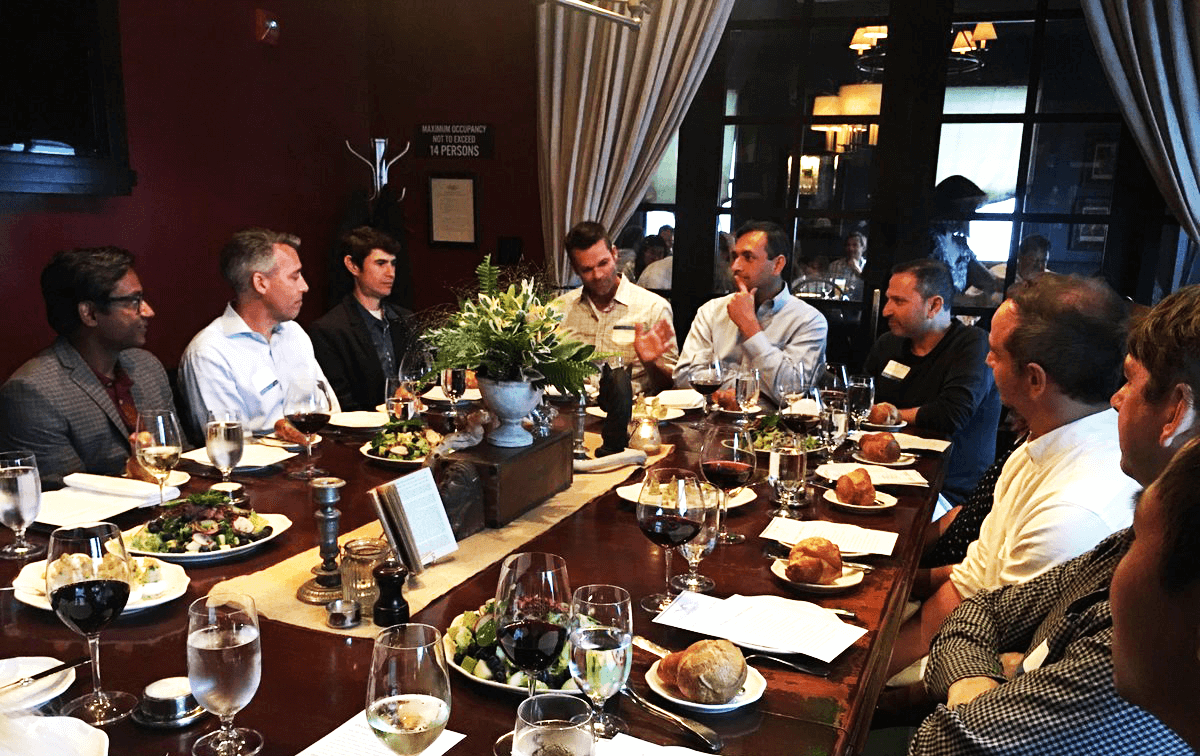
On July 10th, Sapphire Ventures hosted a private Product Leader Dinner to discuss the top challenges that product leaders face today. The San Francisco-based event was attended by nearly twenty product executives from fast growing and venture-backed startups such as Astound.AI, InfluxData, and Narrative Science and global technology companies such as LinkedIn, Salesforce, and Uber.

men sitting around dining table at formal restaurant

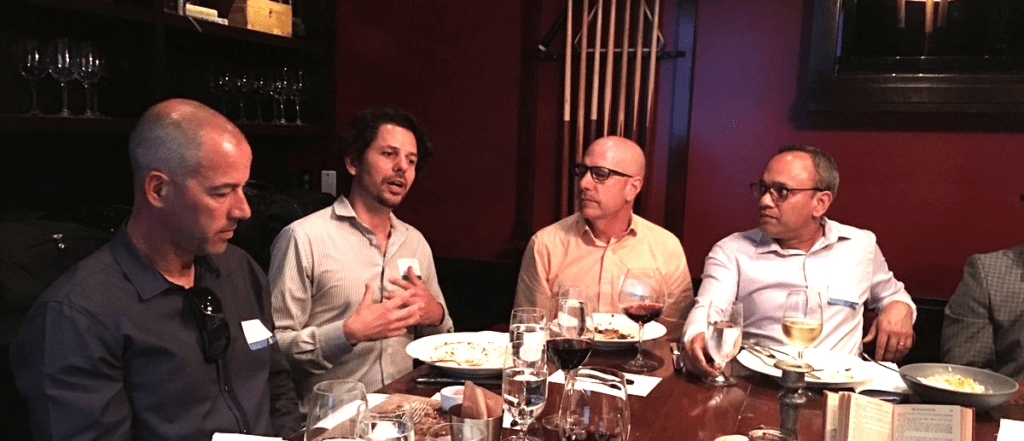
The event featured a round table discussion around four specific subject areas: Innovation and Fundraising; Product Development; Managing Disruption; and Market and Team Development. The product leaders in attendance used their respective knowledge and experience to take turns acting as hosts during the round table discussion, and a few of the questions raised during the conversation will be discussed below.

Special thanks to Mauro Mujica-Parodi III, VP of product at Narrative Science, one of our portfolio companies, for inspiring the event and helping to distill the following key questions and takeaways.

Innovation and Fundraising
How do you foster innovation and continue to motivate your teams to dream big — especially at a large company?

While the group was hard pressed to find many examples of large companies who do this well, they were confident that it could be achieved with the right conditions in place. They agreed that a company’s culture is a key driver in supporting whether innovation can truly survive at scale. Within a company’s culture, they emphasized the importance of questions such as whether risks are rewarded and whether innovation is allowed to permeate the entire organization or is restricted to one small group.

One solution that the group did discuss was innovation groups, but it was a shared sentiment that if innovation groups are going to be successful, a sound structure must be in place:

  • A clear mandate should be enacted; only 10X ideas should be entertained and invested in, and failure is an option.
  • All layers between the group and the Executive Leadership Team should be removed. Moving successful initiatives out of incubation and into production will often require executive level support to alter the status quo.
  • The team should be cross functional, and the leader should be seen as a strong influencer within the organization as a whole.
  • The team should not be held to the same standards for status updates as a production team: executives need to provide the group with the creative space to let their ideas develop and evolve.

Product Development
How do you balance strategic product improvements with existing customers’ immediate needs?

The group discussed two key points around this issue. First, they discussed the importance of better assessing the product development investments by focusing on the problem being solved rather than the solution. Members had ideas to do this by focusing on the life cycle of the product when prioritizing tasks and tying the development investment to actual customer metrics. In large part this stems from the ability to understand the difference between what a customer needs versus wants.

top-challenges-img-2

Second, members of the discussion agreed that partnering with a strategic customer to co-develop a proof of concept is vitally important. This partnership allows for real insights into how the product will be used and what needs the customer has. While there is a risk of “building to order,” a strong product manager should be able to tactfully prevent that from occurring.

Managing Disruption
How do you get your teams to work better together and align around core success metrics?

The group discussed several concrete actions companies should take to drive better alignment across teams. First, a company should ensure that everyone is clear on the mission and core metrics of the company or the business unit. Leaders should check this by asking all team members to articulate the “why” and the “what” in their own words. Second, a team’s overall objectives should be a level higher in comparison to the scope of their day-to-day responsibilities. This ensures that they are solving for the whole rather than for their piece of the problem. Third, the organizational structure should be such that team is encouraged and required to focus on realizing cross-functional opportunities rather than deep siloed thinking within their own department.

Market and Team Development
How do you and your team support customer success functions?

In order to enable teams to support customer success functions, the group focused the discussion around the importance of increasing the entire product development teams’ external awareness. By requiring them to get first hand exposure to buyers and users, team members are more cognizant of the problems they are trying to solve.

top-challenges-img-3

As part of on boarding, new product and engineering hires should spend one to two weeks acting as a customer support representative, and this practice should even be continued annually to continue focusing on the buyer and user. Additionally, engineering team leads should be required to go on at least two or more customer visits a year and brief their teams on the experience. Finally, product managers should be meeting several times a month with customer support to better understand customer pain points.

Favorite Product?
Before entering the room, guests were asked to write down their favorite product. We thought that our product experts had some pretty creative, funny, and insightful answers, so we decided to share a few:

  • Telephone
  • Deck of Cards
  • VW Westfalia
  • Ricochet Modem
  • Tesla Model 3
  • Joule Sous Vide Cooker
  • Folding Wayfarers
  • Google Maps
  • 1 Second Everyday

It was a fantastic night of networking, sharing of best practices, and “thinking bigger” as a collective of product leaders.

Reonomy

Reonomy: Lifting The Veil On Commercial Real Estate

Today at Sapphire Ventures, we are extremely excited to announce our lead investment in Reonomy, a New York based company that is revolutionizing the way data is used in the commercial real estate (CRE) market.

Over the last several years, we’ve been fortunate to partner with folks that are upending the database and data warehouse markets and we’ve invested in multiple generations of companies advancing the state-of-the-art in data transformation, data preparation, business intelligence and analytics. We’ve also had great fun and success working with entrepreneurs who have changed a software vertical or service landscape altogether (e.g. corporate HR, retail and CPG commerce, government operations) by offering innovative functionality that is married with good data — a trend that continues with our investment in Reonomy.

When we first met Rich Sarkis (CEO) and the rest of the Reonomy team, we were intrigued, in part, by the size of the end markets they were beginning to disrupt. More importantly however, we were truly fascinated by the complexity of the problem they had solved and the ease with which we were able to understand the applications they had built, even as CRE newbies. The fact that we genuinely enjoyed and appreciated our interactions with everyone on the team, and that the hockey-stick growth in the business was labeled “actual” — not “forecast” — only fueled our excitement. Ultimately, we decided to lean in on leading Reonomy’s Series C round despite the Company having raised funds earlier this year and having sufficient cash on hand to support its operations.

So, what makes Reonomy so exciting? In their own words, Reonomy is “lifting the veil on commercial real estate”, through data and applications that provide transparency across markets, which are extremely dispersed (spread across 3k+ counties and 20k+ municipalities in the U.S. alone), “dirty” and dynamic. Reonomy constantly aggregates and cleanses this data, selling data APIs as well as applications that are useful for participants in CRE markets such as brokers, investors, lenders, retailers, etc. Because of this, Reonomy is able to provide information around property details, property owner details (often deliberately obscured), transaction and valuation information, as well as workflow, visualization, and discovery capabilities. Today, Reonomy’s database spans 100M+ companies, 150M+ people and 99% of commercial properties in the U.S., which gives the Company an unprecedented understanding of the CRE lending and ownership landscape.

Reonomy started offering its solutions in New York City prior to launching a nationwide product and gaining significant momentum in the second half of last year. Given our experience helping young, hyper-growth companies scale to successfully support rapid and efficient growth over the long term, we are extremely excited to get involved at this point in the Company’s journey and are looking forward to helping Reonomy bring data disruption to CRE and its related markets!


LPs Push Into the Crypto Fray

There is nothing like being ten years fashionably late to a party, though given VC interest investing into crypto[1], it seems like a good time to discuss what LPs think about crypto as an investment opportunity.

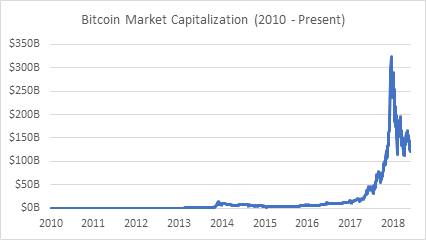
Simply put, there has been massive value creation of cryptocurrencies since 2010 as illustrated by proxy through the growth in bitcoin’s market capitalization.

Bitcoin Market capitalization (2010-present)

And, the majority of this value creation happened in 2017, taking bitcoin’s price from $998 to $14,166.

Bitcoin Market capitalization 2017

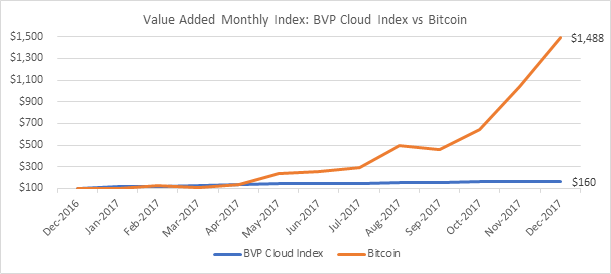
Given that blockchain has reached a significant scale in a short period of time, it shares the venture characteristic of high growth value creation, making the asset interesting to those LP institutional investors looking to access those high growth characteristics. When you ask yourself what software companies have generated $100B+ in market capitalization since 2008, the growth story is even more compelling. One particularly stark visualization is juxtaposing the SaaS index to the cryptocurrency performance in 2017.

BVP Cloud index vs bitcoin

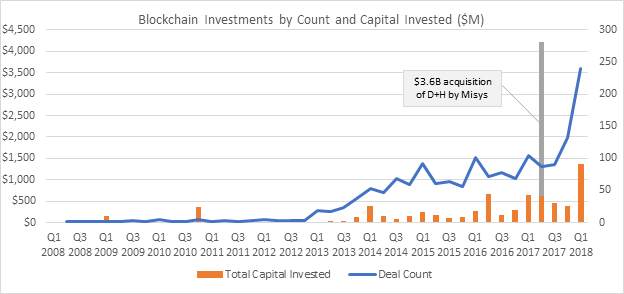
LPs are taking note that some of these investors are putting up very attractive (and liquid) performance, and are jumping into the space to understand how they can access trustworthy partners that will provide access to leading blockchain investments. Specifically, there are a number of VCs and other types of funds investing in blockchain related companies. According to Pitchbook, in 2017 alone, there were 718 investors investing over $5.2 billion in blockchain related companies.

blockchain investments

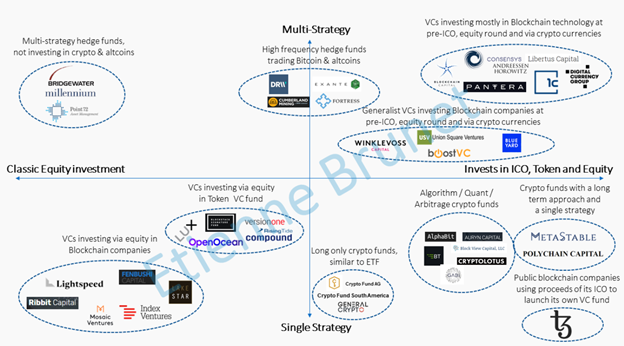
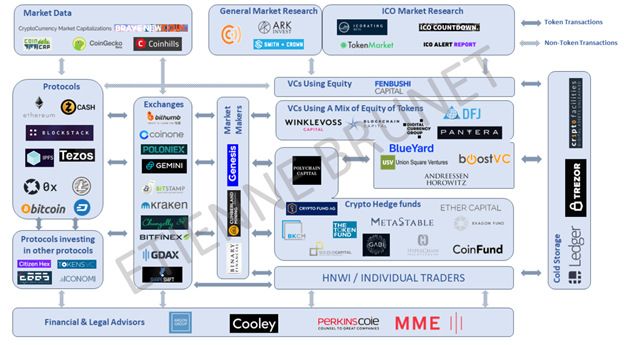
Some are funds like USV, A16Z and Sequoia are investing in blockchain related companies, while others are new entrants to the space that have an access or experience advantage (e.g. Polychain, Placeholder or Blockchain Capital).

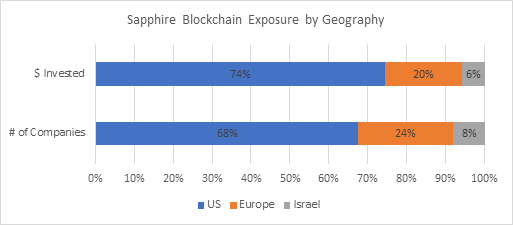
Several LPs, like Sapphire Ventures, for example, already have exposure to blockchain related companies. Specifically, because Sapphire invests as an Limited Partner (LP) into venture capital funds, we have had exposure to blockchain for several years. Sapphire invested in several of the funds that are regarded as leaders in the blockchain world before the recent rise in value of cryptocurrencies. By the end of 2017, Sapphire’s portfolio had over 35 blockchain related companies and cryptocurrencies. Coincidentally, many of the VC “early adopters” in the blockchain space were based in Europe, Israel and other places outside Silicon Valley (at least in the Sapphire portfolio).

Sapphire blockchain exposure (geography)

As seen above, Sapphire already has some exposure in the portfolio to blockchain, but now the opportunity set has widened.

Strategy

Strategy

Given the fast pace of development of blockchain, it’s not only LPs aiming to invest in funds. General Partners (GPs) have begun to invest in funds investing in blockchain to accelerate their learning curves. Publicly, firms such as USV, A16Z, Sequoia, Bessemer and Founders Fund are investing into funds. There are many other VC firms that are following suit in order to get some grasp of the opportunities in this fast scaling area. By the end of 2016, there were collectively 644 cryptocurrencies representing $16.1 billion of total market capitalization (according to CoinMarketCap). By the end of March 2018, there were 1,551 cryptocurrencies representing $328.5 billion of total market capitalization. That’s over 20x growth in market capitalization in one year. With this pace of growth, it’s difficult to keep track of developments without key partners, especially those that are specialists exclusively focused on crypto and blockchain technology.

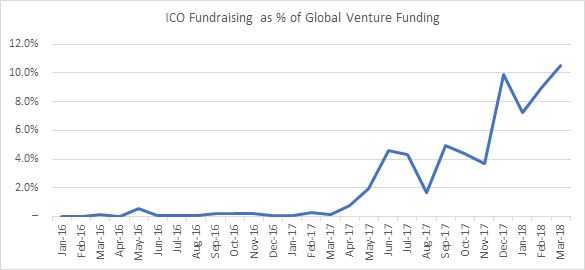
The fundamental VC model of how companies raise capital has been tested by blockchain, in particular Ethereum, which enabled the rise of ICOs.

ICO Fundraising- global venture funding

While there is a clear opportunity to invest, there is a less clear opportunity to invest in opportunities that have appropriate levels of AML/KYC, security, custody, and appropriate vetting of the founding team.

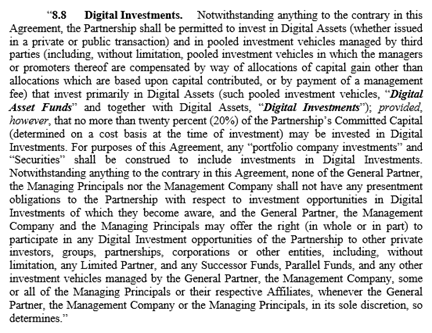
Given the potential for money laundering and detrimental consequences of fraud, LP investors are particularly cautious. Sometimes this has meant LPs continuing with their existing relationships as these VCs expand the strategy to investing in tokens and cryptocurrencies. Typically, this has required the VC to add an amendment to the Limited Partnership Agreement (LPA) so that it is possible to invest in tokens and cryptocurrencies. Most VC funds are restricted in the types of securities in which they can invest, therefore, many have to adjust existing funds to access the blockchain opportunity. Most new funds are adding this language directly into the LPA, expecting these types of investments to continue. Many times, this would look like this:

digital investments

Investing in blockchain requires a different set of knowledge for LPs. In particular, as LPs are getting up to speed with new terminology, such as hash function, ERC-20, tokens, SAFTs, Dapp, DAO and Turing Complete, there are still existing concerns with the technology itself, including the possibility of a 51% attack, the limited number of transactions per second, and the significant compute power required for the technology generally. LPs, along with VCs, are taking a leap of faith that the technology will continue to improve and become more commercially viable.

Despite these considerations, there are also positive aspects that LPs are excited about. Specifically, blockchain has enabled significant value creation through cryptocurrencies and has the potential to enable business process change that could unlock efficiencies and cost savings in traditional businesses (e.g. Ripple). As well, the fund opportunity for LPs may offer faster timelines for value creation and shorter timelines for liquidity than traditional VC (cryptocurrencies do not share the same long term lock-up as VC equity), lower fees, and uncorrelated returns to other asset classes.

bitcoin correlations

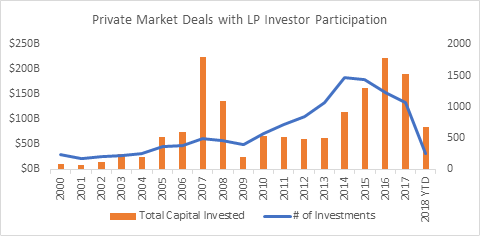
Also, while LPs have increased direct investments in recent years, there does not seem to be an increase in LP co-investments in blockchain assets given how nascent blockchain still is.

Private market deals

And yes, while there have been investments in blockchain applications, the companies that have been successful in terms of creating viable business models are still more the picks and shovels of the industry (e.g. Coinbase/GDAX).

Blockchain is clearly in the lexicon of every LP interested in venture capital after 2017. However, the market generally is still nascent while the opportunity is large. As the market adopts more guidelines and sees more successes, capital will flow into the space, including large amounts of capital from institutional investors searching for high growth opportunities.


[1] Broadly defined to include all crypto assets and blockchain-related companies.

Special thanks to Thomas Moon for helping with the analysis.

Raising A Fund? 9 Questions That Help Get You To GP/LP Fit

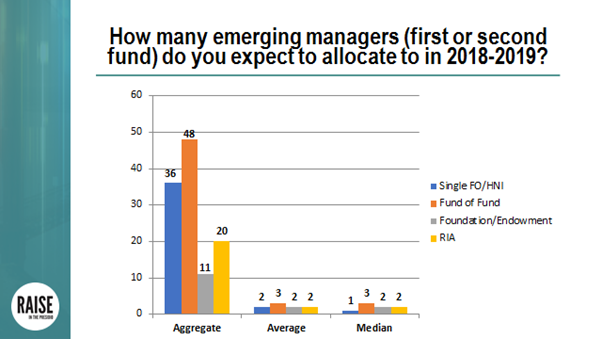
Approximately how many venture capital firms will you add to your portfolio in 18-19

This post serves a part two of a two part series that Samir Kaji and I are co-authoring to help VC’s navigate through fundraising cycles and engender better and more relevant relationships with LP’s. Samir’s first post dug into LP emerging venture fund manager preferences. With this second post we wanted to turn the tables and share advice for GPs (emerging and established) looking to assess if an LP is a good fit for them. As the above graph* shows, even with LPs who are already looking to add new venture fund names to their portfolio, LPs add quite selectively.

There are savvy ways to efficiently and effectively get to know an LP and in so doing, quickly determine if you’re a good fit for investors. And it starts with questions.

Between Samir, who manages over 300 VC relationships at First Republic, and me as a limited partner (LP) in early-stage venture funds, we have spoken to hundreds of VC fund managers (general partners or GPs) in the last few years alone.

In the “getting to know you” phase, I’d say that only half of GPs ask the most critically revealing questions about an LP’s business — even though the answers given may have meaningful implications for the GP.

We understand why this is so. The LP world isn’t very transparent (though hopefully that’s changing with the work Samir does on his blog, Origins and 20minuteVC are doing interviewing LPs, OpenLP and other GPs and LPs writing blogs, speaking at conferences etc). For GPs new to venture, they’re navigating new business relationships with little to no training or playbook to guide them. Even experienced GPs often lack exposure to the fundraising side of the business — it’s not uncommon in established funds to have a single partner responsible for raising money. My hunch is that most GPs do want to ask questions, they just aren’t sure how to go about it or are simply reticent to do so in fear of offending a potential investor.

Our advice: ask the right questions early, and often. As a GP, you have to understand LPs to make sure that they’re the right fit for you, or if you even have a shot at earning their investment.

As an LP, being asked questions by a GP helps get to the bottom of things much more efficiently. This will also help GPs prioritize by spending time with LPs that are an actual alignment versus those that might be data collecting.

Here are my top questions to ask an LP:

1. What are you currently investing in?

The majority of times I meet with GPs, they’re eager to start pitching — which is often why we’re meeting in the first place and is an exciting part of my job. But I usually like to ask if I can talk to you about Sapphire Ventures first to give an overview of who we are what our investment thesis is.

That way, we can find out early in the conversation if there is alignment between the fund you’re raising and what we’re investing in. If there isn’t alignment, you’ve just been spared making your well thought out pitch only to find out that your fund is out of scope for Sapphire. Additionally, often times a LP will offer critical clues about what they care about which will allow you to tailor your pitch to what that LP cares about.

So when you walk into a meeting with an LP, pause to ask them about their business first, instead of jumping right into your pitch. In my opinion, this starting point makes for a more seamless and graceful conversation. Additionally when available, always do your due diligence researching the LP (organizationally and personally) prior to the meeting.

2. Why venture and how long have you been investing in it?

I like this question because it’s an open-ended way of learning about an LP’s interest, experience, and perspective on venture. Understanding more about an LP’s background in venture helps you filter choices for a good fit for your fund.

Maybe you want to weed out investors who don’t know how the venture capital asset class works. Investing in venture is different from writing an angel check or investing in more liquid assets. There isn’t anything inherently wrong with taking on LPs new to venture, but it does mean taking the time to teach them the ropes.

Alternatively, you might be searching for an LP that will add value to your fund by sharing their expertise and opening their network by way of introductions. Learning about an LP’s track record gives you a window into their larger investment philosophy.

Ask open-ended questions and LPs will often bring information to the table that you hadn’t even thought to ask. It can also be a method to gauge how committed an LP is to venture and whether they’ll be there long-term for future funds. As a GP, you’re looking for persistence in partners who will invest with you over multiple fund cycles.

3. How much capital do you have under management, and how much of that is invested in venture?

As a GP, you want to size the breadbox and figure out how much money is actually available to invest in you. A university endowment might have a whopping $10 billion under management, but perhaps the majority of it is going into public markets or other forms of alternative assets (buyouts, hedge funds, etc.) with very little trickling into venture funds. Just because an LP has a lot of capital doesn’t mean they’ve allocated that capital specifically for venture.

A good follow-up to this question is: “How much capital is dedicated annually to investing in venture, or do you invest opportunistically?”

Some LPs earmark money each year for venture investments. Sapphire, for example, has $2.5 billion under management. A big chunk of this is for our Sapphire Partners business, where every dollar is dedicated to venture and we invest annually on a programmatic basis.

Other LPs invest opportunistically. They’ll invest in venture when they see a fund they like better than a private equity buyout or growth equity fund, or whatever their particular range of investments might be. Every dollar that goes into venture has to compete with all the other opportunities on the table. The LP asks themselves “Where can I make the most money per dollar this year?”

It’s important to remember that LPs come in all shapes and sizes, and learning about an LP’s desired fund allocation helps you position yourself accordingly. With a programmatic investor, you might have an easier time than with a platform-agnostic vehicle, where venture has to earn its stripes on a per dollar basis.

4. How many venture managers are you currently allocating to? Will you be allocating to any new managers this year?

Many GPs pose the simple question: “Do you invest in venture?” An LP could truthfully answer yes, but still not be in a position to fund that GP. A more specific question to ask GPs looking to raise money now is: “Will you invest in any new venture fund managers this year?” LPs often choose to work with specific managers and specific funds and don’t always add new managers to their portfolios every year. (Note: this means net new manager to the portfolio, not necessarily a newly formed venture manager.)

One LP you’re talking to might only invest in name-brand funds like Sequoia, Benchmark and Accel year after year. They’re likely not looking to add new funds to their portfolio. Another LP might add new funds occasionally — say every two to three years based on how much available capital they have to invest in new managers. Another LP might even specifically build their platform to target net new funds to add on a more consistent, annual basis.

Even if an LP doesn’t fall within your fundraising timeline, it never hurts to start the relationship early. LPs, particularly larger institutional ones often like to meet a fund two to three years before investing to build a relationship. They like to see how your fund operates over a full cycle — they want to hear your story, get a sense of who you are, and can watch it happen.

5. What strategies and geographies are you actively investing in?

“Strategies” is LP-speak for the kinds of funds an LP is targeting. They might be early-stage or growth-stage funds. Or maybe the LP is focused on a specific sector like AI, or enterprise IT broadly. Strategies can also be geographic plays, targeting the Tri-State area or Europe. Sapphire’s Fund Investments business, for example, focuses on early-stage (meaning primarily Series A focused) funds in the United States, Europe, and Israel.

The bottom-line is that the more you know about where your target LP is looking to invest, the more likely you are to know in advance if there will be “GP/LP fit.”

6. What is your preferred check size and fund size?

Let’s say you have a $200 million fund. You’ve been swapping emails with a certain LP before they say, “We write $50 million dollar checks, and don’t want to own more than 10 percent of the fund.”

That means that they need a $500 million dollar fund. You can take the meeting with them and listen to their advice as investors. They might even refer you to other investors — but your odds of successfully fundraising from them are low.

7. What has been your history of supporting fund managers in follow-on funds? When you have not followed on in a fund, why not?

While it’s rare that an LP will provide any guarantees of investing in future funds, it is important for GP’s to understand whether the LP traditionally has supported managers across multiple fund raises (and through economic cycles). As a manager, an important element of durability is building stability with your LP base and knowing who may or may not be there for the next fund will greatly help with planning ahead.

8. Who is on the investment committee and what is your process for allocation approvals?

LPs are a diverse bunch — maybe your target LP is a family office and the decision-maker is a family member with a background in tech. Or, the LP might be an endowment with an investment committee comprised of alumni, a large pension fund that hires outside consultants to help select managers, or a fund-of-funds with a dedicated team for venture and the ability to make direct and indirect investments.

Understanding the mechanics of how an LP operates gives you more clarity into the investment process — and who is actually voting on the decision to invest in your fund.

When you’re pitching your fund, the representative you talk to might be the person you’ll end up working with (presuming an investment is made) and a staunch advocate on your behalf. However, it’s also possible that the institution evaluates potential investments through a committee of people you will never meet — and your fund will be measured entirely based on a written investment summary they are given to read at the same time they are reading reports on multiple other investment opportunities. Make sure to know your audience and understand your access to the decision-makers.

9. Outside of great returns, what are your expectations of GPs post investment?

Having a healthy relationship of any type requires great communication prior and during the relationship. Understanding what the LP expects in terms of communication cadence and style is critical in ensuring strong alignment. While it may not be practical to create a bespoke relationship plan for each individual LP, uncovering general themes will help create the right type of ongoing engagement (and increase the likelihood of future allocations). Conversely, if the LPs expectations of engagement post-investment are not in alignment with you, it’ll serve as sign to potentially pass.

It’s a people business

Even more so than GPs, LPs work in a people business. As Chris Douvos, an LP at VIA Funds points out, “GPs invest in business ideas that can be evaluated in the context of a more easily understood set of variables while [LPs] invest in people, a far more intricate asset.” That doesn’t mean that LPs have it harder, or vice versa. It simply means that LPs aren’t making direct bets on companies to succeed — they’re betting on the managers they choose.

If you’re a GP pitching an LP, knowing what they invest in and if they’re even making investments is critical information. For GPs with existing LPs, knowing more about that LP base — what their focus is and why they do what they do is just as important.

It’s my hope that we’re building a more vibrant tech ecosystem, with greater involvement and dialogue between LPs, GPs and startup founders. What will help us get there is sharing a little more of the same language — and asking more questions.


The opinions expressed here represent those of the author and not necessarily the views of Sapphire Ventures.

*Graph is taken from an LP survey conducted during the Raise Conference. Some 50+ LPs were surveyed.