How Automation & Low Code/No Code Platforms Help Power our Lives: 4 Trends Driving Adoption

It’s time to retire the phrase “The robots are coming”—the robots are already here. Almost three centuries after the first Industrial Revolution liberated human workers from tedious physical labor, the automation revolution has now arrived for knowledge workers.

At the forefront of this transformation is a new class of innovators popularly known as “low-code/no-code” (LCNC) platforms. By allowing users to customize software to their needs with little to no programming ability, these platforms, which were previously restricted to a handful of highly skilled developers, are now accessible to any employee across the organization.

Popularized in recent years, low-code adoption is picking up steam. Gartner predicts low-code app development will account for more than 65% of all app development functions by 2024. Meanwhile, two-thirds of enterprise companies will deploy at least four low-code platforms.

But “low code/no code”, while a catchy name, doesn’t do full justice to the scope of innovation that’s propelling the space to be worth more than $20 billion by 2022. A series of developments have set the stage for the current golden age of workplace automation, and it’s our belief that there are four types of products that are driving the category forward. Let’s take a closer look:

Consumerization & Innovation Gave Rise to Low Code, and a Better Way to Develop Software

Automation has long been a goal of enterprise operations, thanks to its promise to unlock efficiencies and increase productivity. But it’s only over the last few years that enterprise automation technology has started to come into its own, due to a combination of technological improvements, mounting competitive pressure and evolutions in B2B user behavior.

BPM: The Automation Revolution That Wasn’t

The first rudimentary enterprise automation solutions appeared in the1990s under the name business process management (BPM). The promise was compelling: a systematic approach to automating business processes and enhancing productivity, visibility, process enforcement and flexibility. But as a result of both business complexity and technical limitations, reality largely failed to live up to the promise.

Enterprise processes at the time were highly complicated, spanning multiple functions and departments within the same organization and BPM use cases were primarily focused on synchronizing data between proprietary systems like SAP, Oracle, NetSuite, IBM, and others. Implementing and maintaining these solutions was time-intensive and expensive, requiring heavy involvement from consultants and extensive internal training. 

Even today, a look at the financials of BPM providers Pegasystems and Appian show that anywhere from 25% to 50% of total revenue comes from professional services, due to the level of time, resources and technology involved with implementation and training internal teams to use these systems.

In short, while the first generation of automation solutions promised greater innovation through digitization, BPM systems actually slowed innovation within the enterprise, due to the sheer complexity and rigidity of the solutions.

The Consumerization of Enterprise and the Popularity of Distributed Work

Today’s automation innovators are entering a very different landscape than the one that BPM companies faced 30 years ago. In many ways, the shifts have resulted in a landscape far more conducive to automation innovation.

One of the most important shifts has been in the way enterprise software is bought and distributed. The model prevalent in the 1990s—pricey software packages that centralized IT departments purchased and maintained—has been replaced by a decentralized model that more closely resembles B2C software. Self-serve and freemium business models have shifted purchasing power out of IT departments and into the hands of individual team members while also encouraging network virality in how enterprise software is adopted.

But the “consumerization of enterprise“ isn’t limited to how software is purchased—it applies to user experience, as well. The average employee today uses eight different SaaS applications on the job and, increasingly, they expect these work tools to be as intuitive and easy to use as the apps they use in their personal lives. The popularization of bring your own device (BYOD) policies has further increased the demand for turn-key, interoperable solutions that would integrate with employees’ existing tech stacks.

At the same time that organizations’ app ecosystems are growing increasingly decentralized, the workforce that’s using those apps is growing more decentralized. Even before COVID-19, remote work was increasing in popularity, but the onset of the pandemic has dramatically accelerated the trend. Three months after stay-at-home orders first went into place across the United States in March 2020, 42% of the U.S. workers were working from home full-time. Looking ahead, a PwC survey found that 55% of business leaders expect most of their employees to continue to work remotely after the pandemic has passed.

The shift toward a remote-first workforce will accelerate the demand for automation solutions. With workforces spread across cities and even continents, businesses will need ways to simplify and streamline operations in order to increase efficiency and improve visibility.

Innovation at the Speed of Low Code

The shift to remote work is not the only thing the pandemic has accelerated. Competitive pressures are also intensifying, as the performance gap between top-performing companies and everyone else continues to widen. This places increased pressure on companies and their employees to continue to innovate—particularly in the digital sphere.

Helping to facilitate this accelerated rate of innovation is the proliferation of APIs and open software platforms that have given rise to the ability to truly create workflows that transcend multiple systems. Like the foundation of a house, this digital infrastructure has provided a solid foundation for innovators to build on, and the new class of low-code innovators is showing they know exactly what to do with it. 

It’s at the intersection of these three trends—the consumerization of enterprise software, the rise of distributed work and the accelerating pace of both competition and innovation—where low-code/no-code and automation platforms are coming into their own.

By making automation accessible to workers without extensive coding backgrounds, low-code platforms democratize access to IT innovation. This, in turn, frees up IT resources and developer time, helping to mitigate developer shortages within organizations. Low-code platforms also enable organizations to tackle complex business integrations, tying together numerous third-party applications and databases across the organization and keeping the whole organization in sync.

Most importantly, low-code and automation platforms deliver what every business technology innovation in history has delivered: a finer-grained distinction in the division of labor between people and machines. By managing complex processes and automating routine, repetitive tasks, low-code platforms free individuals to focus on the higher-order tasks that only humans can do—and that unlock still greater levels of innovation for the company.

The High Growth Potential of Low-Code/No-Code Innovation

We’ve laid out the market conditions that have set the stage for low code/no code and grown it into a $10 billion industry. The next question is, how much bigger is the sector likely to grow as these market forces continue to exert their pressure on enterprise operations?

While exact answers to this question vary, what’s clear is that there is a large and expanding total addressable market with significant runway for growth. Top-down models predict the market for low-code platforms will grow to $21 billion by 2022, more than five times its $4 billion total in 2017. But viewed from the bottom up, the opportunity space could be larger still.

Assuming that roughly 28 million developers worldwide use low-code tools totaling $1,300 ASP, that equates to a $36 billion market. But it’s important to keep in mind that one of the core selling points of low-code platforms is that they extend the market for these solutions beyond the traditional developer audience. Assuming even 20% of the 865 million global information workers adopts low-code solutions at a $200 ASP, that gives us an additional $35 billion, and a $70 billion total addressable market by 2023—more than three times the amount the top-down model predicts in 2022.
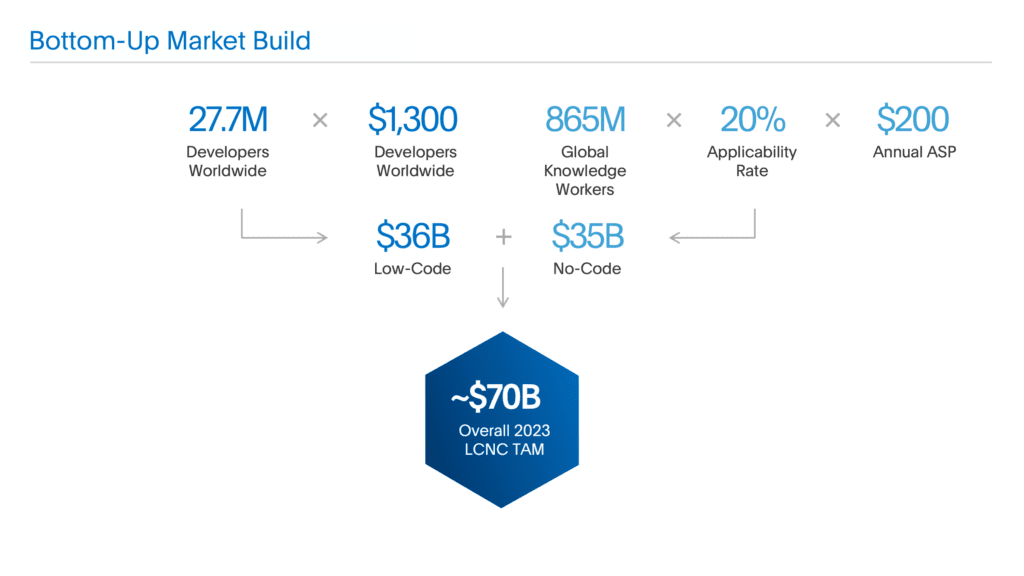
 

Source: Goldman Sachs


Further underscoring low-code’s promise is the increased focus it’s receiving from hyper-scale providers such as Microsoft, Google, Salesforce and IBM. With its Power Platform, Microsoft is positioned to drive digital transformation within its existing customer base. As of December 2019, 86% of F500 enterprises were using Microsoft Power Apps and the number of monthly users had grown 250% year over year. To expand its low-code RPA capabilities, Microsoft acquired Softomotive in 2020. 

In addition, in 2018, IBM announced its partnership with low-code development platform Mendix. Shortly after, in 2019, Salesforce announced that it acquired Tableau for $15.7 billion in a bid to expand its low-code/no-code data visualization capabilities and ServiceNow released its own low code development platform called the Now Platform. More recently in January 2020, Google announced that it would replace its own internal low-code platform App Maker with Seattle-based app-building platform AppSheet.

It’s notable that many hyper-scalers are opting to acquire or partner with low-code and automation startups rather than develop these solutions in-house. Not only does it validate low code as a major center of enterprise innovation going forward, but it underscores the fact that, for startups that get this right, a successful exit may not be far away.

4 Areas of Opportunity Within Low Code/No Code

Now that we’ve established the scope of opportunity waiting to be unlocked, let’s look at four areas of technology driving that opportunity forward: Workflow Automation & iPaaS, App Builders, RPA and IPA.
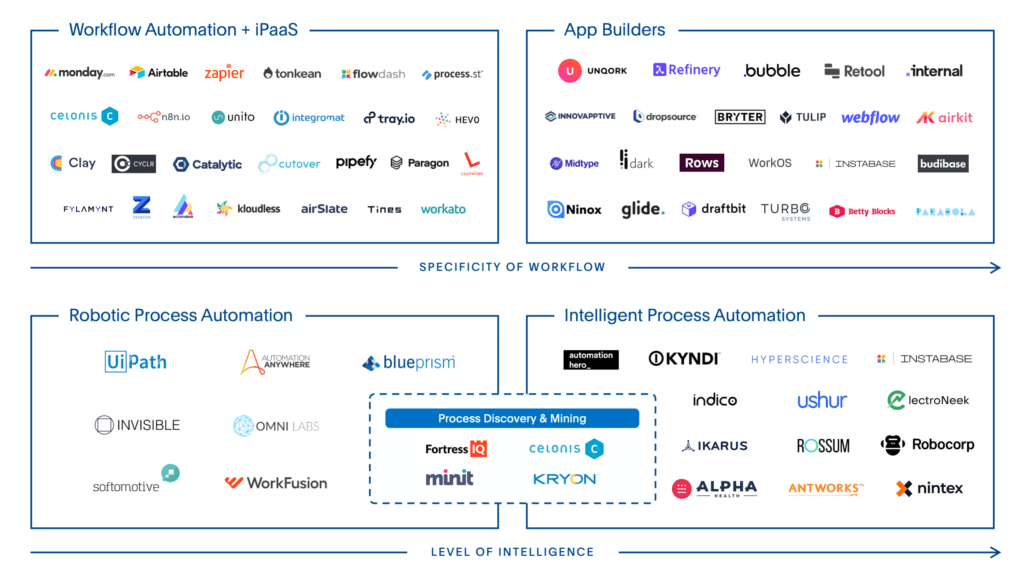
1. Workflow Technology + iPaas (Integration Platform as a Service)

One consequence of the consumerization of enterprise software outlined above has been an explosion in the sheer quantity of applications in use within companies. At the end of 2018, the average enterprise organization (2,000+ employees) used an average of 129 apps—a 68% increase over four years—while smaller organizations average 73 apps.

Our first category of automation innovators—workflow technology and integration platform as a service (iPaaS)—has its sights set on bringing order to that chaos and helping companies streamline and automate business processes across their numerous applications.

Airtable and Sapphire investment Monday.com are among the early leaders in this category due to their familiar spreadsheet-like interfaces and the breadth of use cases they could address. There’s now a new wave of companies building on top of these ideas, which explore intuitive approaches.

General workflow automation platform Tray.io, for example, is applying graphical interfaces to the workflow automation problem. What started with just a few email-based automations now includes integrations with over 400 apps. The company counts IBM as a partner and has raised total funding of more than $100M.

Tonkean and Flowdash take a promising approach by going one step further and orchestrating workflows around the “human in the middle” versus solely between applications. Most workflow automation and iPaaS solutions lack capabilities that intelligently route and delegate many human tasks that cannot be abstracted and focus on automation only. Tonkean and Flowdash provide both and act as an adaptive middleware that becomes smarter and more personalized over time.

Process Street, another entrant in the workflow automation category, has its roots in the “work from anywhere” movement, starting as an internal solution for founder Vinay Pantankar’s distributed marketing company before going on to raise $12 million in Series A funding. They’ve also landed customers including Accenture, Spotify, Salesforce and Atlassian (the last two of which are also investors in the company).

Workflow technology and iPaaS solutions are gaining popularity due to the strength of their ability to orchestrate and automate end-to-end business processes, as well as their potential to abstract all interfaces to a UI of choice. Solving more advanced problems based on intelligent data cleansing and data quality management will be the next important milestone for many companies in this category. 

2. App Builders

While workflow automation and iPaaS solutions focus on improving the interoperability of existing apps, a second category of low-code/no-code innovators is focused on helping workers build custom applications of their own.

One of the chief value propositions of app builders is their promise to increase the speed with which applications can be operationalized. Drag-and-drop code builders like Retool, for instance, allow developers to build internal apps up to 40 times faster than if they were writing the code from scratch. Apps built with app builders are also easy to maintain, adjust and update—a selling point unto itself, given that developers spend more time on maintaining code than they do on writing new code.

While the app-builder category is still in the early stages, there have been a number of high-profile early successes in the space. In October 2020, Retool raised $50 million at a buzzed-about $925 million valuation. The company counts Amazon, Progressive and Peloton among its customers. In September 2020, low-code web builder Webflow was named to the Forbes Cloud 100, a list of the top 100 privately held cloud companies, and recently raised a $140 million Series B at a $2.1 billion valuation. And Bubble has built an extremely powerful, fully customizable platform that allows customers to create interactive, multi-user apps for desktop and mobile web browsers, while also managing deployment and hosting.

Despite all the excitement, there are still challenges and unresolved questions in the app builder sector. For one, most of today’s solutions focus on allowing customers to build internal applications versus customer facing applications that have much more complex requirements in terms of security, design, reliability, regulations like GDPR, HIPAA, etc. Airkit is a solution that addresses these issues and allows its users to build personalized customer engagement workflows in a low-code fashion. 

Ultimately, it’s important to understand that these tools still require humans with the time and ability to master them, including any app sprawl and the resulting application lifecycle management. As a post on Webflow’s blog emphasizes, even no-code tools “require technical users—people who can debug, people who can think in abstractions, and, above all, people who know how to glue just the right tools together in the right way to produce business value.”

3. RPA (Robotic Process Automation)

While young companies are able to implement automation built on low-code/no-code platforms, the shift toward greater automation is not without its risks for older enterprise companies. These organizations have extensive existing infrastructure and established business processes–disruption to any of which could spell disaster for the organization.

This is where robotic process automation (RPA) systems have their chance to shine. These solutions offer a “best of both worlds” scenario of being able to automate some mundane task, boost productivity and free employees to focus on higher-order tasks—without disturbing underlying business processes. As a recent post by UiPath puts it, RPA “lets companies tie existing processes together without needing to rip and replace what they already have.”

Clearly, the value proposition resonates with enterprise audiences. RPA was the fastest-growing category in enterprise software in 2019, according to Gartner. That’s why it’s no wonder that UiPath announced a $225M Series on a $10B valuation in August 2020. According to CFO Ashim Gupta, recurring revenue has quadrupled from $100M to $400M in the last two years. And Automation Anywhere recently raised a $290M round.

But there are limitations to RPA technology that call into question the technology’s durability as a stand-alone low-code/no-code player. For one thing, RPA systems only work with structured data, which limits their usefulness outside of a few business functions, such as finance and accounting. RPA systems also tend to be fragile, require significant resources for maintenance and lack intelligence capabilities that allow the systems to adapt and learn over time. It seems probable that in the long-term, RPA will become a feature of broader platforms, as opposed to a stand-alone tool (e.g. see Microsoft’s acquisition of Softomotive).

4. IPA (Intelligent Process Automation)

First-gen RPA solutions may face a test of their staying power sooner than they realize, and in the form of challenges from our final category of automation, Intelligent Process Automation (IPA). These platforms take the core premise of robotic process automation and add an artificial intelligence layer.

IPA systems directly address many of the limitations of RPA platforms. IPA systems are able to work with both semi-structured and structured data—a meaningful improvement, given the fact that less than 20% of all data is structured. IPA tools also have the ability to mimic human interaction and make advanced decisions, as well as continually learn and improve from user feedback.

The first crop of promising players in the IPA field is just now starting to emerge. For example, ElectroNeek, which streamlines automation for IT professionals and other workers without a background in robots, graduated in the 2020 class of YCombinator companies. Another IPA entrant, Robocorp, raised a $5.6 million seed series in November 2019 for its solution that combines RPA with open source technology. While many IPA providers take a horizontal approach, others are much more focused on a specific vertical or use case. Examples include AlphaHealth for healthcare revenue cycle management, Indico for document intake and understanding, or Ikarus for accounts payable. 

There are still challenges to be navigated in IPA. These systems still require initial training and guidance from human operators, and players will need to continue to innovate around automating workflows and processes end-to-end.

High Hopes for Low-Code/No-Code Innovation

Throughout history, popular narratives around automation have centered on horror stories of mass unemployment, but the truth is far more optimistic.

What we’re seeing isn’t a mass displacement of human ingenuity–it’s a shift in where that ingenuity is focused. A 2018 McKinsey report predicts that there will be a 15% decrease in hours spent using basic cognitive skills from 2016 to 2022, while the time spent on social and emotional skills and technological skills will increase by 24% and 55%, respectively.

In other words, the robots aren’t replacing humans, they’re freeing us to focus on the kinds of skills—creativity, innovation, empathy, etc.—that humans are uniquely suited to perform. Here at Sapphire, we’re excited to see the new levels of uniquely human innovation that low-code and automation platforms will unlock—and we look forward to partnering with the innovators who help make it possible. 

 

Sapphire Ventures: 2020 Year-in-Review

Click on the image to see the full year-in-review infographic!

It’s safe to say that last year was anything but ordinary. Nevertheless, we accomplished quite a lot in 2020!

  • We invested and committed more than $970 million in 48 companies and venture funds
  • We supported our portfolio companies with 300+ customer and partner introductions and 360+ talent introductions
  • 2 of our startups went public and 8 got acquired, totaling 65 exits since 2011

All the while, we grew the Sapphire family and our global footprint with 10 new hires, 10 promotions and 3 new offices. Last summer, we opened our London office, and in just a few months, we will be opening new offices in Austin and San Francisco.

We can’t wait to see what 2021 has in store and hope to spend quality, in-person time with many of you soon.

Enabling the Future of Work & Education: Why We’re Excited to Continue our Partnership with Splashtop and Lead their Series E

As we approach a full year of turning our homes into functional offices and schools, the pandemic has forever changed the way we view work and education. WFH is now simply just work. The traditional office has been completely reimagined for the long-term and as a result, demand for technologies that enable and facilitate remote work and collaboration has soared. Splashtop, which allows users to access their desktop anywhere, at any time, and from any device, has benefitted from these global trends to emerge as one of this year’s first unicorns.

We initially invested in the team behind Splashtop–Mark, Thomas, Robert and Phil–back in 2010. What started out as a college friendship at MIT turned into a professional partnership two decades in the making and across multiple companies. Rarely do we see a leadership team that is as close-knit and has not only persevered through the ups and downs of building a company, but has truly grown closer and stronger together while doing it. This group of founders know the remote access space better than anyone and together, they truly define what it means to be a team.  

What the co-founders have built is a company that delivers the best performing and the best-value amongst remote access, remote support and screen mirroring solutions. Splashtop’s products are used by more than 200,000 businesses and schools and more than 30 million users across over 800 million sessions. While these numbers are extraordinary, we believe that this is just the beginning for Splashtop. Splashtop is helping pave the way for the future of work and education and that’s why, 10 years after our initial investment, we’re excited to lead their $50 million Series E financing.

Best in Class Solutions = Explosive Product-Led Growth

Splashtop delivers its remote solutions via a fluid and smooth experience for users at a fraction of the cost of competitors. Customers love the product (4.8 stars on G2Crowd and 93 NPS) and historically, the business has spent very little on sales and marketing, including zero outbound sales effort to-date. In the past year, Splashtop’s 160%+ YoY growth has been driven by the increasingly popular product-led growth model. In other words, most of Splashtop’s sales have been and continue to be true self-service with product touch alone. What’s more impressive is that about 45 percent of trials become paying customers within just 7 to 14 days. Additionally, Splashtop delivers exceptional customer service (CSAT 90%+) which has resulted in consistent net dollar retention of over 115 percent. 

As Splashtop sees demand skyrocket for its products, the market is ripe for remote access technologies. Largely driven by digital transformation, the rise of SaaS and a more widely distributed workforce across industries, disciplines and geographies, remote-work technologies that enable this new type of workforce are growing in popularity. And many of these trends are here to stay as nearly two-thirds of U.S. workers who have been working remotely during the pandemic would like to continue to do so. It’s no surprise that a recent McKinsey study on device enablement platforms for IT found that the market will reach over $19 billion by 2023. For these reasons, we believe Splashtop has a strong wedge with remote access, and will continue to expand its set of solutions to provide to their 30 million users around the world. 

Making a Big Splash with Remote Learning

When schools shut down last year due to COVID, the majority of students faced disruptions in their education including being unable to access school and university computers in real-time. Computers at universities often use a specific combination of hardware and software that are not cloud accessible. 

Splashtop’s high-performance remote lab access solution enables over 200 schools to provide seamless remote access from any device such as Chromebooks, iPads, Android tablets and personal laptops to students. Students get high performance, multi-monitor, audio and video streaming for Windows or Mac computers so that their learning experience is uninterrupted. Whether it’s work or school, Splashtop’s solutions provide seamless access in a remote environment so that employees and students can go on with their lives without skipping a beat.

Many Avenues of Growth Still Ahead

Splashtop undoubtedly benefited from the remote work and learning trend that was growing in popularity pre-COVID, but exploded during the last 11 months. We expect these trends to last far beyond the pandemic, and for Splashtop to continue to deliver best-of-breed remote solutions to employees and students. 

Looking ahead, Splashtop plans to leverage this new round of funding to invest in and develop new avenues of growth including growing Splashtop for enterprise, launching new products in adjacent, but complementary areas such as collaboration and ZTNA (zero-trust network access) solutions, geographic expansion, new verticals and more.

We’re honored to have been already part of the journey together for the past decade, and are thrilled to continue our partnership with co-founders Mark Lee (CEO), Thomas Deng (EVP Product & Engineering), Robert Ha (COO), and Philip Sheu (CTO). We look forward to helping build a company of consequence by continuing our partnership with the team as they build solutions that will shape the future of work and education! 


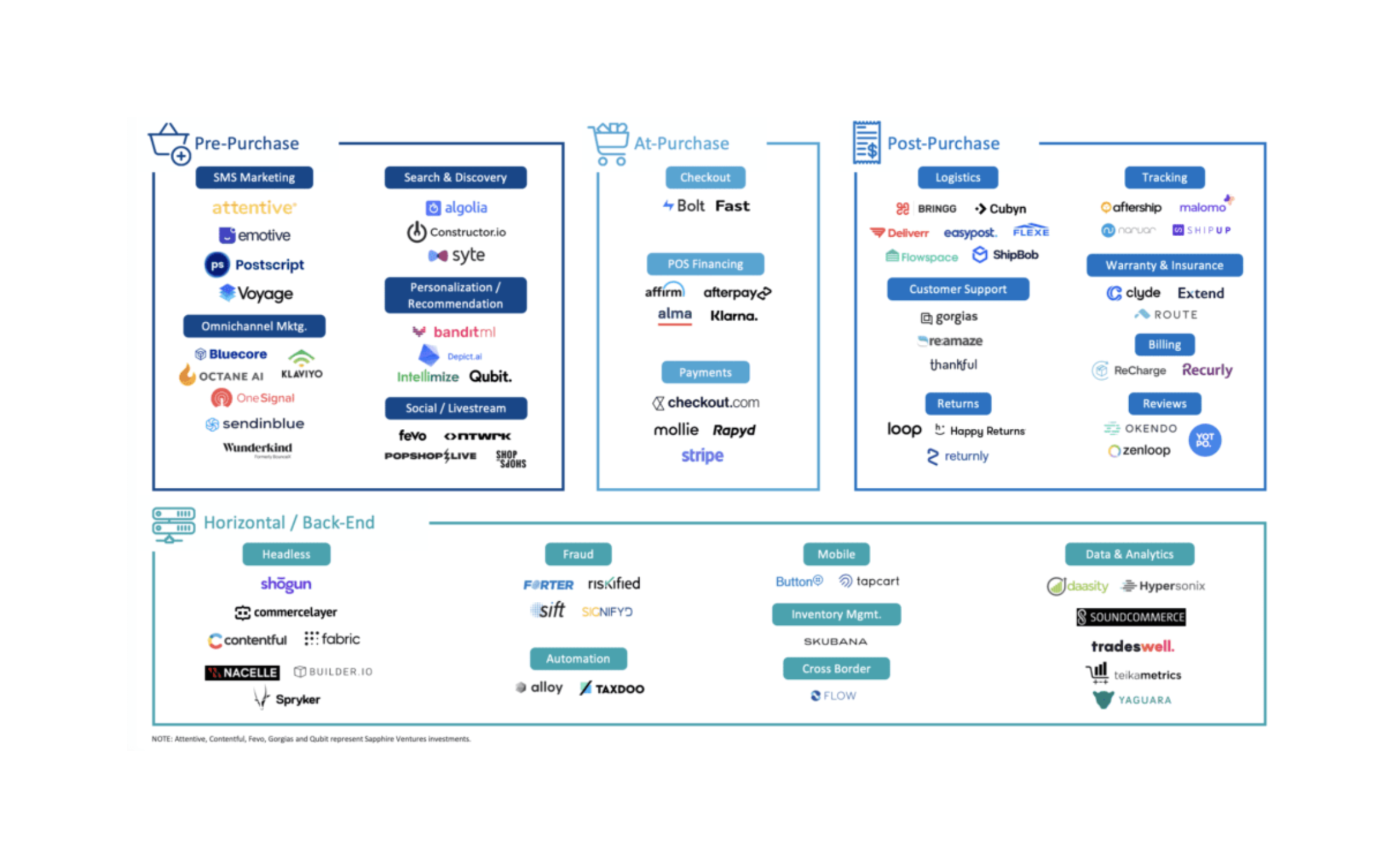
ecommerce market map

Ecommerce is Having a Moment: Why We’re Excited & What’s Next

It’s safe to say that 2020 was the year of the ecommerce boom. Global ecommerce reached $4 trillion in 2020, growing nearly 30% from the year prior. The pandemic has drastically changed the way we shop, pulling forward the shift from brick-and-mortar stores to online shopping by five years. Today, it’s never been easier to buy everything online — from clothing to groceries to cars — all with the click of a button. 

With the rise in online shopping, ecommerce platforms such as Shopify ($140B+ market cap, 1M+ merchants) and BigCommerce ($4B+ market cap, 60K+ online stores) have experienced record highs in growth and valuation. Along with the success of these platforms, we are also seeing an explosion of companies emerge in the broader ecommerce enablement ecosystem. Through tight integrations with underlying ecommerce platforms like Shopify, these new solutions target specific pain points along the customer journey ranging from companies on the pre-purchase side such as Attentive (Sapphire investment) that provides SMS marketing to post-purchase solutions like Gorgias (Sapphire investment) that focuses on customer support. Much like the Salesforce ecosystem, we believe best-in-class solutions will emerge for each category. 

As active investors in the space, here are several key trends we see shaping the the future of ecommerce: 

  • Infrastructure: The Shift to Headless. Ecommerce platforms like Shopify and BigCommerce are built on a monolithic architecture. This means that the frontend, or head (what customers interact with on the site) and the backend, or body (behind-the-scenes admin functions) are tightly coupled together. The challenge with this codependency is that every change made on the frontend needs to be reflected on the backend, making website development highly rigid and cumbersome when it comes to providing the most optimal shopper experience. With a headless architecture, the backend is decoupled from the frontend, and merchants (and their developers) are now equipped with the freedom, agility and speed to create incredibly personalized, creative and dynamic storefronts. For the modern shopper, having a unique user experience becomes especially important in today’s highly crowded digital commerce environment. We see companies like Shogun and Spryker leading the way for the shift to headless. This is an interesting area that we’ll be exploring further, so stay tuned for a detailed thought piece on this topic from the Sapphire team in the coming months. 
  • Pre-Purchase: All About Social. While our in-person social lives have certainly taken a hit in the pandemic, the online shopping experience is becoming much more digitally social and interactive. You can now easily share and split an online shopping cart with your friends via apps like Fevo (Sapphire investment) or buy products directly while scrolling your Instagram feed. Live streaming has also successfully made its way into ecommerce. Brands and influencers can now engage with viewers live, showcasing products directly via livestreams and enabling viewers to instantly click through to make a purchase (much like a digital QVC) via platforms like PopShop and ShopShops. Social media giants like Amazon, Facebook and YouTube have also all leaned in and launched similar live shopping offerings. In fact, livestream commerce is already a huge phenomenon in China and pulled in over $100B(!) in estimated sales last year. Who would’ve thought QVC-style shopping would make a comeback so soon? 
  • At-Purchase: Speed is Everything. Think back to the last time you made a purchase online. Chances are you probably had to type out the same credit card and shipping information for what feels like the 100th time. For how close and critical the checkout flow is in getting a purchase over the finish line, the experience today is still highly manual and full of friction (i.e. account creation requirements, payment security concerns, etc.). In fact, 70% of shoppers drop at checkout, and cart abandonment represents a $4 trillion problem globally. For merchants, losing a customer at the final checkout step is tragic, considering all the marketing dollars already spent to not only attract the customer, but also build up the intent to purchase. Companies like Bolt and Fast are building 1-click, secure checkout experiences to make buying effortless for the consumer and drive substantial conversion improvements for the seller. Gone are the days of filling out the same entry forms over and over again in your buying journey.  
  • Post-Purchase: Building Loyalty with Seamless Support and Fulfillment. Customer support and fulfillment are now more crucial than ever for building customer loyalty and brand. In order to deliver exceptional customer service, online merchants need purpose-built software with deep integrations into the Shopify ecosystem, which is why we partnered with Gorgias last year. Gorgias pulls relevant customer information from various sources onto a single screen and leverages automation to enable even the leanest support teams to respond to customers rapidly. Needless to say, speed is also key when it comes to fulfillment and delivery. Flexe and Flowspace, for example, provide on-demand warehousing, breaking the traditional supply chain paradigm to allow for greater flexibility and speed. Using vendors like Bringg also allows sellers to quickly and easily offer rapid delivery options. Bringg specializes in orchestrating last-mile delivery via software that connects merchants with delivery fleets and optimizes inventory management and driver routing. In today’s delivery-centric world, every minute you can shave off during transit will make a difference. 

At Sapphire Ventures, we’re optimistic that companies of consequence will be built to service online merchants, both large and small, and are excited for what’s to come in digital commerce. If you are building a company in ecommerce enablement, we’d love to hear from you! 


Punchh & Sapphire Ventures: Partners in Improving Customer Loyalty and Engagement for Brick-and-Mortar Retailers

When Punchh was founded in 2010, many retail technology trends were just beginning to take off. Consumers were moving towards mobile, cloud computing was picking up speed, and analysts were heralding the consumerization of IT. As innovation in retail was reaching new heights online and via mobile channels Punchh co-founders Shyam Rao and Sastry Penumarthy saw that innovation had stalled for the in-store experience. 

While omnichannel was a popular buzzword, delivering a connected consumer experience remained difficult for brick-and-mortar businesses. Shyam and Sastry believed that they could build a solution that improved the in-store experience by digitizing a customer’s identity and preferences based on their in-store interactions. With the creation of Punchh, the co-founders developed a personalized marketing product that revolutionized the in-store channel responsible for roughly 90% of traffic.

At Sapphire Ventures, we were believers in Punchh, Shyam, Sastry and the entire team early on. That’s why in 2018, we led Punchh’s Series B round. Soon after, we reiterated our commitment to Punchh’s product and vision by leading the company’s Series C financing in 2019.

Since 2018, we’ve been teaming up with Punchh to provide services across a variety of different disciplines. Our talent team helped Punchh find several key team members including the company’s CRO, chief of staff, president of finance and a strategic advisor to the firm. We also helped Punchh think through and successfully staff Punchh’s engineering hub for artificial intelligence based in Toronto. In addition, our business development team introduced Punchh to a number major brands, connecting them to the SAP ecosystem and making critical deal interventions.

“Sapphire has facilitated numerous introductions to partners and potential customers for us,” says CEO Shyam Rao. “The team always makes a point of putting Punchh in front of the best and most important brands that we could be selling to.” 

Today, in the U.S. alone, 160 million consumers engage with the Punchh platform through the brands that it works with. The company’s portfolio of customers operate almost 95,000 locations and Punchh has visibility into data on billions of dollars of commerce that occur at those locations, whether in-store or online. 

For more than three years, we’ve had the opportunity to partner with the Punchh team, and we couldn’t be more excited about our journey together. To learn more about our partnership, read the following case study.

Read the case study here


7 Tips for European Female Founders Fundraising Right Now

The events of 2020 have compounded the issues female founders face all over the world. In the U.S., despite overall VC funding remaining stable, funding for female founders fell to 2017 levels in the third quarter and decreased on an annual basis last year, according to Pitchbook.

In Europe, the situation is arguably worse. The share of investments involving female founding teams has barely moved in recent years: female-founded companies represented less than two percent of the total capital invested in venture-backed startups according to Atomico’s 2020 State of European Tech Report. 

Despite the downward trending data, there’s a silver lining for European female founders. The COVID-19 pandemic has changed the fundraising process to a mainly virtual world. From this perspective, in some ways it’s making it easier for European female founders to raise capital from international investors.

Many female founders have reached out as they are keen to take advantage of this opportunity to build relationships across borders, especially with U.S. investors. Toward the end of last year, Stacy Kim, London-based Partner at Wilson Sonsini, kindly invited me to a fireside chat with a group of European female founders looking to raise from U.S. investors. I want to share the top tips coming out of the session around how to approach fundraising and what has changed in the post-COVID word. 

As a female founder in Europe, here are 7 best practices to keep in mind as you fundraise:

1. Prepare a Plan of Attack  

Although the fundraising process changes slightly from stage to stage, for example a Pre-Seed round is going to be a different beast than a Series B, but what does not change is having a plan is critical. Across all stages, it’s important to plan out when you want to start fundraising and which VCs you want to engage with. It helps if this plan includes an ongoing process of building relationships and crafting your story even when you are not actively fundraising. 

2. Leverage Your Current Investors

If you’ve been able to secure investment already, one network to not overlook is your existing investors and board members. I often see founders who have done their research and identified VCs that might be a great partner for the next stage of growth, but they don’t deeply engage with the partners they already have. Your existing European-based investors can be a great bridge to other investors, especially U.S. investors. Also, consider doing a practice round with your existing investors as this can help identify what questions investors might have and increase your confidence in responses. 

3. Always Consider the Next Round

One area early-stage European female founders should be mindful of when raising capital and negotiating terms is ensuring you’re continuously investable. Founders who have agreed to highly dilutive rounds or non-standards terms run the risk of setting themselves up for failure in a future round. For example, founders may find it harder to bring on new investors if they think management isn’t incentivized to work for the company because of low ownership or it requires work to fix a messy cap table. To avoid these issues, always make sure you are seeking expert advice and working with experienced lawyers, as well as doing your own research and referencing potential investors. 

4. Craft a Pitch and Metrics Appropriate to Your Stage 

Top tier VCs look for the same thing–whether they’re in the U.S. or Europe. They look for exceptional founders building highly scalability businesses with products that customers love. It’s critical to research and understand if the VC you are considering invests at your stage and is excited about your sector. That said, it’s important to recognize investors focus on different areas depending on the stage: 

  • Pre-Seed / Seed: The team, market and product vision matter a lot. There aren’t that many data points for a VC to look at, so you will need to emphasize why your business needs to be built and why you’re the right person to do it.
  • Series A: Demonstrating product-market-fit is key. Share initial data points around commercialization and what initial customers say about the product.
  • Series B, C and further into the growth stage: Financial metrics and traction to-date is even more important. It’s key to emphasize scalability of the product and your engine for efficient growth.  
5. Seek out Investors that Match Your Needs for Expansion 

At the early stages of a company’s journey having an investor in close proximity geographically can be beneficial. Your broad member will be in the same or similar timezone and can answer those 1 a.m. Whatsapp messages. As a company matures and looks towards international expansion, it can be very beneficial to bring on board a U.S. investor. This is because a U.S. investor can provide better support and guidance accessing the U.S. market, like through Sapphire’s Portfolio Growth team. That said, COVID has accelerated trends around remote work, and I’ve seen more European founders seek out U.S. investors earlier in their journey as they build a global business from day one. 

6. Don’t Forget to Be Confident in Yourself

It’s obvious, but an important area to stress is around confidence. I’ve heard time and time again it can be intimidating to pitch a VC partnership, especially for female founders who face unconscious biases, and there’s data to back it up. Seven years of data from pitches at TechCrunch Disrupt New York City analyzed in research from London Business School Professor Dana Kanze, as explained in her TED Talk, show that female founders get asked more prevention versus promotion questions from VCs. And the result of these biases are stark: male-led startups raise five times more capital than female-led ones. Staying confident and converting prevention questions into promotion answers can help female founders improve their chances of getting funding.

7. Stay Determined

2021 is likely to be another difficult year for many female entrepreneurs. A survey of women across global tech hubs by the Female Founders Alliance found 51 percent of women have delayed or cancelled their plans to start a company as a result of the pandemic. Of those surveyed, 45 percent of female entrepreneurs are fully or mostly responsible for the added workload in their household as a result of the pandemic. 

But female founders have made much progress in the past decade in spite of the obstacles they face. COVID has caused hardship, but it’s also helping bring the female founder and investor community closer together in Europe. 

If you’re a female tech entrepreneur–in Europe or elsewhere–and are chasing your dreams, Sapphire is committed to helping. You can email me at [email protected] to chat, seek feedback or guidance or ask for any pointers.


Shapes organizing into categories

Category Creation: A Marketing Strategy for Long-Term Differentiation

In the early 2000s, Brian Halligan and Dharmesh Shah created a suite of software tools for marketing and sales. By 2012, their team had grown to over 300 employees, their product suite expanded to include social media, content management, web analytics and search engine optimization.

By 2014, they hit $100M+ in annual revenue, and their company — HubSpot — went public despite a turbulent market.

How did they do it?

Yes, they built a good product. Yes, they developed close relationships with customers, hired the right team, and prioritized organic search to reduce cost of sales — yet Hubspot did something different that fueled their long-term growth: They created a new product category — “ inbound marketing” — that identified a new market trend that became synonymous with Hubspot in the minds of their prospects and investors.

Today, category creation, and the example of Hubspot, is the gold standard for what CMOs dream of achieving since defining and owning a new category can be directly measured in terms of its impact on a company and the broader industry.

Like other Silicon Valley marketers, I’ve been tasked in my career with replicating the lightening in a bottle that Hubspot achieved, and I wanted to share the best practices I’ve learned from multiple efforts — with many failures — to create a new category.

Before I give my advice to marketers, I want to provide a word of caution to all of the start-up executive teams who are asking your CMOs to go do this: Category creation requires more than a game-changing product or an interesting tagline. It takes a powerful, consistent vision that you drive throughout all aspects of your business — from product development, to sales strategy, executive content, and yes, marketing.  This isn’t something you can just outsource to marketing and expect it to be successful.

Why would you want to go to this level of effort? Because when it works, category creation:

  • Sharpens internal focus; helps you prioritize, allocate resources and be ruthlessly efficient with your go-to-market activities.
  • Builds awareness; by defining the trend, category creation creates the perception that you’re the expert in this new movement and can start a new market conversation associated with your brand.
  • Fuels the sales conversation; this new market conversation can help qualify leads and accelerate sales by providing a framework for your customers to “think different” — and make your competitors respond to your POV.

If successful, category creation becomes a self-fulfilling prophecy. When you’re able to both identify the disease and deliver the cure — it creates a defensible moat around your business that will be increasingly difficult for the competition to breech.

Numerous industry leaders have written about category creation — yet there is no singular playbook for how to approach this effort.  This often leads companies to diving headfirst into tactical executions without first understanding how category creation is different than a regular marketing campaign. Based on my efforts to build categories at Google, Facebook and Cisco, here are three often-overlooked but fundamental elements to building a new category.

1. Context matters

From the start, you must base your efforts on some broader market, consumer, or societal change that you believe will fundamentally change how we should look at the world.  Providing that macro context elevates the conversation beyond a product pitch from your company, and helps create a sense of inevitability for your vision.   

In my experience, you need quantifiable data to make the trend you’re betting on real.  Without data, your good idea is just another unsubstantiated opinion.

When HubSpot rolled out inbound marketing, it led with a manifesto about the evolution of marketing to digital channels, and the business need to efficiently increase sales and marketing in a tight economic environment.

[Image via HubSpot] Some of the original market data HubSpot used to validate the industry evolution to "inbound marketing".

Against the backdrop of the 2008 financial crisis, HubSpot’s vision of efficient and effective inbound marketing and predictable revenue streams resonated with customers and prospects. The team fleshed out this macro trend with data about the specific impacts on SMBs and enterprises — and detailed tangible steps companies needed to take to remain relevant during this change (i.e., shifting from paid to organic ad channels). Clearly spelling out change, and what customers could do to address it, paved the way for prospective customers to buy into that same vision — more than 95,634 others to be exact.

Category creation requires an intellectual as well as a tangible foundation. You need both a clear problem and solution for the concept to take off. Remember that the intermediate goal for creating a new category is starting a conversation in the market that includes you.  That mean the market context you set up needs to be…

2. Be self-serving, but never self-centered

Once you define the underlying problem you’re working to solve — you must become known as the one solving it. If your initial arguments / messaging / data are well crafted, they will do some of this heavy lifting for you, revealing how smart your organization is in recognizing this sea change. Yet to truly cement your position as an expert, you can’t go it alone. You need the market to weigh in and build on the conversation.

The Achilles’ heel of many category creation efforts is that a company positions itself as the sole solution for the world’s problem. This isn’t credible, particularly if you’ve identified a big enough issue to warrant a new category.  There will likely be incumbents addressing parts of the problem and if the trend you identified is so economically interesting, you should expect to have a host of competitors soon.

The content around your new category will naturally be self-serving — after all, you identified the problem and built a solution to address it.  If you’re legitimately the “only” solution possible, you’re either:

  • Simply engaging in a tone-deaf sales pitch
  • Haven’t identified a big enough trend to be interesting
  • Some sort of monopoly

In your vision for the future, you need to carve out roles for your competitors and legacy solutions.  Remember that by defining the market context, you’ve created a framework that should be able to identify what solutions are better positioned to address what aspects of the problem.  That means that one intermediate measure of success for category creation is when your industry peers begin to respond and disagree with your arguments. Let them.  To become truly valuable, category creation needs more voices in the market to legitimize the problem you identified.

At this point, the marketing challenge shifts from identifying the problem to making sure you out execute everyone else who just woke up to this good idea.

3. Think of category creation as a political campaign

Many startups have the best intentions to create and lead a new category — yet they forget that can take 12-18+ months of consistent execution against a singular idea before it takes hold in the market.

In 2008, Google acquired DoubleClick in an effort to develop a “unified adtech stack” across search, display, video, social formats.  Even after officially announcing this vision of how a unified platform would benefit marketers, it took several years of developing the product and showing the value of a single platform for multi-channel marketing to take root — and peers like Adobe to follow suit.

One way to think of category creation is like a political stump speech. To have your idea “elected” in the market, you’re going to need to deliver the same core messages in different formats over a longer period.  Of course, you can’t just copy and paste and beat people up with the identical message until they believe you.  Just like politicians, you’ll need to vary your anecdotes, your proof points, your channels — even who is delivering your messages — all while staying consistent with your core.

Too frequently, companies and executives lose focus and want to talk about the “next new thing.” In my experience, just about the time when you’re sick and tired of repeating the rationale for your new category is about the time you’ll have a customer or industry pundit say: “that’s interesting, I’ve never heard that before.”  That would be the wrong time to shift your focus to something new.

Set yourself up for success.

Everyone wants to create categories — and many fail. Adobe famously flopped when it tried to pitch “Network Publishing,” and I missed the mark at Cisco with “entertainment operating system” — our attempt to warn media publishers about the need to manage their branded content, audience data, and monetization (a vision that Facebook eventually paid off).

For all of the CMOs being asked to create categories, remember that:

  • Category creation is not just a marketing activity. Given that this is a “moonshot” call-to-action for your company, customers and the industry, you must have top-down alignment from your leadership team.
  • In addition to genuine insight and a crystal-clear articulation of your solution, category creation work requires long-term focus, and grit.  Don’t expect short-term, immediate results. You’re playing the long-game.
  • Despite all of your efforts, you’ll most likely fail.  Category creation is difficult and there are a lot of smart people competing with you.  Regardless, if executed with the above best practices in mind, even a failed category effort will still likely yield some high-quality marketing you can be proud of and will help advance your business.

Despite these challenges, trying to develop a new category isn’t something you should avoid.  Just make sure you approach it the right way to set yourself up for possible success.


4 Key Strategies to Implementing a Usage-Based Pricing Model

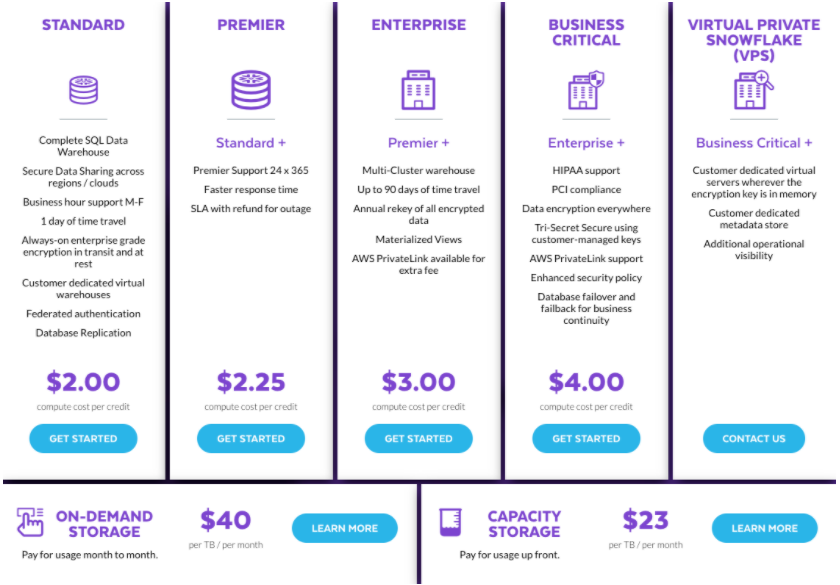
The rise of cloud platforms such as AWS, Google and Azure, and the growth of companies such as Cloudflare, Datadog and Snowflake, has shined a spotlight on usage-based pricing (also known as resource-based, utility and pay-as-you-go pricing). In fact, it’s the second most prevalent pricing model being used today by enterprise technology companies according to a recent KeyBanc SaaS study.

Snowflake Website Pricing 2019

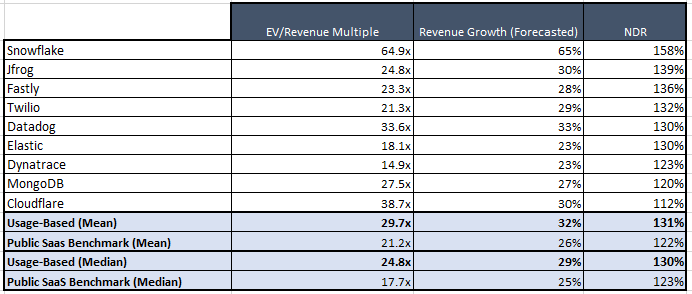
In the table below are the public companies with elements of usage-based pricing models, which are expected to grow revenue at a faster rate and are growing more efficiently compared to a broader list of 50 public high-growth SaaS companies. As a result of usage-based pricing, these public companies are experiencing faster and more efficient growth than their public SaaS peers are being valued at a premium (24.8x vs 17.7x) by the public markets.

Source- NDR are from Company filings (S-1 or 10-K), EV/Rev Multiple Representative 01/06/2021, Revenue Growth are Analyst Consensus Estimates for FY 2021-2022 Revenue as of 01/06/2021

Usage-based pricing not only provides business benefits, but it also helps improve your customers’ experience:

  • It better correlates product usage with pricing thus eliminating the potential “black box” of other pricing models.
  • With a well designed usage-based pricing model you can shift cost control to the customer, providing them with maximum flexibility.
  • It avoids customers having to buy a solution package that is typically oversized to meet their occasional peak demand period for your technology.
  • Provides a low entry price point and allows customers to experience the full product regardless of company size.
  • Customer retention is built into the usage-based pricing model since it does not require customers to cancel their plans during periods of lower usage. 

To successfully implement a usage-based pricing strategy, companies should consider the following four key factors as they design and execute this pricing strategy:

1. Identify the right value metric and start simple

While usage-based pricing is typically priced around technical metrics (i.e. API calls, number of queries, etc.), they should be designed around value-based pricing principles. In short, the metric you are charging against should correlate as closely as possible to the value your customer extracts from your product, and the price should be predicated as a percentage of that value creation. 

One of the advantages of usage-based pricing is it takes a traditionally monolithic pricing approach and allows you to create a composable system that provides different features, which can be monetized in your solution. Ultimately, a usage-based pricing model can make value-based pricing easier as it becomes a packaging exercise as the value dimension- usage -is now variable. 

Sam Lee, Head of Pricing at Snowflake put it this way, “For example, a typical user subscription model offered by many SaaS companies oftentimes package their offering based on service levels (e.g. good, better, best) and on user/role types (e.g. Lite User, Reader, Fulfiller, etc.). This can create a very complex licensing regime for their customers and leads to mislicensing and procurement frustration. Usage-based pricing models may help collapse those complexities into a unified pricing model by eliminating user roles with one variable usage metric.”

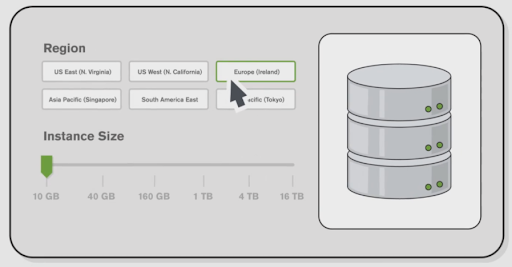
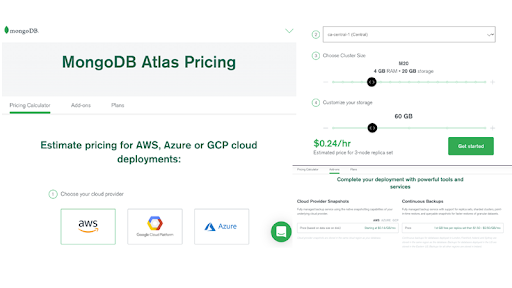
Once you have identified your primary value metric, move on to building a usage-pricing program around that. As you scale, mature and add features, expand usage-based pricing vectors within your solution. A great example of a company that’s progressed this way is MongoDB, which in 2016 launched Atlas and priced it based on region and instance size. Looking at their pricing page today shows a much more robust offering, which allows users to generate pricing based on cloud provider, region, cluster size, storage amount and additional add-ons.

How it started: 


How it’s going:

2. Build Customer Monitoring, Alerting and Reporting

Due to the elasticity of usage-based pricing consumption, and in theory, unlimited consumption capability, you will want to deliver a certain level of monitoring, alerting and reporting to help customers manage costs, performance and the adoption of your solution. 

For example, large enterprise customers will want to monitor and allocate technology consumption by department so that they can bill back costs to business units and departments. Furthermore, system administrators of your solution will want you to provide email alerts and the ability to automatically suspend service to users after consuming a certain percentage of credits to help manage their user’s consumption. 

The last thing you want is for a potential customer to receive an unexpectedly high bill after a certain period of usage, which will make them feel like they have lost control of your technology within their organization. Usage-based pricing is meant to convey the exact opposite impression to your customer.

3. Reimagine the Roles of Sales 

The nuances of sales and customer success will be different with a usage-based pricing company. While customers can pay-as-you-go, it’s more common, especially for enterprise customers, to purchase annual usage commitments in advance to lock-in discounted pricing with payment upfront or as they are utilized.

In this scenario, questions might arise on how to compensate your sales team on commitment contracts. Should quota be retired against the quarter that the customer’s commitment was made, or compensated on commitment amount as they are burned down per quarter? Furthermore, how should sales reps be compensated for those accounts as their consumption potentially grows in future periods, or for those that start off small and grow in value? Typically, with usage-based pricing, the initial sales lands are small with significant expansion opportunities ahead, so sales compensation needs to be adjusted accordingly. It also means that it’s critical to help ensure customers are successful in order to land potential large expansion commitments later on.

Consider these 3 changes to your sales organization when moving to a usage-based pricing model:

  • Due to typically lower contract lands, quotas for new accounts should be adjusted slightly down for your sales team to reflect this dynamic.
  • Consider allowing reps to keep accounts for longer than 12 months or until the first renewal to allow them to take ownership of that critical initial expansion of the account.
  • Compensate sales reps by offering a blend of committed consumption spend and realized revenue/usage during the period to strike a balance and help incentivize proper sizing of commitment contracts.

In an extreme, yet successful example Snowflake has no customer success team as account teams are responsible for driving commitments and then ensuring customers burn down those commitments to obtain quota retirement.

As you adopt a usage-based-pricing model, you’ll want to prevent incentivizing sales teams from having customers sign-on for commitments that are frequently oversized. Customers who continue to underutilize their commitments will become frustrated, resulting in uncomfortable conversations about how you can make them whole on unused credits. This can be done by rolling over credits to the next year with in turn a higher commitment on consumption, which may only exacerbate the problem and put added pressure on your team to ensure they burn down their credit allocation.Ultimately such behavior isn’t aligned with the company’s financial interest anyway – since the company can only recognize revenue after the credit has been consumed. In fact, AWS and Azure comp their reps 100% based on consumption not commitment to better align interests with their customer and promote a focus of customer credit usage with their sales team.

4. Explore Ways to Help Your Customer Budget 

With usage-based pricing it can be difficult for new customers to forecast how much they may consume in a given period. For example, a new user may struggle to understand how much to budget for a service that charges $0.0075 per HTTPS request. It requires your customer and sales team to do some math and have the technical knowledge to forecast the estimated usage of your solution. 

You never want to put extra work on the customer to adopt your solution so here are 3 pricing strategies you can leverage to help alleviate this friction point:

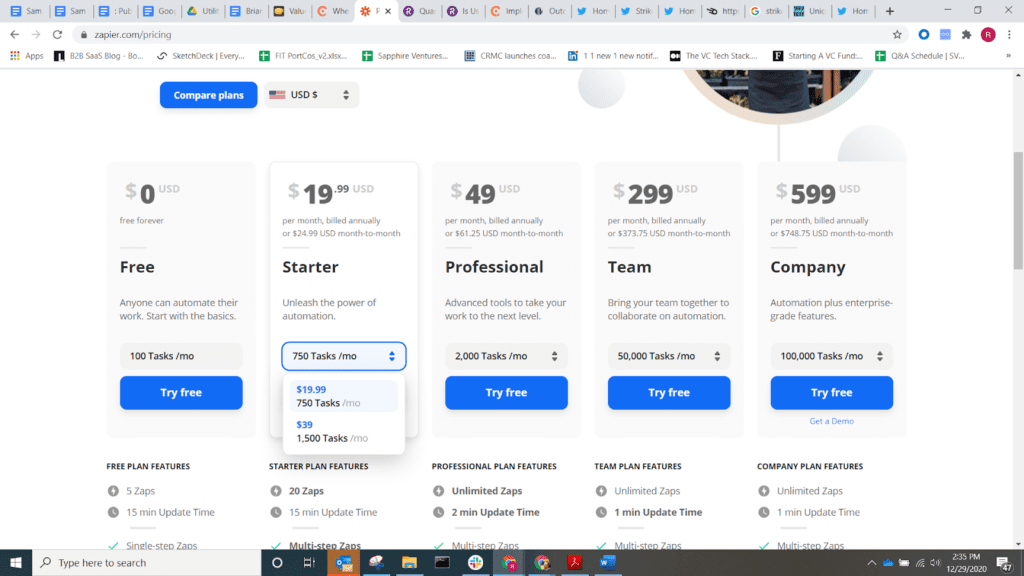
  • Hybrid Pricing: Charge a tiered subscription price for a certain threshold of technology services with additional per usage charges on overage. Basically a combination of a tiered, subscription and utility pricing strategy. Zapier has a hybrid approach with an offering that combines elements of tiered and usage-based pricing.

  • Pricing Calculators: Develop tooling on your website to help your customer easily forecast monthly, annual or unit-based costs by providing a pricing calculator. Below is a view of Fastly’s pricing estimators on their website. It’s simple and makes it very easy for a customer to understand and forecast the cost for your service. For more complex technologies or customer environments, you may have to pull in a solution engineer from your team to help the customer forecast consumption and cost. 

  • Simplicity: As noted above, keep it simple. Charging across four different user metrics and three different service level offerings can lead to potentially 36 different pricing combinations

Brian Mullen, VP & GM of Cloud at portfolio company InfluxData, says of their usage-based program strategy, “With InfluxDB Cloud we sought to eliminate unanswerable pricing questions for our customers. For example, with a database, the duration of a query is tough to forecast. Developers know their own workload in data and query volume, but would be hard-pressed to guess query duration on infrastructure they can’t even see. So we decided to charge by query count, which is knowable by the customer, instead of query compute duration, which is not.”

Usage-based pricing can be a great way to align incentives, improve customer retention and simplify your offering to customers. A successful pricing strategy requires thoughtful execution and coordination across your company. If your solution is very scalable, incurs highly variable usage, and has a clear, measurable transaction that aligns with value for customers then it may be a pricing methodology worth pursuing. Hopefully, the factors outlined above will help provide context in often overlooked implementation considerations of this strategy.


Democratizing Data Insights with a Next-Generation Data Lake Engine: Why Sapphire Ventures is Excited to Partner with Dremio

We’re thrilled to share that Sapphire Ventures is leading Dremio’s $135 million Series D funding round, which catapults the firm to unicorn status. Companies are producing more data than ever before and are increasingly relying on data insights to make important business decisions. Meanwhile, with growing cloud adoption and the separation of computing and storage, enterprises need an efficient way to analyze data stored outside of the traditional definition of a “data warehouse.” 

We believe Dremio, a distributed SQL query engine, is tailor-made to respond to these market shifts. The company’s technology allows data scientists and analysts to use existing tools such as Power BI and Tableau to rapidly query data using a self-service semantic layer directly on cloud data lake storage. Led by seasoned CEO Billy Bosworth and co-founder and Chief Product Officer Tomer Shiran, Dremio aims to move beyond separation of compute and storage, instead making the data itself a separate tier from compute, which allows analytics directly on full data sets independent of any vendor or proprietary formats. 

Here’s more on why we’re so excited about Dremio:

New computing trends driving demand for a different kind of analytics tool

Several key trends in the world of computing are fueling market demand for Dremio’s solution. The volume of data companies are collecting, and its importance to business success, are ballooning. IDC estimates that more than 59 zettabytes of data were “created, captured, copied and consumed” in 2020–a number that’s expected to grow to 140 zettabytes by 2024. 

Storing and making sense of this data has stoked the nearly $22 billion data warehouse market and the $26.5 billion business intelligence and analytics market. At the same time, more and more data is moving to the cloud, a trend that has only accelerated as the pandemic has turbocharged digital transformation initiatives across organizations.

The majority of data can’t be stored in an all-in-one data warehouse for both technical and economic reasons. In addition and at a higher level of abstraction, there’s a movement taking place towards a disaggregated software stack with each layer (storage, compute platform, compute frameworks for batch/real-time/SQL, etc.) built as composable Lego-blocks and away from monolithic and inflexible software stacks (such as a database with its custom storage format, parser, execution engine, etc. in a vertically integrated fashion).

As more companies move to a modern, disaggregated software stack, the separation between compute and storage functions are deepening. Yet the value of all this data can only materialize through analysis. We believe many companies need a tool like Dremio that can quickly access and directly analyze data stored in open formats in cloud storage, without costly data copying  and integration costs. 

Delivering low-cost, high-performance analytics with Dremio’s data lake engine 

Dremio offers users maximum flexibility on when and where to analyze data, separating data from storage. It allows data scientists and analysts to run rapid, self-service queries directly on data lake storage such as AWS S3 and Azure ADLS. Dremio can perform speedy, high-performance queries at the same level as cloud data warehouses without the need to spend resources on data copying, integration or proprietary storage. A vertically integrated semantic layer and distributed SQL engine means teams can get data insights faster and at a lower cost whenever they need them. 

Dremio’s product was built with the performance, security and scalability features that enterprises require. It fits well within the modern enterprise software ecosystem, giving companies the opportunity to use the analytical tools and storage options they prefer. Through a package of data catalog and lineage, Dremio provides strong data governance, allowing its customers—which include names like UBS, NCR, TransUnion and Henkel—to see how data was queried, transformed and connected across sources. 

A product-driven team and a seasoned CEO focused on rapid growth

Dremio was founded in 2015 by then CEO Tomer Shiran and CTO Jacques Nadeau who foresaw the need for a high-performance, low-throughput, low-cost technology stack for data lake queries. After about five years as the company’s CEO, Tomer decided to recruit experienced CEO and enterprise technology leader Billy Bosworth from the company’s board of directors to become Dremio’s new CEO. With the move, Tomer could focus solely on they company’s product strategy and vision as the chief product officer. 

In March 2020, Billy joined the company as CEO alongside Tomer and the broader team. For Dremio, Billy is nothing short of an ideal leader to take the business to the next level. He’s an accomplished executive, having previously been the CEO of DataStax, board member at Tableau and senior leader at companies like Quest Software and Embarcadero Technologies. Billy is an operator through-and-through with a track record of rapidly scaling data-focused companies. Despite the challenges of COVID-19, he has already added 50 new team members since joining.

With this new funding, Dremio is poised to build on its proven product-market fit and scale exponentially. With an unwavering focus on execution, we believe Billy and the team are set up for accelerated growth and seizing market share. 

Dremio is a fantastic addition to our list of portfolio of B2B enterprise technology companies focused on data and analytics, including recent investments such as Alation, DataRobot, Pendo, ThoughtSpot and Uptycs, and recently exited companies like Looker, Segment and Sumo Logic.

We’re excited to have Dremio become our latest partner in helping companies leverage data insights to drive better business results!


Iceberg below the surface

5 Insights Startup CMOs Should Know About Analyst Relations

In this year’s iteration of Sapphire’s annual CIO Innovation Index survey, enterprise leaders again reported that industry analysts were the second-most used source of information to identify emerging technologies and startups they should evaluable (the first source being introductions from the venture community). That means a majority of G2000 CIOs surveyed see the likes of Gartner, Forrester, and IDC as an important source of insights into the innovation landscape. 

Despite the potential value these analysts have for enterprise software companies, the industry analyst landscape is tricky to navigate, especially for small startups. As we’ve been advising portfolio companies on their analyst relations (AR) strategy, we’ve curated five key insights that startup CMOs (and CEOs!) should know about analyst relations:

1. It’s never too early for AR

There’s no downside to beginning to engage analysts via free vendor briefings. Even early-stage companies can benefit from these conversations that help refine your message and get your solution on the radar of these influencers. Plus, you could end up on “new vendor” lists such as Gartner’s Cool Vendors or Forrester’s New Wave.

Your initial investment in AR can be nothing more than the time spent:

  • researching relevant analysts and their published research in your space
  • booking briefings, and 
  • crafting a tight message in the form of an initial briefing deck

There is, however,  a significant step up in both time and resources from running an occasional vendor briefing to running a formal AR function.

2. Analysts provide value beyond published research

While placement in a research report or coveted Magic Quadrant is a successful outcome, analysts firms deliver value for startups in a variety of other ways, including: 

  1. Providing you with feedback on messaging, product roadmap, pricing and market fit, 
  2. Mentioning your solution to enterprise buyers in advisory conversations, and 
  3. Creating marketing opportunities in the form of analyst-hosted events, or mentioning your company during press interviews 

Analysts typically specialize in a specific technology area, and as such they see a broad swath of any given market. This gives them a great vantage point for delivering objective feedback on everything from how to frame your product to enterprise buyers, to prioritizing your product roadmap, and how competitors are positioning themselves. You don’t have to take all of their advice, but a two-way dialogue with a few plugged-in analysts is a valuable source of aggregated feedback on the market.

In addition, most analysts at the major firms spend approximately a third of their time on client-facing engagements: talking to enterprise buyers about their space, their business issues, and possible solutions. Ideally, you’d be top-of-mind for the analysts and they’ll mention your solution in these conversations. Some people may tell you that that mindshare is contingent on how much you spend with that analyst firm, but it’s more likely based on the quality of your interactions with the analyst and — most importantly — the strength of your messaging. Having feedback conversations with analysts early on can help you hone your messaging so that it sticks in the minds of analysts and potential customers alike. 

3. Finding the right individual analyst for your company is crucial

There is no exact definition of what an industry “analyst” does — no qualifications they need, no set of activities they have to provide.  As a result, not all analysts (or analyst firms) undertake the same sort of activities or have equal value to a startup. Each analyst and firm comes with different skills, expertise, influence, brand and offerings you need to match to your own objectives when engaging them.

To create a valuable AR program, you will need to think about the firm — and the individuals — you choose to work with and the role you want them to play in your go-to-market efforts. For many startups, it will make sense to start with one or two of the “Big Three” analyst firms: Gartner, Forrester, and IDC, because of their breadth of research coverage and ways to engage.  In other instances, such as a nascent market, it can make more strategic sense to work with a smaller boutique firm that is willing to dedicate the time to understand a technology before its mainstream.   

4. Don’t count out the smaller players

Though the “Big Three” capture a sizable chunk of the industry analyst market, this doesn’t mean smaller, boutique firms have no value to your AR strategy. Analysts at smaller firms can be more inclined to make provocative determinations in their research that can serve as great marketing materials. They’re also likely to give you more opinionated feedback on market fit and messaging. Plus, there are many smaller industry analyst firms that target very specific technology areas and have considerable mindshare in those areas (think: digital twins, 5G, real estate tech, etc.). 

5. Peer review sites are gaining traction

Previously, we’ve advised startups to monitor their ratings on the peer review sites (G2, Capterra, Peer Insights, etc.), but to not feel obligated to pay to promote their products on these services unless they had more of a consumer or developer-led sales motion. Recently, however, we’ve seen these peer review sites gain importance as a research source for analysts. In recent cycles, Gartner’s Magic Quadrant reportedly drew from Peer Insights reviews rather than direct customer references. While many enterprise buyers still don’t consider peer reviews an authoritative source, placement in site rankings (and ranking trends over time) does carry some weight and should be monitored. 

In addition to their potential long-term value, many startup CMOs mentioned finding it worthwhile to run a few promotional campaigns to ask happy customers for reviews – and then leveraging those positive reviews as content for customer marketing efforts, social campaigns, and other demand gen activities. 

The first step is often the hardest

Despite being repeatedly identified as an important decision-making channel for enterprise buyers, many earlier-stage startups we support find it difficult to take that first step to engaging the analyst community.  The difficulty comes from not knowing exactly how much value analysts really play in a particular market, and the opportunity cost of investing time on analysts relative to other marketing priorities.  In our next article in this series, we’ll highlight how some of Sapphire’s high-growth startups got over the first step of justifying their AR efforts, and how they continue to leverage this channel in their go-to-market mix.

Have thoughts or suggestions on how startups should engage analysts?  Let us know at [email protected] and [email protected].