Ushering in a New Era of Online Banking: Why Sapphire Ventures is Excited to Partner with Current

“When I look for investors, I look for real business partners—those who I feel have shown a genuine interest in our business from the very first conversation, and will be there for the long-haul. Kevin and the Sapphire team have stayed close to us since we were a fraction of the size we are today, helping us shape the business as we’ve continued to build the future of banking. We are incredibly excited about working with them.”  Stuart Sopp, Founder and CEO of Current

There is a commonly used adage that the 50 largest banks are worth over $50 billion. The number is actually closer to about 41 of the world’s largest banks1 that have a market cap of more than $50 billion (10 in the U.S.), still making the global banking industry massive. For an industry so large, there’s been a lack of innovation and significant disruption in the space until recently. What we’re seeing today are outdated solutions and brands being replaced by a new generation of no-fee, mobile-first, branchless online banks.

That is why Sapphire Ventures couldn’t be more excited to announce our investment in Current’s $131 million Series C2 funding round. We strive to help entrepreneurs build Companies of Consequence, and we believe that CEO Stuart Sopp and his team are doing just that for banking, one of the world’s largest markets. 

Current, a rapidly growing challenger bank founded in 2015, is poised to upend a multi-trillion dollar market by providing accessible and affordable banking to the next generation of consumers. After meeting countless startups in the broader online banking space, we immediately gravitated to Stuart’s drive and maniacally product-first vision, as well as the most compelling unit economics we have seen in the industry. 

Here’s more on why we’re looking forward to partnering with Current:

A rapidly growing sector with a solution for everyone

The global banking industry as a whole represents a massive market opportunity worth trillions of dollars. Within this vast market, we’re especially interested in online banks, which are booming amid a generational shift. The digital bank startup industry was worth more than $20 billion in 2019 and is projected to reach $471 billion by 20273

Current provides premium banking services for everyone, regardless of age or income. But the company started out by first targeting Millennial and Gen Z consumers who are driving the shift towards mobile-first solutions that offer digitally-native features with brands that are different than the ones their parents used. Data shows that a whopping 92% of millennials4 say they would choose a bank for its digital services. Furthermore, younger customers have a high distrust of traditional financial institutions, whose reputations have suffered due to high-profile scandals and hefty fees for banking services. 

Current is also seeing a strong following with essential workers, and ethnically and economically overlooked populations5 who have found in Current a solution that works specifically for them. The company’s goal is to lower the barriers to financial inclusion, something traditional banks are not set up to provide.

A next-generation, digital-first bank that stands out 

Current, a branchless, mobile-first bank based in New York, has gained incredible traction in the online banking world. The company offers checking accounts featuring faster direct deposits, free overdraft up to $100, a points system for cash back, instant refunds on gas holds and more, all without any hidden or overdraft fees or minimum balance requirements.

Current derives revenue primarily from the fees merchants pay when users swipe their cards, which means its growth potential directly correlates with the rising spending power of consumers as they continue to grow in life. 

One of the most impressive aspects of this success has been how Current has done it, matching their strong growth with equally impressive unit economics, something we rarely see in the challenger bank space. Current has achieved this by offering a solution people actually want and by building a cloud-native and horizontally scalable technology stack that brings core pieces of banking infrastructure in-house, resulting in meaningful cost savings that can be passed onto its users. 

A visionary leader with strong industry experience

Founder and CEO Stuart Sopp brings with him a deep expertise in the banking industry, including as Head of Trading at Morgan Stanley and Citi. He is product focused and puts the consumer experience first in every circumstance. With a personality that will control any room and a strong team behind him, including executives from Zynga, Topps, Paypal, BlueVine and others, we feel that Stuart is well-positioned to change the banking space forever. 

We’re excited to have Current join a long list of Sapphire portfolio companies in the fintech space, including AvidXchange, Currencycloud, Feedzai, IEX, OnDeck, Square and TransferWise. The investment also fits within our slate of consumer-focused companies, such as 23&Me, Cazoo, Fitbit, LinkedIn and Sun Basket. We look forward to partnering with Current as it reimagines banking with consumers’ best interests in mind!

1www.advratings.com
2www.prnewswire.com
3www.businesswire.com
4www.americanbanker.com
5www.cnbc.com


 

Near-Perfect Transcription with a “Human-in-the-Loop” Approach: Our Investment in Verbit

We’re excited to share that last week, Verbit announced its $60 million Series C funding round, which Sapphire led. Verbit offers a best-in-class transcription and captioning platform that combines the efficiency of artificial intelligence with the accuracy of human transcription. 

There are a number of reasons why we chose to partner with Verbit. First, the market for automatic transcription was already booming pre-COVID, but adoption recently accelerated as organizations quickly shifted online. Second, the near-perfect accuracy of Verbit’s “human-in-the-loop” transcription model has given it a strong customer base among legal and educational institutions and positioned it to emerge as a market leader. And last but not least, Founder and CEO Tom Livne is a passionate leader who saw firsthand the issues associated with transcription while working at a law firm. 

Here’s more on why we’re so excited about Verbit: 

A sizeable market experiencing accelerated growth

The automatic transcription and captioning market is rapidly growing and as such, presents an exciting investment opportunity. That’s because highly accurate transcription is an essential service for higher education institutions, the legal industry, media and entertainment and other market sectors.The education and legal transcription markets alone are worth $5 billion because academic institutions are required to transcribe massive amounts of audio and video content in order to be compliant with federal regulations, and the legal field needs exact records of court proceedings in order for lawyers, courts and more to do their jobs accurately.

Recent advances in automatic speech recognition (ASR) technology, which enable transcription accuracy of up to 90% and transform audio into text in a matter of minutes, have made this an attractive industry. Before COVID-19, automatic transcription across all sectors would have been worth more than $30 billion by 2025. That’s an impressive number that’s likely now much higher due to the aftermath of the pandemic. The rapid transition to an online world has only driven demand for transcription as many organizations have moved operations online, producing much more audio and video content than before. 

In the near future, Verbit aims to expand its automatic transcription service to new sectors, including government, finance and the enterprise. In addition, Gartner estimates that call centers will use speech-to-text technology to transcribe 40% of all inbound queries by 2025. It’s clear that we have only scratched the surface of the potential of automatic transcription.

Combining the power of human and machine for near-perfect accuracy

Rather than offering an AI-powered platform on its own, Verbit uses a “human-in-the-loop” approach to achieve the +99% accuracy that its customers need. The company taps the speed and cost-effectiveness of machine-generated transcription and refines the results using a marketplace of 22,000 freelance transcribers in 120 countries. As a result, Verbit can provide near-perfect transcription at scale, with a faster turnaround and more affordable price than human transcribers. Human input also provides a feedback loop that helps train its speech recognition algorithms to become smarter and faster over time. 

Verbit appeals to enterprise customers, which require almost 100% accuracy, which is why the company also offers best-in-class professional services to its customers who help guide them to make the most out of the platform on a daily basis. 

Looking ahead, Verbit plans to use this additional round of funding to add new product capabilities to serve the finance and insurance industries, cultural institutions and call centers. In addition, Verbit has a promising strategy to supplement organic growth by acquiring small legacy vendors in the space. The company has already demonstrated this by completing its first acquisition of a transcription provider focused on the enterprise and higher education, and moving most of its customers to the more efficient Verbit platform. 

An experienced founder focused on growth

Founder and CEO Tom Livne is a former lawyer who early-on saw the potential for AI to transform the costly and time-consuming process of transcription that has historically been done by stenographers. A second-time entrepreneur and former paratrooper in the Israeli Special Forces, Tom is an out-of-the-box thinker with a proven track record of growing successful businesses. We’re impressed with his clear dedication to rapidly expanding the company and his focus on execution. 

Here at Sapphire Ventures, we believe in Boring AI — the idea that AI will have the greatest impact in solving what most may consider mundane problems in the enterprise, not the sexy (yet rare) use cases that grab headlines. We’ve invested in a number of AI and machine learning startups over the last several years, including current investments such as Clari, an AI-powered revenue operations platform for B2B organizations, and Moveworks, the first autonomous AI platform for resolving enterprise IT issues. We’ve also invested in numerous Israeli-based companies including JFrog, Kaltura and Monday.com. We’re excited to have Verbit become our latest partner in deploying AI to make everyday business processes more efficient — and we believe its future will be anything but boring!


medable social card

Leading the Way in Decentralized Clinical Trials: Why Sapphire Ventures is Excited to Partner with Medable

We’re excited to share today that Sapphire Ventures is leading Medable’s $91 million Series C funding round. Seemingly overnight, COVID-19 forced the healthcare industry to break through decades of systemic inertia and rapidly accelerate digital transformation. Now more than ever before, there’s a massive opportunity for healthcare technology companies to pave the way for a new and better status quo–especially in the clinical trial space.

Medable’s mission is to deliver effective therapies to patients, faster by providing software that enables decentralized clinical trials. We believe that the company’s cloud-based, end-to-end platform is a best-in-breed solution to enable remote clinical trials. Medable’s approach substantially reduces trial times, increases patient access and improves the patient experience, ultimately resulting in better trial outcomes. To help set new standards for clinical trials that will become the new normal long after the pandemic has passed, Medable is working closely with some of the world’s largest biopharma companies and clinical research organizations (CROs). 

Medable’s co-Founder and CEO Michelle Longmire, a Stanford-trained physician, and her team are well-positioned to seize this transformative opportunity in healthcare. Here’s more on why we’re so excited about Medable: 

An urgent healthcare opportunity for a lasting transformation

Despite the proven benefits of conducting clinical trials digitally, healthcare organizations overall have been slow to adopt the approach. Regulatory barriers and privacy considerations in the healthcare industry have contributed to slow uptake. But perhaps an even bigger obstacle has been the lack of change in a field that still often relies on healthcare professionals capturing outcome assessments from patients at a clinical site on pen and paper. 

The pandemic served as a shock to the system and opened the floodgates for the rapid adoption of healthcare and remote telemedicine technology, including clinical trials. As a result of COVID-19, about 80 percent of non-COVID-19 clinical trials were stopped or interrupted, and new studies couldn’t enroll participants. The disruption caused costly delays for pharma, biotechnology and medical device companies working to get new drugs to market. With the traditional methods of conducting clinical trials no longer a viable option, the industry has rushed to invest in software that enables decentralized clinical trials (DCTs). 

Current events aside, the surge in demand for digital and DCT enablers is predicted to take off thanks to the myriad benefits of decentralization. Today, fewer than ten percent of the U.S. population participates in clinical trials, which usually require in-person visits to a facility. Taking trials digital widens the global pool of participants, leading to more and better data, time and cost savings for pharma companies, and faster and more effective drug development that benefits us all. It’s no wonder that global spending on clinical trials is estimated by Grand View Research to reach $69B by 2025.

Best-in-breed technology that serves top global customers

Medable is primed to meet the unprecedented demand for digital and decentralized clinical trials in the industry today. Its modern, flexible and cloud-based platform features unique modular technology that maximizes the benefits of digital in individual studies. Medable also offers enterprise data and operational capabilities that ensures the interoperability necessary for seamless data capture across users and systems across just about any outcome assessment, device or digital endpoint.

Medable includes solutions for remote patient screening and enrollment, telemedicine (TeleVisit), remote eConsent (TeleConsent), and remote electronic Clinical Outcome Assessments (TeleCOA), which powers real time remote patient monitoring to track and analyze trial progress in real-time. Medable also offers solutions that leverage wearables and other devices to seamlessly capture patient data. And it provides patients with engaging apps. In other words, Medable delivers all of the elements needed to run a fully decentralized clinical trial. To top it off, Medable apps are available on web, mobile and tablet and feature slick, consumer-grade interfaces to optimize the user experience. 

Founded in 2015, Medable already counts the majority of the largest 20 biopharma companies in the world  among its customers. As a pure-play software vendor, Medable also partners with top global CROs, which are both customers and key distribution partners into the biggest global biopharma companies.  

A passionate team that combines medical and tech expertise

Co-Founder and CEO Michelle Longmire is a Stanford-trained physician who is passionate about improving human health and saw an opportunity to do so by becoming a company builder. She co-founded Medable alongside CTO Tim Smith, who is a second-time entrepreneur in the space, having previously founded a company that implemented Salesforce in large hospital systems. Michelle and Tim are deeply mission driven, tenacious leaders and they’ve built a team of seasoned executives driven by excellence, commitment and integrity—including EVP of Sales Eric Peper, SVP of Strategy and Solutions Ching Tian, and VP of Customer Success Jared Klingeisen who all bring deep expertise in the healthcare industry.

This latest funding round will enable Medable to meet surging demand by staffing up  go-to-market and customer success teams.

We’re thrilled to have Medable become the newest addition to Sapphire’s portfolio of healthcare technology companies. Our earlier healthcare technology investments in Fitbit, 23andMe and Livongo have taught us that digital platforms can improve healthcare outcomes and create meaningful Companies of Consequence at the same time. We’re looking forward to partnering with Medable on its mission to accelerate the discovery of innovative medical treatments and improve healthcare for all. 


Pioneering a Better Way to Work: Why Sapphire Ventures is Excited to Partner with ActivTrak

We’re thrilled to share that Sapphire Ventures is leading ActivTrak’s $50M Series B funding round. Launched as a SaaS application in 2012, ActivTrak is a leader in workforce productivity and analytics software, which is an area of increased importance for companies today. While it has always been a priority for companies to understand and improve how their employees work, it’s especially important in the current remote work environment and will continue to be in a post-COVID world. 

ActivTrak is pioneering a better way for teams to work together, and we couldn’t be more excited about it. Here’s why we chose to partner: 

Leading in a fast-growing, increasingly valuable market

There are a few reasons why we believe ActivTrak is in the right place at the right time. First, existing workplace management tools have typically focused on monitoring employee productivity and identifying illicit behavior. ActivTrak’s platform goes beyond these basic capabilities by helping companies identify popular apps and get rid of unused ones, ensuring employees have the tools they need and reducing unnecessary costs. ActivTrak also helps detect patterns in behavior, benchmark across peers and industries, coach employees and improve overall team effectiveness. Very large companies have the tools and resources to address some of these pain points, but until recently smaller and mid-size companies have been left flying blind.

Second, the pandemic has forced businesses to reimagine where and how their employees work. Some companies have shifted to a fully remote workforce, while others are expected to have flexible work-from-home policies in the future. While many employees have returned back to work over the last couple of months, a third of U.S. employees are still working from home, with another 25% working remote part-time. With so many employees working in a hybrid or distributed environment for the long term, it’s our belief that companies will invest in the necessary technologies to better understand how their workforce is working, and ensure employees have access to the tools to get their jobs done. 

And third, the timing couldn’t be better for a company like ActivTrak to scale. Looking at the data, the global user activity monitoring market is estimated to be $1.3 billion in 2020. And the industry is projected to expand in the next seven years with an average CAGR of 22.5% that will see the market reach $5.4 billion by 2027. 

Giving companies the tools they need to improve their teams

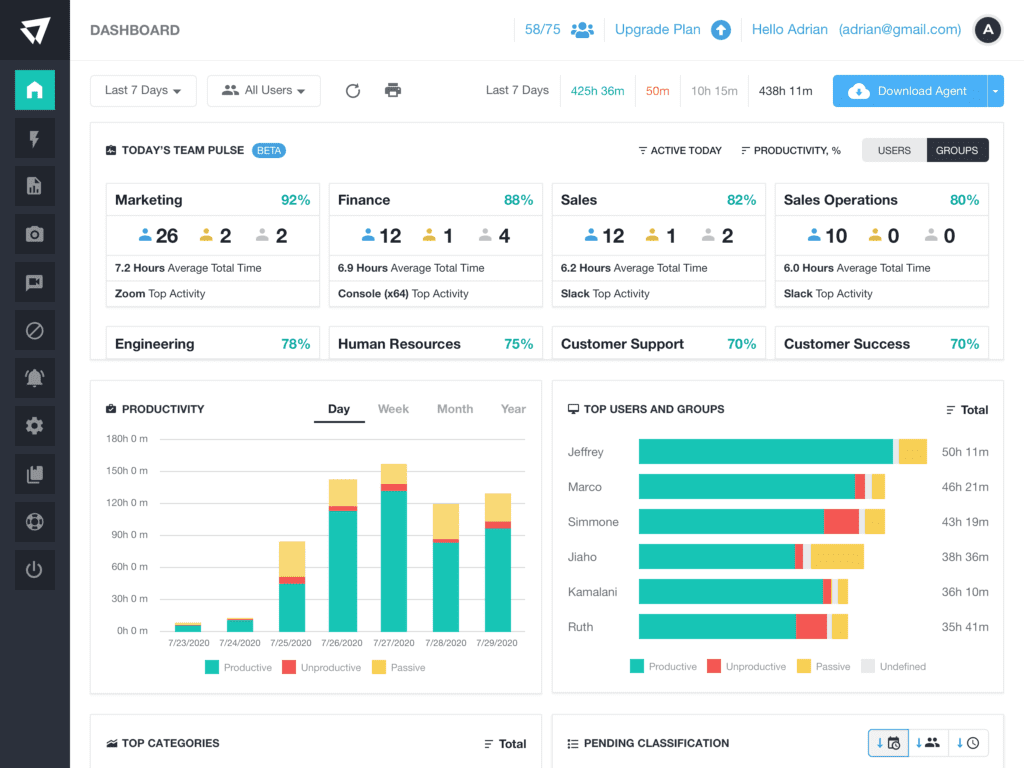
ActivTrak's workforce productivity and analytics dashboard

ActivTrak’s cloud-based platform allows teams to understand how people work based on user activity data that’s collected and analyzed from the websites and applications employees regularly use. The data is populated into a real-time dashboard, which companies and their different teams can integrate with additional tools such as business intelligence (BI) solutions. 

With ActivTrak, teams can observe workforce behavior, learn behavioral patterns, glean insights around performance correlation and see which apps and tools are used the most in the workplace. Employers can use this information to optimize specific workflows and workforces by coaching employees to perform more effectively. ActivTrak encrypts all data and stores the information using the Google Cloud Platform (GCP), which also allows companies to leverage GCP’s capabilities for analytics, AI and security.

ActivTrak’s key features include:

  • Dashboard: Quick visual summaries of key user activities with drill down for further details.
  • Activity Reports: Reports that locate unbalanced work time patterns, measure employee productivity, identify top performers, and understand application and website usage patterns.
  • Team Productivity Pulse: Live dashboard with snapshots of team member productivity data, employee availability status such as active, passive or offline, applications being worked on, and the number of hours worked and most often used work application for each employee.
  • Activity Alarms: Pre-built or customized alarms used to set boundaries or restrictions on social media site usage, monitor USB device activity to protect copying of sensitive data and establish user risk scores with severity levels to understand activities out of compliance.
  • Activity & Productivity Classification: Library of applications and websites employers use to understand how employees work. ActivTrak automatically classifies productivity and categories of common applications and websites, but it can be customized for an organization or team’s unique needs.
  • Data Connect: Analytics feature that provides customers with direct access to key user behavioral activity data to query against and integrate with external BI data visualization tools like Tableau, Microsoft Power BI, Google Data Studio and other business data sources.
  • Website Blocking: Prevents visits to websites to ensure productivity and security.

This is just the beginning for ActivTrak. The company’s 2021 roadmap includes benchmarks of baseline behaviors for users to improve on, as well as access to a personal productivity dashboard so employees can receive insights into their own work habits in real-time. ActivTrak is also boosting integrations to commonly used tools, having recently added Microsoft Teams so that insights can be delivered to users within their existing workflows.

Experienced leadership and expertise puts ActivTrak ahead of the curve

ActivTrak was founded eight years ago with the mission of helping companies understand how their teams perform. Since then, the Austin-based company has brought on new CEO Rita Selvaggi, CRO Justin Endres, CMO Shanel Vandergriff, Head of Operations Heidi Farris, VP Products Javier Aldrete and SVP Engineering Matt Finlayson among others, and has grown to be recognized by SXSW as a leading innovator and by PCMag as the best monitoring software for productivity tracking.

Prior to ActivTrak, Rita, Justin and Shanel held senior roles at AlienVault, the cybersecurity firm that was acquired by AT&T in 2018. Before that, the trio also worked together at SolarWinds leading up to the company’s IPO in 2009. We were drawn to the team given their proven track record of building great technology products and profound operational experience with high-velocity mid-market sales models. Their first decade of working together was an incredible success, and we expect the coming years to be no different. 

We also connected with Rita and the team on a personal level. They are down to earth, yet incredibly driven individuals. And both Nino and Rita share a Croatian and Italian background. Nino is Crotian and spent several years living in Italy, and Rita is of Croatian and Italian heritage.

ActivTrak’s best-in-class platform, paired with a management team with a sterling track record, has us looking forward to a bright future and the opportunity to build a company of consequence. 


Securing Apps From the Very Beginning: Why Sapphire Ventures is Excited to Partner with StackHawk

Sapphire Ventures is excited to lead StackHawk’s Series A funding round, and to work with founder and CEO Joni Klippert and the team. StackHawk is an innovative cybersecurity startup that sits at the intersection of what we believe to be two of the most robust, high-growth technology investment sectors: DevOps and Cybersecurity. As software eats more and more of the world, it’s critical to ensure that this software is secure.  

By bringing together developer operations (DevOps) and cybersecurity in the open-source world, StackHawk is taking a brand new approach to an existing sector of security called Dynamic Application Security Testing (DAST). With its platform, StackHawk enables software developers to make sure that the software code they’re producing is secure as they’re writing it, and prior to release.

Here’s more on why we’re so excited about StackHawk:

Baking security into the software development lifecycle

Most of the time, developers build and publish code to live environments before security testing takes place. If errors are found, the security group has to work with developers to make updates. Not only does this allow security issues into live environments,  but it can lead to tension between developers and the security group.

In addition many legacy offerings, which are still frequently used today, were built for security and not development, so they operate on software already in production. As a result, traditional DAST tools are expensive and are primarily used after a product has shipped, if at all. StackHawk introduces a new way to uncover security flaws by finding vulnerabilities early in the software development process. This is part of a new and growing “shift left” movement, which delivers numerous benefits to developers and the companies they work for, including cost cutting due to less testing required, a quicker path for apps to get to market and fewer unexpected errors when an app goes live.

With its developer-first approach, StackHawk provides a set of workflows and integrations around a core DAST engine based on an OWASP open source web-app scanner called Zed Attack Proxy (ZAP). StackHawk can be integrated into a project’s CI/CD pipeline from the start, ensuring common vulnerabilities are found and resolved before an application is in production. The platform is deployed via Docker and integrates with tools already used in the development workflow like Jenkins, GitHub Actions, and CircleCI (a Sapphire investment), as well as workflow tools like DataDog, Slack and Jira.

A burgeoning market with opportunity for rapid growth

StackHawk is well positioned to succeed in a growing business segment. The application security market was recently valued at $2.8 billion, and is expected to grow to $9 billion by 2022, according to MarketsandMarkets estimates. The increased usage of gaming apps, social media platforms and ecommerce apps are all key drivers of economic activity.

Meanwhile, as app usage rises, the attack surface for applications is quickly expanding. Cloud and mobile apps, APIs and IoT solutions are all areas where we expect to see more security risk. As the number of exposures for these apps increases, so too will the need for security. 

Last but not least, today’s apps are more frequently built on open-source components that can benefit from testing, a fact painfully borne out by the 2017 Equifax breach resulting from an Apache Struts RCE vulnerability. The data breach exposed the personal information of 147 million people, making it one of the largest cyber crimes related to identity theft. 

A team with success to look back and forward on

StackHawk was founded in July 2019 by Chief Executive Officer Joni Klippert, Chief Operating Officer Ryan Severns and Chief Security Officer Scott Gerlach–a trio with an impressive record well before their latest project.

Prior to StackHawk, Joni oversaw product and Ryan was responsible for marketing at VictorOps, an alerting and incident management company bought by Splunk in 2018 for $120 million. Scott was head of security for Twilio and SendGrid. The three founders have a proven track record of serving customers in DevOps and security. Furthermore, Joni is a charismatic and intelligent leader, and the team is extremely knowledgeable of the space, which shows. In our discussions, we were especially inspired by their motivation to become the most developer-friendly security product.

With this new funding, we are excited to see the StackHawk team continue to expand its Dynamic Application Security Testing capabilities, grow the open source ZAP project and get their product in the hands of the growing ranks of DevOps teams at companies both small and large. 

We’re excited to have StackHawk  join a long list of developer-focused Sapphire portfolio companies, including current investments such as Auth0, CircleCI, Contentful and InfluxData, and recently exited companies such as JFrog (NASDAQ: FROG), Portworx (Acq. by Pure Storage), Segment (Acq. by Twilio) and Sumo Logic (NASDAQ: SUMO). And we couldn’t be more thrilled to partner with StackHawk on its mission to make the digital world safer for thousands of developers and millions of users!


The Rise of Digital B2B Payments and Why We’re Excited about AvidXchange

The global payments market is enormous. The industry is $240 trillion in size, which is larger than the global GDP of roughly $85 trillion*. Over the past decade, startups and established players have capitalized on this opportunity by modernizing the payment process for consumers. But the business-to-business payments space, which is actually much larger than consumer payments, remains antiquated and ripe for disruption.

In recent years, consumers have benefited from payment innovations such as contactless payments, mobile wallets and other forms of digital payment-taking. For most of our personal finance needs, we no longer have to step foot into a bank, carry a credit card or write a paper check. These innovations, which have modernized and helped how consumers transact, have also improved the payment process for merchants. All of which have been made possible by disruptors in the space like Square, a Sapphire Ventures investment, which went public in 2015, Stripe and many others. 

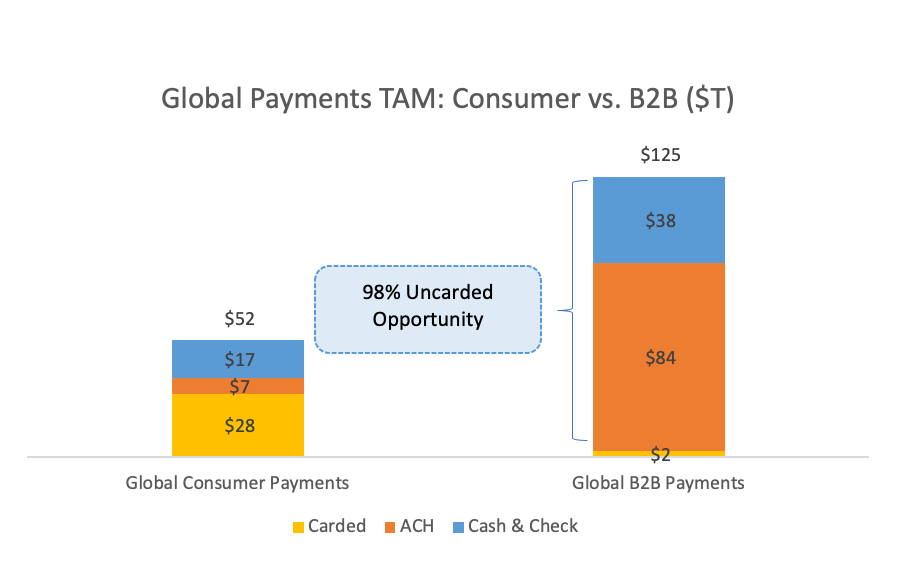
Interestingly enough, the B2B space has experienced far less innovation, despite it representing a bigger piece of the overall payments market. While the B2B payments total market size is at $125 trillion**, amazingly, less than two percent of B2B payments are made via credit and debit cards versus 54 percent for consumer payments***. The vast majority of invoices are still requested by mail and via paper or are emailed with PDF attachments, at best. And 98 percent of B2B payments continue to be made by writing paper checks and through bank ACH processing****.

Source: Credit suisse nice report – Payments Processors FinTech USA.pdf

For these reasons, we believe B2B payments to be one of the most interesting areas in fintech right now. The industry is in an early phase of disruption, and as we look ahead, the opportunity is vast. That’s why we’re excited to share that Sapphire has recently invested $35 million in AvidXchange, a leading B2B payments company that automates accounts payable and payment processes for the middle market.  

Sapphire Ventures and AvidXchange partner to streamline the B2B payment process

AvidXchange is a leading fintech company that provides B2B payment automation for thousands of businesses and their suppliers, processing more than 12 million payments annually*****. AvidXchange’s platform starts by digitizing paper or PDF invoices and automating accounts payable workflows. By digitizing these processes, and integrating with dozens of enterprise resource planning (ERP) and accounting systems, AvidXchange reduces the need for tedious paperwork. The result is an entire payment process and workflow that is faster, better organized and less error-prone from invoicing to payment.

By serving its invoice-paying customers, AvidXchange has also built a massive network of more than 680,000 suppliers across multiple industries. These suppliers benefit from the online workflows, and are able to receive expedited payment through virtual cards or AvidPay Direct, an enhanced ACH payment offering. As more invoice-paying customers onboard their suppliers, the AvidXchange network becomes a familiar standard both to buyers and suppliers, and increases the value to each side of the network. We believe network effects are a very compelling growth driver, as we’ve seen in other Sapphire portfolio companies like LinkedIn, Square, Docusign, OnDeck Capital and Ticketfly.

We’re thrilled to partner with Mike Praeger, the company’s co-Founder and CEO, and his team in their mission to automate B2B payments. Mike started AvidXchange 20 years ago as a small entrepreneurial group in Charlotte, North Carolina. Since then, the company has grown to become a leader in the digital B2B payments space with 1,500 employees worldwide.

We believe that there is a tremendous runway for growth for AvidXchange, and are excited to be part of the company’s journey in helping businesses embrace the future of payments.


*Global Payments Report 2019: Amid sustained growth, accelerating challenges demand bold actions

**Credit Suisse Report: Payments, Processors, & FinTech

***Credit Suisse Report: Payments, Processors, & FinTech

****Credit Suisse Report: Payments, Processors, & FinTech

*****Accounts Payable Automation | AP Software


Baby, You Can Drive My Car ♫: Our Investment in Cazoo’s £240M Series D

Cazoo vane dropping off a car at a person's house

Cars have been symbols of personal freedom since long before the seminal Beatles song. But while owning a car is associated with choice, control, and independence, people rank buying a car as one of their least favorite experiences. The car dealer and an opaque and arduous process stand between them and the open road.

Online car marketplaces as well as car comparison and car discount sites have not significantly alleviated the pains of car buying. The experience has essentially stayed offline with low consumer satisfaction and trust and as one that many loathe.

Cazoo is setting out to fundamentally change the way used cars are purchased by enabling consumers to select from thousands of cars online, purchase the vehicle, and arrange delivery to their home in 72 hours. In the background, Cazoo utilizes proprietary data and pricing algorithms to purchase vehicles and offer consumers the best price. Cazoo then fully reconditions every car to ensure quality before listing them on the platform for purchase. Every car comes with a 7-day money back guarantee and a 90-day warranty and consumers can also obtain financing.

Today, we are thrilled to announce our investment in Cazoo’s £240M Series D financing joining world-class investors, including General Catalyst, Octopus, LocalGlobe, and Stride, among others.

We believe Cazoo has all the ingredients to build a category defining company.

Used cars are the largest retail segment of the UK economy with 8 million cars transacted worth £50B last year, according to the Society of Motor Manufacturers and Traders (SMMT). It is a highly fragmented market with over 12.5 thousand retailers and the largest having less than 3% market share. Of the cars traded, less than 1% are purchased online today. This compares to 61% of UK consumers who are willing to buy a used car online, according to CarGurus’s UK Sentiment Study. Covid-19 has accelerated this strong sentiment, and we believe that the resulting long-term macro trend of shifting from offline to online underpins the bold trajectory of Cazoo.

At Sapphire Ventures, we strive to partner with founders who have the vision and ambition to build Companies of Consequence. Alex Chesterman is that founder. We admire Alex for his unique ability to not only spot changing consumer trends in large markets, but also to execute on those opportunities flawlessly as evidenced through his prior companies Zoopla and LoveFilm. At Cazoo, Alex has put together a world class team that combines scaling experience and execution excellence, and we believe Cazoo is well on its way to becoming a European Company of Consequence.

Cazoo has already achieved impressive traction in its first year of operation with its differentiated business model in a large and untapped market. In addition to its large market, visionary leadership and experienced team, Cazoo also has the advantage of being able to look to America where Carvana and Vroom, two publicly listed companies, have established a successful playbook for the category. Cazoo may be able to leverage learnings from these companies in addition to benefiting from the structural advantages of the UK market with no slowing in sight to expand globally.

We are excited to be riding shotgun with Alex and team proverbially, and we look forward to supporting Cazoo in the next phase of company building.

“I am delighted to welcome Sapphire Ventures to our all-star investor syndicate and have their support for the next stage of our journey,” says Alex Chesterman.

The whole Sapphire team is buckled up and looking forward to the ride, or in other words:

Beep-beep’m, beep-beep, yeah


Congratulations to Sumo Logic on the IPO! And for Revolutionizing DevSecOps with Continuous Intelligence

Today is another exciting day at Sapphire Ventures! Sumo Logic (NASDAQ: SUMO), a leader in continuous intelligence and one of our portfolio companies, became a company of consequence and went public on the NASDAQ Stock Market.

With its Continuous Intelligence Platform, Sumo Logic enables its customers to parse information collected from their enterprise apps and integrations to help pinpoint operational and security issues. Since its founding in 2010, the company has been a key player in the DevSecOps space, which stands for development, security and operations and is the philosophy of integrating security within DevOps. It involves creating a ‘Security as Code’ culture with ongoing, flexible collaboration between release engineers and security teams. Ultimately, the goal of DevSecOps and Sumo Logic has been to create new solutions for complex software development processes within an agile framework. 

We’re incredibly proud of the leadership team at Sumo Logic, and their achievement of leading the company to this point. From the time we first invested in Sumo Logic three years ago, we were certain that it would become a company of consequence, and we’ve been honored to partner with the team along their journey.

Release Software Faster, Secure Loopholes and Better Deliver Solutions with Sumo Logic

We live in a hyper competitive world where organizations can succeed or fail based on real-time intelligence. In other words, a company’s livelihood depends on how it understands and responds to what is happening inside their business, and the infrastructure that runs all its critical systems. 

Sumo Logic’s Continuous Intelligence Platform enables businesses to automate the collection, ingestion and analysis of application, infrastructure, security, and IoT data to derive actionable insights within seconds. The company helps customers:

  • Monitor and troubleshoot applications and cloud and on-premise infrastructure
  • Manage audit and compliance requirements
  • Rapidly detect and resolve modern security threats
  • Extract critical key performance indicators (KPIs) from various types of machine data to gain visibility into customer behavior, engagement and actions

Sumo Logic addresses the gaps in intelligence that arise from siloed development, operations and security teams. With Sumo Logic, organizations can implement a modern DevSecOps operating model, which involves ongoing, flexible collaboration among developers, release engineers, and security teams. The platform also automates the processes between software development and operations teams in order to build, test, secure and deploy modern applications faster. Simply put, Sumo Logic enables DevSecOps teams to gain more insights and intelligence in order to release software faster, optimize processes, secure loopholes and better deliver digital solutions to customers. 

Sumo Logic and Ramin Sayar Prove DevSecOps to be a Massive Opportunity 

We’ve been following Sumo Logic since 2013. And over the years, we’ve seen it evolve into an enterprise cloud-native analytics platform for DevSecOps teams that manage the transition of enterprise infrastructure from data-centers to public and hybrid clouds. While back then this was a growing market and one we felt was propelling forward, what struck us as more important was that the company had brought in Ramin Sayar as its new CEO at the end of 2014. 

Prior to Sumo Logic, Ramin spent nearly 20 years working in product management, strategy and leadership roles at enterprise technology companies including VMware, HP Software Technology, TIBCO and AOL. Since Ramin joined Sumo Logic, he accelerated the company’s transition to focus on the enterprise. So in June 2017, Sapphire Ventures led Sumo Logic’s Series F $75 million funding round. Since our investment, it has been extraordinary to see Ramin and his team grow the company across product, talent and revenues. 

“One of the reasons we partnered with Sapphire back in 2017 was because the investment team had a strong understanding of the market and business critical fundamentals that are required for a company to scale up to and through an IPO,” said Ramin Sayar, CEO of Sumo Logic.

Leading up to today’s IPO, the Sapphire investment and Portfolio Growth teams have worked with Sumo Logic on many different activities. Sapphire helped facilitate numerous customer and partner introductions, provided go-to-market support, helped with talent needs and enabled Sumo Logic to gain broader exposure across the enterprise community with various executive and industry events. We’ve had a fun ride together and are excited for this next stage of growth for Sumo Logic.

“Sapphire’s passion and commitment to helping Sumo Logic over the past few years has been impressive. As we approached going public, Sapphire was there with us lock-step, asking the right questions and providing useful advice. They have the best mix of investors, operators, technologists and services professionals. And they have a massive network to help with a variety of needs, which is probably one of the best kept secrets in the industry,” said Ramin Sayar, CEO of Sumo Logic.


Congratulations to JFrog! An Iconic IPO that Highlights the Coming-of-Age of DevOps

Today is an incredibly exciting day at Sapphire Ventures. Our portfolio company JFrog (NASDAQ: FROG), which is transforming how enterprises manage and release software updates, went public on the NASDAQ Stock Market. 

More than 10 years ago, the JFrog team developed the world’s first universal artifact platform. Artifacts are a by-product of the software development process, and the metadata accumulated about artifacts is essential for reusing code and improving the build process. Artifacts are commonly stored in a repository like JFrog so they can be retrieved on demand and shared across teams. By enabling software development and deployment teams to continuously and securely build, deploy and run software updates, JFrog ushered in an entirely new era in Development Operations (DevOps). 

We couldn’t be more proud of the JFrog management team, and their outstanding achievement of building a company of consequence and leading the company to become public. From our very first investment in JFrog in 2016, we knew what they were doing was special, and have been fortunate to have been part of their journey to-date.

JFrog Makes Software Liquid By Enabling Continuous Updates and Eliminating Versions

The majority of today’s businesses are software companies. As such, they depend on software to create applications and experiences to better engage with their customers, partners and employees. Which is why the continuous and reliable release of new software has become mission critical. Companies that fail to keep their software current or react to problems with timely updates risk losing  revenue, harming their brand’s reputation and even worse, threatening human safety and lives. 

As companies race to rapidly release software to meet the demands for new applications and ongoing updates, they need a new platform to support them. The traditional approach of different teams developing and deploying software is time-consuming and no longer effective. JFrog’s DevOps platform has played a powerful role in improving the process of building, securing and deploying software in this new era of infinitely scalable cloud computing.

JFrog changed the paradigm by encouraging collaboration and communication between software development and deployment teams, which has accelerated the pace of work, accommodated faster release schedules and improved the quality of software. With JFrog, there is no end state when it comes to software updates–it’s an always-on process that’s secure, continuous and delivers value to users, ultimately enabling a world of version-less software.

Our Big Bet on the JFrog Team, Company Vision and Future of DevOps Pays Off

Sapphire Ventures first met CEO and co-founder Shlomi Ben Haim and the JFrog team in November 2015. One of the first things that stood out to us was JFrog’s highly efficient financial metrics, which they continue to deliver on today. It was unlike something we’ve seen before. But even more appealing was the product vision JFrog’s Chief Data Scientist and co-Founder Fred Simon and Chief Technology Officer and co-Founder Yoav Landman outlined. The DevOps platform they were creating would accelerate the building and deployment of software, and made us believe that JFrog was on its way to become a company of consequence.

In January 2016, we participated in JFrog’s $50 million Series C financing. At the time, this was one of the largest DevOps investments made by a venture firm, and it was Sapphire’s first bet in the DevOps space. But Atlassian had just gone public around that time, so we were convinced that DevOps would be a huge market. It became clear to us that all software would be eventually developed, deployed and operated by the same team, which had to be agile and collaborative to respond quickly to customer demands and changing market needs.

Four years later, and we’ve been able to partner with Shlomi and JFrog many times over across our investment and Portfolio Growth teams, supporting business development, talent and more. Over the last several years, we’ve been able to build a true partnership and are thrilled for JFrog and this next chapter of the company’s growth as a public company. 

“We’re pleased to have partnered with Sapphire for more than four years now. From the beginning, the team has felt like family and we’ve received incredible value from the investment and services teams. It was extremely important for us to choose the right partners as we scaled the company. It’s not only about growth, but also the technology and community and, more than anything else, the culture that you care about as a founder. Jai Das has led this partnership on Sapphire’s end, and his vast experience as an investor coupled with the mindset of a developer is a unique combination you don’t see that often in the VC market–this has been a perfect match for us throughout our work together. I’m grateful and honored to be part of the Sapphire family both pre- and post-IPO.” — Shlomi Ben-Haim, CEO and co-Founder, JFrog.


Investing in the Future of Live Video: Why Sapphire is Excited to Partner with Restream

We’re excited to announce today that we’re co-leading the $50 million Series A financing for Restream. Restream is a SaaS platform that allows video creators to easily live stream to multiple social media platforms such as Twitch, YouTube, LinkedIn, Twitter, Facebook and more than 30 other platforms simultaneously.

Over the last several years, live streaming has steadily gained momentum as a popular way for companies, entertainers, influencers and anyone who wants to broadcast video to reach wide audiences. Streaming technology is now sufficiently cheap and accessible to integrate into existing consumer products, such as social media and mobile apps, giving everyone the ability to stream or consume live video anytime, anywhere. COVID-19 has accelerated and amplified the live video phenomenon, and we expect these trends to continue to play out in a post-COVID environment.

When we first met Alex Khuda and the Restream team, we knew they were on to a big opportunity. The explosive growth and proliferation of use cases experienced by Restream in the past year has been impressive. Professional sports leagues are broadcasting games across social platforms via Restream, Global 2000 corporations are turning to the company to market their events, and thousands of churches bring people together through Restream’s live streaming platform. With this new funding, we’re thrilled to help Restream take live video to new levels. Here’s why we’re looking forward to partnering.

Helping broadcasters reach audiences unlike ever before

Restream makes broadcasting to a global audience simple. The platform removes the need for users to download streaming software by offering broadcast services directly from the browser. This ease of use has led to more than 95 million broadcasts delivered to over one billion viewers since the company launched. And by using its own infrastructure rather than relying on a cloud provider, Restream is able to support a community of more than two million creators that broadcast eight million monthly live streams to 750 million monthly viewers around the world.

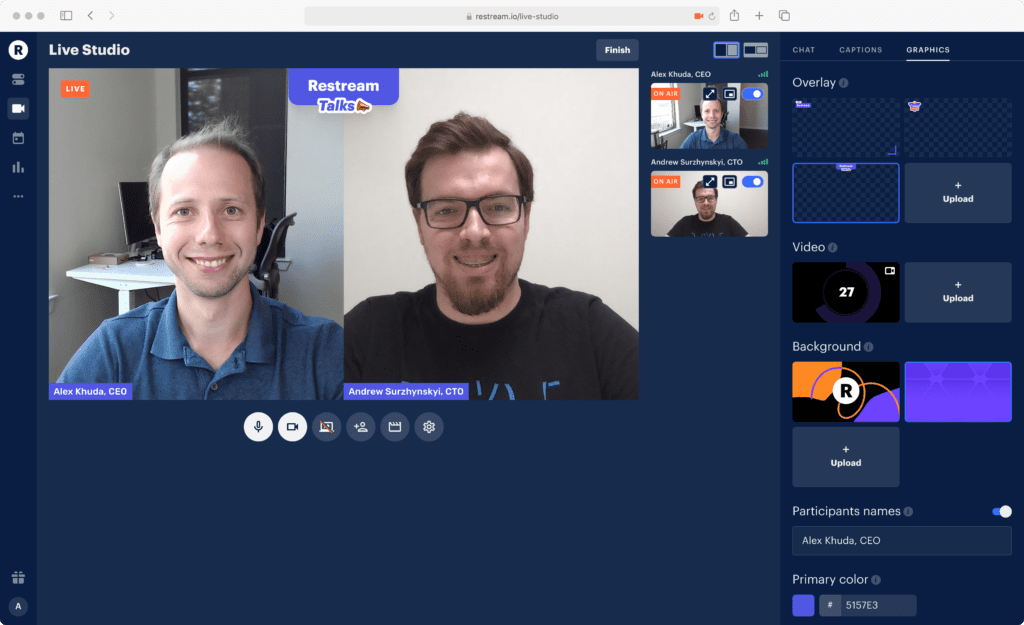
With the launch of Restream Studio earlier this year, streamers are able to deliver a unified experience from original content creation to broadcasting to multi-streaming–all by using Restream. In addition, Restream’s analytics functionality helps users determine aggregate interactions across social media platforms, which is a particular advantage for enterprise broadcasters that use live streaming as part of their broader marketing strategy.

When Restream first launched several years ago, its initial adoption was particularly strong in the gaming community. Since then, Restream has grown to support a variety of verticals, such as politics, entertainment and corporate marketing. And the company has amassed 40,000 subscribers and 12 million users worldwide.

Restream is the first company we’ve seen that targets multi-platform live streaming as a core use-case. Along with Restream Studio and its analytics features, we believe that the company is well-positioned to become the de facto platform for streamers.

A sizeable market opportunity that’s ripe for expansion

We believe that Restream is in the right place at the right time. The global video streaming software market is growing 23 percent annually, and is expected to surpass $10 billion by 2023. A key reason for the growth in live streaming technology is that it has now become cost-effective enough to mass-produce and integrate into existing customer products and social media apps. This creates opportunities for brands and influencers to expand their market reach, and we believe Restream is well positioned to capitalize on the demand.

Over the last several months, Restream and the live streaming industry overall have benefited from mandated remote work and shelter-in-place orders, which have accelerated the need for live streaming capabilities. All types of businesses, organizations, creators, and individuals are turning to live streaming to take their events to the digital stage. For example, Presidential candidate Joe Biden has been using Restream regularly to engage voters on the campaign trail. Major technology companies like Salesforce have been relying on Restream to host webinars, conferences, and live talks. And this past April, The World Health Organization (WHO) used Restream to host the largest digital concert in history, One World Together at Home, reaching 25 million viewers cross-platform and raising over $120 million for COVID-19 relief efforts.

Experienced leadership with the right technical expertise

Alexander Khuda (left), Andrew Surzhynskyi (right)

What drew us to Restream wasn’t just the product and market opportunity, but also the company founders. Restream was founded in 2015 by Alex Khuda, CEO, and Andrew Surzhynskyi, CTO, both of whom are graduates of the National Technical University of Ukraine.

As we got to know Alex and Andrew, it became clear that they had the right expertise to build a platform that will revolutionize how live video content is distributed. As experienced developers and entrepreneurs, Alex and Andrew are product-centric and mission-driven. We’re excited to work with Alex, Andrew and the Restream team.

Together, we’ll amplify live video and pave the way for next-gen broadcasters!