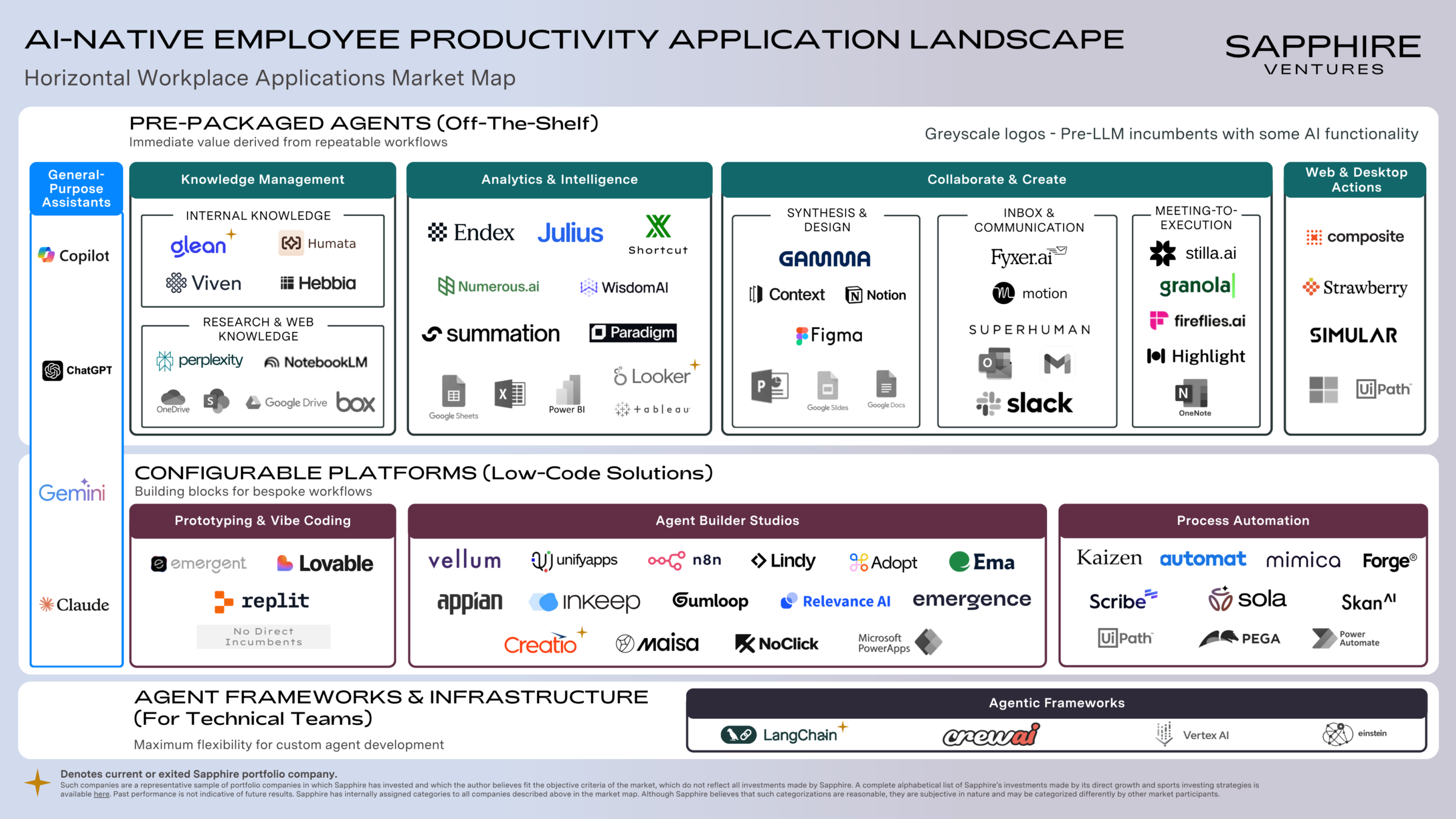
For decades, “productivity software” has meant a stable bundle: email, docs, spreadsheets, and slides, governed by IT and standardized across the enterprise. That stability created powerful cultural (habits), operational (templates, permissions, compliance), and organizational (change management and bundled purchasing) switching costs. As a result, companies like Microsoft and Google dominated–not because of superior product quality, but because leaving was harder than staying.
Finally, AI is reshaping the bundle. Not because “AI features” are novel, but because the interface and the unit of work are changing. The market is shifting from apps that help humans complete tasks to agents that work alongside humans.
Whether you’re building (or buying) into the next generation of productivity, these are the 4 major shifts that matter from our perspective.
Enterprise Context Becomes the Moat
Pre-AI productivity software relied on humans to provide missing context: what “good” looks like, who needs to approve, and the unwritten rules. AI flips that. The software must understand the organization well enough to operate without a person translating everything into explicit steps.
The most compelling AI productivity apps are those that can efficiently capture, reason over, and compound this enterprise context directly in the workflow. Glean (a Sapphire portfolio company), for example, builds an enterprise and personal “graph” that encodes relationships across people, projects, teams, and processes, and uses it to power relevant search results and functional agents.
Incumbents have a head start here. Microsoft and Google sit on decades of enterprise data. But owning data isn’t the same as compounding context. Legacy architectures weren’t originally built to reason over workflows or learn from usage patterns. The gap isn’t access to information–it’s the ability to turn that information into adaptive, agentic behavior. That’s where challengers have an opening.
This pushes defensibility away from “one clever workflow” and toward systems that continuously capture context across permissions, relationships, team-specific norms, historical decisions, and the messy edge cases that make enterprises…enterprises.
“Agent UX” is not the moat. Context is. If your product can’t get meaningfully smarter about a specific enterprise as it’s used, you’re building a feature that will be competed down. If it compounds context, you can earn the right to orchestrate more work over time.
Multiple Adoption Paths, Each with a Different Failure Mode
3 emerging GTM patterns:
- Packaged agents (fast time-to-value): Opinionated solutions that ship out of the box. These can spread bottoms-up quickly, but they’re fragile unless they (a) lock in proprietary context or (b) become a system of record for something real. Otherwise, incumbents copy the workflow and distribution wins. Gamma, for example, becomes where presentations live, not just where they’re created. Teams iterate, store and track engagement directly in Gamma, creating switching costs beyond the initial AI-powered workflow.
- Configurable agent platforms (high ceiling, high flexibility): These are solutions offering flexible layers where teams encode their own workflows like Lovable, Wonderful and Sola. The risk is shelfware. “Customizable” often translates to “never fully deployed” unless the platform is tightly anchored to measurable outcomes and has strong opinions where it counts, including permissions, governance, monitoring and rollback. Wonderful, for example, sidesteps the shelfware trap by orienting its platform around high-ROI use cases such as customer service and employee support, with flexibility and guardrails baked in.
- Agent frameworks (maximum control, full ownership): Tooling like LangChain (a Sapphire portfolio company) and Crew.ai for those building custom agent infrastructure in-house. These give engineering-driven organizations full ownership of their AI stack but have higher barriers to adoption. LangChain, for example, pairs its foundational open-source library with production-grade observability, orchestration and deployment tooling, giving teams everything they need to build and scale proprietary agent systems.
There is no silver bullet. The right approach will vary depending on the nature of work (e.g., deterministic vs. non-deterministic, horizontal vs. vertical-specific) and internal technical sophistication of the organization (i.e., at scale, engineering-centric organizations that tend to build in-house). What ultimately decides the winners is not how agents are built, but whether they credibly tie to tangible business outcomes over time.
Iteration Becomes Frictionless, Raising the Bar
AI collapses the distance between intent and output. Work that once took days–drafting decks, rewriting narratives, generating first-pass analyses–can now happen in minutes.
That doesn’t just increase output volume. It shifts competitive advantage toward teams with taste, clarity, and tight feedback loops. When everyone can produce more, the real differentiator is who can iterate toward the right thing fastest.
The uncomfortable implication for enterprises is that much of the work that was once rewarded, including formatting, coordination overhead and first drafts, becomes table stakes. Value migrates to higher-order judgment, such as deciding what to pursue, what to sunset, and how to communicate decisions crisply.
Capabilities Collapse into a New Control Plane
The most important structural change is that AI is pulling work up a layer. Instead of hopping across 10 apps, users increasingly start in an AI-native canvas like ChatGPT, Claude, and NotebookLM and invoke tools as needed. The control plane becomes the interface for thinking, planning, and delegating, while apps serve as execution backends.
Anthropic’s new Cowork feature illustrates where this is heading. Users can grant Claude access to a folder on their computer so it can read, create, and edit files. This allows Claude to organize downloads, turn receipt screenshots into expense spreadsheets, and draft documents from notes. It can also use connectors to access third-party apps and navigate websites via a Chrome extension.
This is why incumbents should be nervous. Not because their AI features are weak, but because the locus of value is shifting. If the control plane becomes the primary interface and the suite becomes a set of commoditized backends, distribution dynamics change.
What This Means for Productivity Stack Builders
If you’re building in the productivity stack, “make docs/spreadsheets/slides better” is the wrong starting point. The wedge is enabling decisions and actions currently bottlenecked by:
- (a) missing context
- (b) coordination overhead
- (c) compliance and permissions.
A few key questions to ask:
- Do you own compounding context, or are you borrowing it? Borrowed context (via connectors alone) is replicable. Owned context (e.g., workflow exhaust, opinionated data model, permissions) compounds.
- Can you quantify ROI in a way a CFO believes? “Time saved” is weak unless it ties to throughput, cycle time, headcount avoidance, revenue lift, or risk reduction.
- Do you have an answer for governance on day one? Auditing, least-privilege permissions, human-in-the-loop controls, safe rollback, and monitoring are not enterprise “phase two.” They’re the product.
- Are you building a system of action, not just a system of insight? Taking the right actions reliably within real constraints is where value sticks.
The market is reorganizing around agents, context, and new control planes. The companies that win won’t be the ones with the flashiest demos. They’ll be the ones who earn trust to operate in the messy reality of enterprise work and compound value every time a human decides to delegate work to AI.
If you are building or investing in this space, we would love to connect–reach out to Cathy, Adi, or Chloe.
Scope note: This market map focuses on AI-native, VC-backed companies whose primary product is agentic workflow execution in horizontal productivity. We exclude pure infrastructure and function-specific agents (e.g., sales, marketing, or customer support), even where AI plays a significant role.
Legal disclaimer
Disclaimer: This article is for informational purposes only. Nothing presented within this article is intended to constitute investment advice, and under no circumstances should any information provided herein be used or considered as an offer to sell or a solicitation of an offer to buy an interest in any investment fund managed by Sapphire. Information provided reflects Sapphires’ views as of a time, whereby such views are subject to change at any point and Sapphire shall not be obligated to provide notice of any change. Companies mentioned in this article are a representative sample of portfolio companies in which Sapphire has invested in which the author believes such companies fit the objective criteria stated in commentary, which do not reflect all investments made by Sapphire. A complete alphabetical list of investments made by Sapphire’s Growth strategy is available here. No assumptions should be made that investments listed above were or will be profitable. Due to various risks and uncertainties, actual events, results or the actual experience may differ materially from those reflected or contemplated in these statements. Nothing contained in this article may be relied upon as a guarantee or assurance as to the future success of any particular company. Past performance is not indicative of future results.