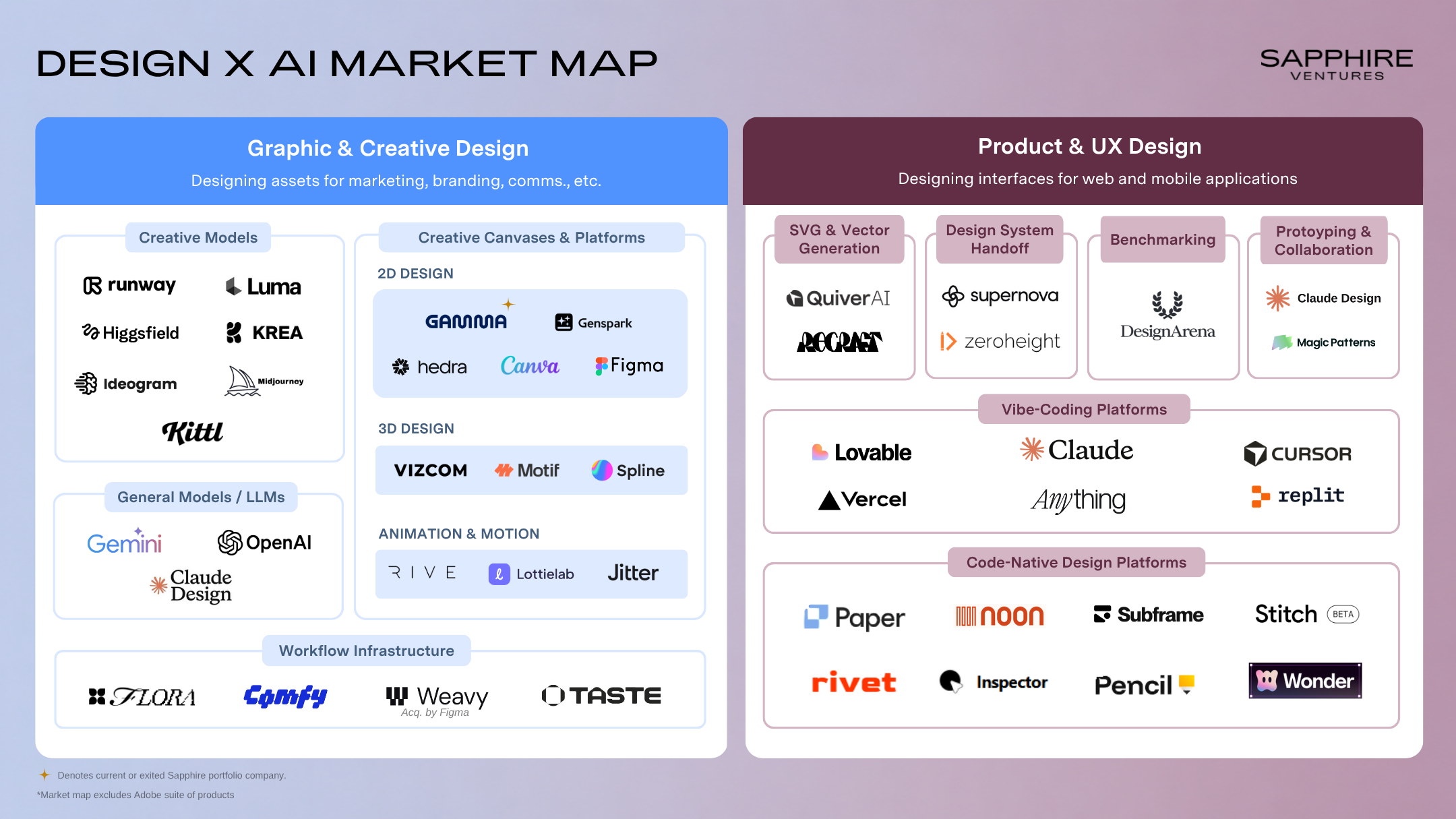
Design hasn’t seen a real platform shift in a decade. For years, the stack barely moved. Figma became the default platform for product design and collaboration, Adobe held its place as the foundation for creative production, and Canva won the long tail of marketers who just needed something simple. Workflows often remained manual and time-intensive, but the roles, tools and outputs were well understood.
AI is changing all of that. It’s redefining who gets to create, what the output actually is and where design ultimately takes place, pulling design closer to where products and content are shipped.
The shift is already measurable. Designer Fund’s 2026 survey of 900+ designers found that 91% now use AI for design tasks at least weekly, up from 54% a year ago, and the average designer’s tool stack has more than doubled in that same span.
At Sapphire, we have spent a lot of time with founders, designers and enterprise practitioners navigating this shift. The market is still young, but three core areas are emerging as ripe for innovation in our opinion. Creative production, product design and the workflow infrastructure connecting them are all changing quickly.
Graphic & Creative Design: From Static Asset to Living, Data-Connected Output
In creative design, the shift has less to do with generation quality and more to do with what the output actually is. For brand, marketing and everyday business content, the artifact, like a deck, social asset, one-pager or an internal report, has long been a static file. Made once, exported and untouched from that point on. We believe two forces are now shifting that standard:
- Personalization and persistence: Rather than a one-time export, the artifact now stays tethered to live data, updating itself and adapting to the viewer instead of going stale. We believe Sapphire portfolio company Gamma is a clear example of this, generating presentations and documents tied to a company’s live data so the output shifts as the underlying information changes.
- Scale and context: A major problem enterprises have isn’t generating one good asset, it’s generating hundreds of on-brand variants without a human touching each one, and doing so in a way that reflects a specific company’s visual language rather than a generic aesthetic. Genspark chains together research, slides and data agents together so context gathered in one step carries through automatically to the next, rather than a human re-entering or re-explaining it at each handoff. Higgsfield uses a brand’s own existing web and app presence to seed material for generation, leveraging performance feedback to decide which variants to produce at scale.
Both forces point to the idea that context, not output quality, is the layer worth owning.
What we’re watching: The skill and time floor for producing professional-grade creative output keeps dropping, pulling in users from marketing generalists to ops teams, who previously had to route this work through an agency or a specialist. Asset quality is no longer the competitive question here since foundation models commoditize that by default. It’s whether a platform can turn a one-time export into something living, on-brand and trusted to run at volume without a human in the loop for every unit.
Product Design: How the Canvas Is Merging With the Codebase
The traditional design process splits the work in two: designers define the experience, developers build it. AI is beginning to blur that line, not just by making individual tasks faster, but by changing where design decisions get made and who gets to make them.
The dominant design platform of the last decade renders designs visually, but engineers still have to interpret and rebuild that output in code. That translation step has always introduced rework, and AI coding tools have made the gap more visible. A new generation of web-native by design tools is helping with that challenge, allowing what you draw on the canvas to already be real code. Paper works directly with version control, letting designers pull real production components onto the canvas so what they design can ship without translation. Noon draws from a company’s existing component library and design system as its design surface, closing the gap between what a designer draws and what an engineer ships.
This is also changing who participates. Product managers and engineers are increasingly creating working first drafts without waiting for a traditional handoff.
The harder question is what happens to design judgment as execution gets cheaper. Designers may shift from producing individual screens to setting the constraints, systems and product logic that guide what gets generated. One design leader we spoke with described how the challenge has already changed, “We’re shifting the bottleneck from, it’s such an expensive process, we have to de-risk it by redlining every screen, to all of a sudden which of the three prototypes that we made this morning are the ones we’re going to commit to.“
What we’re watching: Whether new tools can capture and operationalize design judgment, including a team’s design principles, user context and quality bar, rather than simply helping more people produce interfaces faster.
Workflow Infrastructure: Encoding Creative Judgment
On the creative side, a distinct layer is emerging around the infrastructure behind brand and marketing production. Rather than generating a single image or video, these platforms connect models, preserve context and turn creative processes into repeatable workflows.
The market is taking several forms. Comfy provides an open, highly configurable engine for building production pipelines, with over 60,000 community-built nodes that function as a visual programming language for generative AI. Flora packages multi-model workflows, creative context and enterprise integrations for brand and marketing teams, embedding operators directly inside client organizations during onboarding so the system reflects how that team actually works. Krea sits closer to the prosumer end, making multi-model creation more accessible.
This layer may also become more durable as models improve. The infrastructure approach inverts the usual pressure to rebuild when a better model arrives, since new models can be swapped in as components without touching the surrounding workflow, brand context or organizational knowledge.
What we’re watching: Whether these platforms can capture enough of a company’s creative process and judgment to become the infrastructure through which content is produced, rather than simply another interface for accessing models.
Building in AI x Design? Reach Out!
Across product design and creative production, the pattern is consistent. AI enters through a narrow workflow that is expensive, slow and manual. It proves reliability, captures context through usage and expands.
In creative production, the static export is giving way to artifacts that stay connected to live data, update automatically and run at volume.
In product design, the canvas is moving closer to the codebase, the handoff is collapsing, and the designer’s role is shifting from producing screens to setting the systems and constraints that guide what gets built.
Underneath both, a new infrastructure layer is emerging that encodes creative and product processes into repeatable workflows that outlast any individual model.
We believe the generation layer will continue to compress, and the tools that accumulate a team’s judgment, brand context, design principles and production history will be harder to displace than anything competing on output quality alone.
We are actively investing across this landscape. If you are building here, reach out to Rajeev ([email protected]), Jasmine ([email protected]) or Misty ([email protected]).
Sign up for our newsletter
Legal disclaimer
This article is for informational purposes only. Nothing presented within this article is intended to constitute investment advice, and under no circumstances should any information provided herein be used or considered as an offer to sell or a solicitation of an offer to buy an interest in any investment fund managed by Sapphire. Information provided reflects Sapphires’ views as of a time, whereby such views are subject to change at any point and Sapphire shall not be obligated to provide notice of any change. Companies mentioned in this article are a representative sample of portfolio companies in which Sapphire has invested in which the author believes such companies fit the objective criteria stated in commentary, which do not reflect all investments made by Sapphire. A complete alphabetical list of investments made by Sapphire’s Growth strategy is available here. No assumptions should be made that investments listed above were or will be profitable. Due to various risks and uncertainties, actual events, results or the actual experience may differ materially from those reflected or contemplated in these statements. Nothing contained in this article may be relied upon as a guarantee or assurance as to the future success of any particular company. Past performance is not indicative of future results.