AI is learning to simulate how people behave. That could change how businesses make decisions, from their biggest bets to their smallest everyday choices.
In August 2025, Cracker Barrel took the man in overalls off its logo. A week later, he was back.
What started as a routine redesign had become a national controversy. Critics called it “woke,” and restaurant traffic fell roughly 8% following the announcement. Cracker Barrel had conducted extensive research on its broader brand overhaul. What it underestimated, its CEO later acknowledged, was just how deeply customers identified with the brand’s nostalgic image.
Could a simulation have predicted the backlash? Perhaps. But the episode illustrates how difficult it is to anticipate human behavior, particularly when individual reactions are amplified by social influence, identity and politics.
And for every high-profile mistake like Cracker Barrel’s, businesses make thousands of smaller decisions every day with little evidence of how customers might respond.
A pricing change. A new refund policy. A different way to communicate with patients.
Companies have spent decades building sophisticated systems to understand what happened. They’re far less equipped to explore what might happen if they made a different choice.
That’s beginning to change.
A new category of AI startups is building simulations of real people, populations and markets, allowing businesses to explore how customers might react before making a decision.
We’ve spent the past year talking with founders and enterprise buyers in this emerging market.
Key Shift
The simulation industry is fascinating, but the bigger story is what it could do to the economics of business decision-making.
The Economics of Asking “What If?”
Businesses have always had ways to research a decision before committing. They can survey customers, analyze past behavior or run experiments with real users. But each approach has limitations.
Surveys capture what people say, which often differs from what they actually do. Historical data struggles with situations that haven’t occurred before. And live experiments require exposing real customers to a change, which isn’t always practical when the stakes are high.
AI simulation could unlock the ability for businesses to explore far more decisions before making them. Drawing on interviews, behavioral data and population information, these platforms simulate how people might respond to different choices, including scenarios that would be too costly or impractical to test in the real world.
The technology is still early, but the economics are already compelling.
One enterprise buyer told us that testing four versions of a message with a traditional research panel used to cost $35,000 to $40,000 and take weeks. A comparable test on a synthetic research platform now costs $4,000 to $5,000 and returns results in under half an hour.
A global beauty company shared a similar experience. It once spent two months and more than €50,000 on focus groups to narrow 20 shampoo concepts down to five. Today, it can do that initial screening with digital personas in one or two hours.
The immediate benefit is straightforward. Businesses can conduct the same research faster and at a fraction of the cost. But as testing gets cheaper, companies can start exploring questions they previously wouldn’t have spent the time, money and resources to investigate.
At $40,000, a study needs to support a significant decision. At $4,000, companies can afford to test a much wider range of decisions. And if simulations eventually become cheap enough to run continuously, even small changes to pricing, product copy or customer experience could be tested as part of everyday work.
Key Shift
The biggest competitor to synthetic research may not be Kantar or Ipsos. It’s the decision a company makes without doing any research at all.
Mapping the Simulation Economy
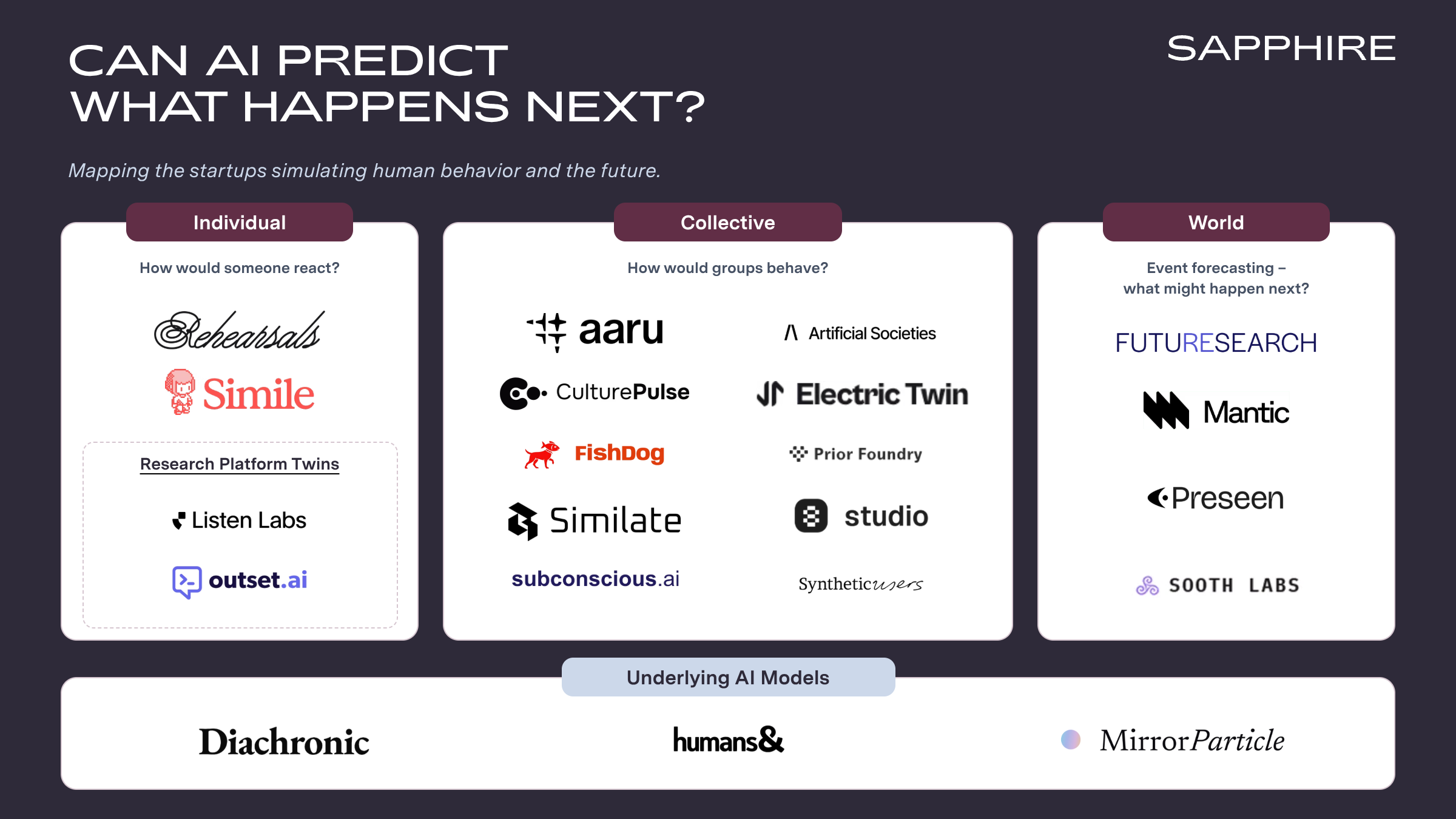
We’ve been watching a growing number of startups approach this opportunity from different angles. As our market map shows, they generally fall into four groups, organized around the scale of what they’re trying to simulate.
- Individual: Companies like Simile and Rehearsals create AI-driven simulations of real people, allowing businesses to explore how and why customers might respond to changes in products, pricing, or messaging before putting those decisions into practice.
- Collective: Companies like Aaru and Artificial Societies simulate larger populations, including how people influence one another. These approaches are most useful when the outcome depends on group behavior, from shifts in consumer demand to the spread of public opinion.
- World: Companies like Mantic and FutureSearch forecast broader events, from elections and interest rate decisions to geopolitical developments. Rather than modeling a particular customer, they help organizations assess different possible futures.
- Model layer: Underneath these applications, companies like Diachronic, humans& and Mirror Particle are developing models specifically designed to represent human behavior rather than act as conventional AI assistants.
There’s unlikely to be one universally superior approach. Understanding why a patient stops taking medication is a different problem from anticipating how a boycott might spread or estimating the likelihood of a supply shock.
The underlying science has progressed quickly. Simile Co-Founder Joon Sung Park led Stanford research showing that AI agents built from two-hour interviews could reproduce people’s survey responses about 85% as reliably as those same people reproduced their own answers two weeks later.
Key Shift
And we’re starting to see what this technology looks like inside large enterprises.
CVS Health has built more than 100,000 agentic twins using Simile, grounded in millions of consented responses from real participants. The company uses them to investigate customer experiences and test potential improvements before rolling them out.
One application involves medication adherence. CVS used simulated patients to explore why people struggle to stay on their prescriptions. The research surfaced issues around trust in pharmacies, confidence in medication handling and anxiety about refill timing. These findings help CVS identify which interventions deserve further testing with actual patients.
CVS has described the technology as something closer to a flight simulator for management.
It’s a useful analogy. Companies have long simulated aircraft performance, factory operations and supply chains to understand what might go wrong before making changes in the real world. Human behavior has been much harder to model, despite being central to so many business outcomes.
The Bigger Market is Outside the Research Budget
One of the most revealing things we’ve heard from early customers is how they’re allocating their spending.
A large consumer brand told us it divides its synthetic research budget roughly in half. One portion replaces traditional surveys it previously bought from firms like Kantar and Ipsos. The other funds what its team calls “crystal ball” questions, such as how a crisis statement might land or where to set a price.
Both still come out of the existing research budget. But the company expects new spending to follow as confidence in the technology grows.
The crystal ball half is where the larger opportunity sits, since better decisions matter well beyond marketing.
Consider a bank deciding how to structure fees or communicate changes to customers. A healthcare company trying to improve medication adherence. Or a retailer weighing a more restrictive return policy against the risk of alienating loyal customers.
Today, these decisions might involve weeks of research, limited testing or no research at all. With simulation, teams could explore more options, uncover unexpected reactions and identify which ideas deserve further testing with actual customers.
Key Shift
The implications go beyond avoiding mistakes. When experimentation gets cheaper, companies can afford to consider ideas they might otherwise dismiss. They can test more frequently and learn earlier, before investing in a full rollout.
There’s a useful parallel in software development. Engineers routinely test code before shipping it, often running thousands of automated checks to catch potential problems. Businesses have nothing approaching that level of test coverage for most decisions involving people.
The largest strategic bets get extensive analysis. Thousands of smaller choices receive far less scrutiny, even when their cumulative impact is substantial.
Of course, human behavior is less predictable than software. A simulation won’t behave like a unit test. But as a first pass, it could change how teams work.
Imagine a pricing manager testing a dozen approaches before selecting three for live experiments. Or a product team running changes past simulated customers as a routine step in development, rather than commissioning a study only when a major launch is approaching.
Over time, research could become continuous instead of episodic. Simulations could be embedded in the software that product, operations and finance teams already use, giving them access to customer insight without needing a separate research project every time.
The potential market starts to look less like traditional research and more like a new way of operating a business.
The Hardest Part is Knowing When to Trust It
There is a catch, and it’s a pretty significant one. A simulation can produce a remarkably convincing answer and still be wrong.
In a test with EY, Aaru recreated a six-month survey of 3,600 wealth management investors in a single day, achieving a median correlation of 0.90 across 53 questions.
One finding was particularly striking. While 82% of surveyed heirs said they would keep their parents’ financial advisor, Aaru’s simulation estimated just 43%. Separate research from Cerulli found that only 20% of people who had already inherited reported keeping the advisor.
It’s a promising result, though not a definitive test of predictive accuracy. The figures come from different populations, and the real test will be whether simulations can consistently anticipate what people actually do.
We believe the strongest synthetic research companies will distinguish themselves through proprietary human data, demonstrated accuracy and continuous validation against real-world outcomes. Rehearsals, for example, has built a first-party human panel that allows it to check simulated answers directly with the people behind its digital twins.
As buyers increasingly rely on simulations, they’ll need to understand when a model is reliable, where it falls short and how quickly it adapts as preferences change.
Key Shift
The cheaper it becomes to simulate people, the more valuable real human data may become.
Reliable simulations still need grounding in reality and feedback loops that measure predictions against what actually happened.
From Occasional Research to Everyday Decisions
We’re still early in understanding what human simulation can reliably accomplish. There are important open questions about accuracy, representativeness and whether these products become standalone platforms or features embedded in existing enterprise software.
But imagine a business where teams can routinely explore how customers might react before changing a price, launching a product or redesigning an experience.
For the biggest strategic bets, that could mean fewer expensive surprises. For the thousands of smaller decisions that rarely get tested, it could mean having evidence where previously there was only intuition.
Cracker Barrel made one big decision with research behind it and still got it wrong. Most companies make thousands of smaller ones every year with little direct evidence at all.
Key Shift
The winners in this category won’t be measured by how many surveys they replace, but by how many decisions they help businesses get right.
If you’re building in human simulation, synthetic populations or predictive decision-making, we’d love to hear from you. Reach out to Cathy Gao, Jasmine Yang or Sara Thomas.
Key Takeaways
- AI simulation lets businesses explore decisions before making them. Using interviews, behavioral data and population information, these platforms model how people might respond to different scenarios, so businesses can compare outcomes without having to put those decisions into practice first.
- Synthetic research significantly cuts testing costs and time. Studies that once required large budgets and weeks of panel research now finish in a fraction of the time.
- The synthetic research market generally splits into four groups: individual (Simile and Rehearsals), collective (Aaru and Artificial Societies), world (Mantic and FutureSearch) and model layer (Diachronic, humans& and Mirror Particle).
- The bigger opportunity sits outside the research budget. Cheaper testing makes continuous decision testing possible.
- Trust determines the winners. We believe the strongest synthetic research companies will pair proprietary human data with proven accuracy and continuous validation.
Legal disclaimer
This article is for informational purposes only. Nothing presented within this article is intended to constitute investment advice, and under no circumstances should any information provided herein be used or considered as an offer to sell or a solicitation of an offer to buy an interest in any investment fund managed by Sapphire. Information provided reflects Sapphires’ views as of a time, whereby such views are subject to change at any point and Sapphire shall not be obligated to provide notice of any change. Companies mentioned in this article are a representative sample of portfolio companies in which Sapphire has invested in which the author believes such companies fit the objective criteria stated in commentary, which do not reflect all investments made by Sapphire. A complete alphabetical list of investments made by Sapphire’s Growth strategy is available here. No assumptions should be made that investments listed above were or will be profitable. Due to various risks and uncertainties, actual events, results or the actual experience may differ materially from those reflected or contemplated in these statements. Nothing contained in this article may be relied upon as a guarantee or assurance as to the future success of any particular company. Past performance is not indicative of future results.